Tag Archives: cuba

The Gift of Aché Part I

[tweetmeme source=”connergo” only_single=false]Folks who know me (or who are paying close enough attention) are aware of my recent rough go of it. Illness, death and dying – that up close and personal, at-the-bedside type of illness and dying – have defined my past 12 months. To put it bluntly, this past year has been a bitch, with moments, days worth of long moments, when my surrender seemed certain.

One of the harshest blows was the death of my friend Angela (known in these parts for her inimitable Cuban Thanksgiving). It was cancer, she was too young, and too loved. To boot, hospice was what hospice always is: well-intentioned and the best compromise given the situation, but sad and painful and a little bit cruel for everyone involved.

I loved Angela and the loss I felt when she finally died – peacefully, surrounded by family and friends in the closest approximation of agape I’ve so far seen – was profound. The grief was shared amongst many and in that there is some solace, but I wasn’t sure that would suffice to carry me through the next steps: I was asked to help clean out her house in Havana and distribute her worldly goods.

The task was entrusted to a five-person team of her nearest and dearest on this side of the Straits and we undertook the task as Angela would have: with a weighty combination of duty and respect, love and courage. She was meticulous in her wishes and armed with a detailed list of who got what, we tackled the job with sorrow-tinged stoicism.

The work went quickly because this is the way of Cubans with a task before them; her computer equipment and kitchenware, jewelry and electronics were distributed as per her written instructions, her love letters and professional correspondence kept confidential. But one wish remained problematic to honor: she asked that Triunfo de Yemayá be transferred to her older brother in South Florida.     

This intricately carved and painted headboard was homage to the Afro-Cuban goddess of the sea and motherhood; surrounded by the magical elements of her domain and influence, the piece was made especially for Angela because she was muse to many, inspiring love and dedication and creativity. Anyone who had been invited into her home over the decades will remember that big, beautiful work of art, stirring memories of good food and friends and the positive energy so engendered.

My problem was Triunfo de Yemayá was as bulky as it was heavy, with fragile protruding bits, and the practical challenges inherent in delivering it to her brother in Miami were many. And my responsibility alone. Not surprisingly, the piece leaned against my office wall for months while I grieved and tried to figure out how to get it across the Straits.    

Triunfo de Yemaya, sitting in my office

The first stumbling block was the crate. This can be a challenge anywhere, but especially in Cuba where resources are scarce and fudging on details, craftsmanship, and follow-through rife. I talked to artist friends and curators to try and find someone to do a proper job of it (see note 1) with little luck. For months no wood was available and the expertise to build a proper crate apparently lacking. To make matters worse, prices carried a Yuma tax, which still rankles, even after 10 years in residence. Triunfo de Yemayá remained an emotional and psychological brick, shoring up my office wall.

And then I met Adam.

(ACHÉ #1)

A babalawo from Centro Habana, Adam is one of those Cubans who can find, fix or resolve anything. In retrospect, it was entirely fitting that a babalawo should step into the picture given the tenor and title of the piece. Within two days, Adam built a beautiful, close-to-MOMA quality crate cheap which would protect Yemayá on her trip across the Straits. Procuring the necessary export papers (see note 2) was the next step and so seamless it felt positively First World.

Packed nicely and with the paperwork squared away, I felt lighter and brighter – I was finally seeing through Angela’s last wishes.

Then I got to the airport.

For those who have never been here, taking big luggage out of Cuba is an anomaly and just a little bit crazy, if you ask me. Even so, lowering the crate from the roof of the Lada felt good and approaching final. How misplaced our feelings can sometimes be.
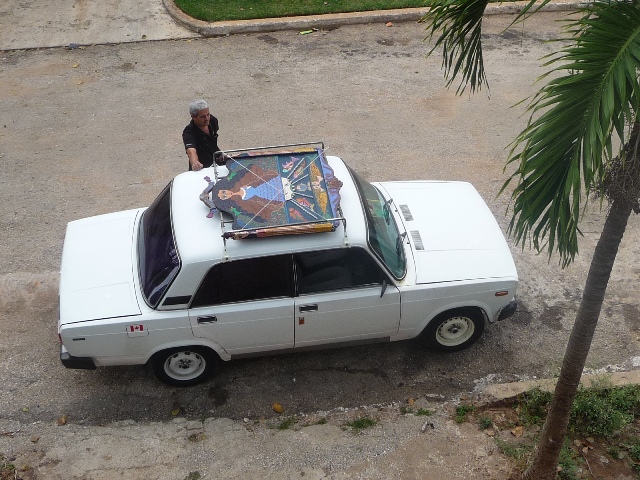
Yemaya: pre-crate, en route to get export papers

“I know you from somewhere, but can’t place your face,” I remarked to a guy standing nearby as I angled Yemayá on to a luggage cart.

“I processed your export papers at the patrimony office. Let me call ahead to our transport specialist so he can smooth your way; he’s on the tarmac now.”

(ACHÉ #2)

As he made the call, I made my way into line, eliciting murmurs and stares as I wheeled my unwieldy luggage towards check-in.

“Are you exporting a TV?” a tourist entirely unclear on the Cuba concept asked.

I laughed. “No. TVs come in to Cuba, they don’t get taken out,” I said, before explaining the story behind the voyage of Yemayá.

As I checked in, the charter representative told me I was 60 pounds over my weight limit and the crate, while lovely, would not fit through the X-ray. Somehow I hadn’t accounted for these factors.

“How can we resolve this, mi amor?” (see note 3) I asked with a smile, taking the opportunity to explain the favor and duty I was doing and the duty I felt to transport the piece.

A $40 “tip” took care of the weight limit issue and the chief cargo officer was summoned to escort Yemayá to that area of the airport where there was an extra grande X-ray machine for oversized luggage. But there was just an hour until the flight and a truck couldn’t be located to get the piece over to cargo. Just then, the aforementioned transport specialist from the National Registry appeared at my side.

(ACHÉ #3)

They decided to go to Plan B.

Wielding the hammer I’d brought for the purpose, the crate was opened and inspected by the Registry’s transport specialist, the chief cargo officer, a customs agent and a couple other rubberneckers.

“My saint is also Yemayá,” someone said, their proclamation hanging in the tiny, crowded office as a final word of sorts.

Working together, we got her repacked right for the next leg of her trip.

“Now what?” I asked, looking at the clock and wondering if 35 minutes would be enough to complete this part of my mission.

“We’re done here. Now we wheel it on to the tarmac and put it on the plane.”

(ACHÉ #4).

As I bid my crew adieu with a hug and the customary right cheek kiss, I heard someone say: “now let’s see what happens in Miami.”

Stay tuned to learn the fate of Triunfo de Yemayá!

(For those wondering, aché means “«the force», not in the sense of violence, but as a vital energy which creates a multiplicity of process and determines everything from physical and moral integrity to luck.”)

Notes

1. In this I have some experience since I lived with an art handler/installer my last four years in the States and precisely how fine art should be transported and handled.

2. To export patrimony +/o art of a certain caliber from cuba requires easy to procure paperwork and 10 CUC; my experience at the Registro Nacional de Bienes Culturales in Vedado was one of the most efficient and friendly I’ve ever experienced here.

3. While compañero and compañera may be waning as preferred terms of address, mi amor never will.

8 Comments

Filed under Americans in cuba, bureacracy, Cuban customs, Cuban idiosyncracies, Cuban phrases, Expat life, Living Abroad, Relationships

Piropos Cubanos: Sí or No?

[tweetmeme source=”connergo” only_single=false]

Cubans are famous for many things: cigars, salsa, and rum jump to mind, with world class athletes not far behind. But that’s amateur hour; after a little more experience and exposure, outsiders (and all non-Cubans are considered so at some time, to some degree) will appreciate less commercial, but equally celebrated traits like Cubans’ sense of humor and solidarity and their art for artifice.

Those who walk the walk and talk the talk know there’s another especially Cuban art and craft – that of come-on lines, known in local lingo as piropos. Whispered your way as you walk by or shouted from a bustling corner, every pretty, average, and ‘butter face’ Cubana has received her share of flowers from the mouths of appreciative men.

If you cook like you walk, I’ll scrape the bottom of your pan,” (note 1) is probably the country’s most popular piropo and anyone with a little swing to their hips has heard it. And while the sentiment sets the imagination awhirl, not a few foreign women have complained to me about how this and other come-on lines tossed their way. In short, they find them offensive.

My friend Juan Carlos argued famously on this precise point with a US feminist poet of note while she was living in Cuba. At that time, she was (and probably still is) vehement in her position that piropos are an affront to women. She’s not alone: similar views were shared here when I mentioned the piropos I receive as I ride this city’s streets on my beloved new bike (see note 2).

To be clear, I’m not talking about groseros – rude, crude lines reinforcing a patriarchal power structure. These are something else entirely and should be rebuked as so. Nor am I referring to the ubiquitous tssssss, tssssss, tssssss that’s used to catch the attention of women countrywide (and which I’m terrified I’ll let slip while beckoning a New York City waitress resulting in bodily harm). No, what I’m concerned with here are those delightfully cunning lines which show appreciation for the female form; I, like my friend Juan Carlos, don’t see the problem.

By way of disclaimer: I was raised by a feminist (by nature, not indoctrination) and I pride myself on being a non-biased, all-inclusive kind of gal who doesn’t give a damn about the color of your skin, to what gender you ascribe, before which god you kneel, or who you choose to screw. Everyone is equal in my heart and mind (until they prove otherwise through moral/ethical digressions). But since so many foreign women have complained to me about piropos, I have to wonder: am I missing something?

And further: what of my impulse to toss out my own piropos to some delicious specimen – a mangón of such magnitude I can’t let him pass without voicing appreciation? Does that make me a failed feminist or a femachista – a term coined by my friend Rigo for those women who talk a good feminist game but reinforce the machismo that is so rampant and damaging here?

After ten years living and working in this wild, incomparable place, I think not. In fact, I’m increasingly convinced that the well-crafted come-on line does no harm. In essence, good piropos are funny, imaginative fare designed to make the recipient pause long enough to laugh; and laughter, along with a sharp mind, is the best aphrodisiac I’ve found – two characteristics which the best piropos embody. This struck me squarely the other day when a guy said to me: “your name must be Alice because looking at you sends me to Wonderland.” I laughed out loud and responded: “good one, brother!” And he laughed too.

I have to ask, then: two strangers laughing out loud at a line cleverly crafted. What’s so wrong with that?

Many foreigners don’t always get this. Furthermore, their attempts at piropos usually pale in comparison. To wit, my old friend Mountain was infamous for cooing “oh to be a bicycle seat” to any pretty girl who rode by.

But to every rule, there’s an exception, like the handsome Swiss stranger who leaned in to tell me: “you must be from heaven, because you have the scapula of an angel.”

Personally, I say ¡! to piropos cubanos.

Notes

1. “Si cocinas como caminas, me comiera hasta la raspa’ sounds a lot better in Spanish.

2. Curiously, the quantity and quality of piropos I get while on two wheels differ considerably from those I get on two feet.

49 Comments

Filed under Americans in cuba, Cuban customs, Cuban idiosyncracies, Cuban phrases, Expat life, Living Abroad, Relationships

Cuban Harley Culture

[tweetmeme source=”connergo” only_single=false]

In the introduction to my forthcoming book (see note 1), I muse briefly on how similar Havana (my adopted city) is to New York (my birth city): the garbage and grit; taxi drivers with higher degrees; the self-contained neighborhoods – it all feels very familiar. Another characteristic both cities share is they teem with subcultures worthy of an urban anthropologist. Poets and punks, gym rats and drunks, shylocks, gamblers, sluts and thieves: here, like there, we’ve got the full spectrum of human passions, vice and interest crashing together like waves on the Malecón.

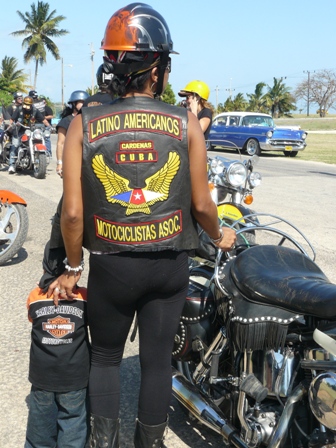
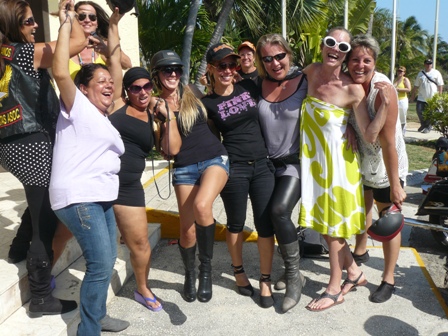
This past weekend, I was (gratefully, willingly) thrust into one of Cuba’s most prismatic and emblematic subcultures and scenes: I rode along on the country’s first Harley rally. For the record: the trip from Havana to Varadero was only the third time I’ve been on a Harley in my life. The first was a joy ride in what was clearly foreplay and a bid to get something more corporeal between my legs than a thundering motor (in this the fella failed, for which I’m thankful: at that destructively drunken point in my life, the last thing I needed was to hook up with a biker bartender). The second was a thoroughly platonic and enjoyable ride home from the year-end party in Habana campo hosted by the Latin American Motorcycle Association (LAMA) and the third time was this past weekend, when over 50 riders made their way to Varadero on pre-1960 bikes from as far as Pinar del Río and Camagüey for three days in hog heaven.

As you may imagine, my muse was working overtime in this new and captivating environment, populated by cool people with their own language and subtext. Since everything I know about biker culture I learned from Easy Rider and Altamont, I was keen to experience the 1ro Encuentro Nacional de Harlistas Cubanos firsthand.

And I wasn’t disappointed. Al contrario: I was inspired and surprised. Because although as a group these folks cultivate and maintain an identity wholly dedicated to, nay obsessed with, Harley Davidson, they remain, al fondo, 100% Cubano.

If you know Cuba from the inside, you know this subculture phenomenon – be it goth, gay, or black – hasn’t always fit in well or properly with the macro unity concept that is the glue for us here in one of the world’s last bastions of socialism. Of course, when there’s USAID or other sovereignty-compromising dollars in the middle, peor todavía. Worse still with reason since I believe all human relations should be driven by mutual respect, regardless if it’s in the realm of sex, economics, culture or politics. In short: you don’t tell me how to live, work or play and I’ll return the favor.

What was even more striking still was that on the whole, these Cuban bikers are more closely connected to their global counterparts and importantly, their US brethren, than any other community I’ve encountered here (see note 2). As a group, they speak (almost) as much English as the slickest jineteros and what’s more, the main biker groups here – LAMA and Harlistas Cubanos – have foreign membership, long timers like me who live here and love bikes. And the mix works seamlessly because beyond the bikes, gear, and foreign presence, what grounds and unites these folks is their Cubanilla, with all the idiosyncrasies good and bad that implies.

Even before we rumbled out of Guanabacoa towards Varadero, the gossip was flying. And believe me: these Harley folks are more chismoso than a kitchenful of bored housewives. I learned all about Antonio’s marital strife; the petty divisions and squabbles among different riders and groups; and how Vladimir got his hog and Oscar lost his. Thanks to the gossip mill, I was privy to the anonymous alcoholic’s struggles and how much Fulano paid for the silicon tits and ass of his funny, sexy, back seat Betty. The grapevine was heavy with juicy fruit, but what impressed me the most was the handful of folks who didn’t gossip. Those are the ones to ponder further, I figure – above all because I abhor gossip as an entirely negative pursuit. With the anti-chismosos, I’d found my people (see note 3).

What also struck me as totally Cubano was the fury for everything with the Harley Davidson logo. I know brand loyalty is common to riders the world over, but Cubans can go overboard like nobody’s business – especially when it comes to logos and bling. And this was no different: there were boots, belts, shirts, jackets and vests, jewelry, headbands, bandanas, flags, stickers, and business cards all emblazoned with the Harley label. Boy, did I ever look out of place with my Hawaii-kine style, particularly when everyone was throwing devil horns and I’m waving the shaka. But while I may have looked out of place, not for a moment did I feel out of place – another sign you’re hanging with Cubans.

If you know this place and manage well in Spanish, you know that there is no one who can make and appreciate a good joke like Cubans – especially when the joke’s on you. And these bikers are tremendous jokers – jodedores constantly dando cuero. No one is spared, least of all me, and these Harlistas ribbed me good-naturedly at every opportunity: about how I leaned into curves (not that well, apparently; ¡que pena!); about my addiction to roasted pork (see note 4); and my penchant for hopping on the back of anyone’s motorcycle, anytime. I’m sure they have words in biker parlance for promiscuous back seat bitches like I was this weekend, but in my case, it ended with a forged love note that had everyone busting a gut. But at least I fared better than another foreigner who had his gold chain vicked by a muchacha ‘fren’ giving him a massage; he never heard the end of it.

But what most drove home the Cubanilla for me was that bedrock Cuban principle driving relations on-island and off which these folks have in spades: what matters above all else is family. Blood, extended, new and departed. And it wasn’t only the adorable kids along for the ride (many in mini Harley gear), but how you know your back is covered when someone falls ill or that someone will lend a hand when you need a new part, mechanic, or lover and an ear when you’re down. As a group, the Harlistas Cubanos function as one big, complicated – dysfunctional at times, but happy all the same – family. United by their love for their bikes, the road, and their patria.

It’s a weekend I’m sure I’ll never forget. If you’re in Havana and want to experience what I’m talking about, stop by their weekly event at La Piragua (Malecón and Calle O, in the shadow of the Hotel Nacional), held every Saturday at 5pm. You just might get lucky and spot me in some colorful get up on the back of a hog, throwing a shaka to my new friends-cum-family.

Notes

1. A perennial work in progress that’s like a so good, but so bad lover you know you should finish with but somehow can’t (or won’t), I’m determined to get this sucker published in 2012.

2. Granted, I don’t hang out with dissidents who are all up in that foreigner action – and not in a good, healthy way like this bunch.

3. Also a sign of my people: so many Harlistas smoke cigars and give them away like candy, I smoked none of my own stash the whole weekend and returned to Havana with healthy stores thanks to their generosity.

4. And let me tell you: the three puercos asados they laid out for the farewell lunch were the tastiest I’ve had in 10 years here, trumping memorable pigs eaten in a bohio in Pinar del Río, on a secluded beach in Las Tunas, and during carnival in Holguín.

36 Comments

Filed under Americans in cuba, cigars, cuban beaches, Cuban customs, Cuban idiosyncracies, Cuban phrases, dream destinations, Expat life, Hawaii, Living Abroad, off-the-beaten track, Travel to Cuba

Six Highly Annoying Cuban Habits

[tweetmeme source=”connergo” only_single=false]

OYE!!

MUCHACHAAAAA!

¡LLEGÓ EL POLLOOOOO!

Are all the Cubans you know shouters? And do they always crank the music to 11 à la Nigel Tufnel? In your world, is a Cuban whisper an oxymoron? If so, you know that calling Cubans loud is redundant and the ruckus here is a full volume affair.

Labeling this noise pollution is a misnomer since 80% of the time the noise in question is a product of partying, kids screaming at play, antique Chevy’s honking out the Godfather theme, or the neighborhood knife sharpener making his rounds. Steaming beans, whirring blenders, trumpeters practicing in the park – Cuban noise is a life-affirming refrain, a symphony of love, work, and play that’s cacophonous at times, but more soulful and less discordant than planes droning overhead, panicky sirens, migraine-inducing leaf blowers and lawn mowers, and ubiquitous, petulant car alarms.

Even without this modern white noise, it is damn loud here. Some people aren’t down with this. I get it, but personally, I adore it (except when regguetón is involved) since I’m from a fast talking, high volume NY family; I feel right at home with all this bulla. I love that I don’t have to think twice about cranking Queen or audible climaxes (see note 1). Meanwhile, there are other Cuban habits which are highly annoying and chap my ass…

The farmer hanky: I was at a wedding not long ago (see note 2) and while I was smoking my cigar in the patio, another guest used a farmer hanky from the balcony above. For those unfamiliar with the practice, a farmer hanky is when you close off one nostril with a strategically placed finger, cock your head to the side and let the snot fly. With the wind, hopefully. I understand the Special Period and its aftermath made toilet paper a luxury item, but in public, at a wedding, you need to do this? How about a cloth handkerchief, which are all the rage down here? I do know one thing: that guy and I were both lucky he didn’t peg me with his snot rocket.

Barging in: After a decade here, I still don’t get the compunction to burst through a closed door without knocking. It doesn’t matter if it’s a boudoir, baño, or office: Cubans are loathe to knock. As you may imagine (and if you’ve spent any amount of time here, you don’t need to imagine this indignity, you’ve lived it), this can be compromising if you’re on the can or in the throes with your honey (see note 3). And this cuts both ways: Cubans aren’t used to locking doors or responding to ‘anyone in there?’ raps and I’ve walked in on my share of people after knocking, receiving no answer and sallying forth as a result.

Flushing reluctance: This is another truly puzzling and widespread habit here. Innumerable are the times I’ve walked into a stall to find the toilet filled with a cocktail of piss. My first thought: ‘the toilet is busted’ is followed by my second: ‘there’s no water’ (both very real possibilities here), but both prove to be wrong when I depress the handle and the cocktail whirls down and away. Laziness? Adaptation for the many non-working, waterless toilets we have here? I don’t know, but I end up dealing with lot of other people’s shit.

PZP: Thanks to fellow blogger at Cachando Chile for coining this acronym for public zit popping, something I find so repulsive and popular, I’ve mused on it before. Daughters squeezing their mother’s blackheads; lovers giggling with glee as they lance a good one; friends squirting puss from each other’s face to pass the time. It’s as disturbingly intimate and inappropriate as people worrying their dandruff scabs in public – something people all over the world can’t seem to resist, I’ve noticed.

Phone etiquette: Anyone who knows this place even half-well knows no one can dial a wrong number like a Cuban. If I had a nickel for every time someone dials me instead of the person they intended, I wouldn’t have to bust my ass peddling my Havana app. I’m talking to the tune of several wrong numbers a week. And this isn’t just limited to guys intentionally given the wrong digits by girls who aren’t interested; old ladies, bureaucrats, kids – everyone has a penchant for wrong numbers here. Hey, anyone can make a mistake, I get it.

What really grates, however, is when I pick up a ringing phone and the voice on the other end asks: “Who’s this?” No compadre, it doesn’t work that way; you called me. The question is: who is this? Sometimes these are acquaintances or colleagues giving bad phone, but often, these are men cold calling until they get a female on the line. They continue to call and coo, asking your name (and in my case: where you from?), until you tell them to stick it where the monkey put the shilling. Still, I wonder: was there ever a guy who got lucky with this mecánica? It’s highly absurd and disturbingly pathetic. Recently, a guy was calling me every morning at 7:45 with such patter until I told him I had caller ID (available here, though I’m too thrifty to pay for it) and was going to report him. Never heard from him again.

Spoilers: You sit down to watch a movie with your Cuban friend, lover, or mother-in-law and before the opening scene concludes, they exclaim: “Oh! I’ve seen this one! It’s where the wife really turns out to be the assassin but you don’t know it until the end!” Or along the lines of: “You haven’t seen The Crying Game?! It’s the one where she turns out to be a he!” Incredibly, this spoiling sport is even practiced by professional filmmakers. Don’t believe me? Check out the 30-minute muela that precedes the Friday night movie program Séptima Puerta – the host runs down the entire plot arc, replete with clips, before the opening credits even run.

Got any annoying habits you’ve observed among Cubans? Drop a comment!

Notes

1. Interestingly, the one situation where the Cubans I know aim for quiet is during carnal affairs.

2. I’ve refrained from writing about this event – the kitschiest thing this side of a Hialeah quince – to protect the guilty happy couple.

3. One thing I do love about here, however, is that on the whole, Cubans aren’t modest when it comes to bodily functions: everyone pisses, shits, and fucks. There’s nothing to be ashamed of.

176 Comments

Filed under Americans in cuba, Communications, Cuban customs, Cuban idiosyncracies, Expat life, Living Abroad

Let Us Pray

[tweetmeme source=”connergo” only_single=false] I ventured once again outside my comfort zone yesterday here in Havana: I went to mass. It was as oppressive (and let’s be frank – hypocritical) as I remember from Jesuit high school (see note 1), although this one was presided over by the big Catholic kahuna himself, Pope Benedict XVI. It was also mercifully short.

While I’m sure you’re oversaturated with ‘The Pope in Cuba’ news up your way, one of the indelible lessons I’ve learned in my 10 years of island residency is that the picture you get of here from there – especially when refracted through the lense of reporters sent to cover such an event – does not accurately reflect what we’re experiencing on the ground. It’s not only that every media outlet from The Militant to FoxNews has an agenda. The view is skewed also because Cuba newbies rarely grasp the complexities of our context (see note 2), nor the attendant history influencing those complexities. You don’t get this perspective unless you’ve been around and stick around and only if you speak Spanish – even a translator is no guarantee (see note 3).

So let me tell you about the mass I attended yesterday under a blazing sun, delivered by a frog-like man in a funny hat.

What folks are saying: One of the pervasive myths about Cubans is that they’re afraid to speak their minds or offer opinions, and that self-censorship is rampant. While it’s undeniable that people keep their heads far below the parapet in the workplace and have the tendency to adjust responses to what they think people want to hear, I’ve always found Cubans to be fiercely opinionated – once you get to know them. Or more to the point: once they get to know you.

The Pope’s visit confirmed this impression.

“I’m so sick of this Pope.”

“Wasn’t he a Fascist?”

“I’ll come by your house once The Almighty Pope leaves and things calm down.”

“Son of a b@&*h! The Pope took our Internet.” (see note 4)

“Faith, hope, and peace: that’s what it’s all about.”

Rocking our rum-pork-party holy trinity: Another element piquing my interest was how Cubans approached this whole Papal visit. Essentially, yesterday felt much like hurricane preparation and landfall: people laid in stores and stayed home watching events unfold on TV, with some chicharrones and a bottle of rum close at hand. Except – and this was a rude awakening for several of my unprepared friends – authorities instituted a booze ban the evening before, which lasted until the Pope Mobile and its cargo were safely at the airport. So those who didn’t lay in the ron were homebound with pork, friends, and family, but no curda. In my decade here, I only recall a few alcohol-free events: election days are always dry and if I’m not mistaken, they did the same during the Non-Aligned Summit here in 2006. Let me tell you: no rum makes Havana kinda grumpy.

Revenue coup: The cleverness of Cuba never ceases to amaze me and yesterday didn’t disappoint once I saw the huge numbers of tourists in the Plaza for mass. My first clue was the distinguished older gentleman of means dressed in khakis, a pink Oxford, and penny loafers, with not a gin and tonic in sight; clearly not one of us. I started looking closely at the crowd and their clothes and distinguishing different accents. Nicaragua, Argentina, Chile, Panama, the DR, USA, PR, Mexico, Venezuela – flags from all across Latin America snapped in the wind whipping across the Plaza and I realized that aside from the pride and so-called “soft power” the Papal visit signified, it also represented a hugely-needed and greatly-appreciated influx of tourist cash. There wasn’t a hotel room to be found; paladares overflowed; extra charter flights were added from Florida. And all Habaneros (save for cops and docs), were given a paid day off. This is the type of devotion we could use more of and we thank you for supporting the cause.

The US matters less: After Juan Pablo II’s visit in 1998, Bill Clinton’s White House issued a press release announcing new policies ostensibly resulting from this historic trip. Most importantly, the release approved people-to-people visits in order to foment “regime change” and “promote a peaceful transition to democracy” – concepts mentioned no fewer than six times in the short document. Blatantly threatening the national sovereignty of an independent and peaceful country thusly is absurd enough, but that Obama maintains precisely the same policies and parrots exactly the same rhetoric 14 years later – that’s just loco. While the US is embarrassingly and unjustly static in its policy, the world and importantly, Cuba has changed, is changing still. Raúl is a different bird from his brother and that manifests itself in many ways, including less of the ping pong policy-making that based decisions on what the bully to the North was doing. That’s how it looks publically anyway.

holy jama!


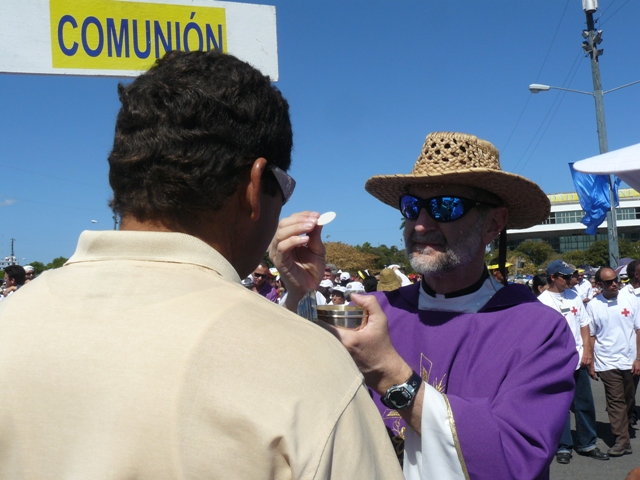
As anti-climactic as the Immaculate Conception: I’m sure you’ve already divined that the religious importance of having his Holiness here held no interest for me and in this I’m not alone: I’ve never seen an event so thinly attended in the iconic Plaza de la Revolución in my 10 years here. In fact, we strolled into the central area just a few moments before the 9:30 mass kicked off and were going against the current of people streaming away from the square. “I came and took the pictures I wanted; I’m going home,” a friend I ran into said. The curiosity seekers and thin crowds were surprising but make sense: as a whole, Cubans just aren’t that church-y. Religious and faith-bound, yes, but that’s different from kneeling before a man in a dress and goofy hat while he proselytizes a doctrine peppered with sins bound to doom your mortal soul. Cubans just aren’t down with that, but they do love a spectacle: one of my favorite moments was when a women who wanted to taste the host tried to fake her way through the motions while the priest held the wafer aloft. When he caught on, he patted her on the head and returned the host to his jaba. Though the Pope himself failed to inspire, Cubans never do.

Notes

1. This, Fidel and I have in common, except those same Jesuits expelled me my junior year (another story entirely!)

2. A simple example: journalists arrive here and compose some flaccid or purply prose (even leading with it occasionally, dios mío) about all the old cars rumbling about. For those of us with continuity here, that’s ‘dog bites man.’ The more compelling, ‘man bites dog’ story is the unbelievable amount of new cars on the road and what that means for traffic, transport options, pollution, etc.

3. The press conference by Foreign Minister Bruno Rodriguez upon the Pope’s arrival is case in point: his response to an English-speaking reporter about “freedom of consciousness” was elegant and sweeping in the original Spanish, mangled and less inspired in English.

4. Cuba has limited bandwidth due to the US embargo-cum-blockade which prohibits the island from connecting to underwater cables running nearby. Instead, the connection for the entire island is provided by a sole, slow Italian satellite. This bandwidth was prioritized for visiting press so they could report live from Cuba. It’s back now, thankfully, obviously.

19 Comments

Filed under Americans in cuba, Cuban customs, Cuban idiosyncracies, Cuban Revolution, Expat life, Fidel Castro, Living Abroad, Raul Castro, Travel to Cuba

Black Market a lo Cubano

[tweetmeme source=”connergo” only_single=false]

If you follow my blog or any similarly semi-intelligent Cuba-related news outlet, you know that things are fast a-changin’ on this side of the Straits. For those out of the loop: in April, 2011, a series of unprecedented policies – which amount to a new (and not without substantial risk) economic paradigm for the country – were approved at the Sixth Communist Party Congress (see note 1).

Though some of my Cuban friends gripe that change isn’t happening fast enough, I’ve been surprised by how many new policies have come to pass as promised: private sales of homes and cars, relaxed regulations for paladares and casas particulares, and the approval of nearly 200 pursuits and services for private enterprise. Other movement towards so-called normalcy is slower and more complicated still: unifying the two official currencies, salary increases, and phasing out the permiso de salida (see note 2) among them.

What these changes will mean for the most vulnerable remains to be seen and I have not a few friends here tormented by uncertainty, anxiety, and a generalized malaise in the face of it all. Uppermost in their hearts and minds: what might these changes mean for the political, social, and ethical tenor of the revolutionary project so many have fought so long to strengthen and so hard to save?

Some days it feels like it’s all going kablooey – that the Cuba we’ve known is reserved now for dewy-eyed nostalgics fingering grainy photos of the 10 million ton harvest. And this is heart breaking to people who have survived so much drama and tragedy: the rending of families in the 60s and 70s, (plus the Bay of Pigs and Missile Crisis), followed by the Mariel boat lift and collapse of the Eastern Bloc in the 80s which led to the torturous Special Period of the 90s. Then there was Fidel passing the baton to hermanito Raúl which I guarantee looks different from your off-island perspective than from ours here in Havana. And let’s not forget the 50 years of sabotage (both bald-faced and covert) by the behemoth to the north, to say nothing of terrorist attacks by US-sheltered individuals and groups.

So before it all goes kaboom (a day late and a dollar short, perhaps?), I’m determined to document the Cuba I’ve known for the past 10 years and the attendant change as accurately, responsibly, and comprehensively as possible. Today, I turn to an examination of the black market.

Jeans and stilettos, perfume and gas. Cigars of course, but also ice cream (Coppelia, the country’s best), and iMacs, milk and meat: it’s all available on Havana’s black market – if you have the hookup or happen upon someone “repurposing” Cuban Clorox or café. In the interest of full disclosure, I have very little direct experience with the black market (or parallel market as Cubans call it) despite a decade in residence; I have no car, so no need for gas, I buy my meat off the cement, fly-spotted counters at my local carnicería, and would love a Mac but don’t earn enough to join that club. Besides, all that shit is stolen (see note 3) and I’ve had enough stuff vicked in my life to know that if you ain’t part of the stolen goods solution, you’re definitely part of the problem.

But then the moral high ground begins to shift (Cuba is funny like that).

—–

Every once in a while, a kind-faced granny shows up at my door selling either eggs (see note 4) or powdered milk – a key ingredient in the Cuban kitchen. Someone on the block must have told her an extranjera lives in Apt 5 because she came straight to my door that first time, knocked hard and called me La Rusa (“The Russian” – old stereotypes die hard). She’s a bit gnarled and I can tell from the edge in her voice and the fade of her blouse that times are tough for the milk-peddling abuelita. Unfortunately, when I need eggs, she has milk; when I want milk, she has eggs. So even though I was keen to help her out, our supply and demand algorithm never quite jived. Last week, her friendly face appeared anew at my door.

“I have eggs,” she said.

“So do I. How about milk?” I asked.

She didn’t have any that day but promised to “resolve” some; I promised to buy it once she did.

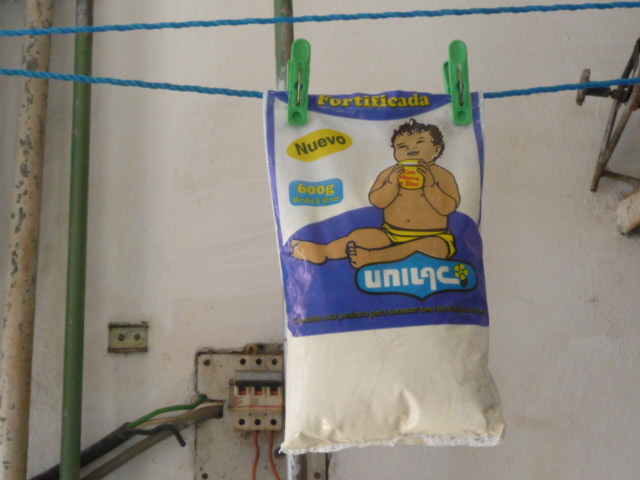
Sitting in my office yesterday whittling a Tweet down to 140 characters instead of working, I once again heard her hearty knock at my door. Smiling big, she told me she had three sacks of milk for sale at $2 a pop (a 50 cent savings over the official store price). I agreed to take one, glad I was finally getting the chance to help out granny. Until she pulled the sachet from her frayed knapsack: I, we both, were taking milk from the mouths of Cuban babes. What my elderly friend was selling was the milk the government guarantees to every child under 7 and I’d just purchased 600 grams of it. I knew that milk wasn’t going to be too tasty. 

—–

This transaction got me to thinking about where all this stolen stuff comes from and put me in mind of my friend Alberto. He has an old Lada on which his livelihood depends. Driving around recently, I noticed a balón de gas (the 20-lb tanks used here for home cooking) wedged behind his seat. Seems Alberto had converted his gas-powered car into a propane-propelled one.

This was a smart investment on his part: although the conversion kit cost $350 and had to be imported from abroad, Alberto fills that tank – which takes him 120 km or so – on the black market for just $5. By way of comparison, that same $5 would buy 15 liters of real gas on the black market; just over four at the pump. I’m glad Alberto has figured a way to enlarge his margins, but wonder about the families who show up to fill their kitchen tanks to be told “no hay” (there isn’t any).

This same pattern repeats itself with steaks and blocks of Gouda, stamps for official paperwork (I was surprised to be asked to produce receipts for my bank-bought stamps on my last visit to immigration) and cooking oil. And while I can appreciate the need for every last Cuban having to do something (or something extra-legal) to make ends meet, the more I parse the situation, the more unsettling it becomes.

And it makes me realize that a certain amount of that aforementioned moral ground is shifting below my feet. At these times I’m forced to ask myself: is this is a part of Cuban culture I wish to participate in? Unluckily for my milk-thieving granny, it is not. But I’m sure she’ll find other clients: as long as there are commodities like oil, meat, and milk to “redirect,” and resell for pure profit, folks will do it.

 As I said: old habits die hard.

 Notes

1. These political powwows are held every so often (the last was in 1997) or mejor dicho: whenever sufficient excrement threatens to make contact with the cooling element, if you know what I mean.

2. All of these issues came to the fore in nationwide public referendum-type debates held in late 2010. The permiso de salida is an exit permit which is mandatory for overseas travel by Cubans and residents. It earns the country revenue, but is also a barrier to travel – an issue that has to be reconciled somehow and soon.

 3. Except the goods in the black market Mac store. None of this is stolen, but rather all new, in-the-box gear with warranty and all, purchased in Miami and spirited into the country.

 4. Eggs aren’t usually stolen either, but rather the product of home-raised hens.

25 Comments

Filed under Americans in cuba, Cuban customs, Cuban economy, Cuban idiosyncracies, Cuban phrases, Cuban Revolution, Expat life, Fidel Castro, Living Abroad, Raul Castro, Travel to Cuba

My New Cuban Love Affair

[tweetmeme source=”connergo” only_single=false]So it’s International Women’s Day (see note 1) and a full moon – two events which occasion a certain randiness and frisk in these parts. And I’m feeling particularly frisky these days thanks to my new love affair with a certain Francis.

Francis is my new bike.

My trusty steed…

Before I wax poetic on the new steed between my legs, let me take this opportunity to digress a bit with a few words about the personification of one’s transport.

I was once in love with a guy who drove a truck – lived with him for over four years actually – and it fell to this unlucky fella to teach me to drive (see note 2). During my schooling, he also taught me the importance of naming your vehicle. Your car (or truck or bike) has a personality, he explained. You need to communicate with one another and work together. A name facilitates this inorganic synergy between man, movement, and machine; completes the anthropomorphic picture so to speak. I took his point. The one and only car I owned (co-owned and only for three months), was a beat up Audi named Otto. My mom’s Subaru is Harriet the Chariot. My sister’s 1982 Peugeot is Bruce. Over the years, I’ve had the pleasure of knowing Rocinante, Mugsy, and Hoss – great cars all.

When I got my new bike, I knew I had to have a name.

But after a month zipping across Puente Almendares, pedallling the pristine macadam bordering Parque Monte Barreto, and bracing my ass against potholes and train tracks, I still didn’t have a name. Clearly it was time for outside counsel. I put it to my friend Lucia, she of the Bambi filets

Her first question: male or female?

Ever-practical, Lucia cut to the obvious question I’d failed to ask. I had been so focused on a name that would translate equally well in English and Spanish, that I’d completely neglected to consider gender. Standing there in her bedroom it occurred to me that I didn’t want only linguistic inclusivity, choosing a name that would make sense in both my languages, I also wanted gender inclusivity.

“How about something gender neutral?” I wondered aloud.

“There aren’t many gender-neutral names!” Lucia’s 10-year old wunderkind piped up. After a few beats she asked: “How about Michel(le)?”

“Good one!” I said, knowing that girls of a certain age (even hyper talented Cuban ones) need encouragement and positive reinforcement. “But this bike doesn’t seem like a Michel(le).”

Wracking my brain for neutral names I’d come across in Cuba, I asked: “How about Francis?”

And a bike was born.

That was a long digression, I know, but I’m taking the Vin Scelsa defense here (see note 3).

_____

 I first cut my two-wheeled teeth in Manhattan (site of my one and only drunk “driving” accident, when I went down hard in a greasy Chinatown alley, erasing a patch of freckles the size of a one peso coin in the process), then in San Francisco, and now in Havana.

If you’ve never had the opportunity to glide along a deserted big city street under a moon so full it makes even me want to lactate, there’s something of the magical hidden from you. Every city has a side that only night owls see, of course – anyone who has walked home from a bar or ballgame in the wee hours has experienced this frisson with a city’s secret side. It’s exciting and slightly illicit somehow. With the wind in your face and the caresses of night billowing your hair and clothes about the faster you pump the pedals only heightens the sensation. Whether I’m coasting down Paseo or along Avenida 31, dodging potholes in Playa, or startling stray cats from their dumpster diving, on my bike I feel free in a way approximated only by orgasm. In short, city cycling unshackles something in the spirit.

Gliding through Havana’s landscape on a bike makes me look at things differently from when I’m walking (or driving, it goes without saying). I’m higher up for one. I see over hedges and into windows. I discover shortcuts and side streets I didn’t know existed. I note every parked car (my greatest – and most realistic fear – cycling in Havana is that I’ll get “doored”) and each driveway. In my experience, riding in a city requires a level of alertness not necessary while walking and opportunities for observation not possible while driving, which makes me keenly aware and appreciative of my surroundings while mounted.

I carefully consider other cyclists now and their habits, from the old dudes who poke along, pants rolled to the knee, to the shirtless young studs who ride as confidently as any Midtown bike messenger, cigarette dangling from their lips. The deplorable state of Havana’s street lighting is hammered home on these late night jaunts, as is the real possibility of encountering a drunk driver. And is there any city that smells like this one? Pedalling along, I get glancing whiffs of savory sea mixed with the off-putting tang of rotting garbage and wet earth if it has rained, dried leaves if it hasn’t.

By day, Francis takes me wherever I need and want to go: to check my PO box across town; to immigration; the grocery store; the theater; and my sister-in-law’s house. Errands that used to take an entire morning using public transportation are completed in an hour or two with Francis. Friends I put off visiting because they live far away now have me landing on their doorstep any day, any time. This in itself is liberating, not only for the time and money I save, but also for how refreshed I feel when I arrive – tired, sure, but refreshed like after a long swim or hot bath.

And oh, how the boys seem to like a girl on a bike. Perched on Francis, riding along 3ra Avenida or the Malecón, I bask in all the piropos trailing me as I pedal by: ‘¡Mami, llévame!’, ‘Que rica estás, rubia’, ‘¡Ay! Si yo fuera tu silla, mi cielo’ make me smile. And the best part is that I can mutually admire these men of all type and stripe and then be safely, happily on my way.

This post is dedicated to Chris and Alexis M, and Julia F who made my partnership with Francis possible; and to Cornelius S who introduced me to the joys of cycling the big city.  

Notes

1. Though largely ignored or unknown in the United States, International Women’s Day, observed each March 8th, is a huge deal in Cuba when every guy shows appreciation for the women in his life with flowers and shouts of ‘¡Felicidades!’ Even strangers proffer the celebratory phrase and many restaurants gift a single gladiola to all female patrons on March 8th. It’s one of the silver linings of machismo, I guess. 

2. I’m fond of making rules for others to live by – have been ever since I declared several decades ago that white people should not have dreadlocks. More recently, I’ve decided that men – I don’t care if it’s your dad, brother or lover – should not teach women to drive. It just adds to the universe’s general conflict and woe.

3. Vin Scelsa has been making what’s known as freeform radio for some 40 years now. His show Idiot’s Delight helped shape the paradigm which holds that the DJ can play and importantly, talk about, whatever the hell he wants. As you might guess, Vin talks a lot on his show, often about stuff not at all music-related. And as he’s fond of pointing out: if you don’t like it, change the station. Precisely my philosophy at Here is Havana.

27 Comments

Filed under Americans in cuba, Cuban phrases, environment, Living Abroad, off-the-beaten track, Relationships, Travel to Cuba

For: My 20-Something Friends, Love: Your 40-Something Tía

[tweetmeme source=”connergo” only_single=false] Sometimes I bore myself with all this Cuba talk and expat navel gazing; granted, there’s a lot to say on the subject (see note 1), so I’m not beating a dead horse per se, but it does make me feel like a wordsmith one trick pony. So very occasionally (e.g. when I was in Haiti and occupied Wall Street), I muse on things which have nothing to do with the beguiling isle.

But this post is a complete departure for me since in addition to being not at all Cuba-related, it’s also the first time I’m writing for a particular readership (see note 2). Inspired by my cohort of young friends on both sides of the Straits (who are remarkably similar in their youthful optimism and doubt, impatience and drive), I wanted to share a bit of wisdom to help ‘abrir caminos’ as we say here (see note 3).

I’m guessing most Here is Havana readers are – like me – “older,” but surely you have some young friends and family who might benefit from my blather. Or perhaps you’ve hit your fourth or fifth decade and have pondered the passage of time and its relation to the parable of life in ways discussed below. Regardless, I’m hoping said blather will resonate, no matter your biological age.

Party hard while you can – Partying until dawn at 40 is an entirely different undertaking from that at 20-something. At your age, you suck it up after a big night out and snag a couple of hours of sleep before going to class or work or both. But when you crawl in at daybreak at my age, you’re looking at a 24 hour recovery period. In short, the day after is totally lost, a write-off, while you drag ass, rest, maybe have a little hair of the dog, followed by more resting. My advice? Party hard while you can because that in itself gets harder as you age.

Shape up now – Your mind, depth of experience, and perspective grow as you grow up (if not, you’re doing something wrong), but your body? Hell in a handbasket, my friends, and you’ll eventually reach the point of sagging muscles and tone loss, slackening skin accompanied by its evil twin wrinkles, and gravity working its black magic on your boobs, balls, and god knows what all. My advice? Eat healthy, exercise, and don’t smoke or drink to best hedge your bets (says the woman suggesting you party hard while you can). I largely ignored this advice at your age, so I’m not throwing stones here, but rather signposting the road of life for my young friends. (I should admit here that I’m also a wee bit nostalgic for the taut, hard body I had at 20.) My advice? Enjoy it while you’ve got it, but know that maintenance is essential if you want to remain fit and bed-able at 40. This is particularly true for young XX readers, since women are saddled with an unjust and inequitable standard of youth and beauty as compared to men.

Get jiggy now– You might not think much of it at the moment, but once you’ve passed 40 or 50 springs on this earth, Viagra will become tantamount. For males, it’s a modern miracle. For us women, it sucks 16 ways from Tuesday. First, there’s straight up anger. They get Viagra and we get menopause?! Where’s my Viagra coño?! Second, those little miracle pills trick men into thinking they’re unjustifiably hot, omnipotent, and virile (some are dupes in this sense regardless, but that’s another story). On the upside, we ladies usually hit our sexual stride much later than guys – i.e. when most age-appropriate males can’t keep up without the help of Big Pharma. My advice? Enjoy yourself (safely!) now and entertain the cougar cruisers when your time comes.  

Some things don’t fix themselves – In addition to penile erectile dysfunction (see above!), other problems in life like clogged drains, yeast infections, back taxes, and bad tattoos (see below!) don’t get better on their own. This can also be said of HIV infection and I feel a little sorry for my 20-something friends who have only lived in the post-HIV world. My advice? Embrace latex and call a professional – whether it’s a sexual health expert, plumber, gynecoloigist, accountant, or laser wizard – when things go awry.    

Resist brand tyranny – Whether it’s Apple or Converse, Mercedes or Harvard, I urge you to resist marketing mania and associated pressure to buy and flaunt labels. Hilfiger or Louboutin, Ed Hardy or Kate Spade: no matter the brand, wearing it will not make you smarter, better looking, or more kind. True, I’m a fashion disaster, but in these matters, I defer to my favorite billionaire who observed: why shell out $10,000 for a Rolex when my $15 Timex keeps the hour just as well? My advice? Think twice before buying into the brand.

Love stinks – Sorry to break it to you, but even at my age you probably won’t have the love thing figured out. Sure, you may be with someone, engaged, married, or in love even, but that doesn’t mean it’s going to be easy. On the contrary, love makes everything more complex and in that complexity lies the problem. My advice? Tellingly, I have none; please let me know if you’ve had any revelations on the relationship front.

Think before you ink – I’m speaking from experience here guys: the tattoo that seems daring, romantic, or artistic at 20 can become a real problem at my age. Trust me – the choice between cover-up and removal isn’t pretty (or cheap) no matter how you cut it. My advice? Think long and hard about the statement you want to make and if it needs to be permanently emblazoned on your body and where.  

Older doesn’t necessarily mean smarter – Which is my way of saying: you don’t always have to listen to people older than you. Authority figures sometimes get off on that alone – i.e. the authority of age and position – and that can be dangerous for reasons too convoluted to go into here. My advice? Question authority, as much for your own benefit as for those wielding that authority because once they go unquestioned, they can do anything. And we definitely don’t want that.

Take the long view – I have a young friend who lost her zest for college two-thirds of the way through and she’s thinking about dropping/copping out. I say copping out because the lion’s share of the work is done and she just needs to suck it up a little longer to successfully attain her degree. Three semesters seems like forever to her at 21, but that ain’t nothing in the scheme of things, baby! I beg those of you close to completing school, a project, or a dream to persevere even though it feels like it will be forever until you reach your goal. My advice? You can do it – just go easy and take it slow when your patience runs thin.  

Keep your finger on the pulse – I’ve learned in the two decades since I was in your shoes that it’s important to befriend, mentor, and seek out and the opinion of, people younger than you. My advice? Whether you’re 20, my age, or double that and your next step is death, nurture relationships with people younger than you to keep your horizons expanding.

Live your dreams – As so many have said, life isn’t a dress rehearsal; it’s the only shot you’ve got. My advice? Make the most of it.

This post was motivated by the friendship of many 20-somethings in Cuba and beyond, including Caitlin, Benji, Joelito, Jenny, and Pablo. I dedicate it to you!

Notes

1. Which is why I’m writing a book (some would call it a memoir, a word that makes me cringe for several reasons) on the topic.

2. If you’ve landed here because you’re interested in Cuba-specific reading, I suggest trolling past posts and checking back in a few weeks – I’m preparing something juicy on the Pope.

3. For the curious: ever since I was 16, I knew I didn’t want to have kids and at 42, I remain exhileratingly child-free (and I’m not alone: check out this group Green Inclinations, No Kids or GINKs). But I adore being an aunt – tía in Spanish, which is a double entendre in Cuban since it loosely means ‘a woman of a certain age no longer considered sexy or eligible for seduction.’ I remember the first time a young Cuban buck called me tía – it smarted, yes it did!

43 Comments

Filed under Americans in cuba, Here is Haiti, Relationships, Writerly stuff

The Cuban Food Question

[tweetmeme source=”connergo” only_single=false]Not questionable Cuban food, mind you, but questions about Cuban food which continue to dog me, even after 10 years here, like: why are there no croutons? Or guacamole? And why don’t Cubans cook with coconut (Baracoa excepted)? Or bacon? I mean, it’s not as if there aren’t enough cocos and pigs to go around. To be fair, bacon is making inroads (see note 1) and I’ve seen a couple of coconut dishes here in Havana, but a tasty use for stale bread and old avocados?! You’d think the frugal out of necessity and habit Cubans, people who always use a tea bag twice and for whom disposable diaper is an oxymoron would be all over these past expiration date preparations. But no.

As devoted readers of this blog well know, I’m preoccupied with food, maybe disproportionately so, but that’s what happens when your formative years are spent in a food insecure home (see note 2). Whether that’s the reason my mom and siblings are such avid, fantastic cooks, I can’t say, but it rubbed off on me. This devotion to inventive, well prepared food coupled with the hundreds of restaurants, bistros, cafés, buffets, and drive-ins (Hawaiian kine) I’ve had to review for guidebooks makes me an expert of sorts (the bad, overly critical kind perhaps, but hey, someone has to steer you clear of shitty food in your travels).

Not surprisingly, I’m both excited and wary about the explosion of new restaurants in Havana. Excited because the quality and diversity of menus are improving – even in state restaurants which seem to be upping their game in the face of stiffer competition. Wary because I know how horrifyingly crappy Cuban food can be and the tricks used to try and cover the fact. At the same time, I’m concerned for my fellow travelers since everyone is writing about these new eateries, including amateurs and hacks who are dangerously unqualified – either due to a lack of regard for good food in general or ignorance of Cuban cooking and context specifically. These poseurs shall remain nameless, (that would be tacky), but their “work” on the topic has motivated me to help out with some observations about eating in my fair city.

All the examples below are from new paladares which are currently or soon will be listed in my app Havana Good Time.

An Indian restaurant sans raita – So Cuba has its first “Indian” restaurant (note quotation marks people – punctuation has a function!). The space is quite lovely and the staff is attentive, but the food? Like the guy I lost my virginity to, being the first is not enough to win me over. I know, I know, I should be thankful that we even have an “Indian” restaurant here (see note 3), but you know what? I cook better Indian food and mine is accompanied by the requisite raita. For those not familiar with Indian cuisine, this traditional sauce is used to cut the spiciness of dishes while adding a dynamic flavor layer to the palate. And before you jump down my throat about the unavailability of certain ingredients here in Cuba: raita is yogurt, cucumbers, and garlic – three items that rarely go missing here in Havana.

“Vegetarian” spring rolls – It’s really too bad that the new Vedado paladar serving this toothsome finger food doesn’t heed punctuation as religiously as we do: when I cut into one of these rolls recently, out spilled bok choy, scallions, cabbage, carrots and…ham. When I asked the waitress (nicely, my shoulders unburdened of any NYC or foodie chip) what was in these rolls, she confirmed the presence of the ever-present pork. I pointed out that this could result in some serious problems – not only with vegetarians (see note 4), but also with Jews and Muslims too, who take as much solace as herbivores to see vegetarian selections on the typically pork-laden Cuban menu. When I asked why they call them “vegetarian,” she said with a straight face: ‘because there are lots of vegetables in there.’ 

Deep fried olives are considered nouvelle cuisine – I don’t know what was more shocking: seeing something besides Gouda cubes and croquettes as hors d’oeuvres or the realization that they had actually deep fried olives to serve to a group of foreign VIPs. While far from heart healthy, I have to admit these were disconcertingly tasty, which can be said for almost anything except the deep fried cucumbers I had last week. Both of these examples, by the way, hail from Habana Vieja, part of Eusebio Leal’s wickedly clever fiefdom (which is usually head and shoulders above regular state enterprises). Alas, sophistication is not an overly common Cuban trait, as evidenced by…

Oil & vinegar, the one and only dressing – Sure, you might get a nice honey Dijon in someone’s home, but in a high end paladar? Not likely, where the same tired oil-vinegar- salt trio prevails (lucky you if that exotic spice we call black pepper is available!).  A few places are starting to provide balsamic and olive oil, considering this the height of haute, showing how far we are from raspberry vinaigrettes or tahini-lemon dressing. Granted, raspberry vinegar and sesame paste are in short supply here, but honey, Dijon, blue cheese, anchovies, capers, soy sauce and many other ingredients for inventive dressings are available sin problema.  But this lack of sophistication is even more blatant in the place with…

Busty waitresses in low-cut blouses and Daisy Dukes – I don’t care how hot you are (or think you are or your manager thinks you are): I don’t want my steak served with more flesh in my face than Copacabana sees in summertime. In a word: inappropriate! Especially at this expensive high-end restaurant featured recently in several glossy magazines (which made a glaring omission of the “uniforms;” unsurprisingly, all the articles were written by men). Havana Hooters anyone?

The $4 fruit shake – Argue with me all you want (welcome to the club!), but this is simply wrong in our context and distorts the local economy like the thousands of bright-eyed NGO workers who rush into post-disaster Haiti or Indonesia and pay triple the going price for bananas, potable water, taxis, whatever. To all the new places offering the four dollar shakes and similar: consider yourself boycotted on GPs.

Musing about all this leads me to believe the absence of croutons, guacamole, and coconut-based dishes is due to lack of knowledge, experience, creativity, motivation, or a combination thereof.

What do you think readers? Any surprising omissions in your Cuban culinary travels?

Notes

1. I predict crispy bacon (not the flaccid, fatty crap at hotel buffet troughs) will explode in popularity as US visitors continue to pour in and restaurateurs realize the egg/bacon/toast triumvirate is as American as inequity.

2. Mom was a single mother of four which made her, out of necessity and habit, a creative, but stretched cook (and very Cuba in her way which is a big factor as to why I’ve been able to survive/thrive in the peculiar conditions on this side of the Straits. Epigenetics might have something to do with it too). We all remember with a shudder living on oatmeal for two weeks solid and the fight over who got more noodles. This fracas is still dragged out to this day – but in the best, sibling rivalry type of way now that our oatmeal and noodle days are behind us.

3. In the interest of full disclosure: everyone I’ve talked to who has eaten there – visitor and Cuban alike – was very impressed with the place which means one of two things: my standards are too high or theirs are too low.

4. I have seen a strict vegetarian take a bite into an egg roll he was told was 100% veggies and the resulting fisticuffs – never underestimate the strength and rage of a pissed off vegetarian!

41 Comments

Filed under cuban cooking, Cuban economy, Cuban idiosyncracies, Travel to Cuba

How to Cope Like A Cuban

[tweetmeme source=”connergo” only_single=false]I’ve got a friend – I’ll call her Lucia. Life has been a bitch for Lucia in that special Cuban kind of way with family torn asunder by bi-lateralpolar politics; dramatic affairs of the heart and all the ardor and betrayal that implies; and the exhaustion inherent in raising three kids – the oldest two during those hard, indelible times known as the Periodo Especial, when stomachs growled and cramped with hunger and entire days were spent in blackout. The Special Period was also when mobs of people cast their fate to the wind, water, and sharks on slap-dash rafts with a 50/50 chance of making it across the Straits.

Many of those poor souls failed in their attempt to escape, dying outright en route or otherwise kept from stumbling into the open arms of Uncle Sam (see note 1). With a forced smile exemplifying the Cuban dicho ‘mal tiempo, buena cara,’ Lucia waved goodbye to friends and family, colleagues and acquaintances as they emigrated north. Due to circumstances financial and otherwise, many of Lucia’s people – including her only sister and two childhood friends – can’t return to visit Cuba. Like so many people I know, Lucia dreams of sharing a Cristal wet with sweat in the honeyed Havana light with her loved ones.

Paddling away on a raft or zipping off in a lancha (regular weekly departures for $10,000 a head) is the most dramatic and dangerous means of escape, but there are others: marrying a foreigner is perennially popular, as is the slower (but somehow less tedious) application for the bombo (see note 2); securing a Spanish passport if your family descends from those parts; or quedándose on a trip abroad. That is: going overseas for work or as a tourist (yes, some Cubans do travel for shopping pleasure) and neglecting to get on the plane back. To give you an idea of how profoundly the emigration question touches Cubans, consider ‘La Visa,’ the latest schoolyard game whereby a ball is thrown in the air and a country shouted out – Yuma! Mexico! España! The kid who catches the ball ‘gets’ the corresponding visa.

But contrary to what the world has been led to believe, there are more Cubans who don’t want to leave than do. Like Lucia. Like my husband and his family. Like many of my co-workers. But just because they aren’t scheming their great escape doesn’t mean they don’t feel trapped now and again. Hemmed in by water, but also bureaucracy, Third World economics, politics and other factors quite beyond one’s control – who wouldn’t be? It’s trying at times and requires figurative escapes – coping mechanisms to mollify the madness and loosen the psychological pretzel island living engenders.

In no particular order:

Sex, drugs, and rock ‘n roll: The Cuban penchant (and talent) for sex is legendary and sexual freedom in the form of multiple partners and the pursuit and conquest of same is part and parcel of our daily landscape. Not only is hooking up freeing in the personal sovereignty sense in that it affirms (however hollowly), one’s individual choice and control, but it’s also free entertainment. The flirting and dancing and piropos (pick up lines and compliments) and foreplay help keep boredom (however temporarily) at bay and serve as an escape from all those factors beyond our control.

Drugs – illicit or not – serve the same purpose and despite Granma’s assertion that drogas aren’t a health problem here, 10 years of living in Havana paints a different picture. I know more than a handful of hardcore drunks for example, and prescription pills are in such high demand family doctors have been trained how to handle patients angling for scripts. Marijuana and cocaine can be had at no small risk and price (see note 3) and I’ve heard about Cuban acid trips and X adventures. Rock ‘n roll (coupled with rolls in the hay) is my personal drug of choice and in this, I’m largely up shit’s creek here since Cuba has crappy rock, though regular gigs by accomplished cover bands like Los Kents provide certain succor.

The Novela: Soap operas are addicting, which you well know if you’ve spent any amount of time in Cuba, where ‘round about nine o’clock the city quietly retreats inside to catch the next installment. Brazilian, Argentine, Cuban – it doesn’t matter the origin, as long as the cast is beautiful, the food abundant and the tragedia delicious. These fantasy worlds provide needed escape for islanders of all stripes, from housewives to priests, cowboys to convicts. On December 31st, a hallowed night spent with family here, the clan licked pork fat from their fingers and waited to pop the cider that stands in for champagne here when all the women mysteriously melted away. ‘La novela,’ someone said when I asked after them. Even Fidel has interrupted one of his televised speeches to assure viewers he wouldn’t run over into the soap opera. If you think I’m kidding about soaps as serious escape, consider that two TV households aren’t uncommon here: one for those who want to watch the novela, another for watching pelota. Homes with just one set become divided and bicker-ridden when the soaps and baseball are simulcast.

DVDs: Even before the explosion of private entrepreneurs selling pirated DVDs descended upon us, Cubans habitually rented and copied movies (or entire seasons of their favorite soap), on VHS and now on DVD and in digital formats. Last week as I looked to buy a 5 movie combo from my neighborhood pirate, the saleswoman nodded knowingly when I told her I was looking for something to ‘desconectarme,’ to ‘saca el plug.’ Whether at home or in the theater, cinematic escape is familiar to all Cubans and the saleswoman had no trouble plucking a DVD from the rack with Moneyball, New Year’s Eve, and three other recent releases.

Sports: Technically (and for all the old timers), baseball may be the national sport, but football/soccer is making a play for the title. Every day in the park near my house, local kids field two full teams and kick up the dirt in bare feet as they drive towards the goal. When Barça or Real Madrid play, the bars are packed with fans wearing their colors who unleash a fury once reserved for the Industriales baseball club and national volleyball team. I’m not surprised that booting a little black and white ball about for millions of dollars while having all the super models, fast cars, and sprawling properties your heart desires is the escape-cum-dream package for so many Cubans.

And that’s what it’s all about, friends: the dream. Not the American one or the European one. Nor the dream of fame and fortune those places symbolize (but rarely actualize) for so many from points south. Just the dream, in and of itself regardless of time, space or place. This is what’s essential. We all have them. We all have the right to them. I encourage everyone, everywhere to embrace, as I have, my mom’s sage advice: ‘live your dreams.’ No matter what they are or where they may take you.

In the words of Blondie: “I’ll build a road in gold just to have some dreaming. Dreaming is free.”

Notes

1. The USA has an extra special immigration policy for Cubans known as ‘wet foot/dry foot’ whereby any Cubano who is able to touch toe to hallowed US ground is granted automatic residency in the Land o’ the Free. This ‘advance to Go, collect $200’ dangled before Cubans (and only Cubans) means would-be immigrants from this island are even more reckless than their nothing-left-to-lose brethren from other latitudes, risking life and limb to reach the USA. Again and again, it has proven fatal (Elián González ring a bell?).

2. Other extra special Cuban immigration rules coming from the USA include this emigration visa, 20,000 of which are pledged under current accords (Obama re-instated this old policy suspended by Bush Hijo).

3. I strongly advise everyone reading this against trying to procure illicit drugs here; see Locked Up Abroad.

20 Comments

Filed under Americans in cuba, bureacracy, Cuban customs, Cuban idiosyncracies, Cuban phrases, dream destinations, Expat life, Fidel Castro, Living Abroad, Travel to Cuba