Tag Archives: travel

Six Highly Annoying Cuban Habits

[tweetmeme source=”connergo” only_single=false]

OYE!!

MUCHACHAAAAA!

¡LLEGÓ EL POLLOOOOO!

Are all the Cubans you know shouters? And do they always crank the music to 11 à la Nigel Tufnel? In your world, is a Cuban whisper an oxymoron? If so, you know that calling Cubans loud is redundant and the ruckus here is a full volume affair.

Labeling this noise pollution is a misnomer since 80% of the time the noise in question is a product of partying, kids screaming at play, antique Chevy’s honking out the Godfather theme, or the neighborhood knife sharpener making his rounds. Steaming beans, whirring blenders, trumpeters practicing in the park – Cuban noise is a life-affirming refrain, a symphony of love, work, and play that’s cacophonous at times, but more soulful and less discordant than planes droning overhead, panicky sirens, migraine-inducing leaf blowers and lawn mowers, and ubiquitous, petulant car alarms.

Even without this modern white noise, it is damn loud here. Some people aren’t down with this. I get it, but personally, I adore it (except when regguetón is involved) since I’m from a fast talking, high volume NY family; I feel right at home with all this bulla. I love that I don’t have to think twice about cranking Queen or audible climaxes (see note 1). Meanwhile, there are other Cuban habits which are highly annoying and chap my ass…

The farmer hanky: I was at a wedding not long ago (see note 2) and while I was smoking my cigar in the patio, another guest used a farmer hanky from the balcony above. For those unfamiliar with the practice, a farmer hanky is when you close off one nostril with a strategically placed finger, cock your head to the side and let the snot fly. With the wind, hopefully. I understand the Special Period and its aftermath made toilet paper a luxury item, but in public, at a wedding, you need to do this? How about a cloth handkerchief, which are all the rage down here? I do know one thing: that guy and I were both lucky he didn’t peg me with his snot rocket.

Barging in: After a decade here, I still don’t get the compunction to burst through a closed door without knocking. It doesn’t matter if it’s a boudoir, baño, or office: Cubans are loathe to knock. As you may imagine (and if you’ve spent any amount of time here, you don’t need to imagine this indignity, you’ve lived it), this can be compromising if you’re on the can or in the throes with your honey (see note 3). And this cuts both ways: Cubans aren’t used to locking doors or responding to ‘anyone in there?’ raps and I’ve walked in on my share of people after knocking, receiving no answer and sallying forth as a result.

Flushing reluctance: This is another truly puzzling and widespread habit here. Innumerable are the times I’ve walked into a stall to find the toilet filled with a cocktail of piss. My first thought: ‘the toilet is busted’ is followed by my second: ‘there’s no water’ (both very real possibilities here), but both prove to be wrong when I depress the handle and the cocktail whirls down and away. Laziness? Adaptation for the many non-working, waterless toilets we have here? I don’t know, but I end up dealing with lot of other people’s shit.

PZP: Thanks to fellow blogger at Cachando Chile for coining this acronym for public zit popping, something I find so repulsive and popular, I’ve mused on it before. Daughters squeezing their mother’s blackheads; lovers giggling with glee as they lance a good one; friends squirting puss from each other’s face to pass the time. It’s as disturbingly intimate and inappropriate as people worrying their dandruff scabs in public – something people all over the world can’t seem to resist, I’ve noticed.

Phone etiquette: Anyone who knows this place even half-well knows no one can dial a wrong number like a Cuban. If I had a nickel for every time someone dials me instead of the person they intended, I wouldn’t have to bust my ass peddling my Havana app. I’m talking to the tune of several wrong numbers a week. And this isn’t just limited to guys intentionally given the wrong digits by girls who aren’t interested; old ladies, bureaucrats, kids – everyone has a penchant for wrong numbers here. Hey, anyone can make a mistake, I get it.

What really grates, however, is when I pick up a ringing phone and the voice on the other end asks: “Who’s this?” No compadre, it doesn’t work that way; you called me. The question is: who is this? Sometimes these are acquaintances or colleagues giving bad phone, but often, these are men cold calling until they get a female on the line. They continue to call and coo, asking your name (and in my case: where you from?), until you tell them to stick it where the monkey put the shilling. Still, I wonder: was there ever a guy who got lucky with this mecánica? It’s highly absurd and disturbingly pathetic. Recently, a guy was calling me every morning at 7:45 with such patter until I told him I had caller ID (available here, though I’m too thrifty to pay for it) and was going to report him. Never heard from him again.

Spoilers: You sit down to watch a movie with your Cuban friend, lover, or mother-in-law and before the opening scene concludes, they exclaim: “Oh! I’ve seen this one! It’s where the wife really turns out to be the assassin but you don’t know it until the end!” Or along the lines of: “You haven’t seen The Crying Game?! It’s the one where she turns out to be a he!” Incredibly, this spoiling sport is even practiced by professional filmmakers. Don’t believe me? Check out the 30-minute muela that precedes the Friday night movie program Séptima Puerta – the host runs down the entire plot arc, replete with clips, before the opening credits even run.

Got any annoying habits you’ve observed among Cubans? Drop a comment!

Notes

1. Interestingly, the one situation where the Cubans I know aim for quiet is during carnal affairs.

2. I’ve refrained from writing about this event – the kitschiest thing this side of a Hialeah quince – to protect the guilty happy couple.

3. One thing I do love about here, however, is that on the whole, Cubans aren’t modest when it comes to bodily functions: everyone pisses, shits, and fucks. There’s nothing to be ashamed of.
176 Comments

Filed under Americans in cuba, Communications, Cuban customs, Cuban idiosyncracies, Expat life, Living Abroad

Black Market a lo Cubano

[tweetmeme source=”connergo” only_single=false]

If you follow my blog or any similarly semi-intelligent Cuba-related news outlet, you know that things are fast a-changin’ on this side of the Straits. For those out of the loop: in April, 2011, a series of unprecedented policies – which amount to a new (and not without substantial risk) economic paradigm for the country – were approved at the Sixth Communist Party Congress (see note 1).

Though some of my Cuban friends gripe that change isn’t happening fast enough, I’ve been surprised by how many new policies have come to pass as promised: private sales of homes and cars, relaxed regulations for paladares and casas particulares, and the approval of nearly 200 pursuits and services for private enterprise. Other movement towards so-called normalcy is slower and more complicated still: unifying the two official currencies, salary increases, and phasing out the permiso de salida (see note 2) among them.

What these changes will mean for the most vulnerable remains to be seen and I have not a few friends here tormented by uncertainty, anxiety, and a generalized malaise in the face of it all. Uppermost in their hearts and minds: what might these changes mean for the political, social, and ethical tenor of the revolutionary project so many have fought so long to strengthen and so hard to save?

Some days it feels like it’s all going kablooey – that the Cuba we’ve known is reserved now for dewy-eyed nostalgics fingering grainy photos of the 10 million ton harvest. And this is heart breaking to people who have survived so much drama and tragedy: the rending of families in the 60s and 70s, (plus the Bay of Pigs and Missile Crisis), followed by the Mariel boat lift and collapse of the Eastern Bloc in the 80s which led to the torturous Special Period of the 90s. Then there was Fidel passing the baton to hermanito Raúl which I guarantee looks different from your off-island perspective than from ours here in Havana. And let’s not forget the 50 years of sabotage (both bald-faced and covert) by the behemoth to the north, to say nothing of terrorist attacks by US-sheltered individuals and groups.

So before it all goes kaboom (a day late and a dollar short, perhaps?), I’m determined to document the Cuba I’ve known for the past 10 years and the attendant change as accurately, responsibly, and comprehensively as possible. Today, I turn to an examination of the black market.

Jeans and stilettos, perfume and gas. Cigars of course, but also ice cream (Coppelia, the country’s best), and iMacs, milk and meat: it’s all available on Havana’s black market – if you have the hookup or happen upon someone “repurposing” Cuban Clorox or café. In the interest of full disclosure, I have very little direct experience with the black market (or parallel market as Cubans call it) despite a decade in residence; I have no car, so no need for gas, I buy my meat off the cement, fly-spotted counters at my local carnicería, and would love a Mac but don’t earn enough to join that club. Besides, all that shit is stolen (see note 3) and I’ve had enough stuff vicked in my life to know that if you ain’t part of the stolen goods solution, you’re definitely part of the problem.

But then the moral high ground begins to shift (Cuba is funny like that).

—–

Every once in a while, a kind-faced granny shows up at my door selling either eggs (see note 4) or powdered milk – a key ingredient in the Cuban kitchen. Someone on the block must have told her an extranjera lives in Apt 5 because she came straight to my door that first time, knocked hard and called me La Rusa (“The Russian” – old stereotypes die hard). She’s a bit gnarled and I can tell from the edge in her voice and the fade of her blouse that times are tough for the milk-peddling abuelita. Unfortunately, when I need eggs, she has milk; when I want milk, she has eggs. So even though I was keen to help her out, our supply and demand algorithm never quite jived. Last week, her friendly face appeared anew at my door.

“I have eggs,” she said.

“So do I. How about milk?” I asked.

She didn’t have any that day but promised to “resolve” some; I promised to buy it once she did.

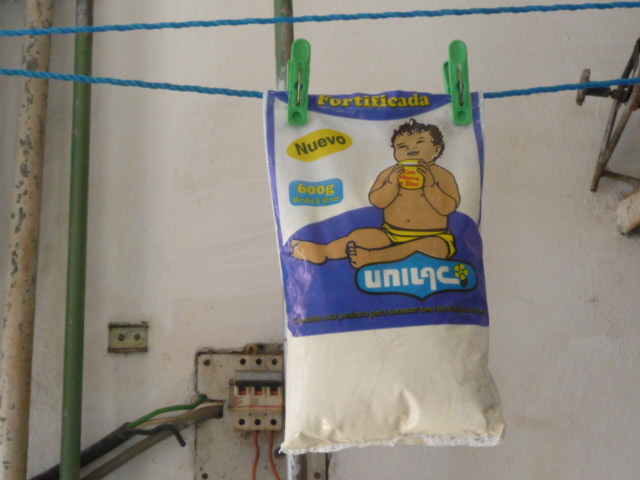
Sitting in my office yesterday whittling a Tweet down to 140 characters instead of working, I once again heard her hearty knock at my door. Smiling big, she told me she had three sacks of milk for sale at $2 a pop (a 50 cent savings over the official store price). I agreed to take one, glad I was finally getting the chance to help out granny. Until she pulled the sachet from her frayed knapsack: I, we both, were taking milk from the mouths of Cuban babes. What my elderly friend was selling was the milk the government guarantees to every child under 7 and I’d just purchased 600 grams of it. I knew that milk wasn’t going to be too tasty. 

—–

This transaction got me to thinking about where all this stolen stuff comes from and put me in mind of my friend Alberto. He has an old Lada on which his livelihood depends. Driving around recently, I noticed a balón de gas (the 20-lb tanks used here for home cooking) wedged behind his seat. Seems Alberto had converted his gas-powered car into a propane-propelled one.

This was a smart investment on his part: although the conversion kit cost $350 and had to be imported from abroad, Alberto fills that tank – which takes him 120 km or so – on the black market for just $5. By way of comparison, that same $5 would buy 15 liters of real gas on the black market; just over four at the pump. I’m glad Alberto has figured a way to enlarge his margins, but wonder about the families who show up to fill their kitchen tanks to be told “no hay” (there isn’t any).

This same pattern repeats itself with steaks and blocks of Gouda, stamps for official paperwork (I was surprised to be asked to produce receipts for my bank-bought stamps on my last visit to immigration) and cooking oil. And while I can appreciate the need for every last Cuban having to do something (or something extra-legal) to make ends meet, the more I parse the situation, the more unsettling it becomes.

And it makes me realize that a certain amount of that aforementioned moral ground is shifting below my feet. At these times I’m forced to ask myself: is this is a part of Cuban culture I wish to participate in? Unluckily for my milk-thieving granny, it is not. But I’m sure she’ll find other clients: as long as there are commodities like oil, meat, and milk to “redirect,” and resell for pure profit, folks will do it.

 As I said: old habits die hard.

 Notes

1. These political powwows are held every so often (the last was in 1997) or mejor dicho: whenever sufficient excrement threatens to make contact with the cooling element, if you know what I mean.

2. All of these issues came to the fore in nationwide public referendum-type debates held in late 2010. The permiso de salida is an exit permit which is mandatory for overseas travel by Cubans and residents. It earns the country revenue, but is also a barrier to travel – an issue that has to be reconciled somehow and soon.

 3. Except the goods in the black market Mac store. None of this is stolen, but rather all new, in-the-box gear with warranty and all, purchased in Miami and spirited into the country.

 4. Eggs aren’t usually stolen either, but rather the product of home-raised hens.

25 Comments

Filed under Americans in cuba, Cuban customs, Cuban economy, Cuban idiosyncracies, Cuban phrases, Cuban Revolution, Expat life, Fidel Castro, Living Abroad, Raul Castro, Travel to Cuba

My New Cuban Love Affair

[tweetmeme source=”connergo” only_single=false]So it’s International Women’s Day (see note 1) and a full moon – two events which occasion a certain randiness and frisk in these parts. And I’m feeling particularly frisky these days thanks to my new love affair with a certain Francis.

Francis is my new bike.

My trusty steed…

Before I wax poetic on the new steed between my legs, let me take this opportunity to digress a bit with a few words about the personification of one’s transport.

I was once in love with a guy who drove a truck – lived with him for over four years actually – and it fell to this unlucky fella to teach me to drive (see note 2). During my schooling, he also taught me the importance of naming your vehicle. Your car (or truck or bike) has a personality, he explained. You need to communicate with one another and work together. A name facilitates this inorganic synergy between man, movement, and machine; completes the anthropomorphic picture so to speak. I took his point. The one and only car I owned (co-owned and only for three months), was a beat up Audi named Otto. My mom’s Subaru is Harriet the Chariot. My sister’s 1982 Peugeot is Bruce. Over the years, I’ve had the pleasure of knowing Rocinante, Mugsy, and Hoss – great cars all.

When I got my new bike, I knew I had to have a name.

But after a month zipping across Puente Almendares, pedallling the pristine macadam bordering Parque Monte Barreto, and bracing my ass against potholes and train tracks, I still didn’t have a name. Clearly it was time for outside counsel. I put it to my friend Lucia, she of the Bambi filets

Her first question: male or female?

Ever-practical, Lucia cut to the obvious question I’d failed to ask. I had been so focused on a name that would translate equally well in English and Spanish, that I’d completely neglected to consider gender. Standing there in her bedroom it occurred to me that I didn’t want only linguistic inclusivity, choosing a name that would make sense in both my languages, I also wanted gender inclusivity.

“How about something gender neutral?” I wondered aloud.

“There aren’t many gender-neutral names!” Lucia’s 10-year old wunderkind piped up. After a few beats she asked: “How about Michel(le)?”

“Good one!” I said, knowing that girls of a certain age (even hyper talented Cuban ones) need encouragement and positive reinforcement. “But this bike doesn’t seem like a Michel(le).”

Wracking my brain for neutral names I’d come across in Cuba, I asked: “How about Francis?”

And a bike was born.

That was a long digression, I know, but I’m taking the Vin Scelsa defense here (see note 3).

_____

 I first cut my two-wheeled teeth in Manhattan (site of my one and only drunk “driving” accident, when I went down hard in a greasy Chinatown alley, erasing a patch of freckles the size of a one peso coin in the process), then in San Francisco, and now in Havana.

If you’ve never had the opportunity to glide along a deserted big city street under a moon so full it makes even me want to lactate, there’s something of the magical hidden from you. Every city has a side that only night owls see, of course – anyone who has walked home from a bar or ballgame in the wee hours has experienced this frisson with a city’s secret side. It’s exciting and slightly illicit somehow. With the wind in your face and the caresses of night billowing your hair and clothes about the faster you pump the pedals only heightens the sensation. Whether I’m coasting down Paseo or along Avenida 31, dodging potholes in Playa, or startling stray cats from their dumpster diving, on my bike I feel free in a way approximated only by orgasm. In short, city cycling unshackles something in the spirit.

Gliding through Havana’s landscape on a bike makes me look at things differently from when I’m walking (or driving, it goes without saying). I’m higher up for one. I see over hedges and into windows. I discover shortcuts and side streets I didn’t know existed. I note every parked car (my greatest – and most realistic fear – cycling in Havana is that I’ll get “doored”) and each driveway. In my experience, riding in a city requires a level of alertness not necessary while walking and opportunities for observation not possible while driving, which makes me keenly aware and appreciative of my surroundings while mounted.

I carefully consider other cyclists now and their habits, from the old dudes who poke along, pants rolled to the knee, to the shirtless young studs who ride as confidently as any Midtown bike messenger, cigarette dangling from their lips. The deplorable state of Havana’s street lighting is hammered home on these late night jaunts, as is the real possibility of encountering a drunk driver. And is there any city that smells like this one? Pedalling along, I get glancing whiffs of savory sea mixed with the off-putting tang of rotting garbage and wet earth if it has rained, dried leaves if it hasn’t.

By day, Francis takes me wherever I need and want to go: to check my PO box across town; to immigration; the grocery store; the theater; and my sister-in-law’s house. Errands that used to take an entire morning using public transportation are completed in an hour or two with Francis. Friends I put off visiting because they live far away now have me landing on their doorstep any day, any time. This in itself is liberating, not only for the time and money I save, but also for how refreshed I feel when I arrive – tired, sure, but refreshed like after a long swim or hot bath.

And oh, how the boys seem to like a girl on a bike. Perched on Francis, riding along 3ra Avenida or the Malecón, I bask in all the piropos trailing me as I pedal by: ‘¡Mami, llévame!’, ‘Que rica estás, rubia’, ‘¡Ay! Si yo fuera tu silla, mi cielo’ make me smile. And the best part is that I can mutually admire these men of all type and stripe and then be safely, happily on my way.

This post is dedicated to Chris and Alexis M, and Julia F who made my partnership with Francis possible; and to Cornelius S who introduced me to the joys of cycling the big city.  

Notes

1. Though largely ignored or unknown in the United States, International Women’s Day, observed each March 8th, is a huge deal in Cuba when every guy shows appreciation for the women in his life with flowers and shouts of ‘¡Felicidades!’ Even strangers proffer the celebratory phrase and many restaurants gift a single gladiola to all female patrons on March 8th. It’s one of the silver linings of machismo, I guess. 

2. I’m fond of making rules for others to live by – have been ever since I declared several decades ago that white people should not have dreadlocks. More recently, I’ve decided that men – I don’t care if it’s your dad, brother or lover – should not teach women to drive. It just adds to the universe’s general conflict and woe.

3. Vin Scelsa has been making what’s known as freeform radio for some 40 years now. His show Idiot’s Delight helped shape the paradigm which holds that the DJ can play and importantly, talk about, whatever the hell he wants. As you might guess, Vin talks a lot on his show, often about stuff not at all music-related. And as he’s fond of pointing out: if you don’t like it, change the station. Precisely my philosophy at Here is Havana.

27 Comments

Filed under Americans in cuba, Cuban phrases, environment, Living Abroad, off-the-beaten track, Relationships, Travel to Cuba

For: My 20-Something Friends, Love: Your 40-Something Tía

[tweetmeme source=”connergo” only_single=false] Sometimes I bore myself with all this Cuba talk and expat navel gazing; granted, there’s a lot to say on the subject (see note 1), so I’m not beating a dead horse per se, but it does make me feel like a wordsmith one trick pony. So very occasionally (e.g. when I was in Haiti and occupied Wall Street), I muse on things which have nothing to do with the beguiling isle.

But this post is a complete departure for me since in addition to being not at all Cuba-related, it’s also the first time I’m writing for a particular readership (see note 2). Inspired by my cohort of young friends on both sides of the Straits (who are remarkably similar in their youthful optimism and doubt, impatience and drive), I wanted to share a bit of wisdom to help ‘abrir caminos’ as we say here (see note 3).

I’m guessing most Here is Havana readers are – like me – “older,” but surely you have some young friends and family who might benefit from my blather. Or perhaps you’ve hit your fourth or fifth decade and have pondered the passage of time and its relation to the parable of life in ways discussed below. Regardless, I’m hoping said blather will resonate, no matter your biological age.

Party hard while you can – Partying until dawn at 40 is an entirely different undertaking from that at 20-something. At your age, you suck it up after a big night out and snag a couple of hours of sleep before going to class or work or both. But when you crawl in at daybreak at my age, you’re looking at a 24 hour recovery period. In short, the day after is totally lost, a write-off, while you drag ass, rest, maybe have a little hair of the dog, followed by more resting. My advice? Party hard while you can because that in itself gets harder as you age.

Shape up now – Your mind, depth of experience, and perspective grow as you grow up (if not, you’re doing something wrong), but your body? Hell in a handbasket, my friends, and you’ll eventually reach the point of sagging muscles and tone loss, slackening skin accompanied by its evil twin wrinkles, and gravity working its black magic on your boobs, balls, and god knows what all. My advice? Eat healthy, exercise, and don’t smoke or drink to best hedge your bets (says the woman suggesting you party hard while you can). I largely ignored this advice at your age, so I’m not throwing stones here, but rather signposting the road of life for my young friends. (I should admit here that I’m also a wee bit nostalgic for the taut, hard body I had at 20.) My advice? Enjoy it while you’ve got it, but know that maintenance is essential if you want to remain fit and bed-able at 40. This is particularly true for young XX readers, since women are saddled with an unjust and inequitable standard of youth and beauty as compared to men.

Get jiggy now– You might not think much of it at the moment, but once you’ve passed 40 or 50 springs on this earth, Viagra will become tantamount. For males, it’s a modern miracle. For us women, it sucks 16 ways from Tuesday. First, there’s straight up anger. They get Viagra and we get menopause?! Where’s my Viagra coño?! Second, those little miracle pills trick men into thinking they’re unjustifiably hot, omnipotent, and virile (some are dupes in this sense regardless, but that’s another story). On the upside, we ladies usually hit our sexual stride much later than guys – i.e. when most age-appropriate males can’t keep up without the help of Big Pharma. My advice? Enjoy yourself (safely!) now and entertain the cougar cruisers when your time comes.  

Some things don’t fix themselves – In addition to penile erectile dysfunction (see above!), other problems in life like clogged drains, yeast infections, back taxes, and bad tattoos (see below!) don’t get better on their own. This can also be said of HIV infection and I feel a little sorry for my 20-something friends who have only lived in the post-HIV world. My advice? Embrace latex and call a professional – whether it’s a sexual health expert, plumber, gynecoloigist, accountant, or laser wizard – when things go awry.    

Resist brand tyranny – Whether it’s Apple or Converse, Mercedes or Harvard, I urge you to resist marketing mania and associated pressure to buy and flaunt labels. Hilfiger or Louboutin, Ed Hardy or Kate Spade: no matter the brand, wearing it will not make you smarter, better looking, or more kind. True, I’m a fashion disaster, but in these matters, I defer to my favorite billionaire who observed: why shell out $10,000 for a Rolex when my $15 Timex keeps the hour just as well? My advice? Think twice before buying into the brand.

Love stinks – Sorry to break it to you, but even at my age you probably won’t have the love thing figured out. Sure, you may be with someone, engaged, married, or in love even, but that doesn’t mean it’s going to be easy. On the contrary, love makes everything more complex and in that complexity lies the problem. My advice? Tellingly, I have none; please let me know if you’ve had any revelations on the relationship front.

Think before you ink – I’m speaking from experience here guys: the tattoo that seems daring, romantic, or artistic at 20 can become a real problem at my age. Trust me – the choice between cover-up and removal isn’t pretty (or cheap) no matter how you cut it. My advice? Think long and hard about the statement you want to make and if it needs to be permanently emblazoned on your body and where.  

Older doesn’t necessarily mean smarter – Which is my way of saying: you don’t always have to listen to people older than you. Authority figures sometimes get off on that alone – i.e. the authority of age and position – and that can be dangerous for reasons too convoluted to go into here. My advice? Question authority, as much for your own benefit as for those wielding that authority because once they go unquestioned, they can do anything. And we definitely don’t want that.

Take the long view – I have a young friend who lost her zest for college two-thirds of the way through and she’s thinking about dropping/copping out. I say copping out because the lion’s share of the work is done and she just needs to suck it up a little longer to successfully attain her degree. Three semesters seems like forever to her at 21, but that ain’t nothing in the scheme of things, baby! I beg those of you close to completing school, a project, or a dream to persevere even though it feels like it will be forever until you reach your goal. My advice? You can do it – just go easy and take it slow when your patience runs thin.  

Keep your finger on the pulse – I’ve learned in the two decades since I was in your shoes that it’s important to befriend, mentor, and seek out and the opinion of, people younger than you. My advice? Whether you’re 20, my age, or double that and your next step is death, nurture relationships with people younger than you to keep your horizons expanding.

Live your dreams – As so many have said, life isn’t a dress rehearsal; it’s the only shot you’ve got. My advice? Make the most of it.

This post was motivated by the friendship of many 20-somethings in Cuba and beyond, including Caitlin, Benji, Joelito, Jenny, and Pablo. I dedicate it to you!

Notes

1. Which is why I’m writing a book (some would call it a memoir, a word that makes me cringe for several reasons) on the topic.

2. If you’ve landed here because you’re interested in Cuba-specific reading, I suggest trolling past posts and checking back in a few weeks – I’m preparing something juicy on the Pope.

3. For the curious: ever since I was 16, I knew I didn’t want to have kids and at 42, I remain exhileratingly child-free (and I’m not alone: check out this group Green Inclinations, No Kids or GINKs). But I adore being an aunt – tía in Spanish, which is a double entendre in Cuban since it loosely means ‘a woman of a certain age no longer considered sexy or eligible for seduction.’ I remember the first time a young Cuban buck called me tía – it smarted, yes it did!

43 Comments

Filed under Americans in cuba, Here is Haiti, Relationships, Writerly stuff

The Cuban Food Question

[tweetmeme source=”connergo” only_single=false]Not questionable Cuban food, mind you, but questions about Cuban food which continue to dog me, even after 10 years here, like: why are there no croutons? Or guacamole? And why don’t Cubans cook with coconut (Baracoa excepted)? Or bacon? I mean, it’s not as if there aren’t enough cocos and pigs to go around. To be fair, bacon is making inroads (see note 1) and I’ve seen a couple of coconut dishes here in Havana, but a tasty use for stale bread and old avocados?! You’d think the frugal out of necessity and habit Cubans, people who always use a tea bag twice and for whom disposable diaper is an oxymoron would be all over these past expiration date preparations. But no.

As devoted readers of this blog well know, I’m preoccupied with food, maybe disproportionately so, but that’s what happens when your formative years are spent in a food insecure home (see note 2). Whether that’s the reason my mom and siblings are such avid, fantastic cooks, I can’t say, but it rubbed off on me. This devotion to inventive, well prepared food coupled with the hundreds of restaurants, bistros, cafés, buffets, and drive-ins (Hawaiian kine) I’ve had to review for guidebooks makes me an expert of sorts (the bad, overly critical kind perhaps, but hey, someone has to steer you clear of shitty food in your travels).

Not surprisingly, I’m both excited and wary about the explosion of new restaurants in Havana. Excited because the quality and diversity of menus are improving – even in state restaurants which seem to be upping their game in the face of stiffer competition. Wary because I know how horrifyingly crappy Cuban food can be and the tricks used to try and cover the fact. At the same time, I’m concerned for my fellow travelers since everyone is writing about these new eateries, including amateurs and hacks who are dangerously unqualified – either due to a lack of regard for good food in general or ignorance of Cuban cooking and context specifically. These poseurs shall remain nameless, (that would be tacky), but their “work” on the topic has motivated me to help out with some observations about eating in my fair city.

All the examples below are from new paladares which are currently or soon will be listed in my app Havana Good Time.

An Indian restaurant sans raita – So Cuba has its first “Indian” restaurant (note quotation marks people – punctuation has a function!). The space is quite lovely and the staff is attentive, but the food? Like the guy I lost my virginity to, being the first is not enough to win me over. I know, I know, I should be thankful that we even have an “Indian” restaurant here (see note 3), but you know what? I cook better Indian food and mine is accompanied by the requisite raita. For those not familiar with Indian cuisine, this traditional sauce is used to cut the spiciness of dishes while adding a dynamic flavor layer to the palate. And before you jump down my throat about the unavailability of certain ingredients here in Cuba: raita is yogurt, cucumbers, and garlic – three items that rarely go missing here in Havana.

“Vegetarian” spring rolls – It’s really too bad that the new Vedado paladar serving this toothsome finger food doesn’t heed punctuation as religiously as we do: when I cut into one of these rolls recently, out spilled bok choy, scallions, cabbage, carrots and…ham. When I asked the waitress (nicely, my shoulders unburdened of any NYC or foodie chip) what was in these rolls, she confirmed the presence of the ever-present pork. I pointed out that this could result in some serious problems – not only with vegetarians (see note 4), but also with Jews and Muslims too, who take as much solace as herbivores to see vegetarian selections on the typically pork-laden Cuban menu. When I asked why they call them “vegetarian,” she said with a straight face: ‘because there are lots of vegetables in there.’ 

Deep fried olives are considered nouvelle cuisine – I don’t know what was more shocking: seeing something besides Gouda cubes and croquettes as hors d’oeuvres or the realization that they had actually deep fried olives to serve to a group of foreign VIPs. While far from heart healthy, I have to admit these were disconcertingly tasty, which can be said for almost anything except the deep fried cucumbers I had last week. Both of these examples, by the way, hail from Habana Vieja, part of Eusebio Leal’s wickedly clever fiefdom (which is usually head and shoulders above regular state enterprises). Alas, sophistication is not an overly common Cuban trait, as evidenced by…

Oil & vinegar, the one and only dressing – Sure, you might get a nice honey Dijon in someone’s home, but in a high end paladar? Not likely, where the same tired oil-vinegar- salt trio prevails (lucky you if that exotic spice we call black pepper is available!).  A few places are starting to provide balsamic and olive oil, considering this the height of haute, showing how far we are from raspberry vinaigrettes or tahini-lemon dressing. Granted, raspberry vinegar and sesame paste are in short supply here, but honey, Dijon, blue cheese, anchovies, capers, soy sauce and many other ingredients for inventive dressings are available sin problema.  But this lack of sophistication is even more blatant in the place with…

Busty waitresses in low-cut blouses and Daisy Dukes – I don’t care how hot you are (or think you are or your manager thinks you are): I don’t want my steak served with more flesh in my face than Copacabana sees in summertime. In a word: inappropriate! Especially at this expensive high-end restaurant featured recently in several glossy magazines (which made a glaring omission of the “uniforms;” unsurprisingly, all the articles were written by men). Havana Hooters anyone?

The $4 fruit shake – Argue with me all you want (welcome to the club!), but this is simply wrong in our context and distorts the local economy like the thousands of bright-eyed NGO workers who rush into post-disaster Haiti or Indonesia and pay triple the going price for bananas, potable water, taxis, whatever. To all the new places offering the four dollar shakes and similar: consider yourself boycotted on GPs.

Musing about all this leads me to believe the absence of croutons, guacamole, and coconut-based dishes is due to lack of knowledge, experience, creativity, motivation, or a combination thereof.

What do you think readers? Any surprising omissions in your Cuban culinary travels?

Notes

1. I predict crispy bacon (not the flaccid, fatty crap at hotel buffet troughs) will explode in popularity as US visitors continue to pour in and restaurateurs realize the egg/bacon/toast triumvirate is as American as inequity.

2. Mom was a single mother of four which made her, out of necessity and habit, a creative, but stretched cook (and very Cuba in her way which is a big factor as to why I’ve been able to survive/thrive in the peculiar conditions on this side of the Straits. Epigenetics might have something to do with it too). We all remember with a shudder living on oatmeal for two weeks solid and the fight over who got more noodles. This fracas is still dragged out to this day – but in the best, sibling rivalry type of way now that our oatmeal and noodle days are behind us.

3. In the interest of full disclosure: everyone I’ve talked to who has eaten there – visitor and Cuban alike – was very impressed with the place which means one of two things: my standards are too high or theirs are too low.

4. I have seen a strict vegetarian take a bite into an egg roll he was told was 100% veggies and the resulting fisticuffs – never underestimate the strength and rage of a pissed off vegetarian!

41 Comments

Filed under cuban cooking, Cuban economy, Cuban idiosyncracies, Travel to Cuba

Conner’s Cuba Rules

[tweetmeme source=”connergo” only_single=false]

Since I’m from the Estados Unidos (more fittingly known as ‘Estamos Jodidos,’ or the independent republic of ‘We’re Screwed’), very few friends have visited me here on the “wrong side” of the Straits (see note 1). The lengths the US goes to keep Cuba down makes me indignant, but also sad since my peeps haven’t been able to experience this place for themselves and draw their own conclusions as to how good (or not so) things are in my world.

Last week however, the friend blockade was broken by some dear old amigos who finally made the leap and turned up for a visit.

As you might expect, they had lots of questions about governance and control, salaries and employment, the burgeoning private sector, tourism, race relations, emigration and myriad other aspects of Cuban life. Their curiosity and desire to better understand the sometimes unfathomable reality that is Cuba, forced me into a thoughtful analysis of the mundane, germane, and slightly insane features of life here.

Since the contemporary Cuban reality is so complex and different from what most people know, I’ve developed several rules of thumb for travelers wanting to maximize their Cuba visit. Part philosophical, part practical, the following complement Trip Tips: Havana Independently, posted in these pages some time ago.

– 8 out of 10 people approaching you on the street want something. ‘Do you have the time?’ ‘Where you from?’ and ‘Hello, my fren! Francia?! Italia?!’ are the most common lines used on new arrivals by jineteros. These are always asked with a good dose of charm in some of the best English you’re likely to hear in Cuba and it usually takes a couple of days before visitors get clued in to the hustle.

Conner’s Rule of Thumb #1: Deny hustlers an easy opening by eschewing clothing or accessories that identify your nationality and learn a few deterring phrases. These might include ‘déjame en paz’ (leave me alone) or for those who won’t take no for an answer: ‘no te metes conmigo, coño’ (don’t mess with me damn it). If you’re a hustler magnet (or hater), consider steering clear of tourist hot spots in Habana Vieja and Centro Habana altogether. In the end, all foreigners are seen as rubes and marks regardless of station, education, or experience.

– Cubans tell you what they think you want to hear. As a rule, foreigners receive the ‘poor oppressed us’ line first. A sympathy ploy laced with political assumption, this tactic is tiresome for its banality and blatant disregard for facts. You’ll be told, for example, about the stiff penalties incurred for killing a cow, but this ‘woe’s me’ contingent will conveniently leave out the part about the government guaranteeing milk for all children under 7, pregnant women, and other vulnerable groups – the reason cows are protected property. Cubans renting rooms in their houses are notorious for this type of incomplete picture peddling, complaining to clients about the taxes levied upon their business. What they neglect to mention is that their income-earning homes are provided by the government virtually rent-free. Wanting a rent-free property to run a business and be tax exempt? That’s chutzpah.

But this cuts both ways. If, for instance, you evidence respect and awe for the Cuban Revolution, you’re likely to hear about free education and the wonders of organic farming. What you won’t necessarily hear about are the overcrowded dormitories with shitty food and water shortages or the country’s experiments with genetically-modified crops.

Conner’s Rule of Thumb #2: Cubans tend to see things as black and white, when the truth more often resides in the gray. When picking a Cuban’s brain, always consider the source and listen to the complainers very closely: you’ll likely hear the axe they’re grinding loud and clear.

– You can’t ‘fix’ Cuba. There’s an especially annoying type of tourist who after two weeks here is convinced they’ve got it all figured, that they know precisely how to fix what’s broken (see note 2). Their simplistic ideas often disregard the complexities of Cuban society and illustrate a woeful ignorance of history, geo-politics, even the weather. For example, if you think hurricanes have little connection to health and housing in Cuba, you might be this type of visitor. Even after living here for 9 years, I can’t figure it all out and while it’s possible some tourist is better positioned to analyze Cuba, it’s not likely.

Conner’s Rule of Thumb #3: The more you know about Cuba, the less you understand. Remember: it’s better to remain silent and appear a fool than open your mouth and prove it. If you’re truly keen to learn, read widely before your trip, ask lots of questions once here, and avoid declarations.

– The more things change, the more they stay the same. Huge, watershed changes are taking place here, but at its core, Cuba is still Cuba. It’s a cultural constancy that may be drawing to a close as market forces gather momentum, but I’m not so sure. Consider this quote:

 It is plain there is a good deal to be learned here…Things which we cannot do without, we must go out of the house to find, and those which we can do without we must dispense with. This is odd and strange, but not uninteresting and affords scope for contrivance and the exercise of influence and other administrative powers…I must inform myself on the subject of this strange development of capital over labor.”

– Richard Henry Dana, Jr.

 What’s so interesting about this observation is that it could have easily been made yesterday, but dates from 1859.

Conner’s Rule of Thumb #4: Cuba is evolving, but not necessarily in the direction or way you or I might think (or want). Though the steps people take to maintain balance might change, the fact that the ground is always moving never does. Do like Cubans and roll with it.

No coge lucha. Threats to national sovereignty notwithstanding, Cubans don’t take too much too seriously, preferring to get and go along over fussing and fighting. I’m convinced it has something to do with the weather – this heat is enough to wither anyone’s defenses – but is probably also related to the fact that there is so little housing and employment movement here, if you piss a neighbor or co-worker off, you’re in for a lifetime of problems.

Conner’s Rule of Thumb #5: Don’t get your knickers in a twist if things don’t go as planned or a government drone isn’t cooperating. Have a sense of humor, laugh it off and follow the old axiom: you catch more flies with honey than vinegar.

Writing all this, I realize I’d be wise to take my own advice!

Notes

1. For anyone new to this blog +/o US-Cuba relations, the freedom for US citizens and residents to travel to the island has been restricted for 50 years. As I type this, the House Appropriations Committee has just voted to reverse the small opening Obama offered US travelers wanting to travel to Cuba.

2. These types really chap my ass, almost as much as the Cuban émigré who hasn’t been here in 20 years or worse, the person sitting at their computer who has never been here.

57 Comments

Filed under Americans in cuba, Cuban customs, Cuban idiosyncracies, Cuban Revolution, dream destinations, Expat life, Living Abroad, Travel to Cuba, Uncategorized

The Road Test: Adventures at the DMV Part II

[tweetmeme source=”connergo” only_single=false]

So I passed the written – a test my friend Pilar called “easy” but which took me a couple of tries (while my ego took a beating) to master. In the end, I’d triumphed. I’d passed; the hard part was over. I had my Cuban driving permit. I wasn’t a bit worried about the road test – I’d been driving for years before my US license expired, including in Havana. It was just a formality.

Famous last words, as Mom would say.

Countdown: 16 Days to Go

Our friend Camilo stopped by for a visita on the eve of the road test. This was serendipitous. Camilo is a professional taxi driver and an old hand at Cuban rules of the road.

“You’ll be fine – just be careful how and where you park. They like to get tricky with that.”

This gave me pause.

“How about the car I’m using? Does it matter that I’m taking it in kind of a clunker?” It wasn’t one of those Meyer Lansky-era jobs mind you, but a car with sus problemitas nonetheless.

“As long as it’s manual – you can’t take it in an automatic. And make sure the emergency brake works. They won’t let you test if it doesn’t.”

The emergency brake, of course, was the car’s major problemita. It was totally flojo, flaccid. Stopping that car with the emergency brake was like trying to shoot pool with a piece of rope.

Sleep was elusive that night. I could blame the refurbished mattress, but my tossing and turning and anxious sighs were caused by images of loose emergency brakes and personal failure followed by financial ruin.

We arrived bright and early the next morning at the police precinct parking lot where the road test began. My stomach was in knots and my eyes had the itch and irritation of insomnia – allegories for my mental and emotional state. It wasn’t yet 8:00 am and already three were three testees, plus their representantes – those folks who drove us to the test and would perform the car inspection before setting out. I took el último. We chatted to pass the time. My hyperkinetic, chain smoking husband did little to allay my nerves.

My heart was beating faster than is normal or healthy when Oswaldo, our examiner (or inquisitor, depending on how you look at it) strode up. He gathered us around and explained the exam. He reviewed common mistakes and what skills he’d be looking for.

“Any questions?”

“If we fail today, how soon can we come back to retake the test?” I asked. My clock was ticking faster than a childless 40-year-old with maternal tendencies and I needed to know exactly where I stood.

“You have to wait a week and can only take it three times. If you fail all three times, you have to wait a year before taking it again and then you start from zero, with the written.”

He asked for all the candidates to step forward with their documents. I was the lone foreigner. There were some younger folks with their bling and blasé attitude, plus an army guy (see note 1), a truck driver, and a tall dreadlocked dude with an extranjera girlfriend so butt ugly she could have cracked a mirror (see note 2).

Oswaldo asked each representante to take the wheel of the cars we’d be testing in to verify that the blinkers, brake lights, and emergency brake were in working order. My husband tossed his smoking cigarette aside and got in the car.

“Accelerate and pull the break,” he was instructed.

He did so. Oswaldo looked at me.

“Back up and do it again. Without stepping on the brakes this time.”

The love of my life did as he was told and coasted to a stop too many yards away.

Oswaldo shook his head. “You can’t take the test in this car. Can you find another?” I told him we would.

My husband called his office and they sent over an even older car that rattled when it rolled. Now I had sweaty palms to go with my irregular heartbeat. This car, not surprisingly, also failed the pre-test inspection. I was starting to get seriously worried. My Plan B – tossing a buddy of mine a “Benjamin” every week for use of his jalopy truck during my assignment abroad – was tenuous at best and I there was no Plan C. I walked home steamed.

After raging against my husband’s shitty work vehicles to our empty living room, I gave my good friend Angela (she of the Cuban Thanksgiving) a call. She had a nearly new Korean jobbie – small and simple – that I was sure she would lend me. She’s solidaria like that. Not only did she agree, she came over later that afternoon so I could give it a test drive.

“Does your car have a name?” I asked her once I was behind the wheel.

She looked at me as if I’d asked her to join me on a stroll of the Malecón with an ‘abajo el socialismo‘ sign.

“It’s just that I know a lot of people who name their cars: Bruce, Chico, Rocinante. That way you can talk to them – maybe cajole them into behaving better. Kind of like plants or kids.”

I took Angela’s no name car for a spin and it felt like I always did behind the wheel: like an experienced driver. We agreed to meet the next morning in the police lot.

Stay tuned for Part III of Conner’s Adventures at the DMV.

Notes

1. I steered clear of any chit chat with this fellow for his sake: all members of the Cuban armed forces who come in contact with a foreigner – even inadvertently – must file some ridiculous paperwork about the encounter. I learned this one day as I sat on my friend’s couch when her nephew dropped by. He was in uniform and tried to hightail it out of there before he was compromised, but too late. This regulation of contact with foreigners is why folks in uniform looking for a botella (hitchhiking – common throughout Cuba) won’t get in your car if you offer them a ride.

2. It’s not my style to notice – much less comment – on someone’s physical appearance (beauty is on the inside after all) but this woman was extraordinarily, exceptionally ugly making me think other factors were likely at play in this Cuban-foreigner hook up.

9 Comments

Filed under Americans in cuba, bureacracy, Living Abroad

Rock, Meet Hard Place

[tweetmeme source=”connergo” only_single=false]

Excuse my absence from this space, dear readers, but to put it bluntly, things are pretty fucked up for me these days here across the Straits.

I won’t bore or burden you with the details. Suffice to say, I’m between a rock and a hard place with very little wiggle room. To boot, it’s my own fault. I alone am responsible. I don’t have to tell you this makes it worse. Much worse.

I’m trying to be Zen about it, but I’m not a Buddhist and I’ve never been a good believer (although I do have faith, but don’t ask me in what right now because frankly, I’m a mess), so it’s very difficult for me to “rest in the middle way.” My (present) inability to resolve this particular problem of my own doing is salt in my wound, lemon juice in my third eye.

For all the wonderful experiences I’ve lived and all the skills I’ve acquired in almost nine years here in Havana, sometimes living abroad sucks. For so many reasons. And while I don’t think I’ve glorified it per se, I’m not sure I’ve devoted enough keystrokes or analysis to all the factors that make it ulcer-producing. That erode my confidence, opening a sluice gate of self doubt and re-awakening insecurities I thought long conquered.

There’s the language for one (and after all this time, I still struggle) which, for someone who traffics in words is a toxic state of affairs. Then there’s what has been “left behind.” Even with the Internet, important emotional and practical pieces of my pre-Cuba life have broken off and fallen away like the façade of an Old Havana tenement. All but my closest relationships (which I work hard to maintain and grow from afar – no es fácil) sit idle, parked in a 9-year coma. My littlest niece is wearing bras and discovering rock ‘n roll, my friends have kids I’ve never met, and my mom grows older. My namesake and goddaughter, much like me at her age, is going through her parents’ break up and I’m missing all of it. I’m neither comfort nor counsel to these people I love.

The practical business of taxes and jury duty, student loans and passport renewal is a whole other ball of angst-enhancing wax (and if I do indeed have an ulcer, these administrative and fiscal obligations are to blame). Attending these boorish tasks, for different reasons, is often impossible from here. Given this state of affairs, some things slide. And I’ve let them. I’ve got no one to blame but myself for arriving between this rock and hard place.

I had planned on writing a triumphant post today about how I faced and conquered this particular problem, how I found my metaphorical paddle in this creek I’m up, but I failed. Twice now I’ve failed. And if first time failure is disheartening, the second time around is downright frightening.

So here I am, scared for our financial future which is riding on a writing gig I’m due to start next week. This project is huge and depends on me passing the Cuban road test. Twice I’ve failed. And I only have one more chance (see note).

I’ve always believed three is a charm. In this case, it damn well better be.

Stay tuned for the next installment of Conner’s Adventures with the Cuban DMV.

Note

I’ve driven (well, I might add) for years in contexts as demanding as LA, Mexico, and Manhattan, making Havana a piece of cake comparatively. I know these streets well, having driven at all hours of day and night, during black outs and fierce tropical storms. But that was before I let my US driver’s license expire. Stupid, stupid, stupid move. Hopefully by writing this someone, somewhere will learn from my ridiculous mistake.

27 Comments

Filed under Americans in cuba, Cuban customs, Living Abroad, Writerly stuff

Wild Camping in Cuba – Part I

[tweetmeme source=”connergo” only_single=false]

The last time I planted tent poles, it was within pistol shot of the crumpled Presidential Palace, Port-au-Prince, March 2010. At 33 nights, it was the longest I’d spent in a tent. Given the wretched situation and endless cavalcade of sick and hungry Haitians seeking succor from the Cuban medical brigade I was covering, it was, (it goes without saying), the most taxing tent time of my life.

But a few months on, I was ready for the swelter of the carpa and clouds of (malaria-free) mosquitoes. Even the dicey baño scenarios didn’t deter. Besides, a camping vacation was the only kind our budget could handle.

Our target was the Bay of Pigs (see note 1). The snorkeling was good, the fishing promising, and the beaches we found on our 2003 island-wide adventure, camper-friendly. But in one of those travel mystery moments, as vague and insistent as a nostalgic scent or voice carried on a breeze that you can’t be sure isn’t just the wind in the leaves, we changed course. Which is how we ended up under a bridge.

—–

As sick as it sounds (and probably is), the plastic tarp and stick structures huddled under the bridges reminded me of Port-au-Prince. The more fortunate had two-person tents and a thatch-screened area for pissing and more demanding duties. Families 15-strong cordoned off their slice of beneath-the-bridge beach using old rope, freshly-cut palm fronds and whatever else was on hand. Their dogs prowled the periphery, their bunches of plátano hung out of reach. Side by side like cubes in an ice tray, kids tucked into mosquito net cubicles rigged by red eyed fathers in knee-high gumboots. As the little ones slept, bonfires blazed and chispa burned throats. Cooking, bathing, dishwashing and other necessities of life were carried out in broad daylight. Children frolicked. Women worked. Men played dominoes. It felt awfully familiar.

We kept exploring. Every few kilometers there was another river carving its path onto the beach and feeding into the sea. Each river was spanned by a bridge. They had evocative, indigenous names that filled my mouth with marbles: Yaguanabo, Cabagan, Guanayara. Then we pulled down into Río Hondo. Claims had been clearly staked at the far side of the beach nearest the deep, green river and by the looks of it, the campamento there was hosting a family reunion of forty. Already I could feel the reggaetón and general bulla rattling my bones and grating my nerves.

We kept on exploring.

Our pocket was tucked away at the other end of Río Hondo’s sandy expanse, where the bridge curved over and away like a mulatta out of your league. Almond and seagrape trees provided shade for weathering Cuba’s brutal summer sun and we could easily improvise bathroom facilities where they thickened back from the beach; the tumble of sea stones that made up the shore gave way to a sandy, shaded patch for our tent; and our closest neighbors were 300 meters down the beach.

The site was, I dare say, perfect.

To be continued…..

Notes

1. You almost never hear ‘Bahia de Cochinos’ in Cuba, which just goes to show you how far apart the thinking is between here and there. Forget coming to terms on human rights issues, immigration, or sovereign state concepts: the two sides of the Straits are even at etymological odds, having different terms for the embargo (know as the bloqueo here and occasionally as genocidio, which I have a small conceptual problem with), the Spanish American War (called the Guerra Hispano-Cubano-Americano here which makes eminent sense: the Cubans, after all, played a pivotal, indispensable part), and the Bay of Pigs (here referred to as Playa Girón).

13 Comments

Filed under Americans in cuba, cuban beaches, environment, Here is Haiti, Travel to Cuba

Es Cuba Mi Amiga*

[tweetmeme source=”connergo” only_single=false]

I love Latin America. I’ve been traveling there as tourist, scholar, reporter, and guidebook writer for 30 years. I dedicated my absurdly expensive stint with higher education to its history and politics. I’ve visited almost every country and know many intimately. Each is different and captivating in its way, it goes without saying. But of all the countries south of ‘El Norte,’ none compares to Cuba.

I should know, I’ve been living here since 2002.

I speak Cuban and know the best scams. (You won’t learn ‘¡¿cuál es la mecánica asere?!‘ studying Spanish in Antigua, homestay or no). My family has a ration book and I commute to meetings in ’56 Buicks. I know where to buy condoms for a penny and procure black market gas. Like anywhere, such practicalities can be learned over time. But the charm of a place, the underlying magic that makes here thrum at a higher frequency than there, dwells within the people.

—–

Bright and early Monday morning, I make my way in a tinny old Lada to the travel agency. Like everywhere in Latin America, errands are best run in the morning lest the lights go, the building springs a leak, or the workers take a 6-hour siesta. I’m not surprised to find the agency next to the Artificial Rain Augmentation office. Es Cuba, after all.

At 8:45 the small, windowless room is already packed – there are four times more people than chairs. As usual, it’s sweltering and the air conditioning is broken.

A bleach blond with two young girls in tow is ceded one of the coveted seats. Her daughters play tope, tope, tope while she chats with the agent. Purchasing a simple plane ticket here is a slow, inefficient process. There’s not a computer in sight, just a single phone, and tickets are written out by hand. Transactions are in cash, meaning at this moment there are of thousands of dollars secreted in bras, stuffed into envelopes, and tucked inside jackets all around me.

To pass the time, we talk about the weather, where to buy rice, and the new soap opera. Those keeping mum are either not Cuban or have been gone so long they’ve lost their local chops – talking to strangers while waiting is both hobby and sport here.

The dyed-blond mom isn’t having much luck today. Each time Inés María tries to ring the central office – where the computers live assumedly – the line is busy. She replaces the handset and asks Blondie what grade the girls are in. With each new client’s arrival, the office grows hotter. A woman wearing the agency’s colors enters at half past nine, proffering a tiny cup of sweet dark coffee to Ines María who immediately offers Blondie a sip.

‘It is so hot in here,’ Inés María says to everyone and no one. She picks up the phone, determined to resolve the problem.

‘Hola amor. This is your colleague in the sauna calling. Can you come check on this AC? It’s so hot I’m ready to take my clothes off in front of all these clients and it’s gonna go porno. It won’t be pretty!’

She signs off with kisses for Mr Fix It’s family and wishes his grandmother a quick recovery.

Blondie’s girls are getting restless. The older one says she has to go to the bathroom.

‘It’s right down the hall, sweetie,’ Inés María tells her.

Typically – for Cuba – the 8- and 6-year old leave without adult accompaniment to find the public bathroom. We resume talking about the weather. Suddenly the younger girl is back.

‘Mom, she needs toilet paper,’ she announces to the now overflowing office. ‘She has to poop.’

Needing a personal, portable supply of toilet paper; talking openly about bowel movements; sharing conversation and coffee with strangers while waiting a couple of hours to purchase a plane ticket: this is normal. This is Cuba.

*This post will appear in the forthcoming ebook anthology of top Latin American bloggers being edited and published by Steven Roll of travelojos. If you’d like to be notified when it’s released, drop me a line.

17 Comments

Filed under Americans in cuba, Living Abroad, Travel to Cuba