Havana Vice: Titimanía

[tweetmeme source=”connergo” only_single=false]

I’m what’s known in these parts as a ‘temba.’ The term generally applies to anyone, male or female, over 40. It’s not a hard and fast rule – a younger person who looks older may be called a temba – nor does it infer, like other terms such as ‘tía’ and ‘pura,’ that the person is over the hill sexually, physically or otherwise. Temba is not derogatory; it’s simply a category of Cuban, used here to describe a state of being, similar to our use of descriptive terms like negro, chino, flaca, santero or maricón (see note 1).

One thing I love about Cuba is its integrated, inter-generational nature. This facilitates friendships with Cubans aged 12 to 84 – something I cherish and which is harder to achieve in the United States. Naturally, however, many of my colleagues and consortes are other tembas. Over years of observation and recently a more in-depth investigation into Cuban sexual practices and mores for a larger piece I’m writing, a couple of tendencies keep cropping up: flexible fidelity is one, titimanía is the other.

Simply put, titimanía is the compulsion temba men have to date impractically young women. This is not limited to Cuba, of course, but by parsing how universal behaviors play out here, I hope to provide insight into the particularities and peculiarities of the Cuban character – for all our sakes (see note 2).

Before proceeding, I should disclose that I’m no stranger to the attractions of older men: at 16, my first serious boyfriend was 26, an arrangement for which he could have been prosecuted in our hometown of New York. While I think statutory rape laws are ridiculous in cases where everyone consents to getting it on, I admit there is something creepier when the ages are more advanced and the age differences greater.

Take my friend Carlos. When I met him a decade ago, he was 40 and his live-in girlfriend was 18. Jenny was gorgeous, of course, but a child – intellectually, developmentally, and practically. Just out of high school, she’d never had to pay a bill, work, or worry about a leaking faucet or roof. After four years together, the relationship ended disastrously, with Jenny hightailing it to Miami taking Carlos’ expensive gifts – jewelry, clothes, electronics – with her. Pre-ordained, perhaps, but that didn’t faze Carlos.

He quickly “recovered” (I’ve noticed men, Cuban and otherwise, tend to rebound fast – but incompletely – from ravaged relationships) and before long had Tania living with him. Prettier than Jenny, smarter, and worldlier, Tania was 22. After a few years, that relationship also ended badly, worse even than the one previous. Tania and Carlos barely speak today, which is uncommon in Cuba where circumstances and reasons too complex to elaborate here fairly obligate exes to remain on good terms. Uncommon and sad: their kids from previous relationships had become siblings and when they split it signaled an end to their blended family to the detriment of everyone involved, even if they don’t realize it.

Today, Carlos is 50 and has recently taken a 20-year old wife. I haven’t yet met her but have heard through radio bemba (our grapevine) that she’s hot and terribly boring, limiting dinner conversations to her new shoes, so-so manicure, and how the sushi she tried last week ‘totally grossed her out’ (see note 3).

Not all 20-somethings are that vapid and clearly, I better understand what’s in it for the women. Older men tend to be better than their younger counterparts in bed (if less athletic and enduring); have more status and economic possibilities; and generally have a clearer idea of what they want in life and are already well on their way to getting it (or should be).

However, once men hit that temba threshold, what they want are girls young enough to be their daughters. My 48-year old friend Elena is finding this out the hard way: after 15 years of marriage, she’s divorced and dating. Elena’s not looking for a new husband or live-in (the two are synonymous here); far from it. She just wants a healthy, available guy for a good time. You’d think this would be easy in libidinous, gregarious Cuba. Not so for Elena. ‘No niños for me,’ she tells me. ‘I don’t want to teach them the art of the orgasm or have to finance our affair. I’ve got my own kids, I don’t need another.’

Elena is looking for someone age appropriate and therein lies the rub: every man her friends try and fix her up with is interested in women her daughter’s age. They are, in short, suffering from acute titimanía. She has actually been told to her face: ‘you’re too old.’ And although they always put it in the nicest way possible, it’s getting her down. Once you rule out the married, infantile (of which there are many), gay, and titimaniacal tembas, Elena’s roster of eligible men is as short as Fidel’s speeches were long. And she’s discouraged, pobrecita.

The titimanía phenomenon came up the other day while I was talking to our mutual friend Alejandro. Clever and fit, with a comely face that belies his 50 years, Alejandro is one of the guys posited – and rejected – as a possible hook up for Elena; he likes them younger. Cubans are very frank about such things, which is efficient at least: while men here might date fat, unemployed, gold-digging, or gap-toothed women, age is not negotiable and they don’t waste time saying flat out ‘you’re too old’ (in the nicest way possible).

Alejandro could tell I was irked by his titimanía and its inequitability. “What chance is there for Elena and her ilk, when you guys are chasing skirts just out of high school?”

Mira, mi amiga,” he said smiling, his eyes crinkling around the corners they way they do with happy people, “from the age of 15, girls try to look older and do all kinds of things to enhance their beauty and heighten their self-worth – fake nails, fake boobs, dyed hair, high heels, the works. Old guys like me don’t do any of that. Instead, we pump up our egos by dating young women.”

“So tembas like you have the mentality of a teenage girl?” I wanted to say, but didn’t.

Laying my indignation aside, I could see his point. It’s about the self-esteem boost for everyone involved. But where does this leave Elena? Alejandro couldn’t provide an answer beyond: “I don’t know, but she’s too temba for my taste.”

Notes

1. This last term, meaning ‘fag’ or ‘queer’ is used in Cuba to denote male homosexuals. And while it’s inherently homophobic – which is why I don’t use it – many highly-educated and cultured people use maricón to classify gay men (or derisively with their straight friends). I employ it here by way of illustration only.

2. Equally as interesting are behaviors which don’t manifest here. For example, the reverse – a young Cuban buck getting jiggy with a cougar or MILF hasn’t caught on here like in the United States (the 13-year old who couldn’t peel his eyes from my temba friend Lucia’s cleavage, declaring her ‘hot and chesty,’ notwithstanding). But I’ll leave this for another post.                                                                                                                                                             

3. While I predict this marriage will be short-lived, I have friends who have been in one of these May-December relationships for ten years. They’re healthy and happy and while it remains to be seen what that relationship will look like when she’s 35 and he’s 63, so far so good. More power to them.


41 Comments

Filed under Americans in cuba, Cuban customs, Cuban idiosyncracies, Cuban phrases, cuban words without translation, Expat life, Fidel Castro, Living Abroad, Relationships

Cuba: The Eternal Education

Some of you may remember my catharsis about know-it-all Cubans, a semi-measured rant dissecting the Cuban ardor for being right – even when they’re talking out their ass.

Not surprisingly, there’s a similar breed of foreigner, an expert on Cuba after two weeks, two years or tenure (see note 1). Maybe you’ve overheard them at the next table at one or another of Havana’s overhyped paladares prattling on about how to unify the currencies or make Cubans more efficient (the most vulnerable rarely have a seat at this table, literally and figuratively). Perhaps you read a blog written by an absentee/wannabe Cubanologist or transient traveler who proclaims to be an authority on political bell weathers or sexual proclivities here.

No matter the source: those claiming to have Cuba pegged are usually off base or worse – not even in the ballpark. Whereas it used to be difficult to understand things on the ground from afar, today it is near impossible since economic reforms are changing the landscape here fast. For us living it, we’re learning something new every day, the details and mechanisms of which cannot be fully known from wherever you are reading this.

Although the economic changes are injecting a level of uncertainty and accelerating individualism (here in Havana at least) that trouble me, I still give daily thanks – or try to – that I live in a time and place that continually teaches me new things. After all, learning something new every day is one of the key ingredients in the ajiaco of life – another reason why I love Cuba. Judging by the experience of certain friends, I’m confident the eternal education Cuba provides is a constant regardless of outside forces or how long you’ve been here.

Take my friends Ann and Alicia. North Americans both, they’ve lived here full-time for a collective 55 years and are still learning. Recently they separately admitted to having just learned that the red ribbon hanging from the undercarriage of 6 out of 10 cars here is to ward off the evil eye. And they both own cars! Such discoveries after so much time in residence encourage me to keep observing, keep meeting and talking to new people, having new experiences, and writing about this complex place where there’s always something new to be learned. In the past several weeks alone, my Cuban education has schooled me thus:

El Torniquete: The observant among you have likely noticed women and young girls chancleteando through the streets of Centro Habana or La Vibora with empty rolls of toilet paper spooled tightly around their tresses and piled atop their heads. This is knows as the ‘tourniquet’ and is a simple, free way to produce a fancy, going out ‘do. Although I’ve long marveled at the ingenuity, I never knew this technique had a name until a friend helping to gussy me up showed me how it’s done. For those wondering, I’ve only been partially successful in my gambit to improve my “look” due to my rabid aversion to shopping and my preference for substance over style. Furthermore, with only 24 hours in a day, other pursuits (e.g. cooking; bike polo; visitas) take priority of personal primping. Clearly, I still have a lot to learn from my impeccably turned out Cubana counterparts.

4/4 Time Dies Hard: I’ve recently taken up salsa lessons which have been measurably more successful than my half-hearted attempts at honing my fashion chops and style. I have an amazing dance teacher – talented, patient, encouraging, and easy on the eyes – which is a large part of the equation. Last class he admitted: ‘I thought it was going to be much harder to teach you’ and after just a few lessons, we’re both impressed that I’m already spinning around the dance floor without spinning off beat. But a lifetime 4/4 habit is a bitch to break, I’m learning, and I still tend to misstep, especially when in the arms of a taller, drunker, or clumsier partner than my teacher.

El Baile de Perchero: Along with salsa, I’ve recently become privy to another dance form known as the Hanger Dance. Surely a Cuban invention, this is when a couple dances themselves out of their clothes and on to more carnal endeavors and pleasures. It’s a testament to Cuban propriety that the name of the dance involves hangers: my clothes usually end up on the floor.

Vestido de Iwayó: Admittedly I know very little about Afro-Cuban religions – Yoruba, Palo Monte, Abakua, et al. But I, like many readers I assume, can’t fail to notice initiates walking around in these parts wearing head-to-toe white clothing. Even accessories – headbands and hand bags, hats and umbrellas – must be white for those haciendo santo and formally entering the religious ranks. It’s one of the most obvious outward manifestations of Afro Cuban religions here, but I’ve only recently learned that it’s called dressed as/for iwayó.

Life on the Inside: Given my insatiable craving for learning about new Cuban customs and culture, I’m very grateful to a friend who admitted he spent five years in a maximum security prison here. For my/our purposes, it matters not the crime for which he did time (though it was non-violent), so I won’t go there. What is important is the crash course he gave me about life inside a Cuban jail. He graciously endured and answered hours of my questions on everything from food and escape attempts to rape and overcrowding. Suffice to say that what I learned was so fascinating, I’m writing an article about the cultural dark side here entitled Havana Black & Blue. Any interested editors reading this are heartily encouraged to contact me as I look for an outlet for this piece.

Of course, the one thing everyone here – visitor and resident alike, whether they like it or not – is always learning, is how to maintain patience and good humor in this sometimes frustrating, but never dull island….

Notes
1. The so-called ‘Cubanologists’ who sit in their ivory tower offices in developed world academies of higher learning (or their cubicles in think tanks), espousing how it is in Cuba (where they visit once a year, perhaps), especially chap my ass.

30 Comments

Filed under Americans in cuba, Cuban customs, Cuban idiosyncracies, Cuban phrases, Living Abroad, Relationships, Travel to Cuba

Birth of a Biker Bitch

Fifteen or so years ago I was living above a taquería and across the street from one of San Francisco’s largest thrift stores. Community Thrift wasn’t the hippest or most swank, but it stocked the eclectic, second-hand zaniness that city is famous for. Living right across the street was dangerous: it made it all too easy to accumulate cool, cheap shit that ends up collecting dust.

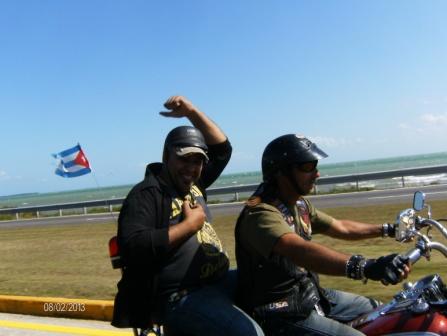
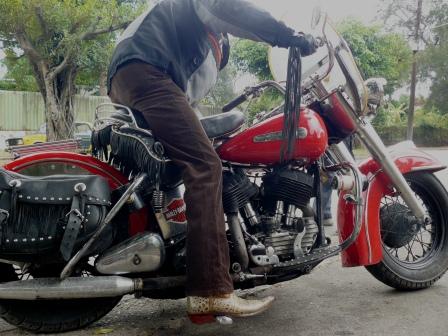
This is how I came across an $18 vintage Harley Davidson jacket. Little did I imagine all those years ago that one day I would be flying along the coast east of Havana on a 1948 Harley wearing that jacket (see note 1).

Seeds get planted, people. Cultivate them – however long it takes – and you shall see that flora flourish, I promise. The problem is, I’ve planted seeds I cannot tend alone – that are so profligate I can’t handle their abundance. When this happens, I write (to wit: this blog!). So while I had no intention of revisiting the Harley scene here at Here is Havana, my garden runs amok…

One of the 12 bikes Ive ridden on...

One of the 12 bikes Ive ridden on…

Some of you may have read my chronicle of last year’s Varadero Harley Rally/Encuentro de Harlistas Cubanos, my first taste of the HD world (save for one long mountain ride years ago, pre-vintage jacket, with a guy who couldn’t hold my attention). Long and short of that post about the Cuban rally? These pre-1960 bikes are impressive and the folks who keep them running and enjoy riding them more impressive still. When I was invited back for the second Encuentro, I was all game.

This year’s event was even better than last – for many reasons but the fundamental one for me was what occurred in the months between rallies: I’m now collaborating with Max Cucchi on his photography book about Cuban Harley riders. Since the 2012 rally, I’ve been hearing all the stories, learning the history, and interviewing the clan. I’m also riding on the bikes; 11 of them 12 of them to be precise and I anticipate trying out more (see note 2).

David Blanco, Harlista Cubano, musician, all around nice guy, rocks out the 2nd Encuentro.

David Blanco, Harlista Cubano, musician, all around nice guy, rocks out the 2nd Encuentro.

It’s true I cringed when that foreign photographer called me a bike dyke, but I have to admit it’s a hell of a lot of run riding on these thundering, troublesome machines. The thing is, riding can’t compare with driving and I know that’s where the real thrill lies (am I doomed to now accumulate a totally cool but not-at-all cheap piece of dust-collecting shit?!). Me acquiring a Harley Davidson is entirely theoretical since I can’t imagine abandoning my beloved bicycle and don’t have the money for anything motorized beyond a rikimbili (see note 3). But while interviewing Cuba’s only female Harley rider for The Book, she offered to let me take her 45 for a spin. Another seed planted, I’m afraid.

li and tony

I’m excited about The Book, in no small measure because it has opened up a whole new world to me, populated by extraordinarily fun, creative, and collaborative Cubans. Until further notice, however, I will be referring to this project as The Book. It had a proper title, which has since been relegated to a working title. Why? Because this is Cuba: things are complicated and being immersed in a rich, rare breed subculture like that of the island’s antique Harleys means being privy to all the gossip, tussles and intrigue therein. Good manners and my desire for everyone to get along prevent me from going into it here. Plus, I’m just the writer/rider so it’s best if I wait and see how it all shakes out. Until it does (in 12 months or so when we go to print), I shall be referring to this project simply as The Book (see note 4).

Cheito Puig, 103 years old and still on a Harley (he's featured in The Book).

Cheito Puig, 103 years old and still on a Harley (he’s featured in The Book).

Besides, none of that is important. What is important is that The Book has images by Max, text by me, and the passion of generations of Harlistas Cubanos.

Notes
1. There are no pictures of me en route, wearing said jacket, since my camera mysteriously disappeared the first night of the rally.

2. As I was readying this post for print a few days ago, I mounted my 12th Cuban Harley. The occasion was a beach BBQ with the gang – fun stuff. Unfortunately, the beast coughed, sputtered, and died two blocks from my house. During curbside repairs, the carburetor caught fire. ‘Socio, you got a fire going there,’ more than one passerby noted casually while eyeballing the red and chrome, leather-accented stallion. It took about an hour to get running again (watered-down gas direct from the Cupet seems to have been the culprit), but that was just the beginning of the 15-hour adventure. A key piece flew off as we flew down the highway; we had to stop at least have a dozen times to do repairs (correction: I watched as my driver and assorted others did repairs); the ‘suicide’ clutch kept getting stuck; and we ran out of gas at 1am in Centro Habana. I guess I’ve concluded the honeymoon phase with these Cuban Harleys…

Even breakdowns are fun in Havana!

Even breakdowns are fun in Havana!

3. These are bicycles outfitted with small motors, usually powered by a liter-and-a-half bottle holding kerosene.

4. Not to be confused with my abandoned memoir. Sigh.

14 Comments

Filed under Americans in cuba, Cuban customs, Cuban idiosyncracies, dream destinations, Expat life, Living Abroad, Travel to Cuba

Backstage at Carlos Varela (& Other Religious Experiences)

[tweetmeme source=”connergo” only_single=false]Hi folks. Remember me? It has been a while and I’ve missed writing for the pure joy and fun of it. But between meeting deadlines for MEDICC Review and A Contemporary Cuba Reader, working on the coffee table book Harlistas Cubanos with photographer Max Cucchi, contributing my monthly column to Insight Cuba, and other (marginally) paying gigs, I haven’t had a moment to muse or grumble.

I’ve also had to make time to start salsa lessons (apply axiom: ‘better late than never’) and check out some new places for inclusion in the app; arrange some badly-needed donations; give presentations to students on study abroad programs here; and get my game on in our weekly bike polo matches.

dancing

So Here is Havana has languished. And for the three readers anxiously awaiting news from my world, this post won’t help much since what follows wasn’t written by me – although I was integral in germinating the idea, playing momentary muse to the writer in question.

Dedicated readers (I’m assuming there are some, along with the aforementioned trio?!), will recognize this guest post for the anomaly that it is, a first, in fact, since I started Here is Havana in 2009. I have nothing against giving space and platform to other writers; indeed, it would take some of the pressure off me to continually produce original, interesting content. The thing is, I don’t often come across writing compelling or thought-provoking enough to include. About travel or love or politics in general? Sure, but not about Cuba. As you may have noticed, a lot of writing about this place is either didactic or dogmatic (‘preachy and screechy’ in Conner-speak), or simply too light – in detail, truth, analysis or characterization (see note 1) – and downright skewed. Sometimes I stumble across good writing and insight (e.g. Fernando Ravsberg), but about topics I’ve already covered (e.g. Cubans and their dogs; questionable fashion; the local penchant for piropos) or that requires laborious translating/editing.

This paradigm was shattered when poet, producer, and political animal Juan Pin Vilar read me his piece Backstage at Carlos Varela. He calls it a poem, but to me it’s more of a short story, complete with narrator, plot arc, conflict, and resolution (of a sort). This distinction sparked a writerly conversation about craft; what’s harder to write – short story or novel; and what characterizes each, to the visible boredom of the non-scribes in the room. I adore these kinds of exchanges since they make me feel part of a community of writers, something I longed for horribly, achingly for years here.

Compañero Vilar et al help fill this void and if more writing like Backstage at Carlos Varela, comes my way (especially from writers like Juan Pin who have no internet access), I’ll be happy to publish it. Already I can hear him yelling at me in his loud, but loving Cubano way: ‘CONNER! Deja la muela, vieja!’

The floor is yours, poeta (English translation follows original Spanish):

Backstage at Carlos Varela
Por Juan Pin Vilar
for Ernán and Wendy

La religión y yo nunca hemos tenido lo que se llama un romance, ni siquiera nos relacionamos como vecinos que intercambian tazas de azúcar. Sencillamente, nos queremos. Anoche, de algún modo, entramos en contacto sin tocarnos. Frecuentamos miradas, frases cortas y guiños, siempre manteniendo la distancia generacional. La religión es infalible como el tiempo, es el tiempo mismo si se quiere, pero yo represento la escupida de Dios. Con él intercambio ideas en momentos triviales, instantes en que nada trascendental ocurre. Extraño los espacios diversos y me detengo en la cima de la montaña rusa de Busch Gardens para pedirle que no me entregue. Que lo impida todo. Como aquella tarde, en Baltimore, cuando dejé olvidada mi chaqueta Levi´s sobre el promontorio blanco de Edgar Allan Poe.

La religión suele ponerse complicada mientras gotea como víctima. Es abstemia y la cultivan bebedores de sombras. Ahora que no bebo lo comprendo. La religión está en los labios de Yanina: en el silencio triste de su Patria. Quizás por eso, y por suerte, no nos debemos nada. Avanza por un camino diferente al mío, y aunque los dos conducen a La Habana, no puedo decir que coincidamos. La religión tiene todo el tiempo del mundo para memorizar. Tiene células de elefante. Pronto comenzará a olvidárseme el presente y todo será recuerdo.

_____

Religion and I never had what you’d call a romance; we weren’t even neighborly, borrowing the occasional cup of sugar. We simply needed each other.
Last night we connected in some way, without touching. Over and over again we exchanged looks, repartee and winks, forever maintaining generations of distance. Religion is as infallible as time; it’s time itself if you like, while I’m just God’s spit. With him I swap ideas, in trivial moments, flashes of time where nothing transcendental happens. I miss those varied spaces and stop at the top of the roller coaster at Busch Gardens to plead with him not to take me. That he stop it all. Like that Baltimore afternoon when I forgot my Levi’s jacket on Edgar Allen Poe’s memorial.

Religion itself is habitually complicated while dripping like a victim. It is abstinence bred by drinkers of shadows. Now that I don’t drink, I understand. Religion is in Yanina’s lips: it’s in the sad silence of her Fatherland. Maybe this is why, luckily, we owe each other nothing. It follows a path separate from mine and though both lead to Havana, I can’t say we agree. Religion has all the time in the world to memorize it. It has elephant cells. Soon it will begin to forget today and it will all be a memory (see note 2).

Notes

1. Many readers write in to tell me they like Here is Havana precisely for its lack of preach and screech.

2. I am an extraordinarily reluctant translator and only endeavor to do it – especially when the words in question are from other writers – when there’s no other choice. I welcome readers to submit a better translation…

7 Comments

Filed under Americans in cuba, Expat life, Living Abroad, Writerly stuff

Adventures of the Cuban Virgins: Part II

[tweetmeme source=”connergo” only_single=false]

We last left our protagonists – American musicians on the island for the first time – as they were figuratively deflowered by the temptress that is Cuba and literally robbed by her inhabitants.

With only 48 hours in country, they were already acquainted with water-borne bichos and explosive diarrhea; frolicked (and perhaps even fornicated) along the Malecón; and acquired groupies. In short, they were partying late, sleeping little, creating music, and making very merry.

The theft of the Fender bass after the Will Magid 4’s first Jazz Festival gig did little to dampen their spirits or enthusiasm for this place. On the contrary: the kind, well-equipped stranger who offered to loan us a bass for the next gigs only reinforced their admiration for Cubans and their ways.

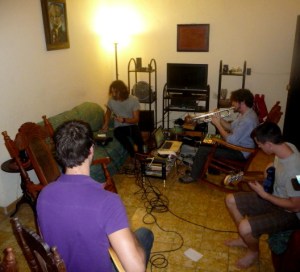
Before you can say ‘pass the planchao, asere,’ it was Friday, hours before the gig that had everyone hot and bothered. It wasn’t a festival event, the crowd would be small by design (we had to keep it quiet in the interest of crowd control), and we weren’t sure how the band would fit in the performance space. But after another rehearsal in my living room, all we could talk about was the Guagua Loca.

Box o rum, at the nice price!

Box o rum, at the nice price!

It’s not really called the ‘Crazy Bus,’ (see note 1); that’s my name for it because it is a little loco (and muy cool) this gutted bus packed with Havana’s best DJs making music and fun on its midnight tour of the city. To date, the Guagua Loca had only made one voyage; my guys were excited to be the first foreigners invited to play this innovative mobile music party.

Clearly, a jazz quartet has no place on the Guagua Loca. But while the Will Magid 4 was here to play Jazz Fest, they aren’t really a jazz combo at all, but an amalgam of funk and groove, sampling and swing drawing on musical roots from New Orleans to Ghana. This is music to boogie and have revelations by and after just one gig, Cubans were already gaga for their delicious mix of live and electronic music. And after meeting Iliam and Alexis, (collectively known as I.A. Electronica, the brain trust behind the Bus), the feeling was mutual. Hopes were high for Friday night’s adventure.

As the sun set and excitement swelled as big as the almost-full moon, the Will Magid 4 + 4 dribbled in from their day’s explorations. I waited until all were assembled to give them the news: the Guagua Loca was off. For reasons beyond our control or comprehension, it had been cancelled by The Deciders. I was at pains to explain it – maybe it was a little too loco for this place and time? Regardless, everyone – the Will Magid 4, the other DJs, and fans – was saddened by this turn of events. So we turned to rum for succor and set our sights on Saturday night’s Jazz Festival gig.

_____

We were running late for the sound check and I was tasting the bane of all music managers: organizing musicians is like wrangling cats in heat. When my phone rang at 4 on the dot and it was Wil Campa asking “Where are you? We’ve got the bass and are waiting at the theater,” I started to fret for real. The bass was locked in, but now we were missing the bass player.

At the beginning of this trip, if I’d had to bet who would go missing, show up late, or somehow leave us hanging, my money would have been on the drummer. To my surprise, Terry turned out to be the only one at our early morning meeting after partying all night and was settled behind his kit on time, every time, earning him a new nickname: Mr Professional. Adam, meanwhile, had taken to Cuba like a drunk to an open bar (despite the theft of his bass), and he was out mixing and mingling somewhere when we had a sound check and a Cuban musician of international renown waiting on us.

Smile on his face and jaba in hand, Adam sauntered up at about 4:05 and we rushed to pack ourselves into an almendrón to the Bertol Brecht Theater. True to his word, Wil Campa and his wife Tony awaited us there with a beautiful six string Rickenbacker they were loaning Adam for the night.

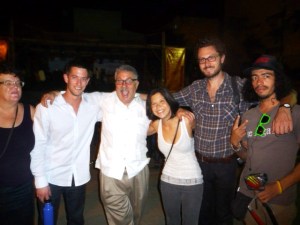
Tony, Adamm & Wil Campa, post-gig

Tony, Adamm & Wil Campa, post-gig

“Please, please, please don’t let this bass out of your sight,” Tony implored.

Slipping the case on to his back, Adam said: “don’t worry, I won’t.”

After kisses and hugs all around, our saviors sped away in their late-model BMW to shoot a music video in the setting sun.
_____

The room was big and a few of our tribe were still suffering from bouts of explosive diarrhea forcing them into a step we’d dubbed ‘the clench and scurry.’ If you’ve ever been to a theater anywhere in Havana, you know how apocalyptic/toxic/disgusting the bathrooms can be. But everyone took this in (scurrying) stride, as they did all their Cuban experiences, from cockroaches in the bedroom to stolen instruments and cancelled gigs.

The Will Magid 4 set up – live electric bass and guitar, drums (with some sort of electronic component I never did grok), trumpet, MacBook, and sequencer – was presenting problems during the sound check. There weren’t enough outlets and we didn’t have the right adapters. We were short a few cables and there was a false contact somewhere between the amp and bass obligating Adam into his own dance and scurry. Little by little we worked together to get it together, but everything was running late and the 25-piece college ensemble following us fiddled with their instruments, anxious to get their sound check rolling. After a few false starts, things were finally set and I took a seat alongside Will’s parents. The first notes erupted from Will’s trumpet and I started to relax when suddenly everything went dark and silent.

Blackout.

Dios mío. Would Cuba pull any punches for these guys?

I followed Emilio, the laid back runner-of-things at the Brecht, onstage. In trembling sotto voce I asked: had the group’s rig blown the circuit?

“Some cables are down,” he explained. (Whew). “The electric company is on their way. Chill out for an hour or so with some beers and I’ll call you when we’re back online.”

Will packed up his Mac, Adam shouldered “his” bass, and we stowed the rest for safe keeping. After a couple of lagers and lively conversation with some Cuban musicians who told me there are only 8 or so fretless Fender Jazz basses in all of Havana (I will find you cabrón, whoever you are) and that both Carlos Varela and Liuba María Hevia had both suffered thefts of their guitars (the WM4 was in good company), Emilio’s call came through: llegó la luz; haul your asses back.

Once there, the sound check went quickly, I bought Emilio a Bucanero, and we cut loose until showtime. In spite of all the mishaps and low level stress (mine, not theirs), energy and hopes were high for this gig. It was indoors, so the sound would be better that at the previous show and we’d done a lot of publicity to get a good crowd. I’d set up two interviews for Will and invitations had already been extended for their return to Cuba.

_____

The Will Magid 4 went on after the talented Jorge Aragón Trio and though the crowd was thinner than we’d hoped, the potential was palpable. I prayed to whomever listens to me – that is, no one in particular – for good sound and functioning equipment. I knew the rest would be superbly attended by the four guys on stage.

WM 4 ADsmall

By the end of their first number, feet were tapping and heads bobbing as the audience got into it. The last notes of Cuban Swing were winding around and down when suddenly everything went dark and silent.

Blackout. (‘Shit!, again?!’)

“Thank you all and good night,” Ethan said into his mic, unplugging his guitar.

“¡Qué lástima!” Terry exclaimed, using his new favorite phrase.

Once again I followed Emilio onstage.

“Leave your rig and gear hooked up. We’re checking on the problem and you guys’ll continue once it’s solved.”

Will looked at the band, lit by the beam from Terry’s iPhone.

“I saw a stand up bass backstage,” Adam ventured.

“St James Infirmary. Acoustic. Let’s do it,” Will said.

And there in that dark theater, the quartet – now a trio as Ethan held the iPhone up high for light – gathered in close. Will began teasing out the first notes of what turned out to be the most soulful and novel version of that jazz-blues standard ever heard on these shores. The Cubans in the audience sat stunned and smiling. Emilio caught my eye with his big thumbs up and nothing could keep my goose bumps down. The notes from Will’s trumpet trembled and leapt through the dark in a visceral eulogy to life’s lost love. The rhythm section paced our emotion, carrying us through one of those impossible to plan and hard to forget only-in-Cuba moments.

It was musical alchemy. The band knew it. The audience felt it and we had the talent and solidarity, dreams, hard work and dedication of so many people, strangers and friends alike, to thanks. It was magic not unlike Cuba itself.

As the last stanzas enveloped us, the band was suddenly, glaringly, bathed in light.

Llegó la luz.

“Can’t we have a little more blackout?” someone in the audience asked.

They finished their impromptu number, Adam traded the stand up for the Rickenbacker, Ethan plugged in and the Will Magid 4 played out their set to a dancing crowd – small, but exultant.

2013? I’m chasing more musical alchemy. Won’t you join me?

My deepest thanks and respect to Will, Adam, Terry, Ethan, Larry, Patti, Julie, Josue, Wil Campa, Tony Massolin, I.A. Electronica, and all the organizers of Festival Jazz Plaza 2012 for helping make my dream of bringing US musicians to Cuba come true.

Notes
1. It’s real name is the ElectroBus; look for it.

1 Comment

Filed under Americans in cuba, Cuban customs, Cuban phrases, cuban words without translation, Expat life, Living Abroad, Travel to Cuba

Adventures of the Cuban Virgins: Part I

[tweetmeme source=”connergo” only_single=false]Honeyed, late-afternoon rays streak down Línea illuminating two men, each carrying a conga in one hand, a cajón in the other. An old Dodge, Ford, then Buick rumble past a tattooed youth helping a blind woman across the street and the smell of baking bread lifts even the darkest mood.

“Can I stay here forever?” the bassist asks so soon after arriving I haven’t yet learned his name.

“Slow down, caballero. You haven’t even been here a night and day. Let’s talk tomorrow.”

I am anxious about this visit: somehow, I’d convinced eight complete strangers to come to Cuba and I’m not sure how they’ll handle it (not everyone can). I know Will in passing – the raison d’être for this descent of California talent upon Havana for the jazz fest – but at this point, the rest are simply the guitar player, the drummer, the bassist, the girlfriend, and the parents. Months in the making, this visit is a dream realized for me: ever since my first trip here in 1993 when Cubans across the island begged me for Kenny G cassettes, I’d felt a moral obligation to share with them higher quality sounds from my patria. This was my chance, but I’d never been involved in a music festival beyond being in the audience – enthusiastically, deliriously, but still.

What was I thinking?!

I didn’t grow up in a musical home and don’t play an instrument. While I’d love to learn to play guitar, until now, I’ve only collected guitarists. I envy the universality, the pure luxury, of music: as a writer, I’m limited to (mostly) one language, but ripping through a riff or pounding out a rhythm needs no translation to move your audience. Despite my vicarious relation to the craft, I’m convinced music holds some key to happiness. When a friend took me to see an act he manages in San Francisco, that key met tumblers and things started to click. With a surfeit of talent and energy and plenty of solos to go around, the Will Magid Four (see note 1) created a transformative, happy conversation between musicians and audience. I knew these guys had to play Cuba.

Will Magid: doing that voodoo that he does so well.

Will Magid: doing that voodoo that he does so well.

This I how I find myself waiting for eight strangers at Terminal 3. I had worked hard to square away details for their participation in Jazz Plaza 2012 – probably doubly so since I’ve never been on the organizational end of music before and this is Havana after all, where things are often needlessly, maddeningly difficult. To boot, only two of the eight had ever set foot in Cuba prior. The potential for disaster is high. Even as they do their first sound check, I’m still not sure it will come off – there are technical and electrical problems, the guitar player is laid flat by explosive diarrhea, and organizers are quietly voicing anxiety about the upcoming show to no one in particular.

But when the eight of them pile all their gear, luggage and laughter into the mini-van from the airport Cuban clown-car-style, I know my misgivings are misplaced. Grossly so: by the end of that first night, I’m marveling at how these folks roll with the Cuban flavor. When I lay out possibilities and options, they choose cajitas over paladars; 10 peso maquinas over hard currency taxis; Serrano over Cubita in the never-ending flow of espresso, and forgo sleep for fiestas. When Adam (AKA “Bass Face;” see note 2) sits down with cardboard, scissors, and glue to fashion sleeves for his CDs he’s giving away, I wonder what strange twist of fate dosed these folks with Cuban blood. It’s not only me: highballs of Havana Club in hand, they fill my apartment with such sweet sounds, my 8-year old neighbor sits rapt throughout the rehearsal whispering to me: ‘Conner! We don’t have music like this in Cuba!’ When I ask if he likes it he replies ‘Yesssssss!’ with a swivel of his hips.

Rehearsal in my living room, Will Magid 4, Havana

Rehearsal in my living room, Will Magid 4, Havana

“I love this city,” Josue would say randomly and repeatedly over the course of his stay. He spoke for himself, me, the group and probably you, if you’re still reading this.

_____

On the day of the first gig, we’re one credential short and every member of the group has spent their pre-dawn, post-party hours sprinting to the baño with crippling diarrhea, fever, and sleep-robbing nausea. Julie projectile vomited a couple of times and Ethan isn’t going anywhere. While this would be enough to sour the experience for most, I’m hunting down another credential, we’re taking Ethan’s guitar to sound check, and those still standing pop some ‘cork you up’ pills courtesy of my neighbor. The rest we tuck in with chamomile tea and crackers, hoping they’ll rally by nightfall. I counsel them to slow down a notch, go easy on the rum, and to eschew 5am batidos from now on. ‘No one can party ‘til pre-dawn for five days straight,’ I tell them (in this, I am proven quite wrong). With nothing left to do, we set out for the sound check.

We flag a maquina, load in the gear, and arrive at the Casa de Cultura a lo cubano. After some questions and clever resolving on the part of the venue’s crew – few here know how to hook up and mix a sequencer and Macbook with live players – the sound check goes off without a hitch. In the middle, Ruben, the artistic director, sidles up beside me and says ‘these guys are amazing.’ I agree, pointing out that not only are they stellar musicians but humans as well: Adam is donating his Fender Jazz Bass once the Festival is over and the group brought an entire suitcase of medicines and hard-to-get items to leave behind.

Patti, Adam, Larry, Julie, Josue & El Loco - faces alight post-WM4 set.

Patti, Adam, Larry, Julie, Josue & El Loco – faces alight post-WM4 set.

It doesn’t matter that the huge screen behind the stage says ‘Will Magio 4’ or that the crowd is thinner than expected. Terry would like a few more minutes to get his gig head on before getting behind his kit and I imagine Ethan is willing his sphincter into submission. In spite of it all, they exuded an equáname – a Cuban kind of go-with-the-flow – I very rarely see in North American visitors. Will leads the band in this and every sense, deftly maneuvering from sequencer to laptop to trumpet with magisterial ease and intent. Although their set is absurdly short, they win hearts and minds with their infectious energy and earnest words – in Spanish – for this opportunity to play in Cuba.

L-R: Terry, double fisting the double economy, Mayabe in one hand, Havana Club in the other; Will, fetchingly pensive; Julie, her smile says it all; and Ethan, seeing the light after a knock-down, drag-out fight with the porcelain god.

R-L: Terry, double fisting the double economy, Mayabe in one hand, Havana Club in the other; Will, fetchingly pensive; Julie, her smile says it all; and Ethan, seeing the light after winning a knock-down, drag-out fight with the porcelain god.

Bottle of Havana Club in hand (with a splash for los santos first), they join the crowd after their set to dance and swing to Wil Campa, the night’s headliner. I have never heard of this Pinar del Río artist and his Cuban music extravaganza, but from the looks of his late-model BMW, he is well known beyond these shores.

Already the WM4 rhythm section is making time with the ladies and a smiling Will is passing out discs. We dance and drink and soak up the Cubanía in a mutual love fest, while ‘El Loco,’ a friend from bike polo, gets it all on video. I feel my musical sixth sense being validated: I didn’t know why these cats had to come play Cuba, but knew magic might happen if they did.

El Loco and Terry, his 'brother from another mother'

El Loco and Terry, his ‘brother from another mother’

When we stop to care, it’s 1am – time to move on to the next fiesta. Little by little we move equipment, band, and ‘frens’ (see note 3) to the sidewalk and talk about where to go and what to do. Adam is the last to saunter out, his Bass Face, traded long ago in for his Cuban perma-grin.

“We ready?” he asks looking from face to beaming face, lingering on the torpid eyes of the mulata by his side.

Vamos!” we sing out.

“Where’s your bass?” someone asks.

He looks around expectantly. The group looks around hopefully, but I know. In the euphoria of their debut set, combined with the sassy, brassy salsa of Wil Campa, and the dancing frenzy fueled by 7-year old rum, ladrones had struck: some cheeky Cuban walked with that fretless Fender bass. I watch the Festival come to a screeching halt for the Will Magid 4.

“I don’t know where to get a bass on such short notice,” I say when someone suggests it.

“You’re not going to see that bass again,” one of the Insta-Groupies adds unhelpfully.

Feo, feo, feo,” one of the Cuban musicians says shaking his head.

Ugly indeed and I feel completely responsible. I could and should have warned them of certain dangers and risks.

“Well, I made the donation,” Adam says, taking the theft in elegant stride. “And at least I know it will get to a musician who needs it.”

Just then, a chic woman appears speaking perfect English, asking what happened. At her elbow is a good-looking blond guy with ojos claros nodding along with the growing crowd of musicians as she explains Cuban realities and how robberies spike at the end of the year. Feeling responsible for the mierda that has gone down and remiss for not warning them, I wonder aloud how they’ll play their next gigs.

“I’ll loan you a bass,” ojos claros says with authority.

“This is Wil Campa. I’m his wife Tony,” the chic woman explains. “Here’s my cell – call when you’re ready to sound check tomorrow and we’ll bring it by.”

My heart swells and I swoon – once again – for this island where one minute you’re the victim of a robbery and the next the recipient of generosity and solidarity unparalled.

The show (and party) would indeed go on…

Stay tuned for Adventures of the Cuban Virgins Part II.

Notes
1. The line up stateside is actually the Will Magid Trio, but grew to four, plus four, for the trip south proving the Cuban mantra: the more the merrier.

2. By the end of the trip, most everyone, (again, getting their Cuban on), had a nickname: Terry is “Fancy LA,” Josue is the “Dairy Fairy,” Adam is “Bass Face/Rubiocito,” Ethan is “Emerson,” and Julie is….in solidarity with my rock ‘n roll sistah, I will not reveal the nickname pinned on her the last night.

3. A good band always attracts hangers-on and it doesn’t surprise me that within 48 hours, these handsome/talented/foreign musicians are surrounded by pretty/charming/bored Cubanas.

17 Comments

Filed under Americans in cuba, Cuban customs, dream destinations, Expat life, Living Abroad, Travel to Cuba

Queer Cuba

[tweetmeme source=”connergo” only_single=false]
I’m what’s known in the vernacular as a ‘fag hag.’ It was not choice, calling or custom that threw me into the gay orbit at an early age, but rather a fortuitous convergence of nature and nurture. My family is peppered with homosexuals and my oldest brother loved to tell us of his escapades with The Eagle Scout, The Priest, and The ‘Straight’ Guy. As a tween, I was already accustomed to seeing men kiss and knew about the dark and personal horrors of the closet (from the likes of The Priest and Eagle Scout, not my brother who was loud, proud, and occasionally obnoxiously, gay; see note 1).

I’ve been to leather bars, bear bars, piano bars and clubs where the dress code is naked and go-go boys dance in cages. I remember one of our tribe – the hottest, most coveted among them – telling me he wished he was straight so he could get with me. I love the humor and the hubris, honesty and fashion/design sense of my gay friends. I go to them for sex tips and appreciate having escorts who won’t try to grope me. They throw the best parties and usually have kismet with the downtrodden, being an oppressed group themselves.

By way of context, I’m talking about pre-AIDS New York City, when there were still dungeon clubs and working “girls” in the offal-slicked streets of the Meatpacking District (see note 2). Back then, bath houses called on gloomy days and condoms were for breeders. But most relevant to this post: straight girls like me were part of the gang.

This wasn’t the case in San Francisco where I lived for seven years after NYC. The queer scene there, to me, felt hyper segmented, with gay men, women, and everyone everywhere along the sexual diversity spectrum siloed in their individual worlds. It smacked suspiciously of tolerance, a weak and non-sustainable stand-in for the unity and community I’d known in New York.

Back here on this island, I’m happy to report that years of tireless, often unappreciated and highly criticized, work by CENESEX (headed by Mariela Castro), the HIV-STI Prevention Center, El Mejunje, advocacy groups like GPSIDA, MSM (Men who have Sex with Men), and the straight allies who support them, is gaining traction.

sorry girls Im gayteeny

Nowadays, men hold hands in public (in Havana anyway), transgendered folks go shopping, clubbing, and to work as their real selves and there are more and more places for the community to convene (see note 3). And every year, Cuba’s International Day Against Homo/Transphobia grows bigger, more fabulous, and better focused. Last night, I attended the World AIDS Day gala which was as sexy, saucy, and talented as you’d expect of this place and the theater was SRO with the entire rainbow representing. I hesitate to say it’s a movement which is a bit of a dirty word here, but I’m heartened to see my queer friends and compatriots finding their stride. It feels like pride, but that’s another questionably good concept in the Cuban context since it implies superiority of one group over another and replicates hegemonic constructs they’re trying to break down and through.

But there’s rhetoric and there’s reality and as the wave of sexual diversity rolls towards a crest, I’m asking myself: will it manifest like NY, SF, or something altogether different? The evidence is conflicting, the analysis complex, and even after talking to lots of friends – gay, straight, and in between – from here and away, I’m still not sure where all this is going. But here are some factors at play in gay Cuba:

The Machismo Hydra – Once again, the scepter of male dominance and perceived superiority rears its ugly head (no pun intended) and underscores human relations here. I’m fairly certain this is part of the reason gay men have more visibility, mobility, and are more tolerated (there’s that sticky wicket again) here than gay women. Just yesterday I overheard this exchange between four friends hanging around their Lada slinging back Bucaneros: “who care if there are fags there? Deep down we’re all fags” (see note 4). The underlying meaning? Men-on-men action is not only within the realm of possibility – no matter how subconscious – but could even be desirable. Is it the power two men together represent, the simple carnality of it? Is it a way to neutralize machismo in an effort to liberate mind and body somehow? Once again, I’m not sure, but while a Cuban guy can say ‘deep down we’re all fags,’ chances are high that same fellow would say of a lesbian: ‘she just hasn’t had the right macho’ (and immediately propose himself as the one to convert her). Almost to a one, lesbians here, foreign and Cuban, have confirmed my impression that a) it never occurs to most men here that a woman can only be into women and b) once they know, it’s simply a question of ‘having the right macho’ to show them what they’re missing. What’s more, lesbian friends often mention the discrimination, including derogatory terms, leveled at them by gay men. This is troubling.

alejandra

The DINK Phenomenon – DINK stands for Double Income No Kids and savvy marketers have long carved out a niche among gay men who on the whole have more disposable cash and fewer familial responsibilities than straight and lesbian couples. So it’s no surprise that many of the loveliest, most successful new bars and restaurants here are owned and operated by gay men – out and not, it’s worth noting. This is great – the boys are cute, the décor classy (or camp), and the food and drink of high standard. I’ve had memorable times at several gay-owned establishments. At a few however, the vibe is decidedly cold shoulder, reminding me of San Francisco, i.e. you’re not one of us, but we’re running a business so we’ll put up with you. Again: troubling.

The Generation Gap – The older I get, the more I understand how age affects human relations, which is one of the reasons I so energetically nurture relationships with people of all ages. Queer relations in Cuba are no different. Talk to a gay men of 60 here and you’ll get a very different perspective from that provided by the 20-something set. The younger generation generally, has a much more open and organic take on sexual diversity – regardless of gender. I remember one night at the Cine Club Diferente film debate here when an elder gay icon stood up and expressed his opinion on the gay politics reflected in the film and its relevance to Cuba. He was followed by a young university student who said he respected the older gent’s opinion and experience, but didn’t share them. And then he told the story of arriving at his dorm the first day of school and telling his roommate: ‘I want you to know I’m gay and if you have a problem with that, we’ll have to make a change.’ The other fellow had no problem with it, they became roommates, and remain so a couple of years on. Meanwhile, young women are increasingly experimenting with other women and although a friend assures me this is just a fad, I have to ask: And? Even if it is a fad – one of those ‘yeah, there was that one night with a friend in college’ type things – doesn’t it open people’s minds, expand their horizons, and break down bias?

Of course, all of this has to be couched in the Cuban context, where there’s a housing crisis, with its attendant lack of privacy (keeping many folks in the closet); salaries are absurdly low (affecting entertainment options, autonomy, and a whole host of other issues related to mental health); and sexually diverse people have experienced very real discrimination. And while friends from the States tell me all of this (i.e. the discrimination, alienation, confusing orientation with preference, etc) sounds familiar, I do think it’s substantively – at least legislatively – different here. Voters in Villa Clara have just elected their first transsexual public official for example, gender reassignment surgery is provided free for those who qualify, and same sex unions will soon be legal nationally.

I guess what I’m trying to say is I love gay culture and sensibilities and while I don’t know where we’re going, I hope to continue to be a part of it. Remember: though we may be straight, that doesn’t mean we’re narrow.

Notes

1. Is that politically incorrect? You let me know, but those who knew Bruce know he could be obnoxious – charmingly so, but obnoxious all the same.

2. R.I.P. My last Giuliani/Bloomberg nerve snapped when I dared to venture down to my old stomping grounds around Little West 12th Street last year. I never thought I’d see New York go generic, but there it was; it could have been Any City U.S.A. (Yes, I’m bitter about “progress” in Manhattan).

3. My Havana Good Time app has a dedicated LGBT category if you’re interested.

4. As with all things, conversations, and events related at Here is Havana, this is 100% true.

21 Comments

Filed under Cuban customs, Cuban idiosyncracies, Expat life, health system, lonely planet guidebooks, Relationships, Travel to Cuba

Havana’s Happy Ending Massage

[tweetmeme source=”connergo” only_single=false]
Next to a full-blown orgasm, there’s nothing more relaxing than a full-body massage in my book. A good massage even beats out great masturbation if you ask me, and while I’ve had massages in places as far flung as Hawaii and the Bronx, Guatemala and the Yucatán, I’ve been reticent to explore such carnal (albeit platonic) pleasures in Havana. It’s not a question of cost – a full one-hour massage is as little as $10 here – but rather the 1-2 combo of Cubans’ notoriously lascivious nature and a rabidly jealous Scorpion husband (see note 1). Who knew what would go down on that table, yours truly lying there nude, a strange man’s hands roaming all about?

But recently, a different 1-2 combo struck, sending me to that table: first, the need for release and relaxation was too pressing to ignore and then a friend opened a full-service spa. Permissible under Cuba’s new consumer capitalism regime, this privately-owned spa is in a privileged corner of an upscale neighborhood and offers everything from spinning classes and yoga to Brazilian wax jobs and microabrasions.

It seemed like the golden opportunity to invite the strong, well-oiled hands of an unknown Cuban macho to get acquainted with my body…

But before getting down to the nitty gritty, I wonder what you imagine when you hear the word ‘spa?’ Is it some oasis serving cucumber water and salmon/watercress baguettes on Little Palm Island? Or a strip mall in the Valley specializing in waxing, wrapping, threading, and peeling? Whatever images the word ‘spa’ conjures in your corner of the world, I bet it’s nothing like what we have in Havana.

All of the spas I know here (see note 2), are mansions or grand homes at least, with living rooms converted to fully-equipped gyms, bedrooms repurposed for Pilates, and closets retrofitted as saunas. My friend’s spa falls under this rubric, though as educated, well-traveled and cultured as she is, her spa is mucho más allá, offering nutrition consultations, medicinal plants for sale on the landscaped patio, and self-defense classes for women.

Bright, clean and spacious, the spa was welcoming but exuded the contradictory energy typical to Cuba at today’s crossroads: phones rang, appointments were made and administrators made sure it hopped with the hustle and bustle of a profit-making/seeking enterprise, while employees sat around picking their nails and contemplating their navels.

I was shown to a Swiss-clean room with AC, professional massage table, and linens monogrammed with the spa’s logo. In the gleaming, marble bathroom, I was instructed to change into the robe provided. Just then, the masseur appeared. I’ll call him Henry. He was big not wide, which was good, and had the sculpted muscles of a gym rat, nicely displayed in a skin-tight wife beater. Except for his braces (adult orthodontia is big here), he was easy on the eyes, which is neither here nor there since my baby blues would be closed, but like having an unattractive or downright ugly gynecologist, it never hurts. Henry had the smooth, lustrous skin privy to youth and would be considered a hottie by anyone’s standards.

Expectations for popping my Cuba massage cherry were high…

I assumed the position face down on the table and Henry spoke the only words he’d utter to me over the next hour: “would you like your gluteus and breasts massaged as well?”

Wait, what?! I was sure I’d heard right, but was struck dumb for a second as yells of “you can do it señora! Feel the burn!!!” bellowed through the thin walls from the spinning class next door. My mind flew into high gear, considering his query:

– Is a tit massage standard procedure?
– Had I ever even been asked this before by a professional masseur?
– Do boobs even have muscles to massage?
– If the answer to the above questions is no, was there a hidden subtext?
– If I answer yes to the tit kneading, does it open the possibilities for a “happy ending” which, considering the cut of Henry’s jib, wouldn’t be the most unpleasant thing to happen to me today?

“Just the gluteus,” I told him when I’d regained my senses. He got busy.

Things started off suavecito, suavecito and my first thought was ‘Is this a massage or foreplay?’ It was too light and fluttery, nothing that would route out my many sore muscles and overworked tendons. ‘Maybe he’s just warming up,’ I reasoned.” But he kept on killing me softly, even on both feet, committing that all-too-common infraction: neglecting the feet in massage quality and quantity.

When it became clear Mr. Muscle wasn’t going to apply himself, I sucked up the string of drool crawling across my cheek and said: “please: do it a lot harder.” And I think he tried – for half a calf at least, but then lapsed back into the massage mode I call “How to Relax Housewives and Pleasure Slackers.” I imagined him learning the techniques at an intensive weekend workshop somewhere bucolic like Las Terrazas or Viñales. Needless to say, this masajito was doing nothing for the knots tucked deep beneath my shoulders and my related stiff neck. Henry’s approach released no toxins and alleviated stress for about as long as takes you to finish reading this sentence.

His hands were big and strong and my mind’s eye saw them kneading whiter skin than he had probably ever touched. ‘Litro de leche’ Cubans often call my skin tone – not always in a good way. When it came time for me to turn my lily white self over, the draping acrobatics commenced. Since I’d declined the boob massage, he had to flip me while keeping both my genitals and chest strategically covered. He was fairly deft at it, though somewhat mechanical, and I imagined a full third of that weekend workshop in Viñales dedicated to ‘How to Drape Your Client without Exposing Popular Erogenous Zones.’

I asked him once again to put more oomph into it, but he didn’t. I resigned myself to the fact that my mind and body were not going to attain any bliss today. Just then there was a knock on the door; a muchacha entered asking if she could leave her bag in the massage room. Busting in on a naked (albeit draped) me didn’t really rankle: I was used to people barging in here – during couples’ therapy, on the toilet, in the throes. Privacy in Cuba is one of the island’s enduring oxymorons and one you have to cope with if you fancy spending large amounts of time here.

My faux/flojo massage was almost over and I realized the only happy ending was for Henry, when I left him a nice tip – just for trying.

Notes
1. In 10 years here, most of those covering the health system (where almost all massage therapists train and work at some time), I’ve never met a female therapist – something which I predict is going to change fast as more foreigners drop into Havana’s day spas.

2. Watch for my upcoming article on Havana’s spas and their inclusion in the next update of my Havana Good Time iapp. It’s worth pointing out that there are both state-run and privately-owned spas here now.

48 Comments

Filed under Americans in cuba, Cuban customs, Cuban economy, Cuban idiosyncracies, Expat life, health system, Living Abroad, Relationships, Travel to Cuba

La Bola en la Calle: Crime in Cuba

[tweetmeme source=”connergo” only_single=false]

“He killed it! And I love this venue,” the young Cuban American says leaving the Jardines de la Tropical where Carlos Varela has just played a rare Havana concert.

“Yeah, way better than when we saw him in Miami,” his friend responds.

“Totally. And it’s so obvious we’re in Cuba: look at all the rejas.”

Gems like these are why I’m such an avid eavesdropper: whatever differences there are between here and there, the one warranting comment is the Cuban mania for throwing up gates and bars around their homes.

If you’ve been to Havana, Santiago de Cuba or anywhere in between, you’ve seen this obsession Cubans have with enclosing their homes with iron bars. They’re cages, literally and figuratively, and are poignantly ironic as a result – so many people carp on about ‘freedom’ here, while locking themselves away in jails of their own construction.

Home robberies do occur, there’s no doubt, and the Puentes Grandes section of town where Varela played fairly beckons ne’er-do-wells: it’s dark, isolated, and provides many easy escape routes. But the disconnect between the real and perceived threat is aggravated by various factors including press coverage (there is none); the Cuban penchant for, and reliance upon, gossip for information (loosely related to the first factor); and our human tendency to place an inordinate amount of importance on Stuff.

Our first home here – a charmless microbrigada box in the industrial outskirts of town – had a small balcony, for which I was thankful, except it was enclosed in a cage. For me, there was no stronger metaphor for a bird with clipped wings and will than looking out from that barred balcony. I tried not to think about it too often, but ended up not using the balcony much at all. That cage mitigated any levity my soul derived from the semi-outdoor space it provided.

But after a decade of watching people struggle to amass money to put up bars (see note 1) and as much time puzzling over the rich and contradictory Cuban psyche, I feel driven to write about theft, safety, paranoia, and protection of stuff here and why I think the Cuban perception is skewed.

There’s no evidence: Have you ever seen crime statistics for Cuba? Me neither. I’m sure they’re collected – after all, the data-laden ONE (Oficina Nacional de Estadísticas) amasses stats on everything from new HIV cases and teacher:student ratios, tomato harvests and tourist visits – but crime is neither reported on nor published. Is crime up? Maybe, if you believe the bola en la calle, AKA what’s being said in the street. But then you’d be violating one of my top Cuba rules: if you haven’t seen or experienced something here firsthand, it’s best to assume it’s false or fabricated (or at the very least exaggerated) until proven otherwise. Indeed, if I believed everything I heard here, I’d be writing about cooking oil made from cremated bodies; JFK’s bastard Cuban son; condom cheese; and the government’s plan to spend nearly $400,000 converting all license plates from American- to European-style. Rumors, nada más, which will remain so until evidence confirms or disproves them.

What my experience tells me is that house theft is not nearly as common as Cubans believe. In over a decade here, I know three people who’ve had their homes robbed. In each instance, no one was hurt, thankfully, though all were home at the time. In only one of these cases was the perpetrator caught; in none of the cases was property recovered. Three robberies in 10 years hardly argue for a generalized wave of house break-ins (see note 2) requiring enclosing your home in bars.

Paranoia, it’s epidemic: In reply to my query about government policies regarding this and that, a dear friend explained: “half of the paranoia is based on experiences of concrete, unrelenting and strategic attacks on the country from without and within. The other half is straight up paranoia.” The Webster Collegiate Dictionary defines paranoia as ‘a tendency on the part of an individual or group towards excessive or irrational suspiciousness and distrustfulness of others.’

Based on my experience with everything here from bureaucracy to busy body neighbors, I’m on board with my friend’s assessment: there are some very real, tangible threats to protect against and there are the imagined ones. Something else my experience tells me is that paranoia is contagious. From day one, all of my neighbors, both in the aforementioned barrio on Havana’s outskirts and now in Playa, have urged me to padlock my front door gate, locking myself inside, especially at night while I’m sleeping.

But I’ve never done it: in my mind, the way Cubans smoke, fire is a much bigger threat than robbery (see note 3), and I’d rather be burgled than trapped inside a blazing building. Recently, a friend slept over after a party and locked up the house after I’d gone to bed. I was amused, but not surprised, to find upon waking that he’d padlocked the front door. What wasn’t funny (and gave me great pause) was, the following night, for the first time in a decade, I padlocked that gate, thinking ‘an ounce of prevention….’ Yet, when that prevention is based on rumor and paranoia, is it really worth it? And how about when the preventive measure generates another danger, in this case rendering my house a fire trap? Needless to say, that was the first and last time I padlocked my front door but it taught me an important lesson: paranoia is a disease, easy to catch.

Friends impose this same paranoia regarding my preferred mode of transport: constantly, I’m urged to be extremely careful on my bike, to the point of not riding at night, ever, because I risk being jumped and the bike ripped from between my legs. While I recognize that someone desperate (or stupid; see next point) enough might attempt this, I’ve never heard of this happening here. Have you? The more people tell me this, the more I think it’s an apocryphal holdover from the Special Period.

I’m was born and raised in New York: My friends from Centro Habana scoff when I tell them this, rejecting it out of hand as any kind of mitigating factor vis-à-vis crime against my person or property. ‘This is Havana, it’s different,’ they invariably say. My first inclination is to say: ‘hell yeah, it’s different!’ and then explain the armor and mechanisms one is forced to develop waiting for a New York City subway on an abandoned platform deep underground circa 1986 when wild-eyed crack hos, male and female, roamed and robbed violently, desperate for money for more rock cocaine.

You needed mad city skills in my New York of yore, I want to explain, but refrain. I don’t tell my Centro Habana friends about walking in the street – never on the sidewalk – in dark, decrepit neighborhoods to improve your visibility and sightlines and lessen the possibility of being jumped or cornered, nor about turning rings inward or forsaking jewelry altogether to decrease your chances of being marked. Although I don’t offer tips like ‘never leave a backpack in a locked car,’ sometimes I wish I had: my stepson made this rookie mistake in Madrid last week and was robbed blind of his laptop, passport, plane ticket and more. Likewise, I don’t explain the very real difference between walking streets where you know people are armed with guns and those where someone may have a knife – but probably not.

I also don’t share my experience of 18 months of self-defense classes where I learned tactics for what to do when jumped, pinned or attacked, at gun or knife-point, or with bare hands. With their belief in la bola, combined with paranoia and lack of firsthand knowledge of what constitutes real and constant threats, what would be the point? Besides, it reeks of mala brujería to talk about it: I don’t want to jinx myself and have to put those skills to the test.

¿Conclusión?

Cubans have an unrealistic measure of what crime looks like outside their door, down the block, across town and overseas (see note 4). The question is: does it really matter? Isn’t this just a chronicle of life in contemporary Cuba? Possibly, except I’m worried about what relying on la bola about crime will mean as we move forward with current economic reforms. As inequalities deepen – and they are, as I type this – and crime begins to climb, as it tends to do when the rich get richer and the poor get poorer, won’t it be helpful for citizens to know exactly what their playing field looks like?

Notes

1. Even more than renovated kitchens and bathrooms, the first home improvement Cubans make is erecting rejas on windows and doors.

2. Ojo: Note that here I am referring only to home robberies and how they correlate with barred windows and doors, not opportunistic theft of bicycles, chain and purse snatching, etc.

3. One friend of mine has fallen asleep not once, but twice, while smoking, torching his mattress in the process. Despite having escaped unscathed, he continues to smoke and nod off; I have the burnt furniture to prove it.

4. This intrigues me even more still since part of the reason for this skewed perception is lack of press coverage of crime here. But you see the same exact fear and paranoia in the US due to too much press coverage and the generalized media strategy of ‘if it bleeds, it leads.’

53 Comments

Filed under Americans in cuba, Cuban customs, Cuban economy, Cuban idiosyncracies, Cuban phrases, cuban words without translation, Expat life, Living Abroad, Travel to Cuba

Apretando Mi Corazón: Cuban Emigration

[tweetmeme source=”connergo” only_single=false]

All my friends are talkin’ about leavin’, about leavin’

So goes the little pop ditty in heavy rotation on one of the satellite radio stations I favor. I’d bet my life Cuba never crossed the songwriter’s mind, but it so easily could have been written by my friend Alma, my prima Anabel, or my colleague Jorge.

Or me.

The song is entitled Ghosts and we’re surrounded by them here as certainly as the water which hems us in, as omnipresent and nebulous as the bureaucracy that hobbles Cuban greatness.

Can you hear me sighing? Crying? Thankfully not, but somewhere out there, not too far from where you read and where I write, there’s a Cuban pining for the friends that have left or for those they’ve left behind.

Or not.

Emigration is a little like death: everyone has their own way of grieving and no one has the right to judge – least of all me with the relative freedom of movement I enjoy. Some people block out departed loved ones as soon as that exit permit is stamped or the fast boat slips silently from shore. Until they’re due back for a visit, in which case copious gifts are expected. And they always do. Return, because the pull of this patria is too strong to resist indefinitely and bear gifts because the guilt – self-imposed and otherwise – of leaving is heavy. Besides, what better way to prove the grass is indeed greener than to come loaded with loot? (see note 1)

Where will her roots grow? Photo by Caitlin Gorry.

What it amounts to is ‘out of sight, out of mind.’ It’s a wholly common coping mechanism here, in fact. Or rather than a way to cope, it’s simply part of the cultural sofrito. After all, many a liaison – and even marriages – (mal)function due to ‘out of sight out of mind,’ and the related ‘what you don’t know won’t hurt you.’ Until you do, but that’s another story.

Some Cubans, meanwhile, go to the other extreme: they pine and fret and share each morsel of news with every person they meet. Iraida got her driver’s license; Alain saw his first St Patrick’s Day parade; Yoselvis likes Burger King, McDonald’s not so much. This is my approach for keeping close everyone I left behind in my own émigré drama. Willingly taking leave of a lifetime of friendships – most Cubans don’t realize we share this in common.

Emigration is a knotty business, muddled by politics vs. agency, needs vs. desires, illusions and disenchantment, resignation, empowerment, circumstance and happenstance. And I’ve faced a lot of loss and separation on this end. Many of my Cuban friends and family – relationships I’ve fed and nurtured over the past 10 years with all the creativity and passion my heart allows – are leaving. Invariably, I’m tipped off when they suddenly start speaking English and going to every doctor they can, even the dentist.

The details of leaving vary, but the reasons rarely do. Frustrated and fed up, my friends want meaningful work at a dignified salary; yearn to improve their families’ station; and itch to experience something beyond their block, barrio, or province. A leave-taker myself, and with what I know beyond this city, island, and hemisphere, our emigration conversations have been in-depth and interesting.

My 20-something friends ache for independence – from mom and the state – though many are clearly unprepared for the reality fleeing the nest and flying solo imply. My 40-something friends, meanwhile, are tired. Tired of only having water un día sí, un día no; tired of waiting on the bus, permissions, and promises that may never materialize; tired of hunger and boredom and heat without respite, tired of the shortages and struggle and slogans – the endless luchita that erodes the will to go on blackout by blackout.

Just today, after a rash of events that included death of the family dog, a trip to the pediatric hospital and stint at the police station (neither resulting in prolonged care or detention por suerte), a friend reached the end of her rope: “I’m a revolutionary, but there are limits to what a person can take. I can’t take any more. I’m ready to get on any lancha or plane to get me out of here.”

I relate to both groups: fiercely independent, I began working at 13 and left home four years later, so I get my young friends’ anti-dependence stance. What trips me up and out, though, is how they replicate the precise behavior they condemn: they don’t participate in any community endeavors like the block association, because they say the block association doesn’t get anything done. In turn, the association blames ineffectual municipal authorities, who blame overworked and gridlocked provincial authorities and on and on goes the blame game up the hierarchy in a cycle of non-action.

I ask if a renovation or re-thinking of these mechanisms is possible (obviously it’s desirable), but they give me ten reasons why it isn’t practical. When I suggest that they volunteer or campaign for those positions in local government where they might affect change, I get the same response. It’s a vicious cycle and self-fulfilling prophecy a la vez: things won’t get better because the people charged with improvements are ineffective and/or shackled so why even deign to try to fix what’s broken or work towards positive change? So they cross their arms and give in to the inertia – while eating grandma’s home cooking with provisions provided by her and the state, in clothes washed by mom, after which they shower in a bathroom they’ve probably never scrubbed themselves. They are resigned, leisurely.

Out of sight, out of mind? Photo by Conner Gorry.

I know that sounds harsh and as if I’ve written them off. But I feel for this generation. They did get the fuzzy end of the revolutionary lollipop after all. They were born into the hardship of the Special Period, just missing the halcyon Eastern Bloc boom, when you could take your honey out for dinner and dancing on the average salary. The emotional, exuberant revolutionary hey day when the entire country put their backs and minds into creating a more just, equitable society was also before their time. To boot, their lives were proscribed by all kinds of dubious innovations like ‘emerging teachers’, the camello, and reggaetón (see note 2).

But there have been positive changes in their lifetimes, too, and when I ask them about the relaxation of restrictions on private property and enterprise or the very public push for full integration of LGBT Cubans into society for instance, they say ‘too little, too late’ or cite non-causal factors for such strides. Many didn’t participate in the national debates that generated these changes, nor have they read or heard Raul’s speeches specifically dealing with these issues – and even thornier ones like travel and the meager salary problem.

When I point out that not all change is good and ask if they’re prepared to take the good with the bad, they say yes – reflexively. Change for the sake of change is their position. And it leaves me wondering what they believe in; I’m coming to think that even if they know, they aren’t prepared to fight for it.

On the whole, my 40-something friends are nostalgic for the late 80s and agree much has changed since then – for good and not so. Back then, you couldn’t even dream of procuring an exit permit to travel abroad (a restriction the majority believes should be lifted, though this involves complexities not everyone is willing or able to recognize). And they praise recent changes, though often such praise isn’t forthcoming without prompting. It makes their resignation doubly troubling – they have the historical context of how great this country was and the maturity to take the longer view (see note 3) but still they want out. When I ask these friends what they would change, they mention freedom to travel (something my own country doesn’t extend its own citizens – another thing we share in common) and less bureaucracy. Some say they want Liberty, capital L.

Mercurial, that liberty thing. Do they realize tyranny comes in many flavors? And that consumer capitalism, powered by its ‘save yourself if you can’ underpinnings, is among the most bitter?  And if you can’t save yourself? Tough luck.

For many, the choice is reduced to resignation or emigration. Neither of which will deliver the liberty or change they so desire, I’m afraid. To be clear: I wholeheartedly support my friends working towards leaving; after all, I did it myself, I left my country and I can leave this one too when I want to. But I miss them something awful once they’re gone.

To the resigned, I say – if you’re going to stick around, stick up for what you believe in. A better Cuba.

Notes

1. OK, so maybe that’s a little crass. Cubans know better than anyone how hard life is here and generally have a genuine desire to help out those back home. Still, doubt creeps in when I learn about the rent-a-bling businesses in southern Florida which lease chunky gold-plated watches, chains thick enough to moor a boat, and rings for every finger to Cubans returning to the island. These doubts are reinforced when I turn sad watching family ruptures at the airport and friends say: ‘that’s all a show, muchacha. Take it with a grain of salt.’

2. This program trained massive amounts of teachers in the minimum amount of time. The idea was to improve the teacher to student ratio, which took a nosedive as older, more experienced teachers retired – often to offer private, complimentary classes to those students who could afford them. More often than not, these emerging teachers weren’t much older than their charges and depended on videotapes and other teaching aides to compensate for their lack of experience. By all accounts, it wasn’t a good approach. Camellos were double-humped hulks pulled by big rig cabs that held over 300 passengers when packed. You still see them in the provinces, but they’ve been phased out in Havana. If you don’t know what reggaetón is, I envy you.

3. Difficulty in taking the long view is not just limited to Cuban youth, I’ve found.

51 Comments

Filed under Americans in cuba, Cuban economy, Cuban Revolution, Expat life, Uncategorized