Category Archives: Expat life

Cuban Harley Culture

[tweetmeme source=”connergo” only_single=false]

In the introduction to my forthcoming book (see note 1), I muse briefly on how similar Havana (my adopted city) is to New York (my birth city): the garbage and grit; taxi drivers with higher degrees; the self-contained neighborhoods – it all feels very familiar. Another characteristic both cities share is they teem with subcultures worthy of an urban anthropologist. Poets and punks, gym rats and drunks, shylocks, gamblers, sluts and thieves: here, like there, we’ve got the full spectrum of human passions, vice and interest crashing together like waves on the Malecón.

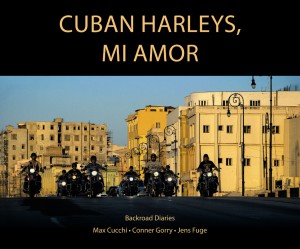
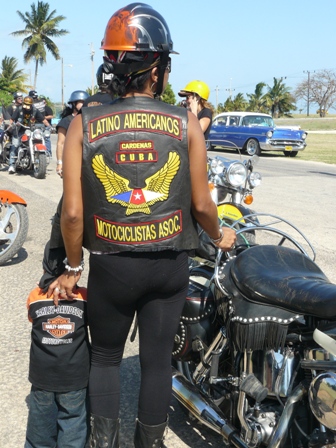
This past weekend, I was (gratefully, willingly) thrust into one of Cuba’s most prismatic and emblematic subcultures and scenes: I rode along on the country’s first Harley rally. For the record: the trip from Havana to Varadero was only the third time I’ve been on a Harley in my life. The first was a joy ride in what was clearly foreplay and a bid to get something more corporeal between my legs than a thundering motor (in this the fella failed, for which I’m thankful: at that destructively drunken point in my life, the last thing I needed was to hook up with a biker bartender). The second was a thoroughly platonic and enjoyable ride home from the year-end party in Habana campo hosted by the Latin American Motorcycle Association (LAMA) and the third time was this past weekend, when over 50 riders made their way to Varadero on pre-1960 bikes from as far as Pinar del Río and Camagüey for three days in hog heaven.

As you may imagine, my muse was working overtime in this new and captivating environment, populated by cool people with their own language and subtext. Since everything I know about biker culture I learned from Easy Rider and Altamont, I was keen to experience the 1ro Encuentro Nacional de Harlistas Cubanos firsthand.

And I wasn’t disappointed. Al contrario: I was inspired and surprised. Because although as a group these folks cultivate and maintain an identity wholly dedicated to, nay obsessed with, Harley Davidson, they remain, al fondo, 100% Cubano.

If you know Cuba from the inside, you know this subculture phenomenon – be it goth, gay, or black – hasn’t always fit in well or properly with the macro unity concept that is the glue for us here in one of the world’s last bastions of socialism. Of course, when there’s USAID or other sovereignty-compromising dollars in the middle, peor todavía. Worse still with reason since I believe all human relations should be driven by mutual respect, regardless if it’s in the realm of sex, economics, culture or politics. In short: you don’t tell me how to live, work or play and I’ll return the favor.

What was even more striking still was that on the whole, these Cuban bikers are more closely connected to their global counterparts and importantly, their US brethren, than any other community I’ve encountered here (see note 2). As a group, they speak (almost) as much English as the slickest jineteros and what’s more, the main biker groups here – LAMA and Harlistas Cubanos – have foreign membership, long timers like me who live here and love bikes. And the mix works seamlessly because beyond the bikes, gear, and foreign presence, what grounds and unites these folks is their Cubanilla, with all the idiosyncrasies good and bad that implies.

Even before we rumbled out of Guanabacoa towards Varadero, the gossip was flying. And believe me: these Harley folks are more chismoso than a kitchenful of bored housewives. I learned all about Antonio’s marital strife; the petty divisions and squabbles among different riders and groups; and how Vladimir got his hog and Oscar lost his. Thanks to the gossip mill, I was privy to the anonymous alcoholic’s struggles and how much Fulano paid for the silicon tits and ass of his funny, sexy, back seat Betty. The grapevine was heavy with juicy fruit, but what impressed me the most was the handful of folks who didn’t gossip. Those are the ones to ponder further, I figure – above all because I abhor gossip as an entirely negative pursuit. With the anti-chismosos, I’d found my people (see note 3).

What also struck me as totally Cubano was the fury for everything with the Harley Davidson logo. I know brand loyalty is common to riders the world over, but Cubans can go overboard like nobody’s business – especially when it comes to logos and bling. And this was no different: there were boots, belts, shirts, jackets and vests, jewelry, headbands, bandanas, flags, stickers, and business cards all emblazoned with the Harley label. Boy, did I ever look out of place with my Hawaii-kine style, particularly when everyone was throwing devil horns and I’m waving the shaka. But while I may have looked out of place, not for a moment did I feel out of place – another sign you’re hanging with Cubans.

If you know this place and manage well in Spanish, you know that there is no one who can make and appreciate a good joke like Cubans – especially when the joke’s on you. And these bikers are tremendous jokers – jodedores constantly dando cuero. No one is spared, least of all me, and these Harlistas ribbed me good-naturedly at every opportunity: about how I leaned into curves (not that well, apparently; ¡que pena!); about my addiction to roasted pork (see note 4); and my penchant for hopping on the back of anyone’s motorcycle, anytime. I’m sure they have words in biker parlance for promiscuous back seat bitches like I was this weekend, but in my case, it ended with a forged love note that had everyone busting a gut. But at least I fared better than another foreigner who had his gold chain vicked by a muchacha ‘fren’ giving him a massage; he never heard the end of it.

But what most drove home the Cubanilla for me was that bedrock Cuban principle driving relations on-island and off which these folks have in spades: what matters above all else is family. Blood, extended, new and departed. And it wasn’t only the adorable kids along for the ride (many in mini Harley gear), but how you know your back is covered when someone falls ill or that someone will lend a hand when you need a new part, mechanic, or lover and an ear when you’re down. As a group, the Harlistas Cubanos function as one big, complicated – dysfunctional at times, but happy all the same – family. United by their love for their bikes, the road, and their patria.
It’s a weekend I’m sure I’ll never forget. If you’re in Havana and want to experience what I’m talking about, stop by their weekly event at La Piragua (Malecón and Calle O, in the shadow of the Hotel Nacional), held every Saturday at 5pm. You just might get lucky and spot me in some colorful get up on the back of a hog, throwing a shaka to my new friends-cum-family.

Notes

1. A perennial work in progress that’s like a so good, but so bad lover you know you should finish with but somehow can’t (or won’t), I’m determined to get this sucker published in 2012.

2. Granted, I don’t hang out with dissidents who are all up in that foreigner action – and not in a good, healthy way like this bunch.

3. Also a sign of my people: so many Harlistas smoke cigars and give them away like candy, I smoked none of my own stash the whole weekend and returned to Havana with healthy stores thanks to their generosity.

4. And let me tell you: the three puercos asados they laid out for the farewell lunch were the tastiest I’ve had in 10 years here, trumping memorable pigs eaten in a bohio in Pinar del Río, on a secluded beach in Las Tunas, and during carnival in Holguín.

36 Comments

Filed under Americans in cuba, cigars, cuban beaches, Cuban customs, Cuban idiosyncracies, Cuban phrases, dream destinations, Expat life, Hawaii, Living Abroad, off-the-beaten track, Travel to Cuba

Six Highly Annoying Cuban Habits

[tweetmeme source=”connergo” only_single=false]

OYE!!

MUCHACHAAAAA!

¡LLEGÓ EL POLLOOOOO!

Are all the Cubans you know shouters? And do they always crank the music to 11 à la Nigel Tufnel? In your world, is a Cuban whisper an oxymoron? If so, you know that calling Cubans loud is redundant and the ruckus here is a full volume affair.

Labeling this noise pollution is a misnomer since 80% of the time the noise in question is a product of partying, kids screaming at play, antique Chevy’s honking out the Godfather theme, or the neighborhood knife sharpener making his rounds. Steaming beans, whirring blenders, trumpeters practicing in the park – Cuban noise is a life-affirming refrain, a symphony of love, work, and play that’s cacophonous at times, but more soulful and less discordant than planes droning overhead, panicky sirens, migraine-inducing leaf blowers and lawn mowers, and ubiquitous, petulant car alarms.

Even without this modern white noise, it is damn loud here. Some people aren’t down with this. I get it, but personally, I adore it (except when regguetón is involved) since I’m from a fast talking, high volume NY family; I feel right at home with all this bulla. I love that I don’t have to think twice about cranking Queen or audible climaxes (see note 1). Meanwhile, there are other Cuban habits which are highly annoying and chap my ass…

The farmer hanky: I was at a wedding not long ago (see note 2) and while I was smoking my cigar in the patio, another guest used a farmer hanky from the balcony above. For those unfamiliar with the practice, a farmer hanky is when you close off one nostril with a strategically placed finger, cock your head to the side and let the snot fly. With the wind, hopefully. I understand the Special Period and its aftermath made toilet paper a luxury item, but in public, at a wedding, you need to do this? How about a cloth handkerchief, which are all the rage down here? I do know one thing: that guy and I were both lucky he didn’t peg me with his snot rocket.

Barging in: After a decade here, I still don’t get the compunction to burst through a closed door without knocking. It doesn’t matter if it’s a boudoir, baño, or office: Cubans are loathe to knock. As you may imagine (and if you’ve spent any amount of time here, you don’t need to imagine this indignity, you’ve lived it), this can be compromising if you’re on the can or in the throes with your honey (see note 3). And this cuts both ways: Cubans aren’t used to locking doors or responding to ‘anyone in there?’ raps and I’ve walked in on my share of people after knocking, receiving no answer and sallying forth as a result.

Flushing reluctance: This is another truly puzzling and widespread habit here. Innumerable are the times I’ve walked into a stall to find the toilet filled with a cocktail of piss. My first thought: ‘the toilet is busted’ is followed by my second: ‘there’s no water’ (both very real possibilities here), but both prove to be wrong when I depress the handle and the cocktail whirls down and away. Laziness? Adaptation for the many non-working, waterless toilets we have here? I don’t know, but I end up dealing with lot of other people’s shit.

PZP: Thanks to fellow blogger at Cachando Chile for coining this acronym for public zit popping, something I find so repulsive and popular, I’ve mused on it before. Daughters squeezing their mother’s blackheads; lovers giggling with glee as they lance a good one; friends squirting puss from each other’s face to pass the time. It’s as disturbingly intimate and inappropriate as people worrying their dandruff scabs in public – something people all over the world can’t seem to resist, I’ve noticed.

Phone etiquette: Anyone who knows this place even half-well knows no one can dial a wrong number like a Cuban. If I had a nickel for every time someone dials me instead of the person they intended, I wouldn’t have to bust my ass peddling my Havana app. I’m talking to the tune of several wrong numbers a week. And this isn’t just limited to guys intentionally given the wrong digits by girls who aren’t interested; old ladies, bureaucrats, kids – everyone has a penchant for wrong numbers here. Hey, anyone can make a mistake, I get it.

What really grates, however, is when I pick up a ringing phone and the voice on the other end asks: “Who’s this?” No compadre, it doesn’t work that way; you called me. The question is: who is this? Sometimes these are acquaintances or colleagues giving bad phone, but often, these are men cold calling until they get a female on the line. They continue to call and coo, asking your name (and in my case: where you from?), until you tell them to stick it where the monkey put the shilling. Still, I wonder: was there ever a guy who got lucky with this mecánica? It’s highly absurd and disturbingly pathetic. Recently, a guy was calling me every morning at 7:45 with such patter until I told him I had caller ID (available here, though I’m too thrifty to pay for it) and was going to report him. Never heard from him again.

Spoilers: You sit down to watch a movie with your Cuban friend, lover, or mother-in-law and before the opening scene concludes, they exclaim: “Oh! I’ve seen this one! It’s where the wife really turns out to be the assassin but you don’t know it until the end!” Or along the lines of: “You haven’t seen The Crying Game?! It’s the one where she turns out to be a he!” Incredibly, this spoiling sport is even practiced by professional filmmakers. Don’t believe me? Check out the 30-minute muela that precedes the Friday night movie program Séptima Puerta – the host runs down the entire plot arc, replete with clips, before the opening credits even run.

Got any annoying habits you’ve observed among Cubans? Drop a comment!

Notes

1. Interestingly, the one situation where the Cubans I know aim for quiet is during carnal affairs.

2. I’ve refrained from writing about this event – the kitschiest thing this side of a Hialeah quince – to protect the guilty happy couple.

3. One thing I do love about here, however, is that on the whole, Cubans aren’t modest when it comes to bodily functions: everyone pisses, shits, and fucks. There’s nothing to be ashamed of.

176 Comments

Filed under Americans in cuba, Communications, Cuban customs, Cuban idiosyncracies, Expat life, Living Abroad

Let Us Pray

[tweetmeme source=”connergo” only_single=false] I ventured once again outside my comfort zone yesterday here in Havana: I went to mass. It was as oppressive (and let’s be frank – hypocritical) as I remember from Jesuit high school (see note 1), although this one was presided over by the big Catholic kahuna himself, Pope Benedict XVI. It was also mercifully short.

While I’m sure you’re oversaturated with ‘The Pope in Cuba’ news up your way, one of the indelible lessons I’ve learned in my 10 years of island residency is that the picture you get of here from there – especially when refracted through the lense of reporters sent to cover such an event – does not accurately reflect what we’re experiencing on the ground. It’s not only that every media outlet from The Militant to FoxNews has an agenda. The view is skewed also because Cuba newbies rarely grasp the complexities of our context (see note 2), nor the attendant history influencing those complexities. You don’t get this perspective unless you’ve been around and stick around and only if you speak Spanish – even a translator is no guarantee (see note 3).

So let me tell you about the mass I attended yesterday under a blazing sun, delivered by a frog-like man in a funny hat.

What folks are saying: One of the pervasive myths about Cubans is that they’re afraid to speak their minds or offer opinions, and that self-censorship is rampant. While it’s undeniable that people keep their heads far below the parapet in the workplace and have the tendency to adjust responses to what they think people want to hear, I’ve always found Cubans to be fiercely opinionated – once you get to know them. Or more to the point: once they get to know you.

The Pope’s visit confirmed this impression.

“I’m so sick of this Pope.”

“Wasn’t he a Fascist?”

“I’ll come by your house once The Almighty Pope leaves and things calm down.”

“Son of a b@&*h! The Pope took our Internet.” (see note 4)

“Faith, hope, and peace: that’s what it’s all about.”

Rocking our rum-pork-party holy trinity: Another element piquing my interest was how Cubans approached this whole Papal visit. Essentially, yesterday felt much like hurricane preparation and landfall: people laid in stores and stayed home watching events unfold on TV, with some chicharrones and a bottle of rum close at hand. Except – and this was a rude awakening for several of my unprepared friends – authorities instituted a booze ban the evening before, which lasted until the Pope Mobile and its cargo were safely at the airport. So those who didn’t lay in the ron were homebound with pork, friends, and family, but no curda. In my decade here, I only recall a few alcohol-free events: election days are always dry and if I’m not mistaken, they did the same during the Non-Aligned Summit here in 2006. Let me tell you: no rum makes Havana kinda grumpy.

Revenue coup: The cleverness of Cuba never ceases to amaze me and yesterday didn’t disappoint once I saw the huge numbers of tourists in the Plaza for mass. My first clue was the distinguished older gentleman of means dressed in khakis, a pink Oxford, and penny loafers, with not a gin and tonic in sight; clearly not one of us. I started looking closely at the crowd and their clothes and distinguishing different accents. Nicaragua, Argentina, Chile, Panama, the DR, USA, PR, Mexico, Venezuela – flags from all across Latin America snapped in the wind whipping across the Plaza and I realized that aside from the pride and so-called “soft power” the Papal visit signified, it also represented a hugely-needed and greatly-appreciated influx of tourist cash. There wasn’t a hotel room to be found; paladares overflowed; extra charter flights were added from Florida. And all Habaneros (save for cops and docs), were given a paid day off. This is the type of devotion we could use more of and we thank you for supporting the cause.

The US matters less: After Juan Pablo II’s visit in 1998, Bill Clinton’s White House issued a press release announcing new policies ostensibly resulting from this historic trip. Most importantly, the release approved people-to-people visits in order to foment “regime change” and “promote a peaceful transition to democracy” – concepts mentioned no fewer than six times in the short document. Blatantly threatening the national sovereignty of an independent and peaceful country thusly is absurd enough, but that Obama maintains precisely the same policies and parrots exactly the same rhetoric 14 years later – that’s just loco. While the US is embarrassingly and unjustly static in its policy, the world and importantly, Cuba has changed, is changing still. Raúl is a different bird from his brother and that manifests itself in many ways, including less of the ping pong policy-making that based decisions on what the bully to the North was doing. That’s how it looks publically anyway.

holy jama!


As anti-climactic as the Immaculate Conception: I’m sure you’ve already divined that the religious importance of having his Holiness here held no interest for me and in this I’m not alone: I’ve never seen an event so thinly attended in the iconic Plaza de la Revolución in my 10 years here. In fact, we strolled into the central area just a few moments before the 9:30 mass kicked off and were going against the current of people streaming away from the square. “I came and took the pictures I wanted; I’m going home,” a friend I ran into said. The curiosity seekers and thin crowds were surprising but make sense: as a whole, Cubans just aren’t that church-y. Religious and faith-bound, yes, but that’s different from kneeling before a man in a dress and goofy hat while he proselytizes a doctrine peppered with sins bound to doom your mortal soul. Cubans just aren’t down with that, but they do love a spectacle: one of my favorite moments was when a women who wanted to taste the host tried to fake her way through the motions while the priest held the wafer aloft. When he caught on, he patted her on the head and returned the host to his jaba. Though the Pope himself failed to inspire, Cubans never do.

Notes

1. This, Fidel and I have in common, except those same Jesuits expelled me my junior year (another story entirely!)

2. A simple example: journalists arrive here and compose some flaccid or purply prose (even leading with it occasionally, dios mío) about all the old cars rumbling about. For those of us with continuity here, that’s ‘dog bites man.’ The more compelling, ‘man bites dog’ story is the unbelievable amount of new cars on the road and what that means for traffic, transport options, pollution, etc.

3. The press conference by Foreign Minister Bruno Rodriguez upon the Pope’s arrival is case in point: his response to an English-speaking reporter about “freedom of consciousness” was elegant and sweeping in the original Spanish, mangled and less inspired in English.

4. Cuba has limited bandwidth due to the US embargo-cum-blockade which prohibits the island from connecting to underwater cables running nearby. Instead, the connection for the entire island is provided by a sole, slow Italian satellite. This bandwidth was prioritized for visiting press so they could report live from Cuba. It’s back now, thankfully, obviously.

19 Comments

Filed under Americans in cuba, Cuban customs, Cuban idiosyncracies, Cuban Revolution, Expat life, Fidel Castro, Living Abroad, Raul Castro, Travel to Cuba

Black Market a lo Cubano

[tweetmeme source=”connergo” only_single=false]

If you follow my blog or any similarly semi-intelligent Cuba-related news outlet, you know that things are fast a-changin’ on this side of the Straits. For those out of the loop: in April, 2011, a series of unprecedented policies – which amount to a new (and not without substantial risk) economic paradigm for the country – were approved at the Sixth Communist Party Congress (see note 1).

Though some of my Cuban friends gripe that change isn’t happening fast enough, I’ve been surprised by how many new policies have come to pass as promised: private sales of homes and cars, relaxed regulations for paladares and casas particulares, and the approval of nearly 200 pursuits and services for private enterprise. Other movement towards so-called normalcy is slower and more complicated still: unifying the two official currencies, salary increases, and phasing out the permiso de salida (see note 2) among them.

What these changes will mean for the most vulnerable remains to be seen and I have not a few friends here tormented by uncertainty, anxiety, and a generalized malaise in the face of it all. Uppermost in their hearts and minds: what might these changes mean for the political, social, and ethical tenor of the revolutionary project so many have fought so long to strengthen and so hard to save?

Some days it feels like it’s all going kablooey – that the Cuba we’ve known is reserved now for dewy-eyed nostalgics fingering grainy photos of the 10 million ton harvest. And this is heart breaking to people who have survived so much drama and tragedy: the rending of families in the 60s and 70s, (plus the Bay of Pigs and Missile Crisis), followed by the Mariel boat lift and collapse of the Eastern Bloc in the 80s which led to the torturous Special Period of the 90s. Then there was Fidel passing the baton to hermanito Raúl which I guarantee looks different from your off-island perspective than from ours here in Havana. And let’s not forget the 50 years of sabotage (both bald-faced and covert) by the behemoth to the north, to say nothing of terrorist attacks by US-sheltered individuals and groups.

So before it all goes kaboom (a day late and a dollar short, perhaps?), I’m determined to document the Cuba I’ve known for the past 10 years and the attendant change as accurately, responsibly, and comprehensively as possible. Today, I turn to an examination of the black market.

Jeans and stilettos, perfume and gas. Cigars of course, but also ice cream (Coppelia, the country’s best), and iMacs, milk and meat: it’s all available on Havana’s black market – if you have the hookup or happen upon someone “repurposing” Cuban Clorox or café. In the interest of full disclosure, I have very little direct experience with the black market (or parallel market as Cubans call it) despite a decade in residence; I have no car, so no need for gas, I buy my meat off the cement, fly-spotted counters at my local carnicería, and would love a Mac but don’t earn enough to join that club. Besides, all that shit is stolen (see note 3) and I’ve had enough stuff vicked in my life to know that if you ain’t part of the stolen goods solution, you’re definitely part of the problem.

But then the moral high ground begins to shift (Cuba is funny like that).

—–

Every once in a while, a kind-faced granny shows up at my door selling either eggs (see note 4) or powdered milk – a key ingredient in the Cuban kitchen. Someone on the block must have told her an extranjera lives in Apt 5 because she came straight to my door that first time, knocked hard and called me La Rusa (“The Russian” – old stereotypes die hard). She’s a bit gnarled and I can tell from the edge in her voice and the fade of her blouse that times are tough for the milk-peddling abuelita. Unfortunately, when I need eggs, she has milk; when I want milk, she has eggs. So even though I was keen to help her out, our supply and demand algorithm never quite jived. Last week, her friendly face appeared anew at my door.

“I have eggs,” she said.

“So do I. How about milk?” I asked.

She didn’t have any that day but promised to “resolve” some; I promised to buy it once she did.

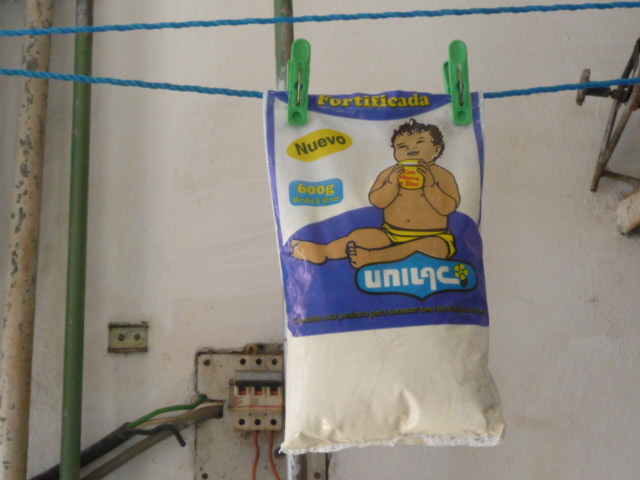
Sitting in my office yesterday whittling a Tweet down to 140 characters instead of working, I once again heard her hearty knock at my door. Smiling big, she told me she had three sacks of milk for sale at $2 a pop (a 50 cent savings over the official store price). I agreed to take one, glad I was finally getting the chance to help out granny. Until she pulled the sachet from her frayed knapsack: I, we both, were taking milk from the mouths of Cuban babes. What my elderly friend was selling was the milk the government guarantees to every child under 7 and I’d just purchased 600 grams of it. I knew that milk wasn’t going to be too tasty. 

—–

This transaction got me to thinking about where all this stolen stuff comes from and put me in mind of my friend Alberto. He has an old Lada on which his livelihood depends. Driving around recently, I noticed a balón de gas (the 20-lb tanks used here for home cooking) wedged behind his seat. Seems Alberto had converted his gas-powered car into a propane-propelled one.

This was a smart investment on his part: although the conversion kit cost $350 and had to be imported from abroad, Alberto fills that tank – which takes him 120 km or so – on the black market for just $5. By way of comparison, that same $5 would buy 15 liters of real gas on the black market; just over four at the pump. I’m glad Alberto has figured a way to enlarge his margins, but wonder about the families who show up to fill their kitchen tanks to be told “no hay” (there isn’t any).

This same pattern repeats itself with steaks and blocks of Gouda, stamps for official paperwork (I was surprised to be asked to produce receipts for my bank-bought stamps on my last visit to immigration) and cooking oil. And while I can appreciate the need for every last Cuban having to do something (or something extra-legal) to make ends meet, the more I parse the situation, the more unsettling it becomes.

And it makes me realize that a certain amount of that aforementioned moral ground is shifting below my feet. At these times I’m forced to ask myself: is this is a part of Cuban culture I wish to participate in? Unluckily for my milk-thieving granny, it is not. But I’m sure she’ll find other clients: as long as there are commodities like oil, meat, and milk to “redirect,” and resell for pure profit, folks will do it.

 As I said: old habits die hard.

 Notes

1. These political powwows are held every so often (the last was in 1997) or mejor dicho: whenever sufficient excrement threatens to make contact with the cooling element, if you know what I mean.

2. All of these issues came to the fore in nationwide public referendum-type debates held in late 2010. The permiso de salida is an exit permit which is mandatory for overseas travel by Cubans and residents. It earns the country revenue, but is also a barrier to travel – an issue that has to be reconciled somehow and soon.

 3. Except the goods in the black market Mac store. None of this is stolen, but rather all new, in-the-box gear with warranty and all, purchased in Miami and spirited into the country.

 4. Eggs aren’t usually stolen either, but rather the product of home-raised hens.

25 Comments

Filed under Americans in cuba, Cuban customs, Cuban economy, Cuban idiosyncracies, Cuban phrases, Cuban Revolution, Expat life, Fidel Castro, Living Abroad, Raul Castro, Travel to Cuba

Conner’s Cuba Rules Part II

[tweetmeme source=”connergo” only_single=false] About six months ago I wrote Conner’s Cuba Rules, a super popular post that raised the ire of some readers. Rereading my musings six months later, I better understand some of the dissent offered by commenters. Given that much has changed here in Havana since then and I’ve had several opportunities to travel outside of the capital thanks to my day job, I’ve compiled a new, hopefully more positive, set of rules to complement the first ones.

The Revolution will be televised: I’ve met a lot of visitors (and even some foreign residents) who have never seen Televisión Cubana. Granted, there are only five channels here, but you’re missing out on a big chunk of Cuban culture if you don’t surf those five at least occassionally. For the intersection of politics and journalism, check out the Mesa Redonda (see note 1) and the prime time news. The latter is important in and of itself for the weather report; pay special attention if Dr José Rubiera is forecasting. Meanwhile, a good baseball game can rivet entire households, the novela even more so. Only if you watch TV here will you understand what Cubans mean when they say: “it was like the Saturday night movie” (see note 2). Meanwhile, the music shown down here – videos, documentaries, concerts and jam sessions – can be as moving as the live thing. I’ve seen Chucho Valdés, Clapton and Queen, the Festival of Modern Drumming and some guy from Uzbekistan singing Talk Boom, a riveting song I’m still trying to track down – all in a single night on Televisión Cubana. Watch it; you’ll like it (or at least get a good laugh or song lead).

Pack a sense of humor: It always amazes me when I read something that disregards, overlooks, or otherwise fails to recognize the Cuban sense of humor, which ranges from the side splitting to the sublime. The writer can be someone who knows and loves Cuba long time or a visitor who has parachuted in and out on vacation. No matter the source, the frequency with which folks miss the funny stuff here is alarming. It’s true, a lot depends on speaking Spanish (or a crackerjack translator), but however you resolve the language question, if you’re comparing Cuba to China, Vietnam, or the defunct USSR, you’re missing one of the most important ingredients in the Cuban character. These folks love to share stories, jokes, and the occassional tall tale, and use their verbal prowess to enliven, laugh, and woo; it is what has enabled these people to resist so much for so long. Even without Spanish skills or a translator, if you’re not laughing a lot on a visit here, you’re doing something wrong in my personal and professional opinion (see note 3).

Use pesos cubanos: If you know even a little about Cuba, you know we operate on a dual currency system with pesos cubanos and pesos convertibles circulating side by side. Since one of my goals of Here is Havana is to bust myths, I always take the opportunity to debunk one of the most pervasive: that foreigners cannot use pesos cubanos (AKA Moneda Nacional, MN), but only pesos convertibles (AKA divisa, chavitos, CUC). This is 100% false. Anyone can use either currency. It’s what each can buy where the difference lies. Certain goods and services, for example, are only available in CUC including cooking oil and butter, hotel rooms and the internet. But fruits and veggies, surprisingly pleasant cigars, fixed route taxis, movie tickets and lots of other stuff are sold in pesos cubanos – if you know where to look. My advice? Change some CUCs into MN (1:24) to experience firsthand how much pesos cubanos can buy and how the double economy works.

So as to avoid confusion +/o more myths: you can always pay for goods and services priced in pesos cubanos with hard currency pesos convertibles but never the other way around. And some services (interprovincial buses, concert and ballet tickets) are sold in pesos cubanos to Cubans and residents, but in hard currency to visitors.

Bring your own reading material: Rarely a week goes by when someone isn’t griping to me about the lack of English-language books and magazines here. What is available is largely limited to historical and political titles and they are very expensive (and make for dull beach reading besides). The Kindle can be handy in this regard, but the bonus to bringing print publications is that you can pass them along to some avid English reader (like me!) upon departure. Drop me a line if you have some good (ie no romance novels or sci fi pulp) English-language reading material to donate to the cause.

Hightail it out of Havana: This may seem contradictory, given that I have an iApp to the city and I recommend in my guidebooks and elsewhere that visitors consider basing their entire trip in Havana. But things are changing fast here and though I’m a city girl by birth and breeding, I’m back peddling a bit on that advice. Havana, with its dirt, garbage, and graft, noise and air pollution, and materialistic ways (I did call Habaneros ‘logo whores’ after all) is distorting Cuba’s image. In short, Havana is not Cuba, which can be said of every major city around the world from New York to Manila, Managua to Dakar. But since visitors often request recommendations for “authentic” experiences and how to discover the “real” Cuba, I now find it prudent to advise getting out of Havana and exploring farther afield. With more flights, both charter and commercial, to provincial capitals like Holguín, Camagüey, and Santiago de Cuba, this is also a more practical proposition than ever.

Above all, have fun and keep your head about you!

Notes

1. The Mesa Redonda (Round Table) is a nightly “debate” show which discusses a topic (US aggression overseas; Latin American intregration) on which all four guests and the modeator agree.There are many jokes in these parts about the program; the shortest and sweetest calls it the Mesa Cuadrada, meaning ‘Square Table’ in literal Spanish, but meaning something more along the lines of ‘Dogmatic Table’ in Cuban.

2. The Saturday night movie here is prefaced by a parental warning, the most common of which alerts viewers that the Hollywood action shlock about to be shown contains Nudity, Violence, & Foul Language. To wit: the old, slow, over-crowded camello buses (of which I took many), were always called ‘the Saturday night movie.’ [NB: did it annoy you to have to scroll down to read this note? Yeah, me too, but I haven’t been able to figure out how to hyperlink notes within posts; if someone has a solution, please get in touch].

3. Trying to connect to and use the internet excepted. Even casual visitors know that connectivity is no laughing matter here. Indeed, I flirted with the ledge and sharp knives today as I frittered away several hours trying to connect. Once I “succeeded,” it topped out at 9.6kbps – not nearly fast enough to load even a simple web page before timing out.

30 Comments

Filed under Americans in cuba, cigars, Communications, Cuban customs, Cuban economy, Cuban idiosyncracies, Cuban Revolution, Expat life, Living Abroad, lonely planet guidebooks, Travel to Cuba

How to Cope Like A Cuban

[tweetmeme source=”connergo” only_single=false]I’ve got a friend – I’ll call her Lucia. Life has been a bitch for Lucia in that special Cuban kind of way with family torn asunder by bi-lateralpolar politics; dramatic affairs of the heart and all the ardor and betrayal that implies; and the exhaustion inherent in raising three kids – the oldest two during those hard, indelible times known as the Periodo Especial, when stomachs growled and cramped with hunger and entire days were spent in blackout. The Special Period was also when mobs of people cast their fate to the wind, water, and sharks on slap-dash rafts with a 50/50 chance of making it across the Straits.

Many of those poor souls failed in their attempt to escape, dying outright en route or otherwise kept from stumbling into the open arms of Uncle Sam (see note 1). With a forced smile exemplifying the Cuban dicho ‘mal tiempo, buena cara,’ Lucia waved goodbye to friends and family, colleagues and acquaintances as they emigrated north. Due to circumstances financial and otherwise, many of Lucia’s people – including her only sister and two childhood friends – can’t return to visit Cuba. Like so many people I know, Lucia dreams of sharing a Cristal wet with sweat in the honeyed Havana light with her loved ones.

Paddling away on a raft or zipping off in a lancha (regular weekly departures for $10,000 a head) is the most dramatic and dangerous means of escape, but there are others: marrying a foreigner is perennially popular, as is the slower (but somehow less tedious) application for the bombo (see note 2); securing a Spanish passport if your family descends from those parts; or quedándose on a trip abroad. That is: going overseas for work or as a tourist (yes, some Cubans do travel for shopping pleasure) and neglecting to get on the plane back. To give you an idea of how profoundly the emigration question touches Cubans, consider ‘La Visa,’ the latest schoolyard game whereby a ball is thrown in the air and a country shouted out – Yuma! Mexico! España! The kid who catches the ball ‘gets’ the corresponding visa.

But contrary to what the world has been led to believe, there are more Cubans who don’t want to leave than do. Like Lucia. Like my husband and his family. Like many of my co-workers. But just because they aren’t scheming their great escape doesn’t mean they don’t feel trapped now and again. Hemmed in by water, but also bureaucracy, Third World economics, politics and other factors quite beyond one’s control – who wouldn’t be? It’s trying at times and requires figurative escapes – coping mechanisms to mollify the madness and loosen the psychological pretzel island living engenders.

In no particular order:

Sex, drugs, and rock ‘n roll: The Cuban penchant (and talent) for sex is legendary and sexual freedom in the form of multiple partners and the pursuit and conquest of same is part and parcel of our daily landscape. Not only is hooking up freeing in the personal sovereignty sense in that it affirms (however hollowly), one’s individual choice and control, but it’s also free entertainment. The flirting and dancing and piropos (pick up lines and compliments) and foreplay help keep boredom (however temporarily) at bay and serve as an escape from all those factors beyond our control.

Drugs – illicit or not – serve the same purpose and despite Granma’s assertion that drogas aren’t a health problem here, 10 years of living in Havana paints a different picture. I know more than a handful of hardcore drunks for example, and prescription pills are in such high demand family doctors have been trained how to handle patients angling for scripts. Marijuana and cocaine can be had at no small risk and price (see note 3) and I’ve heard about Cuban acid trips and X adventures. Rock ‘n roll (coupled with rolls in the hay) is my personal drug of choice and in this, I’m largely up shit’s creek here since Cuba has crappy rock, though regular gigs by accomplished cover bands like Los Kents provide certain succor.

The Novela: Soap operas are addicting, which you well know if you’ve spent any amount of time in Cuba, where ‘round about nine o’clock the city quietly retreats inside to catch the next installment. Brazilian, Argentine, Cuban – it doesn’t matter the origin, as long as the cast is beautiful, the food abundant and the tragedia delicious. These fantasy worlds provide needed escape for islanders of all stripes, from housewives to priests, cowboys to convicts. On December 31st, a hallowed night spent with family here, the clan licked pork fat from their fingers and waited to pop the cider that stands in for champagne here when all the women mysteriously melted away. ‘La novela,’ someone said when I asked after them. Even Fidel has interrupted one of his televised speeches to assure viewers he wouldn’t run over into the soap opera. If you think I’m kidding about soaps as serious escape, consider that two TV households aren’t uncommon here: one for those who want to watch the novela, another for watching pelota. Homes with just one set become divided and bicker-ridden when the soaps and baseball are simulcast.

DVDs: Even before the explosion of private entrepreneurs selling pirated DVDs descended upon us, Cubans habitually rented and copied movies (or entire seasons of their favorite soap), on VHS and now on DVD and in digital formats. Last week as I looked to buy a 5 movie combo from my neighborhood pirate, the saleswoman nodded knowingly when I told her I was looking for something to ‘desconectarme,’ to ‘saca el plug.’ Whether at home or in the theater, cinematic escape is familiar to all Cubans and the saleswoman had no trouble plucking a DVD from the rack with Moneyball, New Year’s Eve, and three other recent releases.

Sports: Technically (and for all the old timers), baseball may be the national sport, but football/soccer is making a play for the title. Every day in the park near my house, local kids field two full teams and kick up the dirt in bare feet as they drive towards the goal. When Barça or Real Madrid play, the bars are packed with fans wearing their colors who unleash a fury once reserved for the Industriales baseball club and national volleyball team. I’m not surprised that booting a little black and white ball about for millions of dollars while having all the super models, fast cars, and sprawling properties your heart desires is the escape-cum-dream package for so many Cubans.

And that’s what it’s all about, friends: the dream. Not the American one or the European one. Nor the dream of fame and fortune those places symbolize (but rarely actualize) for so many from points south. Just the dream, in and of itself regardless of time, space or place. This is what’s essential. We all have them. We all have the right to them. I encourage everyone, everywhere to embrace, as I have, my mom’s sage advice: ‘live your dreams.’ No matter what they are or where they may take you.

In the words of Blondie: “I’ll build a road in gold just to have some dreaming. Dreaming is free.”

Notes

1. The USA has an extra special immigration policy for Cubans known as ‘wet foot/dry foot’ whereby any Cubano who is able to touch toe to hallowed US ground is granted automatic residency in the Land o’ the Free. This ‘advance to Go, collect $200’ dangled before Cubans (and only Cubans) means would-be immigrants from this island are even more reckless than their nothing-left-to-lose brethren from other latitudes, risking life and limb to reach the USA. Again and again, it has proven fatal (Elián González ring a bell?).

2. Other extra special Cuban immigration rules coming from the USA include this emigration visa, 20,000 of which are pledged under current accords (Obama re-instated this old policy suspended by Bush Hijo).

3. I strongly advise everyone reading this against trying to procure illicit drugs here; see Locked Up Abroad.

20 Comments

Filed under Americans in cuba, bureacracy, Cuban customs, Cuban idiosyncracies, Cuban phrases, dream destinations, Expat life, Fidel Castro, Living Abroad, Travel to Cuba

An Ex-Pat Occupy Manifesto

[tweetmeme source=”connergo” only_single=false]

I know there are a lot of us out there. Recent statistics show at least four million US-born folks live outside their native country – the so-called “ex-pats.” I’m one of them (though I’m not sure I’d call myself a patriot, let alone an ex one). I left the States in October 2001, just after my hometown was attacked.

This November I was back in New York and marched with 35,000 others of the 99% across the Brooklyn Bridge, occupied Liberty Plaza (AKA Zuccotti Park), and helped broadcast a bilingual people’s mic for the Women’s March. I got dangerously addicted to the live stream and followed news from Occupy cities across the globe.

But now I’m back in my adopted country and far from what’s happening back in the States. Just like millions of other expats, many of whom I’d guess, like me, were driven to move away (at least in some shape or form), precisely by the same forces against which Occupy stands and shouts and fights and films (keep filming! Keep filming it all!)

So my question is what can we do? What can the 99% living outside the States contribute to the movement?

Here’s what I’m thinking:

1. Spread the word. Use social media – Facebook, Twitter, YouTube – the information is out there. Inform yourself. Share the knowledge. Go to the live feeds and blogs of cities you love and tweet, like, and recommend whatever strikes a chord. Keep the wheel turning.

2. Translate. When I was in New York, the Occupied Wall Street Journal en Español lagged behind the English version for lack of translators. You live abroad – perhaps you speak the language of an immigrant community in your home city back in the States. Consider offering to translate some web pages or content, posters, or flyers.

3. Donate. Many Occupy cities have specific needs lists – in New York it was everything from books (after the People’s Library was trashed by authorities) to plastic bins for storage; in Denver it was winter gear. Visit the web pages, poke around, pony up.

4. Tell your 99% story. I’m 42 and still carrying over $40,000 in student loan debt. In the States, I couldn’t afford healthcare, to pay off my loans, and keep a roof over my head. So I moved to somewhere I could. Maybe you have a similar story. Tell it here.

5. Share your ideas. Maybe you’ve seen effective slogans, campaigns, or direct actions in your adopted country (Bolivia anyone?). Throw your ideas into the ring – go to chat rooms on the live feed or write a manifesto of your own!

6. Vote in local elections, for progressive, social justice candidates (where they exist). This applies only to those still maintaining residency in the States (I know many of you do and this goes for your spouses, too). A corollary to this is that electoral authorities must be compelled to count all ballots in a fair, transparent way.

7. Banking. This is one area, I’m afraid, where expats feed the 1% Hydra daily, incessantly. So much has to be done electronically when you live abroad, it’s hard (impossible?) to wrestle free of the corporate financial chokehold. For this, I have no suggestions, so leave it for future musings.

For now, I urge those of you reading this on screens far from your former home, to not remain mute and immobile. Support the demand for a more just, equitable, and harmonious society. Add your voice to the chorus.

For those of you in Occupy cities around the United States and the world: we are watching, we are with you. Let’s make that more just, equitable, and harmonious global society happen.

¡Venceremos!

Conner Gorry

Havana, Cuba

December 2011

11 Comments

Filed under Expat life, Living Abroad

Let Me Count the Ways…

[tweetmeme source=”connergo” only_single=false]
Ay Cuba.

What have you done to my heart, torn in so many directions but always aching for 23° 7′ 55″ North, 82° 21′ 51″ West? And my soul? Of, by, and for New York from birth, but now reconfigured into an alma cubana that whispers mysteries in Spanish I’m still unable to cipher.

I’m not sure when this happened – feeling betwixt there and between here – though I know it’s common to long-term expats. Hell, I’ve even parsed some of this awkward, never complete transition over the years, crafting a sort of road map to the cultural, linguistic, and romantic bumps in my road.

Despite my musings and analysis, I entered some unknown territory on my most recent trip off-island: in a nutshell, I did not want to leave. Maybe I’ve been hanging out too much with Moises and Rina, two friends who had to travel to the United States recently, but neither of whom had the ganas to do so. It wasn’t due to fear – both have traveled several times for work – nor was it because they’d traveled so extensively that trips abroad had become old hat and rote (see note 1). They just didn’t want to leave the island and these days, nor do I. It feels wrong and a bit scary, like kissing a cousin or sibling.

It makes me sad because I know the lengths so many Cubans take just for a chance to see what lies beyond all that water crashing against the Malecón. And it’s confusing, because on every previous trip, I too felt the need to ‘saca el plug’ (pull the plug) and ‘desconectar’ from the drama-rama that is Cuba. Trips out used to be exciting, emotional, and necessary.

But not this time. I didn’t want to cut whatever cord hooks fast into those of us crazy for Cuba, making us spend money we don’t have, go against our better judgment, and jeopardize job, health, and relationships to get back to the island. In an effort to untangle that cord (or loosen the noose, depending on your POV), I offer all these reasons why I love Cuba (see note 2).

The $1 lunch – Whether it’s a cajita across from the CUJAE or a knife and fork sit down at El Ranchón (one of my all-time favorites), Cuba has some kick ass $1 lunch with all the fixings. Even at the airport: on my recent trip off-island, I filled up at the cafeteria outside Terminal 2 (clearly one of the greatest benefits of the new economic regulations) with a plate overflowing with pork, congris, yucca, salad, and chips. It was so tasty a fellow diner said: ‘my congratulations to the cook – he must be from Pinar del Río!’ (see note 3).

Touching, hugging, and general closeness – Latinos have a different concept of personal space and Cubans, as is their wont, take it to an extreme. Men embrace and greet each other with kisses on the cheek, female friends walk hand in hand, and my best salsa partners have been girlfriends. All of this is to say that Cubans aren’t afraid to touch – your leg when telling a story, your back as they try to pass you in the hall, your shoulder as they ask: ‘how is your family?’ Cubans fill elevators to its maximum capacity and I always delight in watching a mixed Cuban-foreigner crowd boarding them for the mutual awkwardness that ensues. Up in the States, the awkwardness is mine every time I step into a nearly full elevator, encroaching somehow, though there is always room for one more. That weird, reactionary, and let’s be frank, harmful rule that teachers can’t hug students in the USA? My Cuban friends can’t even grasp the concept when I try to explain it.

The hello/goodbye kiss – Related to touching is the traditional Cuban greeting – one kiss on the right cheek no matter if you know each other or not. Even taking leave of big groups results in blowing a kiss to the crowd. I think we should start this trend up north. Our world couldn’t be any worse off with more kisses, could it? On my visit to the States recently, I leaned in towards my host and said: ‘you were wonderful tonight,’ touching his knee as I spoke. Did he misread my Cuban-ness? Interpret it as something more?, I wondered later as he slid his hand down my back to cup my ass. This doesn’t happen in Cuba unless the signal is an unequivocal green (ie the ass grab is mutual).

Fun in the sun – I was born and bred in northern climes, but I’m a winter wimp through and through. Sure I loved tobogganing and ice skating and snowball fights as a kid – still do in fact – but the bulky clothing, the cold that turns wet once the fun is done, and the squeak of day old snow that sounds like someone is packing Styrofoam in your ear isn’t my bag. I like loose clothing, walking in the sun, and smelling gardenias or fresh cut grass in December. Summer clothing is sexier I think we can all agree, and as white as I am, when my freckles fuse into a pseudo tan, I work those scanty, loose-fitting clothes to full effect.

Drink, smoke, & be merry – The 8am Bucanero; the post-feast cigarette; the incessant regguetón: Cubans milk the ‘party hearty, the rest of you be damned’ approach to its fullest. Believe me, I know. And should it slip my mind, my neighbors are quick to bust out their state-of-the-art karaoke machine and warble drunken, sappy ballads until the wee hours.

And the smoking, dios mío. I remember going for my first pap smear at my local doctor’s office here in Havana…hoisting my feet into the stirrups, I watched aghast as the doctor took one last drag of her filter-less cigarette and with a deft flick of her gloved hand sent it flying out the window before diving between my legs (see note 4). If you’re a non-drinker, non-smoker, or not into music appreciation, you’ll probably find Havana offensive. But for those who like an after dinner cigar, enjoy (or need) some hair of the dog once in a while, or are usually the first on the dance floor at parties and functions, I bet Cuba will float your boat.

It’s safer than where you live – Okay, that’s a broad stroke, I know: after all, I don’t know where you live, much less the crime rates. But I can tell you that the absence of crack cocaine, crystal meth, heroin, and guns means a generally safer city. I’m not saying drugs, prostitution, violence, and rackets don’t exist in Havana. They do. But as a longtime traveler and writer of guidebooks to some of Latin America’s most violent cities (Caracas, Guatemala City, San Pedro Sula, Tegucigalpa) and an eyewitness to NYC’s crack attack in the 80s, I can tell you that Havana is a gated community comparatively. Kids play unsupervised in the street here and I walk home alone at night frequently. (Truth be told, I took a short hiatus of walking home alone after a tall guy grabbed me from behind and thrust both hands between my legs one night in Vedado, but I conquered whatever uncertainty the event planted within me). Most of the crime here is of the opportunistic/snatch and grab variety and tends to peak between October and December when people are trying to rally resources for Christmas and New Years’ celebrations.

These are some of the reasons why I love Havana and if you’ve been thinking about coming here, let me leave you with one piece of advice: don’t put it off any longer. The only certain thing in life is that life is uncertain.

Notes
1. Yes, there are Cubans who get tired of traveling they do it so much: politicians, organizers, academics, musicians, and artists, typically.

2. For those interested in earlier thoughts on this subject, see my earlier post Things I Love about Cuba.

3. Country cooking like they do in Pinar del Río is unrivaled – trust me on this one and seek out a campesino lunch next time you’re in that wonderful province.

4. For new readers to Here is Havana, let me reiterate that all the stories found throughout these pages are entirely true, though some names have been changed to protect the guilty.

20 Comments

Filed under Americans in cuba, cigars, cuban cooking, Cuban customs, Cuban economy, Cuban idiosyncracies, Cuban phrases, dream destinations, Expat life, Living Abroad, lonely planet guidebooks, Relationships, Travel to Cuba, Uncategorized

My Digital Divide

[tweetmeme source=”connergo” only_single=false]Have you ever lost a job or revenue due to tech inequity? Watched hours of productivity get sucked into the ether by a dial up connection that poke, poke, pokes along, draining all satisfaction from the act like an inexperienced or egotistical lover? Known the frustration of not being able to perform any task involving large documents, YouTube, streaming, or VOIP? And my list of music to download? A pipe dream – along with watching Jon Stewart – until I’m off-island. Is there anyone out there who feels my pain?

Before I detail the many and sundry ways Cuba, and more specifically I personally, am far behind the tech curve, let me be clear: it’s not all bad, this technological disadvantage – knowing how to write and submit via a super slow, unreliable connection for example, helped build skills and instill patience which served me well reporting from post-quake Haiti.

Let me also point out that in some cases my technological handicap is not because the gadgets aren’t available in Cuba, but because they’re out of my financial reach – which is the same thing in the end, and a reality faced by many of the world’s poor. Something to think about the next time you hear someone defending technology as the great leveler (and when you receive text messages from Yoani Sanchez: where does she get the money? I have to wonder).

Taken together, the technical challenges (see note 1) combine with the price of buying and maintaining new technologies to create a digital divide which I’m guessing most HIH readers can’t imagine. Here’s a litmus: have you ever folded laundry, washed dishes, or otherwise had to multi-task while waiting for a page to load? No? Then you probably can’t relate.

Before anyone kicks me to the curb for being a privileged foreigner who’s insensitive to what ‘regular Cubans’ go through (see note 2), let me clarify a couple of things. First, I have access to funds many Cubans don’t and I have the ability to open an internet account as an accredited journalist. So privileged? Yes. Insensitive? No – just ask my friends and family without access of their own.

Furthermore, my livelihood in large measure depends on my ability to research and submit articles, stories, and guidebooks and update my iApp via the internet. Without those gigs, I’d be left with just this blog and empty pockets. Don’t get me wrong: Here is Havana is a great writing tool, motivator, community-builder, outlet for angst and cathartic vent, but without my internet connection, it would go the way of Obama’s campaign promises, fast.

This is the practical effect of the digital divide, but there’s a subtler, more insidious side to the disconnect: it contributes to the outsider status of expats like me. Neither entirely comfortable where we came from or wholly accepted where we’ve moved to, we’re in this limbo that is pointed up every time someone waxes orgasmic about Angry Birds or Google +. Mostly I prefer being behind the tech curve (I’ll take the Flinstones over the Jetsons any day) but when it affects The Work, I bug (see note 3).

For those interested in how a decade living in Cuba translates vis-à-vis tech challenges, here goes:

I have no cell phone. Cubans are incredulous when they discover I’m not celled up, but their disbelief is based on their assumptions that a) I can afford one (see note 4) and b) I want or need to be localizable 24/7. They’re wrong on both counts.

I’ve never used a GPS. I’m a map idiot, I admit, but the GPS concept is just dangerous if you ask me. First, any map skills someone like me may have had (or had the chance of developing), go out the window once you introduce GPS. Second, they’re useless in contexts that don’t fit the traditional mapping mold, like Cuba, Hawaii, the Mosquito Coast, and every medina. Third, they limit one’s likelihood to get lost, thereby curbing new discoveries, spontaneity and flexibility, and chances for fun.

I’ve only played Wii once. Granted it was for three days straight and was a helluva lot fun but…Here in Havana I have a friend with a Wii, who calls it ‘healthier than Playstation’ and limits his daughter’s usage (but not his, I suspect!). Tip for those looking for a gift for Cuban friends: you can’t go wrong with a Wii, (two remotes, please).

Kindle-free. My take on the Kindle is kind of like my take on sexual diversity: to each his (or her) own – as long as it doesn’t infringe on my action. In other words: you can have your Kindle, but let me have my books. This is where my old fashioned ways are a disadvantage, to be sure, since hauling books here is a real pain in the ass (see note 5), plus they require shelf space. Sure, a Kindle would make my life easier, but it would also make it less enjoyable. When someone talks quality of life to me, that involves the look, smell, and heft of books.

Blue Tooth?! About a month ago I saw a Cuban American picking his way among the busted up sidewalks of Centro Habana with one of these gadgets wedged in his ear. I burst out laughing at the newest accessory in the Miami crowd’s insatiable need to ‘especular’ (show off their material goods). I tried to imagine what was so damn pressing on the other side of the Straits that this guy was willing to pay three months average Cuban salary (minimum!) to have it mainlined into his ear. Then I remembered what Cubans do with other signs of apparent wealth like watches and cell phones: they wear them and flash them, but it doesn’t mean they work. But it’s one thing to have a busted watch strapped to your wrist or a bunk cell phone clipped to your belt (that’s how the men do it here; the women tuck them into their cleavage), while it’s quite another to walk around with a pinguita in your ear.

¿Conclusión?

My life goes along happily, swimmingly without these advances. Just don’t bring it up at deadline time or mention Jon Stewart – unless you want to see me cry.

Notes

1. Cuba is prohibited by the blockade from connecting to any US satellites or fiber optic cables. At the moment, that leaves Cuba only one choice for connectivity – an Italian satellite which transmits all the data to and from the island.

2. While it’s true Cubans have the lowest connectivity rate in the hemisphere with only 14% of the population connected, these figures don’t reflect the reality since internet accounts are widely and regularly shared here. And the famous underwater cable that has been laid from Venezuela to Cuba and promises to increase our connectivity by 3000%? When it was announced a few years ago, I counseled folks to not hold their breath. Take my advice: keep breathing and continue to file under ‘I’ll Believe It When I See It.’

3. This post was inspired by an ongoing freelance gig that I couldn’t accept because I have no access to Skype.

4. Despite the exorbitant costs (to get a cell account here costs $40, with both incoming and outgoing calls charged at $0.10-$0.45/minute), most Cubans are gaga for cell technology and spend what little money they have to get it.

5. This is also extremely costly: on the direct flights from the USA to Cuba which I’m eligible to take, any luggage over 44 pounds is charged at $1/lb – and that includes carry on.

54 Comments

Filed under Americans in cuba, Communications, Cuban idiosyncracies, Expat life, Here is Haiti, Living Abroad, Travel to Cuba

Lost in Translation II: Gringa Says What?!

[tweetmeme source=”connergo” only_single=false]
Liza may think life is a Cabaret, but for the rest of us, it’s rather a paradox. Take me for instance: I can turn a quick, clever phrase in English without trouble and indeed, have cobbled together a career of it. But ironically (sometimes I think cruelly), I’ve little facility with foreign languages. Nearly 10 years living full time here and I still struggle. Cuban Spanish? Let’s just say it’s as particular and odd as the island itself. To be honest, sometimes my cup of foreign language frustration runneth over…

For all its myriad benefits, living in a foreign culture is also a burden. I figure most expats would agree, whether they’ve thrown down roots in Beirut or Rabat, Paris or Istanbul. And while 20 or 30 years living in a foreign land may put you in tune, teach you a thing or three, and imprint that culture on your heart, you’ll never be of that culture. This isn’t culture shock – blatant and determinate – but rather a more subtle, low frequency current that pulses beneath every waking moment, reminding us that we are somehow “other.” Facing an unknown word or discordant concept? That’s when this outsider feeling hits particularly square and fast.

But live long enough in a foreign country and eventually this cultural disconnect will get flipped on its head. In my case, every once in a while I have to try and explain to Cubans certain US tendencies, words or quirks that just don’t compute. The pillow talk and technical sex terms alone could fill several pages, for example.

It’s frustrating, receiving that blank stare when I’m explaining something important or impassioned about my life ‘up there.’ Along with the frustration, a string of nostalgia gets plucked and motes of homesickness settle on my psyche. To swipe that dusty corner clean and set those notes of nostalgia free, I offer this list of terms and concepts which just don’t translate into Cuban.

“I don’t drink” – Before I moved to Cuba, I was a liquid dinner kind of gal, forsesaking food for whatever would get me off – martinis, whisky, and wine mostly. I come from a long line of accomplished drinkers, so I could handle it. And I tended to handle it in one of two ways: I was the life of the party when the good head was on, a scattershot bitch when that head turned bad – an unsustainable and pitiable state of affairs. Thankfully, an ultimatum by my ex-lover/partner/husband (see note 1) made me lay down the liquor for good. This doesn’t compute in Cuba. Here’s a typical exchange at parties:

“Conner, do you want a trago? A mojito or Cuba libre?”

“No, thanks. I don’t drink.”

“OK. How about a beer?”

“No, I don’t drink.”

“A glass of wine, then.”

“I’m married” Fidelity and marriage step to the beat of a completely different here. Men maintaining secret families or boy toys (see Gaydar, below); women faking adoration for material gain or immigration papers; and everyone sneaking off with weekend loves – frankly, I’m not down with any of it. So I know I shouldn’t be surprised when Cuban men hit on me and the ‘I’m married’ parry doesn’t have the desired, deterring effect. ‘And?’ is the standard response, followed by the perennial popular: ‘Don’t worry. He won’t find out.’

“Gaydar” – It has taken too long, but after nearly a decade, I’ve finally started to tap into the gay community which was such an important part of my other life. Why it took so long and the LGBT differences between here and there are best saved for another post, but after thinking long and hard about it, I’m still stumped by the absence of Cuban gaydar.

For those unfamiliar with the concept, gaydar is a play on radar and means what you might guess: it’s a beeping signal or blip that goes off when you sense someone is gay. For those with the finest tuned gaydar, it doesn’t matter if the person is out or not – the alarm will sound regardless. As you may imagine, there’s a lot of ‘passing’ in macho Cuba (pretending to be heterosexual, keeping a wife and kids for example, while grooving with guys on the side), and my gaydar goes off pretty often. So I started asking my gay friends here if there was a comparable expression in Cuban for queer folks flying low, below the radar so to speak. My query received the telltale blank expressions. Only after going round and round, trying to explain the concept, did my friends offer a loose equivalent: ‘aquello tiene plumas’ (that one has feathers), like a pajarito (little bird), a slang term for a gay man.

“Blue-eyed soul” – Cubans, it goes without saying, are phenomenal musicians – no matter if it’s rock, salsa, son or chamber music in question. But the island has been blockaded by the USA for over 50 years, which means it has been cut off from certain musical paradigms I just can’t live without. Soul, R&B, and funk especially, enter only episodically into the Cuban musical vernacular. Sure, they know Aretha and Ray Charles, Stevie Wonder and a handful of other luminaries. But when I mention Bill Withers, the Bar Kays, George Clinton or Curtis Mayfield, I’m getting the 1,000-mile stare again. The likes of Hall & Oates and other blue-eyed soulsters? Fugget about it (see note 2). The same holds true for straight up blues – a genre you’d think Cubans would easily adopt and adapt, given all their trouble and woe.

“Self-Storage” – Having so much stuff – valuable stuff, not the termite-eaten and rusty shit that every Cuban has stashed somewhere in their house – that you require off-site storage: this is a foreign concept for Cubans (and most other folks from the Global South, I imagine). But mark my words: within a decade or two, Havana will have its U-Store-It or Guardando Tareco or similar.

“Marketing” – In case you haven’t heard, we’re undergoing an ‘economic opening,’ a ‘relaxation,’ a ‘new way forward.’ Whatever you call it, what it amounts to is the revolution’s most aggressive experiment with capitalism to date. More than 180 activities and services previously the sole domain of the state and attendant black market are now open for private business. Havana is a hive of entrepreneurial activity – private gyms overflow with hard body wannabes, ice sellers do a brisk business, and street food (some toothsome, some inedible) is sold from Centro to Santo Suárez. There’s even a Cuban Kinko’s now.

But not all entrepreneurs are created alike, which becomes glaringly obvious with the banal marketing behind all these new businesses. Rainbow umbrellas are the universal signs for cafeterias and all the same horror DVDs, with all the same faded covers, displayed on cookie cutter racks are sold in every neighborhood. Meanwhile second-hand clothes hang limply from iron gates, advertising themselves. Indeed, sophisticated marketing here is a string of blinking Christmas lights and a garish LCD ticker advertising batidos and comida criolla.

This, however, will change. Already websites and social media are being exploited by the savviest restaurateurs and a new English-language weekly for tourists called The Havana Reporter will soon be chock-a-block full of local ads if my predictions are correct. This is just the beginning and I can’t wait for the day when my favorite eateries advertise their no Styrofoam policy or proclaim they’re a regguetón- or TV-free zone (two plagues in Cuban bars and restaurants). Better yet, I look forward to gorgeous guys joining the hot mulattas who now dominate ad campaigns and efforts. I only hope it happens before I’m too old and grey to enjoy ogling the talent!

Notes
1. Live in: another hard-to-translate concept. Not legally spouses, but more than lovers, we eventually settled on partners, a term I never liked. It sounds weird in any language and implies business dealings or sexual orientation.

2. I should point out that many Cubans have a sap-sap-sappy streak and get all dewy-eyed for love songs and ballads and other music that I generally associate with elevators and the dentist chair (to wit: last week I got into a collective taxi blasting Air Supply). So while the lighter side of soul and R&B may be known by some, the funky side ain’t.

52 Comments

Filed under Americans in cuba, Communications, Cuban economy, Cuban idiosyncracies, Cuban phrases, Expat life, Living Abroad