Category Archives: Americans in cuba

Trip Tips: Havana Independently

[tweetmeme source=”connergo” only_single=false]

Havana is hot and I’m not talking about mulatas or the weather: from Cayo Hueso to Regla, Cementerio Colón to Ciudad Deportiva, you can’t swing a dead gato around here these days without hitting a tourist. To tell you the truth, I don’t think I’ve seen this many foreigners in Havana since the 2006 Non-Aligned Meeting (see note 1).

There are reasons of course. The Cigar and Young Filmmakers Festivals are going strong as I write this, we’re getting a couple of monster cruise ships docking each week, and all-inclusive packages from Canada are mad cheap (see note 2). But most importantly, Havana’s streets teem thanks to Obama’s rollback to Clinton’s policy whereby US college students and select others can travel “legally” to the island. I’m surprised the effects have been so lightening fast – the new/old regulations were just announced in January – but everywhere I turn these days there seems to be a fresh-faced co-ed in Wesleyan gear or a Teva-shod geek. I hope they all have iPads.

Many of these people won’t end up liking Havana (hell, even I don’t like Havana some times). Starting with poor air quality, negative travelogues grouse about the expense of this place; perceived levels of state control; difficulties scratching below the surface +/o contextualizing their experience; and of course, crappy goods and even shittier services.

The dramatic economic changes happening around here – legalizing 178 types of private business from clown to cook, masseur to manicurist – are altering the travelers landscape (see note 3). So that Here is Havana readers can maximize their visit to this enigmatic city, I dedicate this post to travel strategies designed to get you beneath Havana’s skin.

#1. Talk the talk. There is no better way to maximize an independent holiday here than to speak cubano, with all its chopped off words, odd pronunciation and slang (see note 4). Even if ¿que bola asere? and ‘la heva está enpinga’ isn’t in your repertoire, try at least to dust off that high school Spanish since surprisingly few Cubans dominate English (and many of those that do are unusually accomplished charlatans). Not speaking Spanish doesn’t mean you’ll have a bad time – on the contrary. But it will limit your ability to get information, negotiate, learn and arrange logistics.

#2. Embrace pesos cubanos. As soon as you’re able, get some moneda nacional, also known as pesos cubanos and CUP. There’s a myth out there as tenacious as herpes in a whorehouse and which no amount of posting, commenting, and conversing seems to dispel: that tourists can’t use this ‘local’ currency. Complete rubbish. The truth is, most visitors simply don’t know how to use CUP. I suggest starting your trip by changing $5 of hard currency (24 CUP = 1 CUC = 0.82 USD) into this funny money to use for fixed route taxis, movies, food, condoms, cigars, and stepping out.

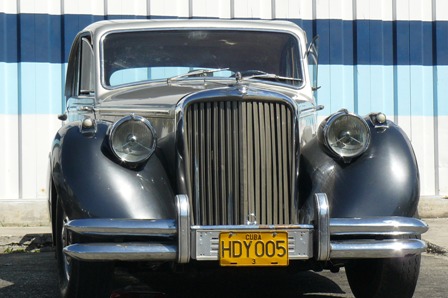
#3. Roll like a local. Long-finned Pontiacs, Capone-era Dodges, and other ‘Yank tanks’ leap to most minds when Cuba is mentioned. Undeniably cliché, these cars are everywhere, plying Havana’s streets working as communal, fixed-route taxis. For 10 pesos cubanos (about 0.40 USD), you can hail one of these endearing jalopies (I climbed into one yesterday that had packing tape upholstery and a ceiling lined with old refrigerator boxes) between Playa and Vedado or Habana Vieja, out to Miramar or Marianao. Longer routes – from Habana Vieja out to the Playas del Este beaches for example – will run double. To grab one, just stick out your arm parallel to the ground and ask the driver if he’s going to where you need to be. It helps to be on the right thoroughfare: 23 or Línea in Vedado, San Lázaro or Neptuno in Centro Habana, Avenida 31 or 41 in Playa, Calle 51 in Marianao, or 3ra Avenida in Miramar.
c. C Gorry

Even lower down on the transportation food chain is the guagua (pronounced wa-wa) – the Cuban bus. A ride literally costs pennies and while not especially comfortable or efficient, riding the guagua gives a real taste of Cuban daily life with all its attendant humor and hardships.

If these options don’t appeal, consider renting a car and driver. Part of the new regulations stipulate that licensed freelance drivers can now be contracted (by anyone, including foreigners as I understand it) to provide transport islandwide. There are no set fares, with rates to be determined between driver and client. Already nearly 6,000 choferes in Havana have applied for the freelance license; 2,000 have been granted. If the market has its way, the increased competition should make for more bargaining power and improved service. At the very least, it provides visitors an alternative to renting a car for $100 a day (which will somehow end up costing more when the agency is done with you). I predict that freelance drivers who speak English are going to do very well under these new regulations.

#4. Make yourself at home. One of the great benefits presented by the new regulations for travelers is the possibility to legally rent an entire house. This means you can shop at the agro (using those pesos cubanos) and cook for yourself, throw a dinner party, or introduce Cuban friends to the concept of brunch. Having your own private space means you can channel surf Cuban state TV (University for All! Little House on the Prairie! Seinfeld!), take mojitos on your porch to the delight of the neighborhood gossips, or stumble in carefree at 4am.

Another idea for a different Havana experience is to take lodging in more off-the-beaten-track places like the beach towns of Guanabo or Baracoa or Cojimar – the fishing village made famous by Hemingway’s Old Man and the Sea. These are close enough to enjoy Havana but just far enough removed to give a taste of small town life.

c. C Gorry

#5. Get primped & pampered. The new regulations approve all sorts of services which visitors can now enjoy without any sneaking around. Now your visit can include a 1-hr massage for $20 (really $10, but you might be charged double – the foreigner tax digamos), manicures for $2, and haircuts for $5 (careful with this last however).

If you’re interested to learn if someone – driver, masseuse, pizza maker – proffering these and other goods and services is licensed to do so, ask to see their licencia de cuenta propista. Most people are proud to flash their spiffy new ID cards.

#6. Spread the wealth. Frankly I weary of travelers asking me how they can avoid patronizing state businesses. That’s like asking how to avoid death or taxes. From the moment you buy your $20 tourist card to enter the country, to the minute you’re paying the $25 tax to leave, you’re supporting the Cuban government. What’s so evolved about this place is that paying into government coffers does in turn support the Cuban people (maybe not how or to the extent you’d like, but in my book the Cuban approach is fundamentally better than subsidizing bombs in Afghanistan and spies in Caracas). If you have a problem with this, do us all a favor and go to Cancun.

Having said that, I do recommend spending your hard-earned cash at a mix of state and private enterprises, but how to tell the difference? With eateries, there are some telltale signs. If your server is wearing a uniform or hairnet the place is probably state-owned. If your food descends from a balcony in a bucket it’s definitely private.

With taxis it’s even clearer: 99% of the old Motor City monsters (and many of the Ladas) brandishing taxi signs are privately owned. When in doubt, do like the Cubans do and look at the license plate (see note 5). There’s an entire code for plates here, with the first clue being the color: blue is for state-owned, yellow is private. All hotels, meanwhile, are at least 51% state-owned, but casas particulares (rooms or independent houses for rent) are privately operated. Look for the blue ‘arrendador divisa‘ sign.

c. C Gorry

If you’re interested in learning more of the Havana ‘mécanica‘ including bus and fixed-fare taxi routes, the best spot for 75 cent whisky shots and $1 lunch, Cuban line etiquette and more, please check out my iapp Havana Good Time.

Notes

1. It’s highly doubtful we’ll reap the same benefits however: when Cuba hosted the meeting as is customary for the country holding the rotating presidency, Havana’s main roads were repaved, trees were planted (including many of the trees lining Boyeros every visitor zooms by on their way from the airport) and house facades all along the arrival route were painted up nice and spiffy for the visiting delegations.

2. These 7-day all inclusive deals are oftentimes cheaper than just a Toronto-Havana Cubana flight. Savvy travelers just book the package and stay a day or two at their resort and then travel independently. As an aside, tourism figures for January indicate a 16% increase for the same period last year. Top countries visiting Cuba: Canada, Italy, Germany, France, Russia, Argentina, and Mexico.

3. I say travelers here instead of tourists because I believe there is a fundamental difference between a person who passively observes a culture and someone who desires to actively participate in it. If you’re one of those disposed to take issue with the tourist vs traveler terminology, I invite you to focus on the phenomenon/philosophy I’m talking about rather than the etymology of the terms used to describe it.

4. Those interested in Cuban slang and phrases should check out this Dichos iapp. I haven’t been able to get it yet (the US government blocks iTunes from operating in Cuba) but am loca to try it.

5. This national reflex is widespread and wild to watch: no matter what type of car you’re in, observe how passing Cubans immediately drop their eyes to check out the license plate. Via the coded plates, they’ll know if your car is from Havana or the provinces, whether you’re a foreign resident or visiting, even if you work for the state, a mixed Cuban-foreign enterprise, a church or an NGO.

37 Comments

Filed under Americans in cuba, cuban beaches, Cuban phrases, dream destinations, off-the-beaten track, Travel to Cuba, Uncategorized

Always the Outsider Inside Cuba

[tweetmeme source=”connergo” only_single=false]

Maybe it’s me, but certain zingers people have sent my way 10, even 25 years ago I just can’t shake (note 1). There was the time in elementary school when the Mean Girl said: ‘ever wonder why you have no friends?’ I responded: ‘I have friends you don’t even know about.’ Pretty clever in my 10-year old estimation, but she didn’t miss a beat. ‘That’s because they’re imaginary.’ Ouch.

Then, some years later, a different Mean Girl (yeah, I was the one everyone loved to pummel – metaphorically and literally), shot my ego to shit when she told me I’d be better looking as a guy. This memory floated to the surface when I was covering the Cuban disaster team in Haiti and a doctor in our camp nicknamed me Tom Cruise. He meant it affectionately and now we’re friends, but it kicked up the dust in that toxic corner of my consciousness.

 As an adult, here in Havana, what sticks with me is something a stranger said back in 2003. I was researching the Lonely Planet Cuba guide and had rented a car for the eastern portion of the trip. I was in Santiago de Cuba, the heroic city, when I went to return the rental. I still had half a tank of gas, for which there would be no reimbursement. Claro que no. So I walked up to a group of guys clustered around a Lada drinking beers (a popular pastime on this side of the Straits) and proposed selling them the half-tank of gas I wouldn’t be needing.

 “Where you from?” one asked me.

 “The United States.”

 He whistled and cracked his index and middle fingers together in that rapid-fire way Cubans have that looks like they’ve burnt themselves and sounds like bubble wrap popping. “A yuma who knows our mecánica. ¡Peligroso!

And he and his buddies proceeded to siphon my tank.

I was getting it, beginning to grok how this place works. My gas buyer in Santiago called it dangerous, but I considered mastering the mecánica as my first step towards integration. The first sign of acceptance.

 How much I still had to learn…

_____

 Some 8 years on, I have a different perspective. Today, despite my mastery of many things Cuban, it feels less like acceptance and more like I’ve got partial membership in a club dubious of my credentials. A club, furthermore, which doesn’t extend full membership to any foreigner, ever (El Che and Máximo Gómez notwithstanding). The heart of the matter is the unalterable fact that I’m not, nor will I ever be, Cuban. Consider the saying:  ‘those who aren’t Cuban would pay to be’ and you have an idea of how deep nationalist pride runs.

I’ve got some things working against me to be sure. First, I’m blonde-haired and blue-eyed, making it impossible for me to “pass” as Cuban (at least in Havana; see note 2). Thus, my outsider status is constantly called out. I’m also from ‘los Estamos Jodidos‘ as my friend Mike likes to call los Estados Unidos (see note 3). Hailing from the nasty north carries its own particular baggage in the Cuban context – some good, lots bad – and I pay in a way for that too.  Lastly, I’m from New York, a city that makes you feel if you can make it there, you’ll make it anywhere (except maybe in Havana ironically). When someone takes me for a mark or accosts me on the street like happened last week, it’s an insult to my hometown, as if the archetypical concrete jungle didn’t properly prepare me, as if my urban armor were insufficient (see note 4).

_____

In the peculiar social hierarchy that reigns here foreigners are on the bottom rung. It doesn’t matter how long you’ve been here – even friends who’ve clocked 20 or 30 years in Havana struggle with this reality to some extent or another. It’s damn disheartening. And it doesn’t matter how much money you have either since everyone will assume you have mucho.

Allow me a moment to vent about the ‘all-foreigners-are-rich’ stereotype that dogs me. This is an assumption I confront everywhere, every day. In the street and at the market; in conversations with friends and encounters with colleagues. I hate to say it, but this myopic view exposes the ignorance many Cubans have of the real world – that world beyond free education and heavily-subsidized housing, electric bills of 35 cents a month and nearly gratis public transportation.

For me, this rich foreigner perspective is akin to the ‘Kmart is cheaper than the farmers market’ argument: when you factor in all the health, environmental and transportation costs Kmart lettuce is actually much costlier than a similar head bought from farmers. In my case, when you factor in the $60,000 of student loans I’m still carrying, the 30% the US government takes in taxes, plus the 20% cut the Cuban government takes in the exchange rate, my earnings are actually quite paltry. And let’s not forget: la yuma doesn’t have a ration card. (Soon few will, but that’s another post.) I realize I’m better off than some, but I’m also worse off than many others, something beyond comprehension here apparently.

It’s not that I expect Cubans to understand my situation – most know not the wrath of the tax man and certainly nothing of the student loan burden. But just once, I’d love for someone to understand that there might be other factors at work, that I’m not the goose that laid the golden egg or an ATM with legs.  

In my youth, I was often told I was spunky, a girl with pluck. Here, (as recently as last week), I was said to lack ‘guara‘ – another of those impossible to translate Cubanisms, but pluck and moxie come pretty close. What is it about this place that makes me feel like I’m 12 again, beating back the Mean Girls every day after school? Is it like this for all foreigners living far from home I wonder? Drop me a line with your experiences; I’d like to hear other viewpoints and try to ratchet down this loneliness a bit.  

Notes

1. I wish our mental hard drives had a ‘delete permanently’ function. Yes! Send to trash, damn it!

2. There are plenty of people who look like me here (thanks largely to French immigration in the early 19th century). Unfortunately, the majority of them are in Holguín and other points far to the east.

3. I’ve always loved this play on words which more or less turns the ‘United States’ into ‘We’re Screwed.’

4. I did open up a big ole can of NYC whup ass on the guy that grabbed me from behind, thrusting his hand between my legs. He was scurrying away fast when I was done with him, but that and a couple of bucks will get me on the subway.

60 Comments

Filed under Americans in cuba, Cuban customs, Cuban phrases, cuban words without translation, Here is Haiti, Living Abroad, lonely planet guidebooks

Drinking the Capitalist Kool-Aid in Cuba

[tweetmeme source=”connergo” only_single=false]

I’m not sure what news about Cuba is being made over your way, but I assume you’ve heard changes are afoot. I’m talking big, game-changing adjustments that surely have Che spinning in his grave (to say nothing of Marx and Lenin). The reasons are many and complex why I’ve put off writing about “the changes” (sounds like a euphemism for menopause which isn’t a bad metaphor for today’s Cuba I should think) but suffice to say, I can no longer keep quiet.

A sort of financial shock therapy, these changes are deeply personal and downright frightening for many Cubans. However necessary (and dare I say it?) inevitable, the greatest free market experiment since 1959 is a sink or swim proposition: if it does work, Havana will start looking more like Santo Domingo or Miami. But if it doesn’t work, millions of people will bear witness to generations of work going down the tubes.

This predicament, the very real possibility of economic failure translating into socio-political failure is causing anxiety, anger, breakdowns and break ups. Of course, the changes give hope to some, but I’m not among them. From where I’m sitting, they’re an unworkable solution. Salvaging the Cuban economy by allowing private enterprise and other too little, too late measures is an impractical workaround I call ‘Shutting Barn Door, Horse Long Gone’ (see note 1). The Cuban economy was, is, and always shall be struggling. It’s geography, politics, history and fate. It’s The Way it Is.

So I take exception to the theory and the timing. But even more so, I question the mechanism. Pandora’s Box is being thrown wide with this headlong dive into the shallow end of the free market pool. I call this last gasp for cash ‘One Foot on the Slippery Slope.’

I’m a capitalism refugee. I know viscerally that money is the root of all evil. It corrupts, ruins friendships, ruptures families, crushes love, and damages the environment. And make no mistake: this genie has a one-way ticket out of his bottle.

A fascist anti-materialist (see note 2), I moved to Cuba in part to escape the unchecked consumerism and dollar lust that grips my old world. An error in judgment, faulty analysis or both since I quickly learned that money and stuff (along with sex, transportation, and protein) are uppermost in Cubans’ minds; in fact, most days are dedicated to their pursuit. Still, I loved how time was made for friends and conversation, how freely people shared. This will all roll away down the Slippery Slope once the real money lust sets in, I’m afraid. When taxes and employees and suppliers must be paid and profits are squirreled away for baubles – this is when things will get ugly de verdad.

Already the fury for iPods and 2 inch acrylic nails, nights dancing at the Salon Rojo, navel piercings, and tramp stamps (see note 3) are eroding values and substituting style over substance, form trumping function. The market, I have no doubt, has the unique capacity to undermine most everything the Cuban revolution stands for.

The feeding frenzy is already in full scrum. I have friends who procured licenses under the new regulations to train dogs, sew and sell dresses, and even make ice – home delivery extra. In any neighborhood nowadays I can browse CDs & DVDs, shoes, guayaberas and house wares set out for sale on people’s porches. Every few days, an old guy walks my block shouting: “I buy empty perfume bottles.” I guess I should be glad that Havana garages hold perfume factories instead of meth labs – for now at least.

What scares me most is the fundamental economic concept of supply and demand: if there’s enough of the latter, someone will step up to provide the former. And if there’s one thing we have a surplus of here, it’s demand. I call this the ‘Special Period Hangover’ (see note 4).

Worrying me these days is more than the simple human desire for things. It’s the confluence of factors making free market free-for-alls particularly toxic and potent here: the US embargo which keeps Cubans in a permanent state of want and need; the indelible psychological effects of the Special Period; the new opportunities to amass cash; and the myriad different and novel ways to spend it.

Now, before you get your knickers in a twist, let me say that I fully and clearly understand how easy it is for me to disparage the lust for stuff, having had my chance at it. But I feel nauseous when I think about this socio-economic ‘perfect storm’ and what it means for the future – our future – the future being forged for Cubans, by Cubans.

Consider what I call the ‘Miami Effect:’ throughout southern Florida and especially in Miami, there are businesses dedicated to renting thick gold chains and ghetto hoops, rings for every finger and gold-plated watches – all gauche to the extreme. Men’s signet bracelets are also in high demand at these shops which exist solely to rent gold and bling to Cuban Americans returning to the island to visit friends and family.

Who cares if the 14k bracelet says Tito and your name is Yamel? The important thing is to arrive in Havana (or Holguín or Camagüey) looking like an old skool NY guido who just hit the Lotto. Thanks to these businesses, you can achieve your look at a reasonable price (just don’t forget to relinquish those jewels upon your return). Has it not dawned on these folks that their money is better spent on cooking oil or a pair of decent sheets for family back home? Maybe some quality sponges, batteries or other utilitarian items every Cuban home needs?

I invite my readers to take a moment to ponder the absurdity of a poor person visiting even poorer people and budgeting for bling (see note 5). I mean, I know ‘form follows function’ is a foreign concept in Miami, but this boggles the mind. And it scares me that this is part of the Cuban character. This type of materialist twist and bent is my nightmare. After 9 years in Cuba, I dread waking up to it.

A friend said to me years ago that if the Yanquis want to kill the revolution, all they have to do is drop a jabita stuffed with Levi’s, Converse, and Lancôme at every doorstep and everyone will roll over. I hope she’s wrong because that is just too fucking depressing.

Notes

1. Surely Cubaphiles will have caught the double meaning here: Fidel is sometimes referred to as ‘el caballo.’

2. For example, my blood pressure spikes when I watch my neighbor walking her two Siberian Husky puppies – the new breed of choice down here. I find it cruel and unusual for these dogs to suffer a Havana summer just because their owner wants a couple of status symbols. Then there’s all the kitschy Ed Hardy knock offs that make me shudder and groan. Maybe I should start importing Bedazzzlers – the Cubans will go gaga over a tool that allows them to bling everything from baja chupas (tube tops) to blumers (underwear). To get a better understanding of just how anti- I am about all this, check the Church of Life After Shopping link on my Blog Roll.

3. To put things in perspective, consider what these non essentials cost here on the average Cuban salary: iPod = 4 to 20 months salary; acrylic nails = 1 month’s salary; night out at the Salon Rojo = 2 months salary (minimum); navel piercing = 2 weeks salary; tramp stamp = 1.5 months salary.

4. Once the Berlin Wall fell, Cuba’s almost total economic collapse was swift. Nearly 85% of foreign aid disappeared, Cuban adults lost 20 pounds on average and the first experiment with private industry was launched. This era (1993 to depends-who-you-ask) was dubbed ‘A Special Period in Time of Peace.’

5. I welcome input from other immigrants and expats – have you found this to be true of folks from your country or where you live?

63 Comments

Filed under Americans in cuba, Cuban Revolution, Fidel Castro, Raul Castro

Those Faithful Cubans

[tweetmeme source=”connergo” only_single=false]

Back in the 1850s, when everyone from priests to sugar barons were fighting for their piece of the pie (and their piece of mulatta ass, let’s be frank), this island was known as “la siempre fidelísima Isla de Cuba.” The forever faithful island of Cuba.

As a yuma married to a Cuban for going on nine years now, I can tell you this fidelity question has nagged me long and hard. And I’ve finally reached the tipping point. It took some time, though.

I remember when I was a tenderfoot on these shores – all bright-eyed and basking like a well-fed turtle, not bothered by termites in my bed or even reggaeton (see note 1) – and how much I still had to learn. On one of those fine sunny days way back when, I was seaside with some friends (a pair of ex-pat Europeans who bailed long ago) having a few cold drinks and taking the ocean air.

‘But don’t you wonder where he was?’ my friend asked. She’s one of those naturally beautiful, smart women who always seems to get what she wants even when she’s not entirely sure what that is.

‘Nah.’ I said. ‘I trust him implicitly.’ Did I really just say that? More to the point, do I really believe it? Me, who has only trusted implicitly five people my whole life, four of whom share my last name? It slipped out, but it was true. At least I wanted to think it was true.

The distinguished gent across from me, a rich well-traveled Turk who was living in Cuba on a lark, raised his eyebrow and his glass. ‘I wouldn’t trust anyone here implicitly, querida,’ he said sipping his Bucanero.
_____

It was my first summer here – 2002. I’d never even seen a spit-roasted pig or the inside of a hospital (see note 2) and my husband and I were spending August camping around the island. I was blissfully unaware of the depth of my ignorance about Cuba – had I known then what I know now and I had known how confused I’d still be all these years later, I may have run away and quit before my Cuban odyssey ever really started.

The car packed high with tent and stove, kitchen kit and several gallons of water, we went way off the beaten path. Making our way across the country we’d just pick a place on the map and go. This is how we found ourselves kicking up dirt on a deserted road heading towards Punta Covarrubias in god forsaken Las Tunas (see note 3). We saw nothing for miles – no birds stirred the air, nary a lizard snuck out his tongue. Not one car or person appeared in the 90 minutes we were on that rutted road. Finally the sea grew into view and with it came gales of laughter.

When we pulled up between pines as thin as a Cuban campesino, we saw a panel truck and a party in full swing. The beach and lone hotel were deserted – closed for the season or some other confounding Cuban reason – but these folks had come to let their hair down and hot dog!, roast a pig.

My husband busted out a bottle of rum and we took turns rotating the pig. Dominos materialized of course. We got to know our hosts in that way Cubans have of making fast friends. They were lovely people, country folk who worked hard and had the calluses to prove it. With the sun dipping low, we swapped addresses (none of us had phones in our homes) and I promised to send Eliades the photos we’d taken.

“On no! Don’t send them to me. My wife will kill me if she finds out!”

And here I’d thought the buxom brunette with the sunburned collarbone he’d been fondling all day was his wife. Silly me.
_____

Not long thereafter, I was on the 100 bus going to a meeting. It was one of those oppressive Havana days when tempers are short, the sun’s rays are long and you’re sweating as soon as you step from the shower. In sum, a typical July day in these parts. The 100 bus, I should mention, ‘tiene sus cosas‘ as we say here – it has it’s thing going on.

This bus runs through Marianao – a very working class, very black neighborhood run thick with bling and babalawos – from where it descends to the seashore in Miramar. In summer, this bus is an asses to elbows, hips to groin crush of humanity desperate to get to the “beach” (no sand, just a nasty species of shoreline rock known as diente de perro). At these times, boys ride the 100 shirtless and the girls are more scandalously clad than usual (if that’s possible). It’s so crowded daredevils hang from the windows, hitching a ride from the outside.

On this day, I was all up in it inside the bus. There was no choice but to squash up against the strangers squeezing in around me. I tried to angle away from any erogenous zones – theirs and mine. As we crossed Calle 51, the crowd crushed in tighter and I felt a warm rush of air on my face.

“Come to the beach with me baby,” a young, chiseled guy chuffed in my ear. I turned away, making sure to steer clear of his bulge.

“I don’t think my husband would approve,” I snapped.

“You’re married? So what?” the kid responded, pressing in tighter against me.
_____

Some years ago, I was let in on a secret. It wasn’t really a secret (a concept which is completely foreign to most Cubans) but rather one of those things that people know about but no one mentions: the two family phenomenon. I had drawn breath 32 years before I’d ever known that there were men who keep two families. Not Big Love style, but two secret families – one on one side of town, the younger on the other.

I have one friend, the poor soul, who discovered the ignoble injustice as her dearly beloved lay on his deathbed. On that day, she had brought him his breakfast and coffee just like every day since he had been hospitalized. She kissed him goodbye and turned to leave just as a second woman came in, breakfast and coffee thermos in hand, trailing two kids. The Other Wife with The Other Children who had no idea they had a half-brother and -sister on the other side of town. The bastard died not long thereafter. My friend and I don’t talk about it.

The same thing befell another friend, Josue. As an adult, he discovered his father had kept another family secreted away, also with kids – two brothers Josue spent a whole life not knowing.

I wonder about men who are so weak and insecure they need two women, two sets of kids, two lives. I imagine it must be extraordinarily stressful and hard to keep straight. I wonder how they look themselves in the mirror.
_____

Don’t believe for a second it’s only the men. Rosario is a perky (natural) blond with the hips of a mulatta and the ass of a negress. Her husband Julian is not only hot, he’s a talented, super successful musician to boot. They have a beautiful son together. One morning Julian woke up to an empty house. Turns out Rosario had married a Mexican on the side to leave the country and took the boy with her. She ditched the Mexican as soon as possible of course; she and the boy now live in Miami.

And what I’ve seen during my work abroad, covering the Cuban medical missions? Por favor. These folks serving two years in godforsaken places are like sailors on shore leave the way they hook up with one another. And the longer and harder the posting, like Haiti or Pakistan? Let’s just say it’s far from ‘la siempre fidelísima Isla de Cuba.’

For someone like me, faithful as a damn dog, this is all pretty disturbing. What does ‘faithful’ mean here, I wonder? Does it even translate? Does giving head count as cheating? Getting it? How about a mercy fuck? I’m not sure I want to know. What I do know, now that I’ve learned a little about Cuba, is that I wouldn’t necessarily say implicitly…

Notes
1. For the record, I have always been bothered by cold water showers and turds at the beach.

2. Since then I’ve been regularly employed as a journalist (take that OFAC!) by MEDICC Review which has thrust me inside all sorts of Cuban hospitals – from pediatric to post-disaster.

3. Very near here is one of the points of highest illegal immigration to the United States in all of Cuba. So common and scheduled are the super fast speed boats that pick up Cubans to zip them across the Straits to Florida they’re called ‘Yutongs’ – our equivalent of a Greyhound.

191 Comments

Filed under Americans in cuba, camping, Cuban customs, Cuban phrases, Living Abroad, off-the-beaten track, Relationships

Driving Eleggua: Adventures at the DMV, Finale

[tweetmeme source=”connergo” only_single=false]

Countdown: 15 Days to Departure

I got all my mojo working the morning of the road test. I donned my lucky Argentinean underwear, wore my St Christopher’s medal tight around my neck (see note 1), and insisted my beloved husband not accompany me. That’s all I needed. It had taken me two tries to pass the written and the aborted attempt at the road test the day before had pushed my panic button. My time was running out; I needed this driver license.

My friend Angela arrived in her car and we stood around chatting with the other would-be drivers while we waited for Oswaldo The Road Test Cop. He sauntered up late and nonplussed. I looked him in the eye and smiled.

‘Remember me?’ that smile said. Today’s the day.

I knew the drill but gathered in close with the others to listen to his pre-test spiel. I wanted to show him I was respectful and ready. That I meant business. I waited my turn and handed over the required documents: my Cuban ID card, plus Angela’s license and registration. Oswaldo looked them over, plucking Angela’s license from the fan of laminated cards in his hand.

“She can’t be your representante. You need someone with a Cuban license” (see note 2).

I had asked my husband precisely this the night before.

“You’re worrying too much. She can be your representante and you’re going to pass,” he had assured me.

Turns out Mr. Know-it-All was wrong on both counts. Angela couldn’t represent me and the Po Po Cubano didn’t take kindly to me asking the gathered crowd if anyone was willing to stand in for Angela. In the end, a co-worker of my husband’s came to my rescue, but by then my nerves were shot; I didn’t make turns at a true 90° angle, I parked incorrectly, and even confused third gear with first when pulling away from a stop light. It was a disaster and Oswaldo flunked me.

“Practice your turns, pay better attention to how and where you park, and come back next week to try again.”

I was disconsolate and walked home choking back tears. I finally let them pour once I was safely inside. The stress was killing me. Worse, I felt really, really dumb. After all, I’d been driving for years.

Countdown: 8 Days to Departure

I practiced all week. I re-conned the route, memorized the one- and two-way streets so I’d know where to park (see note 3) and familiarized myself with Angela’s Kia. I enlisted my friend Camilo the taxi driver to be my representante.

To be honest, I was a complete mess. My work depended on this license, my backup plan had totally backfired (the jalopy of a truck I was going to “rent” from a friend had blown a fuel pump), and I had no Plan C. I stayed awake at night or woke in the middle fretting about the license, my job, and our financial future. I was nasty that week, fighting with my husband and myself. My stomach permanently ached.

I did breathing exercises. I visualized myself on the tropical balcony of the Cuban DMV receiving my newly-minted driver’s license. I did everything short of pray (and even considered it).

All for naught.

I hesitated when I had the right of way and was snookered anew by the tricky parking question. Oswaldo could have passed me had he wanted but he didn’t. Was he looking for a bribe, or did he just have it out for foreigners I wondered? Either way, I was really up that proverbial creek; my departure was in eight short days and I had only one more chance to pass the road test.

“You’re right: we need to name the car,” Angela said to me when I told her I’d failed. Last week I’d asked her if her car had a name – I felt the need to talk to it, commune and communicate with the mechanical beast.

We agreed the car was male since it was presenting so many difficulties.

“It has to be a good name, a powerful name,” she said to me. “I know! Eleggua!” (see note 4).

I quit practicing the exam route – You’ve been driving for years! I told myself. You have real life experience; you don’t need practice! Still, I slipped a 50 CUC note in my pocket just in case wheels needed greasing (see note 5) and I switched up my representante. This time I took my own weapon: Eliseo, a retired top cop and dear friend. Aside from being an all around great guy – what Cubans call un pan – maybe Eliseo could give Oswaldo some special cop handshake or eyebrow wiggle or something. Couldn’t hurt I figured.

Countdown: 1 Day to Departure

On my last try, I showed up more resigned than nervous. The world wouldn’t stop turning if I didn’t pass the test. I was healthy, I was loved, so whatever. ‘It is what is,’ as Mom would say.

Eliseo and I waited for Oswaldo with yet another group of wannabe drivers. Seems a lot of drivers fail this road test: I recognized the trucker from the week before and a kid with his jeans slung so low I could see his bad Job Boxer knock off underwear.

‘When I was practicing for the test, my uncle set a tiny cup of coffee on the dash and said ‘Drive. And don’t spill any!'” one guy said.

“I screwed up on the parking the first two times I took it,” said his friend.

I looked at Eliseo.

“Don’t worry muchacha. You’ll be fine,” he reassured me.

“Here he comes,” someone said and we all looked over to watch our examiner approach. To my horror, it wasn’t my old buddy Oswaldo. My stomach knotted. My palms grew slick.

Our new examiner took us through the same orientation song and dance as Oswaldo, asked if we had any questions and proceeded to inspect the cars – checking that the blinkers and brakes were in good working order. He then told us we could have our representante in the car if we were nervous.

Eliseo hopped in the back seat. I gave Oswaldo’s substitute my winningest smile. I drove Eleggua down and around the block, pulling over and parking at the curb when told to do so. I looked over at my examiner.

“You drive beautifully,” he said. “Congratulations.”

Within 20 minutes I had my brand spanking new Cuban license. Tomorrow: Hawaii (see note 6).

Notes
1. I’m more superstitious than religious, but he is the patron saint of travelers.

2. Angela has been based in Cuba for nearly two decades, but never switched over to a Cuban license, preferring to maintain her US license. Smart lady.

3. This is one of the tricks these driving cops use to fail folks: they take you down a one-way street with cars parked every which way on both sides and ask you: ‘which side of the street will you park on?’ Of course it’s the left, but it gets tricky with Havana’s poor signage and cars parked facing forward and back on both sides of the street. “They can park illegally,” Oswaldo told me as I hesitated. “They have their license. You don’t.”

4. In the Afro-Cuban religion of Santería, Eleggua is the trickster god, but also the god who opens pathways, broadening horizons so to speak. Coincidentally (or not), a babalawo once told me that Eleggua was my guardian god.

5. I’m terrible at this kind of thing and offering a bribe in Cuba always carries the risk of backfiring. See other readers’ comments and ideas on bribing Cuban officials here.

6. Those of you following this saga may have been wondering – where is she off to and on what assignment? I’m currently on the Big Island of Hawaii updating the Lonely Planet guide to that wild and wonderful place. And check it out: you can both rent and drive a car in the United States with a Cuban driver’s license (well, in this state anyway).

8 Comments

Filed under Americans in cuba, bureacracy, Living Abroad, Uncategorized

Here is Havana in Stellar New eBook

[tweetmeme source=”connergo” only_single=false]

Hi folks and sorry for the absence. Ive been watching live lava and baby dolphins a-leapin’ and a-spinnin’ on another far away isle lately (post coming soon on these adventures!). In the meantime, I wanted to let you know that Stephen Roll of Travel Ojos has just published a fantastic eBook entitled Celebrating Latin America at Ground Level. There is some terrific writing in here, by people who are living the dream (and occasional nightmare!). Here is Havana represents with an entry entitled “La Gente.”

The best part? The book is free! just click: Celebrating Latin America at Ground Level.

Adventures at the DMV: The Finale coming soon. Stay tuned and thanks for all your support!

2 Comments

Filed under Americans in cuba, Living Abroad, Uncategorized, Writerly stuff

The Road Test: Adventures at the DMV Part II

[tweetmeme source=”connergo” only_single=false]

So I passed the written – a test my friend Pilar called “easy” but which took me a couple of tries (while my ego took a beating) to master. In the end, I’d triumphed. I’d passed; the hard part was over. I had my Cuban driving permit. I wasn’t a bit worried about the road test – I’d been driving for years before my US license expired, including in Havana. It was just a formality.

Famous last words, as Mom would say.

Countdown: 16 Days to Go

Our friend Camilo stopped by for a visita on the eve of the road test. This was serendipitous. Camilo is a professional taxi driver and an old hand at Cuban rules of the road.

“You’ll be fine – just be careful how and where you park. They like to get tricky with that.”

This gave me pause.

“How about the car I’m using? Does it matter that I’m taking it in kind of a clunker?” It wasn’t one of those Meyer Lansky-era jobs mind you, but a car with sus problemitas nonetheless.

“As long as it’s manual – you can’t take it in an automatic. And make sure the emergency brake works. They won’t let you test if it doesn’t.”

The emergency brake, of course, was the car’s major problemita. It was totally flojo, flaccid. Stopping that car with the emergency brake was like trying to shoot pool with a piece of rope.

Sleep was elusive that night. I could blame the refurbished mattress, but my tossing and turning and anxious sighs were caused by images of loose emergency brakes and personal failure followed by financial ruin.

We arrived bright and early the next morning at the police precinct parking lot where the road test began. My stomach was in knots and my eyes had the itch and irritation of insomnia – allegories for my mental and emotional state. It wasn’t yet 8:00 am and already three were three testees, plus their representantes – those folks who drove us to the test and would perform the car inspection before setting out. I took el último. We chatted to pass the time. My hyperkinetic, chain smoking husband did little to allay my nerves.

My heart was beating faster than is normal or healthy when Oswaldo, our examiner (or inquisitor, depending on how you look at it) strode up. He gathered us around and explained the exam. He reviewed common mistakes and what skills he’d be looking for.

“Any questions?”

“If we fail today, how soon can we come back to retake the test?” I asked. My clock was ticking faster than a childless 40-year-old with maternal tendencies and I needed to know exactly where I stood.

“You have to wait a week and can only take it three times. If you fail all three times, you have to wait a year before taking it again and then you start from zero, with the written.”

He asked for all the candidates to step forward with their documents. I was the lone foreigner. There were some younger folks with their bling and blasé attitude, plus an army guy (see note 1), a truck driver, and a tall dreadlocked dude with an extranjera girlfriend so butt ugly she could have cracked a mirror (see note 2).

Oswaldo asked each representante to take the wheel of the cars we’d be testing in to verify that the blinkers, brake lights, and emergency brake were in working order. My husband tossed his smoking cigarette aside and got in the car.

“Accelerate and pull the break,” he was instructed.

He did so. Oswaldo looked at me.

“Back up and do it again. Without stepping on the brakes this time.”

The love of my life did as he was told and coasted to a stop too many yards away.

Oswaldo shook his head. “You can’t take the test in this car. Can you find another?” I told him we would.

My husband called his office and they sent over an even older car that rattled when it rolled. Now I had sweaty palms to go with my irregular heartbeat. This car, not surprisingly, also failed the pre-test inspection. I was starting to get seriously worried. My Plan B – tossing a buddy of mine a “Benjamin” every week for use of his jalopy truck during my assignment abroad – was tenuous at best and I there was no Plan C. I walked home steamed.

After raging against my husband’s shitty work vehicles to our empty living room, I gave my good friend Angela (she of the Cuban Thanksgiving) a call. She had a nearly new Korean jobbie – small and simple – that I was sure she would lend me. She’s solidaria like that. Not only did she agree, she came over later that afternoon so I could give it a test drive.

“Does your car have a name?” I asked her once I was behind the wheel.

She looked at me as if I’d asked her to join me on a stroll of the Malecón with an ‘abajo el socialismo‘ sign.

“It’s just that I know a lot of people who name their cars: Bruce, Chico, Rocinante. That way you can talk to them – maybe cajole them into behaving better. Kind of like plants or kids.”

I took Angela’s no name car for a spin and it felt like I always did behind the wheel: like an experienced driver. We agreed to meet the next morning in the police lot.

Stay tuned for Part III of Conner’s Adventures at the DMV.

Notes

1. I steered clear of any chit chat with this fellow for his sake: all members of the Cuban armed forces who come in contact with a foreigner – even inadvertently – must file some ridiculous paperwork about the encounter. I learned this one day as I sat on my friend’s couch when her nephew dropped by. He was in uniform and tried to hightail it out of there before he was compromised, but too late. This regulation of contact with foreigners is why folks in uniform looking for a botella (hitchhiking – common throughout Cuba) won’t get in your car if you offer them a ride.

2. It’s not my style to notice – much less comment – on someone’s physical appearance (beauty is on the inside after all) but this woman was extraordinarily, exceptionally ugly making me think other factors were likely at play in this Cuban-foreigner hook up.

9 Comments

Filed under Americans in cuba, bureacracy, Living Abroad

Cubans Do it Better: Adventures at the DMV Part I

[tweetmeme source=”connergo” only_single=false]

I’ve never been a fan of the DMV. There’s the bureaucracy of course – a paradigm of grouchy inefficiency with which I’m sure you’re familiar – but it’s more than that. It’s too many hoops to jump through and rules and the petty (but potent) power wielded by the cogs in the department of motor vehicles machine that chap my ass.

So when my US driver’s license expired, my gut seized up and more hairs grayed as I imagined the horror of the Cuban DMV (see note 1). The adventure started when I tried to get a copy of Ley #60 – Cuban rules of the road – to study up. The DMV didn’t have any and after a brief consultation, the nice lady cop suggested I check across town at the driving school.

I hoofed it over there in a McCarthy-era Dodge and walked a dozen long, hot blocks under a blazing Cuban summer sun only to have the dark, heavy-lidded compañera at the reception desk inform me that they didn’t have any. After almost nine years in Cuba, I know not to ask ‘why?’ But my disappointment must have showed, for the desultory lady livened up to say: “the new regulations are being implemented. The books are being printed up now.”

“and they’ll be ready?…”

The somnolent curtain descended again and she shrugged. After a moment she offered to transfer a digital version of the old road rules book onto a memory stick if I had one.

I didn’t.

So it was back to the drawing board, which meant I’d have to go about things ‘a lo cubano‘ or ‘por la izquierda‘ (see note 2). An Internet search brought up Ley #60 (all 67 pages of it) and friends supplied the same classes and practice quizzes given at the fancy, hard-currency driving school.

I set to studying.

Some of the Spanish tripped me up (I had never had cause to use the word contén and can anyone explain to me in plain English the difference between a remolque and semi remolque?!) but luckily, Cuba is a signatory to the 1949 UN Convention on Road Traffic, so most of the US road rules with which I’m familiar applied. I skimmed the rural transit section – surely I don’t need to know the tare weight of a tractor trailer or speed limits for horse carriages. I took the quizzes, did OK, and readied myself for the written exam (see note 3).

I arrived bright and early – a bit nervous, but excited. For no reason, it turns out: the computers were down. I’d have to come back the next day. “Or better yet in two,” said the cop with the boyish good looks and tender smile. He was easy on the eyes even as he delivered the bad news.

My time was running out you see and this unforeseen delay was deeply troubling. I was due to leave soon on assignment and I would have to cover a lot of ground, in a context where a car is compulsory – think LA or the French Riviera. I needed this gig. We needed the money. The debt I imported from my life “before” in the US continued to grow (see note 4) and my income wasn’t keeping pace. This was our money for most of 2011. I couldn’t blow it. I had to get that Cuban license.

Countdown: Four Weeks

I returned two days later to take the written. The system was still down. I asked the comely cop for a phone number (no, not his – faithful readers of Here is Havana know I’m hopelessly devoted to my husband) to call before trudging over again. I phoned the next day to see if thee system was up and running.

Game on.

The waiting room was archetypical Caribbean, sporting coral-colored walls and a phalanx of tropical plants leading to the balcony where new drivers awaited their laminated, holograph-imprinted licenses. That balcony was my goal. Poco a poco.

I waited to be called into the exam room. A nearly life-sized poster of Raúl loomed above me. He wore his poker face and olive greens, but somehow remained avuncular in a way that Fidel can be but isn’t often. The quote emblazoned in red below brother Raúl was new to me: “gossip is a divisive and counterrevolutionary act.” Here was a man after my own heart.

I was summoned into the exam room and let the AC wash over me. A dozen computer terminals occupied by wrinkled grandpas and young studs in bad Hugo Boss knock offs lined the room. This was much more high tech than I expected and more modern than I was used to. All around me I saw furrowed brows punctuated by nervous laughter. Men outnumbered women four to one.

I sat at terminal 3 and began the test. I knew most of the answers but not all. The Spanish was somewhat confusing and I second guessed myself. I got the question about tractor tare weights and failed by one wrong answer – just shy of the required 75 points to pass. Another setback. More stress, which grew when the proctor with a keen eye for cheaters (and there were several) told me I had to wait a week before I could take it again. No exceptions. No overrides of the computer system.

“Study up and come back next Friday at 11am when I start my shift.” Was that a wink or a nudge I saw when she said that? I certainly hoped so and planned to show up next week with a package of high quality, hard currency coffee for the affable cop proctor.

Countdown: Three Weeks

I read every word on each page of the 67-page long law. I highlighted tricky concepts and took copious notes. I checked terms with my husband I didn’t understand. One sign – described, but not pictured anywhere – was a complete mystery to everyone we consulted. It had something to do with railroad crossings, we got that much, but otherwise was a complete puzzlement. The written exam always had a ‘what does this sign mean?’ question, but what were the odds I’d get this one?

I returned the Friday following nervous, but more confident (the coffee weighing down my handbag helped). I hailed Raúl and his sage words for all the revolutionary chismosos and strode into the exam room. The nice proctor was nowhere in sight. I felt stood up and doubted the policewoman with dyed jet black hair and fire engine lipstick would be as kind.

‘Focus, Conner, focus,’ I admonished myself.

Elvira’s Cuban cousin left the room and the kid on my right with a marijuana leaf belt buckle as big as my palm began feeding answers to his socio on my left. Really? Cheating on the DMV permit test? That’s unethical and dangerous; I don’t want to share the road with the idiot that needs to cheat on the written. Should I tell Elvira, I wondered?

‘Focus, Conner, focus.’

Then came question 11. It was a red and white railroad sign with an inverted V below a red X. The mystery sign from the night before. I called Elvira over.

“Hi there. I’m a little confused. I’ve never seen this sign here. Does it even exist in Cuba?”

She laughed and leaned over my shoulder to check out the sign on the screen. “Well, some are international and correspond to the treaty to which Cuba is a signatory, but you don’t necessarily see them around.”

“Oh,” I nodded.

She leaned in again to consult my screen. “Don’t worry. You answered correctly.”

Buoyed, I set to the remaining nine questions. When I’d finished, I started from the beginning, re-reading each question carefully, parsing the Spanish. I went through all 20 again and reviewed my work. I was just about to click ‘Finish and get results,’ when a film crew entered and started shooting. Elvira told the classroom to continue as if they weren’t there. It was the prime time program On the Road where the finer points of Cuban road rules are discussed for a half hour each week (see note 5). Seems yours truly was going to feature.

My hand was sweating. I hovered over ‘Finish and get results.’ I clicked. 95 out of 100, with just one incorrect response: question #11 with the mystery railroad sign. Gracias, Elvira.

Stay tuned for Part II of Cubans Do it Better: The Road Test
.

Notes

1. Officially called the Oficina de Licencia de Conducción, conveniently attached to the local police precinct.

2. Note to self: when a problem needs resolving, best to start “Cuban-style,” consulting with informal channels known literally as doing things “via the left.”

3. This process also included supplying $30 in official stamps, an eye exam (performed at my local polyclinic), a medical exam, and a couple of photos.

4. Note to all would-be expats: this is a really bad move. IRS, student loans, family floats – whatever the debt, try to clean it off your plate before moving abroad.

5. If all this attention to Cuban traffic law – new regulations, prime time TV shows, and the like – seems odd, it isn’t when you consider that the #5 cause of death in Cubans as a whole is accidents (it’s the #1 cause of death in Cubans aged 5-19); the overwhelming majority of these are traffic accidents.

12 Comments

Filed under Americans in cuba, bureacracy, Cuban customs, health system, Living Abroad

Rock, Meet Hard Place

[tweetmeme source=”connergo” only_single=false]

Excuse my absence from this space, dear readers, but to put it bluntly, things are pretty fucked up for me these days here across the Straits.

I won’t bore or burden you with the details. Suffice to say, I’m between a rock and a hard place with very little wiggle room. To boot, it’s my own fault. I alone am responsible. I don’t have to tell you this makes it worse. Much worse.

I’m trying to be Zen about it, but I’m not a Buddhist and I’ve never been a good believer (although I do have faith, but don’t ask me in what right now because frankly, I’m a mess), so it’s very difficult for me to “rest in the middle way.” My (present) inability to resolve this particular problem of my own doing is salt in my wound, lemon juice in my third eye.

For all the wonderful experiences I’ve lived and all the skills I’ve acquired in almost nine years here in Havana, sometimes living abroad sucks. For so many reasons. And while I don’t think I’ve glorified it per se, I’m not sure I’ve devoted enough keystrokes or analysis to all the factors that make it ulcer-producing. That erode my confidence, opening a sluice gate of self doubt and re-awakening insecurities I thought long conquered.

There’s the language for one (and after all this time, I still struggle) which, for someone who traffics in words is a toxic state of affairs. Then there’s what has been “left behind.” Even with the Internet, important emotional and practical pieces of my pre-Cuba life have broken off and fallen away like the façade of an Old Havana tenement. All but my closest relationships (which I work hard to maintain and grow from afar – no es fácil) sit idle, parked in a 9-year coma. My littlest niece is wearing bras and discovering rock ‘n roll, my friends have kids I’ve never met, and my mom grows older. My namesake and goddaughter, much like me at her age, is going through her parents’ break up and I’m missing all of it. I’m neither comfort nor counsel to these people I love.

The practical business of taxes and jury duty, student loans and passport renewal is a whole other ball of angst-enhancing wax (and if I do indeed have an ulcer, these administrative and fiscal obligations are to blame). Attending these boorish tasks, for different reasons, is often impossible from here. Given this state of affairs, some things slide. And I’ve let them. I’ve got no one to blame but myself for arriving between this rock and hard place.

I had planned on writing a triumphant post today about how I faced and conquered this particular problem, how I found my metaphorical paddle in this creek I’m up, but I failed. Twice now I’ve failed. And if first time failure is disheartening, the second time around is downright frightening.

So here I am, scared for our financial future which is riding on a writing gig I’m due to start next week. This project is huge and depends on me passing the Cuban road test. Twice I’ve failed. And I only have one more chance (see note).

I’ve always believed three is a charm. In this case, it damn well better be.

Stay tuned for the next installment of Conner’s Adventures with the Cuban DMV.

Note

I’ve driven (well, I might add) for years in contexts as demanding as LA, Mexico, and Manhattan, making Havana a piece of cake comparatively. I know these streets well, having driven at all hours of day and night, during black outs and fierce tropical storms. But that was before I let my US driver’s license expire. Stupid, stupid, stupid move. Hopefully by writing this someone, somewhere will learn from my ridiculous mistake.

27 Comments

Filed under Americans in cuba, Cuban customs, Living Abroad, Writerly stuff

A Cuban Bedtime Story

[tweetmeme source=”connergo” only_single=false]

Sometimes being here feels like a punishment. I know that sounds harsh, hypocritical even – after all, being here is a choice. But since hypocrites are as tolerable as scabies in my book, I’ll chalk it up to sleep deprivation instead (see note 1).

Not being able to sleep even (or especially) when exhausted and content or simply post-orgasmic spent, is hitchhiking-in-the-rain frustrating. This is the state of affairs around here recently. It’s not insomnia como tal. We head to bed, make wild love, and sleep – for a bit. But after a while, the trifecta of mosquitoes (see note 2), heat, and our mattress de mierda conspires to rob us of the sweet opiate of sleep (see note 3). Since the heat, mosquitoes, and the changes afoot are largely beyond my control, I present you, dear readers, with a diatribe against the Cuban “mattress.”

——

Everyone I know is sleeping on a mattress at least 20 years old. That’s a lie: my friend Angela told me the other day she’s due a new one – hers is 17 years and counting. My sister-in-law, meanwhile, sleeps on the same mattress on which she was conceived…37 years ago. The mattress at our first apartment didn’t seem that long in the tooth – it sagged just slightly and rarely did we roll over onto a spring un-sprung. When we moved to our new place a couple of years ago, the bed seemed fine – at least it didn’t collapse unexpectedly, dramatically at anticlimactic moments and the lumps were tolerably spaced. The first time we flipped it, however, we discovered it was tunneled through with termites; as long as I didn’t think of that visual, I slept fine.

My husband, unfortunately, had more than termites needling him – a discovery I made one night when he was out of town. Turns out his side of the bed was hecha mierda: crappy, wrecked, a god awful mess. Not only did it tilt to port, it featured a fist-sized spring poking into the small of his back. He never complained (he’s an atypical Cuban!), easing into sleep each night stoically. I discovered our inequitable mattress situation when I slept on his side once when he was out of town. No flipping or rotating resolved the problem (besides, I didn’t want to see those burrowing termites again, ever) and eventually, inevitably, the time came to do something about it.

I know what you’re thinking: ‘just go out and buy a damn mattress already!’ But here in Havana, it’s not that simple (what is?!). There’s the cost of course (see note 4), but that’s the least of it: I’d beg, borrow or steal the CUCs I’d need to assure a good night’s sleep for me and my loved one. Unfortunately, here, one thing you learn fast is that there are some things no manner of money can buy. From tortillas to tofu, Rolling Stone to the NY Times, certain things are simply not available ever.

Mattresses fall into this category. There are no mattress stores here, no Bed, Bath & Beyonds or 1-800-Mattres. But I wondered: what do the hotels do for instance or famous folks like Chucho and Silvio? Certainly they aren’t sleeping on 20-year old, termite-infested numbers? I researched cargo from Mexico but that’s over-the-top expensive, as is using the services of crafty Cubans who make a business of shipping over beds, flat screen TVs, fine wines, and other exotic wares from Panama and ports beyond.

So we – or I should say, my husband – sucked it up. Then one miraculous day, mattresses started appearing in stores. Everything from basic twins to not-quite-pillow-top-but-close-enough kings we’re suddenly on sale. The prices were astronomical it goes without saying – the just better than standard double we were ogling ran about $375; box spring excluded of course. We got excited. We started amassing the cash.

But then the reports started rolling in from friends who had already taken the plunge and our fears about these made in Cuba mattresses were confirmed: big sags developing in the middle after a few weeks and couples waking up crashed against one another (and not in a good way). Typical Cuban manufacturing is kind of like French cars and Italian toasters: looks good, works like shit (see note 5). So we soured on the idea even before we had the money together.

——

We continued sucking it up. By this point, my husband’s sleep-us interrupt-us was waking me at ungodly hours. Too often we were irritable by day and frustrated at night. We decided to go to Plan B: mattress reconstruction. For almost every Cuban (including those aforementioned friends sleeping on 20-year old units), this is their only option. It’s kind of a hard concept to get your head around. Think of it like a refurbished computer, only it’s your bed. Mattress reconstruction is one of those well-established local private enterprises – like knife sharpening, manicures, and gardening – that are studiously ignored right, left and center. Seems they don’t square with anyone’s concept of Cuba’s state controlled economies. These businesses have been around a long time and the mattress builders, at least, have been getting rich off it, steadily and quietly, for years.

Reparación de colchones!” they yell as they stroll the streets of Playa, Marianao, and Centro Habana.

Once they catch a client, they set up a pair of sawhorses on the sidewalk, roof or back patio onto which your tattered old mattress is heaved. They rip off the cover with strong, deft strokes of a 6-inch knife and start tearing out the stuffing by the handful, carefully picking out the fluff stuck to the springs. After all the stuffing is out and the springs laid bare, they go to work recoiling those gone astray and clip away the pointy parts that have been wrecking your beauty sleep. Once the springs are more or less tamed, they re-stuff the mattress with “new” materials brought for this purpose, envelop it with a new cover, and sew it up with a long, strong needle that would make a good weapon to commit a crime of passion. They finish it off by sewing divots in strategic points like poking holes in a pie being readied for the oven.

Reparación de colchones!” came the cry one recent overcast Saturday. My husband and I went to the window. Already two neighbors had lined up their lumpy beds for repair. There was a knock at the door. My husband opened it to Julio, a big, black bear of a man with illegible tattoos smudged into his neck. I kept to the back of the house – just seeing my foreigner face would jack the price. He quoted his compadre $60 to fix our mattress.

Outrageous! I mouthed to my husband when he came to the back telling me the price. “That’s highway robbery. Besides, we can’t afford it.”

After a call to friends confirmed a mattress refurbishing costs around $50 or so in their rough and tumble ‘hood, negotiations continued. When my husband finally shut the door saying we couldn’t afford it right now, he had bargained Julio down to $40.

“We should have done it!” I admonished my husband once he reported back. “That bed is en llama. We probably won’t get another 40 dollar chance.”

By this time clouds were gathering, the 4-member refurbishing team had three clients still to go and our window of opportunity had closed.

The next day there was an unexpected knock at the door.

“$35. That’s our final offer,” Julio told me.

“Done,” I said leading him and his helper to our bedroom.

Once the mattress was on the sawhorses on the sidewalk below, I stood by fascinated, watching as they tore off the cover and discovered…a layer of cardboard. Old Haier refrigerator boxes mostly, with a couple of corrugated swatches filling it out.

!Miro esto! they exclaimed as they strew it aside and started ripping away the stuffing. They worked quickly, wielding the knife with authority. I noticed more tattoos on the other men’s necks and knuckles – words to live by like ‘Mets’ and ‘Mami.’ The guys were friendly and funny and their boss was a whip cracker of a woman – one of those sturdy country types who doesn’t suffer fools.

“Would you like a blue or beige cover, amor?” she asked me after we’d talked a bit about her business.

“Beige, I guess.”

“I like the beige myself. It’s classier. The blue is mostly for bed wetters – the dark color hides the stains better.”

I watched the men stuff and sew up our “new” mattress. The whole process took about an hour and when they were done they hauled the thing up three flights of stairs and plopped it on our bed.

Things haven’t been the same since.

I don’t know if it’s the absence of the protective cardboard layer or the “new” stuffing of questionable origin or a corner cut here or there to accommodate the $35 nice price, but since that day, neither my husband nor I has had a decent night’s sleep.

It’s getting tiresome.

Notes

1. This type of justification-cum-absolution is one sure sign I’ve gone native.

2. Few Cuban homes have actual windows. Instead, they have wooden slats which cantilever open. These are great for air circulation and more secure than panes during hurricanes, but give free passage from outdoors in to every mosquito, frog, bug, and bicho.

3. Of course, anxiety can’t be ruled out as a co-factor – hearts and minds are racing these days down this way, what with 500,000 layoffs and more in the offing. There are big changes afoot and people are feeling it – not at all positively.

4. Hello?! What’s up with the worldwide mattress mafia? Can someone explain to me why they’re so fucking expensive? It’s a racket I tell you.

5. I know this is a wild generalization but Cubans tend to favor form over function.
As long as it looks good…

25 Comments

Filed under Americans in cuba, Living Abroad