I Got the Cuba in Me

[tweetmeme source=”connergo” only_single=false]

Coming back to the States for a visit is always odd. It’s an out-of-place feeling common to most expats I suspect – awkward yet surreal, like watching a movie you know by heart dubbed in Thai or Tagalog.

For years I’ve carried my ‘Cuban-ness’ back with me and it freaks people out. I touch people while in conversation, call strangers “sweetie” or “honey” (our closest equivalent to “mi amor”) and crowd everyone’s personal space. Solidarity flows from within me for the downtrodden and I chat in Cubano with every bus boy, street sweeper, and young thug I can.

But something about this trip is different. I’ve brought more than my touchy-feely Latino tendencies and finely honed español back to New York this time. Suddenly, I’m seeing how much the Big Apple (my birth home) resembles Havana (my adopted home). And not in a good way.

The similarities are disconcerting in no small measure because they represent an entirely new perspective. For years, I’ve parsed the differences between my old and new homes. On those rare occasions when I did examine commonalities, I focused on how Havana resembled Manhattan, not the other way around. But my perception has flip flopped this trip. Have I crossed some imaginary frontier? Is this what happens when birth home cedes incrementally, but irreversibly to new home? Have I gone native?

Looking back, I realize it started as soon as I deplaned in Miami (see note 1). Approaching the escalator to baggage claim and customs, I noticed a white haired woman – old, but in no way frail – hesitating at the edge of the moving stairway.

“Would you like some help?” I asked her in Spanish. She took my arm gratefully and we maneuvered down towards customs together.

“I’m missing a contact lens. It’s hard to navigate the escalator,” she explained though I didn’t ask. Thinking about it now, it seems more likely that she had never before been on a moving staircase – you can count the escalators in Havana on one hand. Besides, she was from Varadero.

Mirta told me she was visiting her son who had left Cuba a dozen years ago. It was her first time in Miami. I told her I’ve lived in Cuba for 9 years, though she didn’t ask.

“I’ve lived there for 74,” she responded proudly.

Once we got shuttled to the customs green line (see note 2), Mirta explained that she had to call her son and tell him where she was.

“He’s too tacaño to park and come find me,” she said touching the point of her elbow – the Cuban symbol for cheap.

I liked Mirta’s spunk (see note 3) and was kind of appalled at her inconsiderate son, but I didn’t have a cell phone. Less than 30 minutes on US soil and already I was a stranger in a strange land. Even so, I couldn’t just ditch Mirta in the middle of MIA like a Cubana would her brand new husband she’d used to emigrate. I felt an obligation to ‘resolver’ the situation.

I spied a guy with a phone hooked to his belt and asked if he would lend it to us for a quick local call. He apologized saying his phone was broken. The second guy I approached was totally embarrassed, explaining that he had no money on his. Strike one and two a lo Cubano: cell phone as fashion accessory and no cash in the account. Luckily, the next guy not only had a phone and spoke Spanish, but was an MIA employee and had a soft spot for little old ladies. Mirta went from my care to his, but not before planting a farewell kiss on my cheek.

Mirta was lovely and I enjoy making deposits in my travel karma account, but I shrugged off the episode: it was Miami after all, with Cubans acting like Cubans down to non-functioning phones. But New York looking like the other side of the Straits gave me pause. And it’s not because Havana is evolving, my friends. Rather, I was seeing that shit happens, things break down, and systems fail, even in all mighty Manhattan.
_____

It had been a long night, but I had places to be. I rolled off my friend’s couch, inhaled some good, strong coffee and hustled off to the PATH train. When I got there, all the MetroCard machines were broken. And there was no attendant in the booth. Hola? Is this Havana? I braced my arms on either side of the turnstile and prepared to hop. It’s not my fault I can’t pay, I figured in that particularly Cuban way.

“The cameras will catch you,” a woman behind me said. “Allow me.” And with one fluid motion, she swiped her card through my turnstile.

I ran to catch the train, ‘thank you!’ streaming down the corridor like a boat’s wake.

As my train shuttled past chop shops and strip clubs, I thought about how weird it was for something as necessary as ticket machines to be broken here. Weirder still was a stranger coughing up a couple of bucks to bail me out.

When I got to Newark, I had time for a bite before my next train. Eating: it’s an all-consuming pursuit of mine, especially since many of my favorite foods are as rare in Cuba as multi-tasking and fidelity. When stateside I’m a junky for Thai food, sushi, tofu, cheese of all types, bagels, pizza worthy of the name, mussels, crème brûlée, asparagus, artichokes, and something known in these parts as an almond horn.

Saliva pooled on my tongue as I approached the case packed with Black & Whites, croissants, crullers, and turnovers. There were macaroons, brownies, blondies, carrot cake, cheese cake and muffins. Danish jammed against bagels, while the bialys yearned to be noticed. But nary an almond horn in sight. Mysterious absence of normal foodstuffs: this felt familiar.

As I tried to contain my disappointment and choose from the (too) many choices, an announcement boomed throughout the station. ATTENTION PASSENGERS: DUE TO A POWER OUTAGE, THERE WILL BE NO TRAINS RUNNING UNTIL FURTHER NOTICE.

A blackout? Of indeterminate duration? Here? The similarities were getting increasingly eerie – and frequent. Later that day, choosing something simple off the diner menu (faced with too many choices again), the gum snapping waiter informed me they’d run out of that dish. This is de rigueur in Havana where you eschew the menu entirely, instead cutting to the chase by inquiring, ‘what’s available?’ But here, in the land of plenty? Things run out? Since when?

Then there’s the ban on incandescent light bulbs. From the “news” coverage I’ve been able to stomach, I gather this is chapping a helluva lot of asses around here. Seems the USA is compelling people (sort of, in a way, only those willing) to swap out energy-draining incandescent bulbs for more efficient compact models. In Cuba, we did this in 2006 (“Year of the Energy Revolution”), when brigades of young folks across the island went door-to-door removing incandescent bulbs and replacing each and every one with the energy efficient curlicues (note 4).

And the potholes. I can’t remember a time when there were so many giant holes pocking New York City’s streets. Everyone is blaming it on the bad winter, but these craters are Diez de Octubre worthy, forcing drivers to swerve and veer in an effort to avoid them, exactly as we do in Havana. On some NY roads, there’s no avoiding them, they all bleed together to form one giant hueco. Is this all the fault of a harsher than usual winter? Regardless, invoking something as nebulous as the weather to justify the crumbling streets seems so….Cuban.

It’s sad – I don’t want my hometown to fall apart – but at the same time, it’s reassuring in a way. Maybe we’re all in the same hand basket, headed hell-ward, no matter if the point of departure is Santos Suarez or SoHo. Or maybe it’s simply that I’ve crossed that imaginary frontier, where my ‘otherness’ is finding its (dis)equilibrium between here and there. Either way, NY no longer feels like home.

Notes
1. As a journalist, I’m legally permitted by the US government to travel to Cuba on the 45-minute, $400 charter flights between Miami and Havana.
2. As we all know: green means go. Once I ended up on the evil red line where a buxom agent threatened to liberate me from my 5 cent cigars. The yellow line is only marginally better (and perhaps worse for all its ambiguity).
3. Dedicated HIH readers know my fondness for viejitas.
4. In the interest of full disclosure, let me say that I refused to swap out our bedroom light (no way I’m fucking to fluorescents) and snuck in some incandescents in my suitcase.
24 Comments

Filed under Americans in cuba, cigars, Cuban customs, Expat life, Living Abroad

Sensing Havana

[tweetmeme source=”connergo” only_single=false]
Travel anywhere can be magical for many reasons, but as a writer what inspires me most is the shift in perspective – seeing new things, which is as trite as it is true of course – but also seeing old things in a new way. Have you ever noticed how returning home after a big trip even the mundane snaps into focus, like putting on a new pair of glasses? How obviously a tree trunk in the yard resembles a thumb and forefinger though you’d never once noted it or the regularity with which that dun colored bird comes to visit each morning?

I’ve lived in Havana the past nine years and what snapped to my attention and popped into focus when I first got here I rarely notice now (see note 1). Mustachioed women and muffin tops for instance or the fastidiousness with which people sweep the sidewalk and grass strips in front of their homes. I lament no longer seeing my adopted city with a “child’s eyes” – that precious curiosity and wonder we tend to lose as adults – but tell myself it’s justified. Change is happening so fast here (for here), how could I focus on the constants?

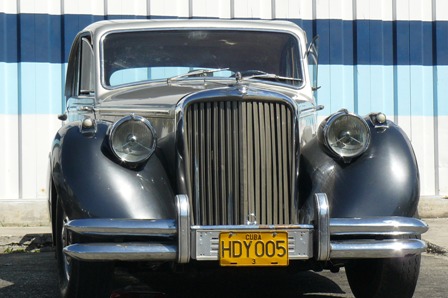
 It used to be for instance, that the only Mercedes’ you’d see were taxis lined up at the Hotel Nacional or zooming down 5ta Avenida transporting heads of state. Back in the day, a couple of superstars had them too: Once I saw the unmistakable salsero Pedrito Calvo behind the wheel of his Mercedes, but it was missing a hubcap and had dents around the wheel well. Today, there are all kinds of shiny new cars cruising Havana’s cratered streets – BMWs and Audi’s, but also at least one Bentley, Hummer, and mini Cooper. All sport yellow license plates (indicating private ownership), not black (embassy) or blue (state).

 Today, Havana is in flux. Accumulation of wealth and inequalities are becoming inevitably more pronounced and the political future is…uncertain. There’s a lot of anxiety and low level stress judging by what I’m hearing in the streets and hallways (and the difficulty I’m having scheduling a slot with my new therapist – but that’s another post).

 Some days, like today, I prefer to retreat from all the politics and angst, uncertainty and yes, sadness to some degree, and see Havana like I once did all those years ago – with fresh eyes.

Elaborate topiary & saucy garden gnomes: Tacky and suburban to my sensibilities, most of my Cuban friends appreciate and admire the artistry of a well-trimmed bush and the kitschy-cute gnomes that dot front lawns from Vedado to Boyeros. There are even buxom female gnomes (gnomettes? gnomas?) squeezing their bosoms like ripe fruit in yards across the city. Brightly-painted cement mushrooms often complete the scene.

Public zit popping: This habit is part sport, hobby, and time killer for Cuban couples. On park benches and at bus stops or waiting on the bread line, lovers are popping each other’s zits and squeezing out blackheads with glee. Does someone need to point out to them that acne and food never mix? Apparently, someone does.

Dogs doing their thing:  Innumerable are the times we’ve had to stop the car for a couple of canines fucking in the middle of the street as if they were ensconced in their own private posada. Nonplussed, the bitch regards us with a feral smile as she’s humped away by some mangy stray. They refuse to be rushed: No coitus interruptus for these puppies. The same goes for middle-of-the-street shitting. She squats, watching and taunting us to inch forward with a toothy snarl. It can be a laborious stand off – almost all Cuban dogs are constipated.

Pure breds: While we’re talking dogs, I noticed from the start that certain perros de raza are all the rage here. It used to be cocker spaniels (still the go-to dog for sniffing out lethal and illicit substances at the airport), followed by Dalmatians. This isn’t unique to Havana: certain pets the world over become fads and status symbols (see: Nemo and chihuahuas). But what’s hard to square here is the craze for chow chows, who walk the streets with heat-ravaged fur and black tongues hanging as low as an old man’s balls and Siberian Huskies. Pobrecitos. Dogs die of heat exhaustion too.

Gold teeth: Like pure-bred dogs, the gold teeth fad swept across Havana some years ago like the flu making the rounds now. From 10-year old kids to aging cabaret dancers, everyone was chasing the dental bling. There were even TV shows and news coverage about it. Oral ore seems to be on the decline, but whether it’s just a fad that’s fizzled or a sign of the economic times, I cannot say.

Come hither weatherwomen: When Leticia, the master degree-holding weatherwoman popped on the nightly news screen in gold lamé, I laughed and wondered if the wardrobe captain had taken a vacation or fast boat to Miami. A few days later, she informed us about the advancing frente frío wearing a black lace-up corset and sheer drape. Does she sidle into the next studio after the 5-day forecast to film the novela, I wondered? (see note 2). But nothing topped learning temperatures would drop over the next couple of days from a woman on national television sporting a camel toe.

Cuba: you never cease to restore my sense of awe. And that’s a good thing.

Notes

1. This is the reasoning some guidebook companies use for not employing locally-based authors – they’re too inured to place. It has occasionally worked against me, but I can see their point. The ideal scenario, I think, is for individual guides to be written by a combination of local and non-local authors. This is our arrangement on Lonely Planet Hawai’i and it works well.

2. Even among scientists, Fredrick’s of Hollywood stands to make a fortune here once/if the embargo is lifted.

17 Comments

Filed under Americans in cuba, Cuban customs, Cuban Revolution, Living Abroad, lonely planet guidebooks, Travel to Cuba, Writerly stuff

Trip Tips: Havana Independently

[tweetmeme source=”connergo” only_single=false]

Havana is hot and I’m not talking about mulatas or the weather: from Cayo Hueso to Regla, Cementerio Colón to Ciudad Deportiva, you can’t swing a dead gato around here these days without hitting a tourist. To tell you the truth, I don’t think I’ve seen this many foreigners in Havana since the 2006 Non-Aligned Meeting (see note 1).

There are reasons of course. The Cigar and Young Filmmakers Festivals are going strong as I write this, we’re getting a couple of monster cruise ships docking each week, and all-inclusive packages from Canada are mad cheap (see note 2). But most importantly, Havana’s streets teem thanks to Obama’s rollback to Clinton’s policy whereby US college students and select others can travel “legally” to the island. I’m surprised the effects have been so lightening fast – the new/old regulations were just announced in January – but everywhere I turn these days there seems to be a fresh-faced co-ed in Wesleyan gear or a Teva-shod geek. I hope they all have iPads.

Many of these people won’t end up liking Havana (hell, even I don’t like Havana some times). Starting with poor air quality, negative travelogues grouse about the expense of this place; perceived levels of state control; difficulties scratching below the surface +/o contextualizing their experience; and of course, crappy goods and even shittier services.

The dramatic economic changes happening around here – legalizing 178 types of private business from clown to cook, masseur to manicurist – are altering the travelers landscape (see note 3). So that Here is Havana readers can maximize their visit to this enigmatic city, I dedicate this post to travel strategies designed to get you beneath Havana’s skin.

#1. Talk the talk. There is no better way to maximize an independent holiday here than to speak cubano, with all its chopped off words, odd pronunciation and slang (see note 4). Even if ¿que bola asere? and ‘la heva está enpinga’ isn’t in your repertoire, try at least to dust off that high school Spanish since surprisingly few Cubans dominate English (and many of those that do are unusually accomplished charlatans). Not speaking Spanish doesn’t mean you’ll have a bad time – on the contrary. But it will limit your ability to get information, negotiate, learn and arrange logistics.

#2. Embrace pesos cubanos. As soon as you’re able, get some moneda nacional, also known as pesos cubanos and CUP. There’s a myth out there as tenacious as herpes in a whorehouse and which no amount of posting, commenting, and conversing seems to dispel: that tourists can’t use this ‘local’ currency. Complete rubbish. The truth is, most visitors simply don’t know how to use CUP. I suggest starting your trip by changing $5 of hard currency (24 CUP = 1 CUC = 0.82 USD) into this funny money to use for fixed route taxis, movies, food, condoms, cigars, and stepping out.

#3. Roll like a local. Long-finned Pontiacs, Capone-era Dodges, and other ‘Yank tanks’ leap to most minds when Cuba is mentioned. Undeniably cliché, these cars are everywhere, plying Havana’s streets working as communal, fixed-route taxis. For 10 pesos cubanos (about 0.40 USD), you can hail one of these endearing jalopies (I climbed into one yesterday that had packing tape upholstery and a ceiling lined with old refrigerator boxes) between Playa and Vedado or Habana Vieja, out to Miramar or Marianao. Longer routes – from Habana Vieja out to the Playas del Este beaches for example – will run double. To grab one, just stick out your arm parallel to the ground and ask the driver if he’s going to where you need to be. It helps to be on the right thoroughfare: 23 or Línea in Vedado, San Lázaro or Neptuno in Centro Habana, Avenida 31 or 41 in Playa, Calle 51 in Marianao, or 3ra Avenida in Miramar.

c. C Gorry

Even lower down on the transportation food chain is the guagua (pronounced wa-wa) – the Cuban bus. A ride literally costs pennies and while not especially comfortable or efficient, riding the guagua gives a real taste of Cuban daily life with all its attendant humor and hardships.

If these options don’t appeal, consider renting a car and driver. Part of the new regulations stipulate that licensed freelance drivers can now be contracted (by anyone, including foreigners as I understand it) to provide transport islandwide. There are no set fares, with rates to be determined between driver and client. Already nearly 6,000 choferes in Havana have applied for the freelance license; 2,000 have been granted. If the market has its way, the increased competition should make for more bargaining power and improved service. At the very least, it provides visitors an alternative to renting a car for $100 a day (which will somehow end up costing more when the agency is done with you). I predict that freelance drivers who speak English are going to do very well under these new regulations.

#4. Make yourself at home. One of the great benefits presented by the new regulations for travelers is the possibility to legally rent an entire house. This means you can shop at the agro (using those pesos cubanos) and cook for yourself, throw a dinner party, or introduce Cuban friends to the concept of brunch. Having your own private space means you can channel surf Cuban state TV (University for All! Little House on the Prairie! Seinfeld!), take mojitos on your porch to the delight of the neighborhood gossips, or stumble in carefree at 4am.

Another idea for a different Havana experience is to take lodging in more off-the-beaten-track places like the beach towns of Guanabo or Baracoa or Cojimar – the fishing village made famous by Hemingway’s Old Man and the Sea. These are close enough to enjoy Havana but just far enough removed to give a taste of small town life.

c. C Gorry

#5. Get primped & pampered. The new regulations approve all sorts of services which visitors can now enjoy without any sneaking around. Now your visit can include a 1-hr massage for $20 (really $10, but you might be charged double – the foreigner tax digamos), manicures for $2, and haircuts for $5 (careful with this last however).

If you’re interested to learn if someone – driver, masseuse, pizza maker – proffering these and other goods and services is licensed to do so, ask to see their licencia de cuenta propista. Most people are proud to flash their spiffy new ID cards.

#6. Spread the wealth. Frankly I weary of travelers asking me how they can avoid patronizing state businesses. That’s like asking how to avoid death or taxes. From the moment you buy your $20 tourist card to enter the country, to the minute you’re paying the $25 tax to leave, you’re supporting the Cuban government. What’s so evolved about this place is that paying into government coffers does in turn support the Cuban people (maybe not how or to the extent you’d like, but in my book the Cuban approach is fundamentally better than subsidizing bombs in Afghanistan and spies in Caracas). If you have a problem with this, do us all a favor and go to Cancun.

Having said that, I do recommend spending your hard-earned cash at a mix of state and private enterprises, but how to tell the difference? With eateries, there are some telltale signs. If your server is wearing a uniform or hairnet the place is probably state-owned. If your food descends from a balcony in a bucket it’s definitely private.

With taxis it’s even clearer: 99% of the old Motor City monsters (and many of the Ladas) brandishing taxi signs are privately owned. When in doubt, do like the Cubans do and look at the license plate (see note 5). There’s an entire code for plates here, with the first clue being the color: blue is for state-owned, yellow is private. All hotels, meanwhile, are at least 51% state-owned, but casas particulares (rooms or independent houses for rent) are privately operated. Look for the blue ‘arrendador divisa‘ sign.

c. C Gorry

If you’re interested in learning more of the Havana ‘mécanica‘ including bus and fixed-fare taxi routes, the best spot for 75 cent whisky shots and $1 lunch, Cuban line etiquette and more, please check out my iapp Havana Good Time.

Notes

1. It’s highly doubtful we’ll reap the same benefits however: when Cuba hosted the meeting as is customary for the country holding the rotating presidency, Havana’s main roads were repaved, trees were planted (including many of the trees lining Boyeros every visitor zooms by on their way from the airport) and house facades all along the arrival route were painted up nice and spiffy for the visiting delegations.

2. These 7-day all inclusive deals are oftentimes cheaper than just a Toronto-Havana Cubana flight. Savvy travelers just book the package and stay a day or two at their resort and then travel independently. As an aside, tourism figures for January indicate a 16% increase for the same period last year. Top countries visiting Cuba: Canada, Italy, Germany, France, Russia, Argentina, and Mexico.

3. I say travelers here instead of tourists because I believe there is a fundamental difference between a person who passively observes a culture and someone who desires to actively participate in it. If you’re one of those disposed to take issue with the tourist vs traveler terminology, I invite you to focus on the phenomenon/philosophy I’m talking about rather than the etymology of the terms used to describe it.

4. Those interested in Cuban slang and phrases should check out this Dichos iapp. I haven’t been able to get it yet (the US government blocks iTunes from operating in Cuba) but am loca to try it.

5. This national reflex is widespread and wild to watch: no matter what type of car you’re in, observe how passing Cubans immediately drop their eyes to check out the license plate. Via the coded plates, they’ll know if your car is from Havana or the provinces, whether you’re a foreign resident or visiting, even if you work for the state, a mixed Cuban-foreign enterprise, a church or an NGO.

37 Comments

Filed under Americans in cuba, cuban beaches, Cuban phrases, dream destinations, off-the-beaten track, Travel to Cuba, Uncategorized

Always the Outsider Inside Cuba

[tweetmeme source=”connergo” only_single=false]

Maybe it’s me, but certain zingers people have sent my way 10, even 25 years ago I just can’t shake (note 1). There was the time in elementary school when the Mean Girl said: ‘ever wonder why you have no friends?’ I responded: ‘I have friends you don’t even know about.’ Pretty clever in my 10-year old estimation, but she didn’t miss a beat. ‘That’s because they’re imaginary.’ Ouch.

Then, some years later, a different Mean Girl (yeah, I was the one everyone loved to pummel – metaphorically and literally), shot my ego to shit when she told me I’d be better looking as a guy. This memory floated to the surface when I was covering the Cuban disaster team in Haiti and a doctor in our camp nicknamed me Tom Cruise. He meant it affectionately and now we’re friends, but it kicked up the dust in that toxic corner of my consciousness.

 As an adult, here in Havana, what sticks with me is something a stranger said back in 2003. I was researching the Lonely Planet Cuba guide and had rented a car for the eastern portion of the trip. I was in Santiago de Cuba, the heroic city, when I went to return the rental. I still had half a tank of gas, for which there would be no reimbursement. Claro que no. So I walked up to a group of guys clustered around a Lada drinking beers (a popular pastime on this side of the Straits) and proposed selling them the half-tank of gas I wouldn’t be needing.

 “Where you from?” one asked me.

 “The United States.”

 He whistled and cracked his index and middle fingers together in that rapid-fire way Cubans have that looks like they’ve burnt themselves and sounds like bubble wrap popping. “A yuma who knows our mecánica. ¡Peligroso!

And he and his buddies proceeded to siphon my tank.

I was getting it, beginning to grok how this place works. My gas buyer in Santiago called it dangerous, but I considered mastering the mecánica as my first step towards integration. The first sign of acceptance.

 How much I still had to learn…

_____

 Some 8 years on, I have a different perspective. Today, despite my mastery of many things Cuban, it feels less like acceptance and more like I’ve got partial membership in a club dubious of my credentials. A club, furthermore, which doesn’t extend full membership to any foreigner, ever (El Che and Máximo Gómez notwithstanding). The heart of the matter is the unalterable fact that I’m not, nor will I ever be, Cuban. Consider the saying:  ‘those who aren’t Cuban would pay to be’ and you have an idea of how deep nationalist pride runs.

I’ve got some things working against me to be sure. First, I’m blonde-haired and blue-eyed, making it impossible for me to “pass” as Cuban (at least in Havana; see note 2). Thus, my outsider status is constantly called out. I’m also from ‘los Estamos Jodidos‘ as my friend Mike likes to call los Estados Unidos (see note 3). Hailing from the nasty north carries its own particular baggage in the Cuban context – some good, lots bad – and I pay in a way for that too.  Lastly, I’m from New York, a city that makes you feel if you can make it there, you’ll make it anywhere (except maybe in Havana ironically). When someone takes me for a mark or accosts me on the street like happened last week, it’s an insult to my hometown, as if the archetypical concrete jungle didn’t properly prepare me, as if my urban armor were insufficient (see note 4).

_____

In the peculiar social hierarchy that reigns here foreigners are on the bottom rung. It doesn’t matter how long you’ve been here – even friends who’ve clocked 20 or 30 years in Havana struggle with this reality to some extent or another. It’s damn disheartening. And it doesn’t matter how much money you have either since everyone will assume you have mucho.

Allow me a moment to vent about the ‘all-foreigners-are-rich’ stereotype that dogs me. This is an assumption I confront everywhere, every day. In the street and at the market; in conversations with friends and encounters with colleagues. I hate to say it, but this myopic view exposes the ignorance many Cubans have of the real world – that world beyond free education and heavily-subsidized housing, electric bills of 35 cents a month and nearly gratis public transportation.

For me, this rich foreigner perspective is akin to the ‘Kmart is cheaper than the farmers market’ argument: when you factor in all the health, environmental and transportation costs Kmart lettuce is actually much costlier than a similar head bought from farmers. In my case, when you factor in the $60,000 of student loans I’m still carrying, the 30% the US government takes in taxes, plus the 20% cut the Cuban government takes in the exchange rate, my earnings are actually quite paltry. And let’s not forget: la yuma doesn’t have a ration card. (Soon few will, but that’s another post.) I realize I’m better off than some, but I’m also worse off than many others, something beyond comprehension here apparently.

It’s not that I expect Cubans to understand my situation – most know not the wrath of the tax man and certainly nothing of the student loan burden. But just once, I’d love for someone to understand that there might be other factors at work, that I’m not the goose that laid the golden egg or an ATM with legs.  

In my youth, I was often told I was spunky, a girl with pluck. Here, (as recently as last week), I was said to lack ‘guara‘ – another of those impossible to translate Cubanisms, but pluck and moxie come pretty close. What is it about this place that makes me feel like I’m 12 again, beating back the Mean Girls every day after school? Is it like this for all foreigners living far from home I wonder? Drop me a line with your experiences; I’d like to hear other viewpoints and try to ratchet down this loneliness a bit.  

Notes

1. I wish our mental hard drives had a ‘delete permanently’ function. Yes! Send to trash, damn it!

2. There are plenty of people who look like me here (thanks largely to French immigration in the early 19th century). Unfortunately, the majority of them are in Holguín and other points far to the east.

3. I’ve always loved this play on words which more or less turns the ‘United States’ into ‘We’re Screwed.’

4. I did open up a big ole can of NYC whup ass on the guy that grabbed me from behind, thrusting his hand between my legs. He was scurrying away fast when I was done with him, but that and a couple of bucks will get me on the subway.

60 Comments

Filed under Americans in cuba, Cuban customs, Cuban phrases, cuban words without translation, Here is Haiti, Living Abroad, lonely planet guidebooks

Drinking the Capitalist Kool-Aid in Cuba

[tweetmeme source=”connergo” only_single=false]

I’m not sure what news about Cuba is being made over your way, but I assume you’ve heard changes are afoot. I’m talking big, game-changing adjustments that surely have Che spinning in his grave (to say nothing of Marx and Lenin). The reasons are many and complex why I’ve put off writing about “the changes” (sounds like a euphemism for menopause which isn’t a bad metaphor for today’s Cuba I should think) but suffice to say, I can no longer keep quiet.

A sort of financial shock therapy, these changes are deeply personal and downright frightening for many Cubans. However necessary (and dare I say it?) inevitable, the greatest free market experiment since 1959 is a sink or swim proposition: if it does work, Havana will start looking more like Santo Domingo or Miami. But if it doesn’t work, millions of people will bear witness to generations of work going down the tubes.

This predicament, the very real possibility of economic failure translating into socio-political failure is causing anxiety, anger, breakdowns and break ups. Of course, the changes give hope to some, but I’m not among them. From where I’m sitting, they’re an unworkable solution. Salvaging the Cuban economy by allowing private enterprise and other too little, too late measures is an impractical workaround I call ‘Shutting Barn Door, Horse Long Gone’ (see note 1). The Cuban economy was, is, and always shall be struggling. It’s geography, politics, history and fate. It’s The Way it Is.

So I take exception to the theory and the timing. But even more so, I question the mechanism. Pandora’s Box is being thrown wide with this headlong dive into the shallow end of the free market pool. I call this last gasp for cash ‘One Foot on the Slippery Slope.’

I’m a capitalism refugee. I know viscerally that money is the root of all evil. It corrupts, ruins friendships, ruptures families, crushes love, and damages the environment. And make no mistake: this genie has a one-way ticket out of his bottle.

A fascist anti-materialist (see note 2), I moved to Cuba in part to escape the unchecked consumerism and dollar lust that grips my old world. An error in judgment, faulty analysis or both since I quickly learned that money and stuff (along with sex, transportation, and protein) are uppermost in Cubans’ minds; in fact, most days are dedicated to their pursuit. Still, I loved how time was made for friends and conversation, how freely people shared. This will all roll away down the Slippery Slope once the real money lust sets in, I’m afraid. When taxes and employees and suppliers must be paid and profits are squirreled away for baubles – this is when things will get ugly de verdad.

Already the fury for iPods and 2 inch acrylic nails, nights dancing at the Salon Rojo, navel piercings, and tramp stamps (see note 3) are eroding values and substituting style over substance, form trumping function. The market, I have no doubt, has the unique capacity to undermine most everything the Cuban revolution stands for.

The feeding frenzy is already in full scrum. I have friends who procured licenses under the new regulations to train dogs, sew and sell dresses, and even make ice – home delivery extra. In any neighborhood nowadays I can browse CDs & DVDs, shoes, guayaberas and house wares set out for sale on people’s porches. Every few days, an old guy walks my block shouting: “I buy empty perfume bottles.” I guess I should be glad that Havana garages hold perfume factories instead of meth labs – for now at least.

What scares me most is the fundamental economic concept of supply and demand: if there’s enough of the latter, someone will step up to provide the former. And if there’s one thing we have a surplus of here, it’s demand. I call this the ‘Special Period Hangover’ (see note 4).

Worrying me these days is more than the simple human desire for things. It’s the confluence of factors making free market free-for-alls particularly toxic and potent here: the US embargo which keeps Cubans in a permanent state of want and need; the indelible psychological effects of the Special Period; the new opportunities to amass cash; and the myriad different and novel ways to spend it.

Now, before you get your knickers in a twist, let me say that I fully and clearly understand how easy it is for me to disparage the lust for stuff, having had my chance at it. But I feel nauseous when I think about this socio-economic ‘perfect storm’ and what it means for the future – our future – the future being forged for Cubans, by Cubans.

Consider what I call the ‘Miami Effect:’ throughout southern Florida and especially in Miami, there are businesses dedicated to renting thick gold chains and ghetto hoops, rings for every finger and gold-plated watches – all gauche to the extreme. Men’s signet bracelets are also in high demand at these shops which exist solely to rent gold and bling to Cuban Americans returning to the island to visit friends and family.

Who cares if the 14k bracelet says Tito and your name is Yamel? The important thing is to arrive in Havana (or Holguín or Camagüey) looking like an old skool NY guido who just hit the Lotto. Thanks to these businesses, you can achieve your look at a reasonable price (just don’t forget to relinquish those jewels upon your return). Has it not dawned on these folks that their money is better spent on cooking oil or a pair of decent sheets for family back home? Maybe some quality sponges, batteries or other utilitarian items every Cuban home needs?

I invite my readers to take a moment to ponder the absurdity of a poor person visiting even poorer people and budgeting for bling (see note 5). I mean, I know ‘form follows function’ is a foreign concept in Miami, but this boggles the mind. And it scares me that this is part of the Cuban character. This type of materialist twist and bent is my nightmare. After 9 years in Cuba, I dread waking up to it.

A friend said to me years ago that if the Yanquis want to kill the revolution, all they have to do is drop a jabita stuffed with Levi’s, Converse, and Lancôme at every doorstep and everyone will roll over. I hope she’s wrong because that is just too fucking depressing.

Notes

1. Surely Cubaphiles will have caught the double meaning here: Fidel is sometimes referred to as ‘el caballo.’

2. For example, my blood pressure spikes when I watch my neighbor walking her two Siberian Husky puppies – the new breed of choice down here. I find it cruel and unusual for these dogs to suffer a Havana summer just because their owner wants a couple of status symbols. Then there’s all the kitschy Ed Hardy knock offs that make me shudder and groan. Maybe I should start importing Bedazzzlers – the Cubans will go gaga over a tool that allows them to bling everything from baja chupas (tube tops) to blumers (underwear). To get a better understanding of just how anti- I am about all this, check the Church of Life After Shopping link on my Blog Roll.

3. To put things in perspective, consider what these non essentials cost here on the average Cuban salary: iPod = 4 to 20 months salary; acrylic nails = 1 month’s salary; night out at the Salon Rojo = 2 months salary (minimum); navel piercing = 2 weeks salary; tramp stamp = 1.5 months salary.

4. Once the Berlin Wall fell, Cuba’s almost total economic collapse was swift. Nearly 85% of foreign aid disappeared, Cuban adults lost 20 pounds on average and the first experiment with private industry was launched. This era (1993 to depends-who-you-ask) was dubbed ‘A Special Period in Time of Peace.’

5. I welcome input from other immigrants and expats – have you found this to be true of folks from your country or where you live?

63 Comments

Filed under Americans in cuba, Cuban Revolution, Fidel Castro, Raul Castro

Those Faithful Cubans

[tweetmeme source=”connergo” only_single=false]

Back in the 1850s, when everyone from priests to sugar barons were fighting for their piece of the pie (and their piece of mulatta ass, let’s be frank), this island was known as “la siempre fidelísima Isla de Cuba.” The forever faithful island of Cuba.

As a yuma married to a Cuban for going on nine years now, I can tell you this fidelity question has nagged me long and hard. And I’ve finally reached the tipping point. It took some time, though.

I remember when I was a tenderfoot on these shores – all bright-eyed and basking like a well-fed turtle, not bothered by termites in my bed or even reggaeton (see note 1) – and how much I still had to learn. On one of those fine sunny days way back when, I was seaside with some friends (a pair of ex-pat Europeans who bailed long ago) having a few cold drinks and taking the ocean air.

‘But don’t you wonder where he was?’ my friend asked. She’s one of those naturally beautiful, smart women who always seems to get what she wants even when she’s not entirely sure what that is.

‘Nah.’ I said. ‘I trust him implicitly.’ Did I really just say that? More to the point, do I really believe it? Me, who has only trusted implicitly five people my whole life, four of whom share my last name? It slipped out, but it was true. At least I wanted to think it was true.

The distinguished gent across from me, a rich well-traveled Turk who was living in Cuba on a lark, raised his eyebrow and his glass. ‘I wouldn’t trust anyone here implicitly, querida,’ he said sipping his Bucanero.
_____

It was my first summer here – 2002. I’d never even seen a spit-roasted pig or the inside of a hospital (see note 2) and my husband and I were spending August camping around the island. I was blissfully unaware of the depth of my ignorance about Cuba – had I known then what I know now and I had known how confused I’d still be all these years later, I may have run away and quit before my Cuban odyssey ever really started.

The car packed high with tent and stove, kitchen kit and several gallons of water, we went way off the beaten path. Making our way across the country we’d just pick a place on the map and go. This is how we found ourselves kicking up dirt on a deserted road heading towards Punta Covarrubias in god forsaken Las Tunas (see note 3). We saw nothing for miles – no birds stirred the air, nary a lizard snuck out his tongue. Not one car or person appeared in the 90 minutes we were on that rutted road. Finally the sea grew into view and with it came gales of laughter.

When we pulled up between pines as thin as a Cuban campesino, we saw a panel truck and a party in full swing. The beach and lone hotel were deserted – closed for the season or some other confounding Cuban reason – but these folks had come to let their hair down and hot dog!, roast a pig.

My husband busted out a bottle of rum and we took turns rotating the pig. Dominos materialized of course. We got to know our hosts in that way Cubans have of making fast friends. They were lovely people, country folk who worked hard and had the calluses to prove it. With the sun dipping low, we swapped addresses (none of us had phones in our homes) and I promised to send Eliades the photos we’d taken.

“On no! Don’t send them to me. My wife will kill me if she finds out!”

And here I’d thought the buxom brunette with the sunburned collarbone he’d been fondling all day was his wife. Silly me.
_____

Not long thereafter, I was on the 100 bus going to a meeting. It was one of those oppressive Havana days when tempers are short, the sun’s rays are long and you’re sweating as soon as you step from the shower. In sum, a typical July day in these parts. The 100 bus, I should mention, ‘tiene sus cosas‘ as we say here – it has it’s thing going on.

This bus runs through Marianao – a very working class, very black neighborhood run thick with bling and babalawos – from where it descends to the seashore in Miramar. In summer, this bus is an asses to elbows, hips to groin crush of humanity desperate to get to the “beach” (no sand, just a nasty species of shoreline rock known as diente de perro). At these times, boys ride the 100 shirtless and the girls are more scandalously clad than usual (if that’s possible). It’s so crowded daredevils hang from the windows, hitching a ride from the outside.

On this day, I was all up in it inside the bus. There was no choice but to squash up against the strangers squeezing in around me. I tried to angle away from any erogenous zones – theirs and mine. As we crossed Calle 51, the crowd crushed in tighter and I felt a warm rush of air on my face.

“Come to the beach with me baby,” a young, chiseled guy chuffed in my ear. I turned away, making sure to steer clear of his bulge.

“I don’t think my husband would approve,” I snapped.

“You’re married? So what?” the kid responded, pressing in tighter against me.
_____

Some years ago, I was let in on a secret. It wasn’t really a secret (a concept which is completely foreign to most Cubans) but rather one of those things that people know about but no one mentions: the two family phenomenon. I had drawn breath 32 years before I’d ever known that there were men who keep two families. Not Big Love style, but two secret families – one on one side of town, the younger on the other.

I have one friend, the poor soul, who discovered the ignoble injustice as her dearly beloved lay on his deathbed. On that day, she had brought him his breakfast and coffee just like every day since he had been hospitalized. She kissed him goodbye and turned to leave just as a second woman came in, breakfast and coffee thermos in hand, trailing two kids. The Other Wife with The Other Children who had no idea they had a half-brother and -sister on the other side of town. The bastard died not long thereafter. My friend and I don’t talk about it.

The same thing befell another friend, Josue. As an adult, he discovered his father had kept another family secreted away, also with kids – two brothers Josue spent a whole life not knowing.

I wonder about men who are so weak and insecure they need two women, two sets of kids, two lives. I imagine it must be extraordinarily stressful and hard to keep straight. I wonder how they look themselves in the mirror.
_____

Don’t believe for a second it’s only the men. Rosario is a perky (natural) blond with the hips of a mulatta and the ass of a negress. Her husband Julian is not only hot, he’s a talented, super successful musician to boot. They have a beautiful son together. One morning Julian woke up to an empty house. Turns out Rosario had married a Mexican on the side to leave the country and took the boy with her. She ditched the Mexican as soon as possible of course; she and the boy now live in Miami.

And what I’ve seen during my work abroad, covering the Cuban medical missions? Por favor. These folks serving two years in godforsaken places are like sailors on shore leave the way they hook up with one another. And the longer and harder the posting, like Haiti or Pakistan? Let’s just say it’s far from ‘la siempre fidelísima Isla de Cuba.’

For someone like me, faithful as a damn dog, this is all pretty disturbing. What does ‘faithful’ mean here, I wonder? Does it even translate? Does giving head count as cheating? Getting it? How about a mercy fuck? I’m not sure I want to know. What I do know, now that I’ve learned a little about Cuba, is that I wouldn’t necessarily say implicitly…

Notes
1. For the record, I have always been bothered by cold water showers and turds at the beach.

2. Since then I’ve been regularly employed as a journalist (take that OFAC!) by MEDICC Review which has thrust me inside all sorts of Cuban hospitals – from pediatric to post-disaster.

3. Very near here is one of the points of highest illegal immigration to the United States in all of Cuba. So common and scheduled are the super fast speed boats that pick up Cubans to zip them across the Straits to Florida they’re called ‘Yutongs’ – our equivalent of a Greyhound.

191 Comments

Filed under Americans in cuba, camping, Cuban customs, Cuban phrases, Living Abroad, off-the-beaten track, Relationships

Wanna Go to Havana for Free?!

[tweetmeme source=”connergo” only_single=false]

Now that the paroxysm of consumerism known as Christmas is behind us (and any entity public or private still playing carols should be shut down or shot), I invite you to experience a different slice of life – Havana.

Until January 3, I’ll be giving away 30 free copies of my iapp Havana Good Time (see notes 1 & 2). All you have to do is let me in on one of your favorite places in Merida (Mexico), The Big Island (Hawaii) or Havana. Why these three? Just because they’re among my favorite places in this hemisphere. If your suggestion is already known to me (in the case of the first two) or listed in the iapp in the case of my adopted city, I might still gift you Havana Good Time just for playing (see note 3).

How to play? Easy: just enter your submission in the comment field or drop me a line.

CAVEAT EMPTOR: this offer only good at the US iTunes store (sorry about that folks – this part is out of my control)

Tell your friends!

Hell, tell strangers. And while you’re at it, let them know about Havana Good Time’s Facebook page, where I post all the latest tidbits, juicy news, and hot concerts happening around town.

Happy 2011 everyone – may it be full of new adventures and health for all.

Notes

1. OK, so it’s a free virtual trip to Havana, but this iapp is so dialed in, with over 300 great images, you’ll feel like you’re there.

2. Havana Good Time currently works on the iPhone, iTouch, and iPad. Versions that work on your computer coming soon!

3. If you win, all subsequent versions of Havana Good Time are free too!

31 Comments

Filed under Uncategorized

Mi Tocayo

There’s this magical, hard-to-reach place I’ve dreamt of seeing for years. Atop my ‘to visit’ list, I tacked Technicolor postcards of this glorious spot on my office wall and gazed upon its grandeur whenever writer’s block or boredom hit. Admittedly, a visit there takes considerable preparation and determination, not to mention luck – when the weather turns for the worse, my dream destination becomes inaccessible.

I’m talking about Waimanu Valley, the Big Island, Hawai’i.

Waimanu is so birthing-the-earth beautiful, so seductively tropical, tears have sprung to my eyes simply gazing upon that aforementioned postcard. This mana-packed valley (see note 1) is also sacred to native Hawaiians and is occasionally still visited by ghosts of gods in the night. Truly a godly place (no matter what that means to you), Waimanu’s towering falls and steeply sculpted walls beckoned me.

There are certain places on the planet that are rightfully hard(er) to reach. This is their protection, helping maintain their natural and cultural integrity to an extent. The Galapagos for instance, or Bhutan. Cuba, too, is in this harder-to-reach category (for Americans at least) keeping that island from the north’s greedy grasp – somewhat anyway, for now anyhow.

There are only three ways to reach Waimanu Valley: by foot, kayak, or on a helicopter tour.

The last was never an option since helicopter tours run at least $200 on the Big Island, and so are way beyond my means (see note 2). More importantly, watching these grand waterfalls (or flowing lava for that matter) from behind glass seems too much like porn and masturbation to me. I wanted to taste, touch, and smell the valley. I wanted to earn the climax.

Kayaking into this part of the Big Island’s windward coast, meanwhile, is a complex proposition. The changeable weather, combined with the fierce, surgey ocean with its rips and undertow, advises against paddling in. Conditions need to be just right and although I’d sea kayaked 18 miles of the inimitable Na Pali coast on Kauai, local kayakers told me this wasn’t really practical for Waimanu Valley.

That left the hike. It’s not long – just under eight miles one way – but compensates with difficulty what it lacks in length (see note 3). And with no foreplay: the first mile is 1200 feet straight up. It’s a knee shaking, thigh quaking ascent from legendary Waipi’o Valley and not even the azure sea pounding the black sand beach below makes ‘The Z’ trail enjoyable. My hiking buddy rated The Z (so named for the precipitous switchbacks that carve that letter into the valley’s emerald cliffs) a B, for Brutal. Once you crest the switchbacks, sweaty and panting, there are a dozen gulches to maneuver through, making for a foot-propelled roller coaster ride.

It was hard. It was hot. At times it felt interminable. But the final descent into Waimanu Valley: therein lies the rub. It’s just .9 miles, but it’s an ‘okele kicker (see note 4). Slippery even when not wet, and as narrow as Sarah Palin’s mind, this is a seriously steep and treacherous stretch of trail. With a tent, sleeping bag, and four days of provisions strapped on my back, I had my work cut out for me. One slip and I’d go tumbling 1200 feet into verdant valley.

—–

We managed the descent and I wasn’t surprised the valley was more glorious than the postcard tacked up in my office back in Havana. The black sand beach fed by a freshwater stream teeming with fish and prawns; the deeply-carved, rice paddy green of the valley walls; and the forest full of wild guava and coffee, breadfruit and feral pigs – it was beautiful. But most captivating of all was Wai’ilikahi Falls – a 1100-foot high set of double falls tumbling over the valley cliffs into an idyllic pool frequented by few.

Following a day of rest and play, I set out to tackle the (officially closed, but fairly clearly marked) trail to the falls. I considered turning back after crossing paths with a feral sow and her piglet. I’d been treed once by a pack of peccaries in the Costa Rican jungle; I know not to mess with wild swine. I almost turned back a second time too – where an ugly invasive choked off the ‘trail,’ obscuring my way for a while.

But I kept on. After an hour or so, the trail began meandering along a rock-strewn stream. I could hear the waterfall clearly now and feel it’s windy swoosh. The trail dipped suddenly and I was dumped at the base of Wai’ilikahi Falls, a pool the size of a helipad at its base.

I threw my arms heavenward, praising its beauty and feeling like a goddess – so blessed was I to be there, living my dream. I was struck dumb by its natural beauty. I swiped a tear dropping from the corner of my eye when I heard a rustling from the trail. It wasn’t a feral pig as I’d imagined, but a young couple, tattooed and tie-dyed, emerging from the wood. I had only been in my dreamscape for five minutes. I was surprised I hadn’t heard them on the trail, that’s how closely on my heels they followed. More surprisingly still, I wasn’t disappointed to have my solitude broken, to have to share this special place with strangers.

We chatted, basking in the falls’ beauty. We voiced our appreciation for this sacred place, so remote and hard-earned. As the young woman washed their clothes in the pool (see note 5), I ‘talked story’ (that most Hawaiian of pastimes) with her husband: Where are you from? First time on the Big Island? Where have you been? The usual travel patter. They were young and adventurous and had been whirling the world for over two years. I took a quick shine to them – especially the guy.

After a brief silence, the falls’ chill misting us softly, I stuck out my hand.

“It’s nice to meet you way out here in this beautiful place. What’s your name?”

He took my hand and smiled. “Connor.”

I was stunned silent, literally struck dumb for the second time in ten minutes. Here I was, in the middle of nowhere and the center of everywhere, at the heart of my Hawaiian dream and who should emerge from the wood without warning but my tcayo (see note 6).

Very funny place, this big island.

Notes

1 In Hawai’i, mana is the island’s life force, the spiritual mojo that pulsates within the volcano, the sea, and deep in waterfall-cleaved valleys like Waimanu. If you’ve been here, you’ve likely felt it, that’s how palpable it is.

2. Even though I’m on the Big Island updating a Lonely Planet guidebook, the payment structure, combined with the company’s policy that we can’t take anything for free in exchange for positive coverage, puts most of these activities beyond my reach.

3. There are four emergency helipads strung along this hike to give you an idea of the difficulty.

4. This, my third time on the Big Island, I’m making a conscious effort to learn more Hawaiian; ‘okele (if you’d hadn’t already guessed) means butt.

5. Note to the valley gods and goddesses: forgive her, she knows not what she did.

6. Like descampar (to stop raining) and buen provecho (have a good meal), tocayo is one of those Spanish expressions with no real equivalent in English. It means to share the same name. Except for my goddaughter Conner, who (although a spectacular and special kid) doesn’t really count since she was named with me in mind, I’ve never had the opportunity to hang out with my tocayo. And certainly not in such a spectacular spot as Wai’ilikahi Falls.

6 Comments

Filed under Cuban phrases, environment, Hawaii, Living Abroad, off-the-beaten track, Writerly stuff

Driving Eleggua: Adventures at the DMV, Finale

[tweetmeme source=”connergo” only_single=false]

Countdown: 15 Days to Departure

I got all my mojo working the morning of the road test. I donned my lucky Argentinean underwear, wore my St Christopher’s medal tight around my neck (see note 1), and insisted my beloved husband not accompany me. That’s all I needed. It had taken me two tries to pass the written and the aborted attempt at the road test the day before had pushed my panic button. My time was running out; I needed this driver license.

My friend Angela arrived in her car and we stood around chatting with the other would-be drivers while we waited for Oswaldo The Road Test Cop. He sauntered up late and nonplussed. I looked him in the eye and smiled.

‘Remember me?’ that smile said. Today’s the day.

I knew the drill but gathered in close with the others to listen to his pre-test spiel. I wanted to show him I was respectful and ready. That I meant business. I waited my turn and handed over the required documents: my Cuban ID card, plus Angela’s license and registration. Oswaldo looked them over, plucking Angela’s license from the fan of laminated cards in his hand.

“She can’t be your representante. You need someone with a Cuban license” (see note 2).

I had asked my husband precisely this the night before.

“You’re worrying too much. She can be your representante and you’re going to pass,” he had assured me.

Turns out Mr. Know-it-All was wrong on both counts. Angela couldn’t represent me and the Po Po Cubano didn’t take kindly to me asking the gathered crowd if anyone was willing to stand in for Angela. In the end, a co-worker of my husband’s came to my rescue, but by then my nerves were shot; I didn’t make turns at a true 90° angle, I parked incorrectly, and even confused third gear with first when pulling away from a stop light. It was a disaster and Oswaldo flunked me.

“Practice your turns, pay better attention to how and where you park, and come back next week to try again.”

I was disconsolate and walked home choking back tears. I finally let them pour once I was safely inside. The stress was killing me. Worse, I felt really, really dumb. After all, I’d been driving for years.

Countdown: 8 Days to Departure

I practiced all week. I re-conned the route, memorized the one- and two-way streets so I’d know where to park (see note 3) and familiarized myself with Angela’s Kia. I enlisted my friend Camilo the taxi driver to be my representante.

To be honest, I was a complete mess. My work depended on this license, my backup plan had totally backfired (the jalopy of a truck I was going to “rent” from a friend had blown a fuel pump), and I had no Plan C. I stayed awake at night or woke in the middle fretting about the license, my job, and our financial future. I was nasty that week, fighting with my husband and myself. My stomach permanently ached.

I did breathing exercises. I visualized myself on the tropical balcony of the Cuban DMV receiving my newly-minted driver’s license. I did everything short of pray (and even considered it).

All for naught.

I hesitated when I had the right of way and was snookered anew by the tricky parking question. Oswaldo could have passed me had he wanted but he didn’t. Was he looking for a bribe, or did he just have it out for foreigners I wondered? Either way, I was really up that proverbial creek; my departure was in eight short days and I had only one more chance to pass the road test.

“You’re right: we need to name the car,” Angela said to me when I told her I’d failed. Last week I’d asked her if her car had a name – I felt the need to talk to it, commune and communicate with the mechanical beast.

We agreed the car was male since it was presenting so many difficulties.

“It has to be a good name, a powerful name,” she said to me. “I know! Eleggua!” (see note 4).

I quit practicing the exam route – You’ve been driving for years! I told myself. You have real life experience; you don’t need practice! Still, I slipped a 50 CUC note in my pocket just in case wheels needed greasing (see note 5) and I switched up my representante. This time I took my own weapon: Eliseo, a retired top cop and dear friend. Aside from being an all around great guy – what Cubans call un pan – maybe Eliseo could give Oswaldo some special cop handshake or eyebrow wiggle or something. Couldn’t hurt I figured.

Countdown: 1 Day to Departure

On my last try, I showed up more resigned than nervous. The world wouldn’t stop turning if I didn’t pass the test. I was healthy, I was loved, so whatever. ‘It is what is,’ as Mom would say.

Eliseo and I waited for Oswaldo with yet another group of wannabe drivers. Seems a lot of drivers fail this road test: I recognized the trucker from the week before and a kid with his jeans slung so low I could see his bad Job Boxer knock off underwear.

‘When I was practicing for the test, my uncle set a tiny cup of coffee on the dash and said ‘Drive. And don’t spill any!'” one guy said.

“I screwed up on the parking the first two times I took it,” said his friend.

I looked at Eliseo.

“Don’t worry muchacha. You’ll be fine,” he reassured me.

“Here he comes,” someone said and we all looked over to watch our examiner approach. To my horror, it wasn’t my old buddy Oswaldo. My stomach knotted. My palms grew slick.

Our new examiner took us through the same orientation song and dance as Oswaldo, asked if we had any questions and proceeded to inspect the cars – checking that the blinkers and brakes were in good working order. He then told us we could have our representante in the car if we were nervous.

Eliseo hopped in the back seat. I gave Oswaldo’s substitute my winningest smile. I drove Eleggua down and around the block, pulling over and parking at the curb when told to do so. I looked over at my examiner.

“You drive beautifully,” he said. “Congratulations.”

Within 20 minutes I had my brand spanking new Cuban license. Tomorrow: Hawaii (see note 6).

Notes
1. I’m more superstitious than religious, but he is the patron saint of travelers.

2. Angela has been based in Cuba for nearly two decades, but never switched over to a Cuban license, preferring to maintain her US license. Smart lady.

3. This is one of the tricks these driving cops use to fail folks: they take you down a one-way street with cars parked every which way on both sides and ask you: ‘which side of the street will you park on?’ Of course it’s the left, but it gets tricky with Havana’s poor signage and cars parked facing forward and back on both sides of the street. “They can park illegally,” Oswaldo told me as I hesitated. “They have their license. You don’t.”

4. In the Afro-Cuban religion of Santería, Eleggua is the trickster god, but also the god who opens pathways, broadening horizons so to speak. Coincidentally (or not), a babalawo once told me that Eleggua was my guardian god.

5. I’m terrible at this kind of thing and offering a bribe in Cuba always carries the risk of backfiring. See other readers’ comments and ideas on bribing Cuban officials here.

6. Those of you following this saga may have been wondering – where is she off to and on what assignment? I’m currently on the Big Island of Hawaii updating the Lonely Planet guide to that wild and wonderful place. And check it out: you can both rent and drive a car in the United States with a Cuban driver’s license (well, in this state anyway).

8 Comments

Filed under Americans in cuba, bureacracy, Living Abroad, Uncategorized

Here is Havana in Stellar New eBook

[tweetmeme source=”connergo” only_single=false]

Hi folks and sorry for the absence. Ive been watching live lava and baby dolphins a-leapin’ and a-spinnin’ on another far away isle lately (post coming soon on these adventures!). In the meantime, I wanted to let you know that Stephen Roll of Travel Ojos has just published a fantastic eBook entitled Celebrating Latin America at Ground Level. There is some terrific writing in here, by people who are living the dream (and occasional nightmare!). Here is Havana represents with an entry entitled “La Gente.”

The best part? The book is free! just click: Celebrating Latin America at Ground Level.

Adventures at the DMV: The Finale coming soon. Stay tuned and thanks for all your support!

2 Comments

Filed under Americans in cuba, Living Abroad, Uncategorized, Writerly stuff