Category Archives: Cuban economy

Habana Brats

Okay, people. I know I (semi) committed to writing about Cubans’ belligerent resistance to healthy/sane/considerate cologne application. If you haven’t been to Havana, trust me when I tell you the problem is generalized, acute, and worsening. When you can taste the chemicals wafting off a shaved metrosexual half a block away and instead of his taut ass in tight jeans all you see is that icon of stink Pepé Le Pew, you know the issue is serious.

But that’s going to have to wait because there’s another little drama happening over here which has my panties in a twist – I’m talking my underthings are in a massive, up-the-crack bunch thanks to what I call Habana Brats.

These cubanitos are chapping my ass. I need to write about them. It will help me move on. Hopefully. The stinky Cuban diatribe will have to wait.

They’ve always existed, these better-off, entitled, vacuous kids (e.g., certain military/political offspring who rolled up at high school during the Special Period in their own Ladas), but the phenomenon is spreading like an outbreak of VD in a freshman dorm around here lately.

First of all, these kids are clueless, which is annoying enough (see note 1). They don’t know what it means to pay an electricity bill – much less what’s involved when there’s no money to pay said bill. Nor do they know the exhaustion that comes from working a double, (let alone a triple), shift. They don’t know how to food shop or menu plan, some don’t even know how to make a pot of rice. They’ll need these life skills. Most of them anyway – the really rich ones will just hire help to do their grunt work and trust me, you don’t want me to start ranting about that. At the very least, knowing how to manage money, cook, and perform other mundane, but necessary, tasks of adulthood will make them more attractive mates. I pity them. As mom always says: ‘pity: it’s the basest coin in the realm.’

This new generation is a whole lot of hedonism, which is fun, to be sure, but unproductive – both for them as individuals and society as a whole. Unproductive and detrimental. I repeat: for them personally and us as a collective. They spend their days walking their pure-bred dogs, primping at private salons, and shopping (not for the evening meal, obviously). Nights are dedicated to bar hopping from one wannabe “lounge” to another, spending two weeks’ of a teacher’s salary on cheesy cocktails like Blue Hawaiians and Appletinis. I feel like telling them to grow a pair and graduate to vodka on the rocks (see note 2). They get giddy smoking cherry-flavored tobacco from hookahs (Havana’s new fad) and pursuing deep (insert ironic cough) conversations about where to buy designer clothes and pirated iapps (including mine).
hgt banner

I don’t know where they get the money to pursue this lifestyle, but young friends of mine (the thinking kind, thank you), posit that it probably comes from their parents +/o Miami. So shame on them too for enabling their brats. I’m sure these kids are the envy of their peers – equally worrisome if you ask me.

Returning to the point about this generation being vacuous: in my (thankfully) passing experience with this class of kid, the most demanding thought to skip across their minds is what to wear to the Ernesto Blanco concert or the superior photographic capabilities of the iPhone 4s (the iPhone 5 has yet to be seen in the hands of a Cuban in these parts). You may not find this problematic, but if you don’t find it boring, you’re probably one of them.

But what really rankles, the trend that makes me want to grab these brats and shake them like a chequere, is how they talk, loudly, obnoxiously, about their first-world problems (i.e. bullshit), throughout an entire set of music. Cuban musicians are globally-renowned for a reason: They are fuck-all talented and are products of a long tradition of formal musical education (and informal: Benny Moré was an autodidact, as was Arsenio Rodriguez). Many are prodigies and/or award winners – Montreaux, Grammys. We’re talking giants of music. Moreover, they’re playing their hearts out for peanuts. And these little ingrates are chattering away ad nauseam, drowning out greatness with their banal drone.

I first noticed it during a double set at the Café Miramar by Aldo López-Gávilan – one of the country’s most talented young pianists. An intimate club with good audio (see note 3), this is one of the popular spots on the new Miramar bar circuit favored by these nouveau rich kids. As Aldito and his conjunto ripped through one tune after another, these chamas couldn’t be bothered to listen. I actually had to move right alongside the piano to be able to hear the music over their din.
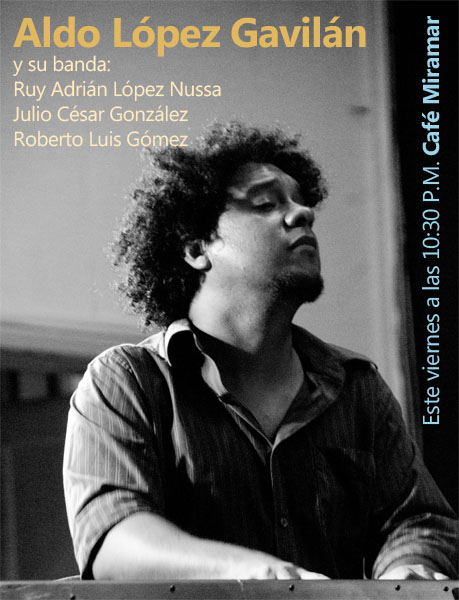
Aldito en el Cafe Miramar

Disgraceful and disrespectful a la vez.

The same thing happened at a packed Casa de las Americas gig recently. The concert, billed as Drums La Habana, was particularly unique in that it showcased Cuba’s most accomplished young drummers – Oliver Valdés and Rodney Barreto. To call these guys talented is like calling an anorexic lithe. These two are monstruos as we say here, producing percussive feats that your mind, eyes, and ears are hard-pressed to process.

The concert was unbelievable – the musicians were in the zone, Cheshire Cat grins plastered across their faces as they pounded their kits and poured their hearts out. Unfortunately, this virtuosity was accompanied by a low, constant thrum emanating from the back of the historic Che Guevara auditorium. I’m pretty sure I saw sax player Carlos Miyares grimace in their general direction at one point and I wonder how many artists are bothered by these bad manners and lack of listening skills? People around town have criticized Santiago Feliú for walking off stage recently two tunes into a set because he couldn’t be heard over the chatter. For those who don’t get it: have you ever performed live for an audience who thought their conversation was more important than the music you were making? It’s degrading. Creating art in front of a live audience is a brave act. Cubans used to respect that. Many still do, but they tend to be over 40.

I know a lot of what I’ve written here applies to youth the world over. But Cubans have distinguished themselves by being different. And this is getting lost and eroded little by little, day by day. Sometimes I wish all these kids would just emigrate and join their homogenized, opiated tribe up there and leave the island to those who are still interested in forging new paths, exploring frontiers, and listening, quietly, with appreciation, to some of the world’s best music.

Notes
1. If you’re new here, let me repeat: what I write at Here is Havana does not apply to all Cubans. I’m not implicating an entire pueblo, of this I’m very conscious, so save your comment for some other blinder-wearing blog. On a related note: although I’ve been based here since 2002, there’s a reason this blog is called Here is Havana: what I write applies only to what I know, that is to say, only to the capital. I really have no idea what happens in the provinces.

2. A new Russian bar, Tovarishch, is about to open up on Calle 20 and 5ta. I hope the bartender laughs openly at every kid who orders any pastel-colored or fruity vodka drink. I know that sounds mean, but I’ve had one too many run-ins lately with the annoying chamas. I promise to return to my upbeat self as soon as you arrive at the end of this sentence. OK, I lied. These kids have bad taste, to boot. 

3. Except behind the two wide pillars in the middle of the room; come early for a table with clean sight lines and clear sound.
23 Comments

Filed under Americans in cuba, Cuban economy, Cuban idiosyncracies, Cuban Revolution, Expat life, Living Abroad, Travel to Cuba

Today’s Cuba Reveal: Cuenta Propismo

I know more than a little about ‘cuento propismo,’ which in Cuba means freelancing (see note 1). I’ve been a cuenta propista writer since my grad school thesis was published and while writing is qualitatively different from slinging soggy pizzas from a Centro Habana tenement, many of the same principles apply. Tax burden and penalties; supply and demand; competitive advantage; 7-day work weeks and phantom vacations; plus a good dose of self-discipline, accountability and responsibility all come in to play when you’re your own boss. You also need to hone or have a knack for selling your product.

Here in Havana, where small businesses are sprouting like zits on a teenager, the learning curve is steep. Marketing is largely limited to twinkly lights, decals, and flyers and it’s not uncommon to see half a dozen or more cafeterias selling the same greasy grub on a single block. To date, over 400,000 people have solicited licenses to run or work at private businesses (tellingly, statistics released by the government fail to mention how many of these businesses have closed or failed since the licenses became available), the majority for food sales, preparation and services. It’s an experiment in market capitalism unfolding as I write this and it’s changing the face and feel of the city.

Some of the transformations are good, others are bad, and a few are ambiguous – for now anyway. Like a ‘sleeping shrimp,’ I’ve been swept along, but Havana is starting to feel vastly different for both individual and societal reasons and whenever I get this ‘oh shit, the roller coaster is about to dip and bank’ foreboding, I know it’s time to write about it.

Because I’m consciously, doggedly trying to emphasize the positive, I’ll start out with the good changes first.

The Good

More choice – For too long, Cubans have had to settle for what was available, when and if it was available. This is a result of severe scarcity on a national scale, for reasons well known (see note 2), coupled with centralized control of every sector of the economy. Today, you can choose from where you buy (state or private) and from whom – a friend, neighbor, family member, the muchacha you have a crush on, or the little old man trying to make ends meet. Both purveyors and consumers are still learning about how competition combines with supply and demand to drive choice, but at least now there is a choice – for those who can afford it (more on this under ‘The Bad,’ later).

Higher quality goods and services – The quick learners fast realized that they needed to provide quality products and services if they were going to survive. The savviest of Havana’s new small business owners – many from the Diaspora returning to the island to get a jump on the post-socialist Gold Rush – provide guarantees for their services and inculcate in their staff the philosophy that the customer is always right (not an easy feat in the Independent Republic of Saben lo Todo). On the consumer end, Cubans are starting to appreciate the value of paying more for higher quality – in other words, ‘you get what you pay for’ is starting to take hold.

Greater control and room to breathe/dream – One of the benefits to all this private enterprise – as intangible and unquantifiable as it may be – is that people working in the cuenta propista sector feel they have a modicum of control over their lives and destinies. This isn’t very practical in the state sector where the rule of thumb is ‘we pretend to work and they pretend to pay us (a pittance),’ and decisions can be made without explanation and seem absurdly arbitrary as a result. Striking out on your own, meanwhile, takes courage, fortitude, and a semblance of vision; how you dream your future can’t be arbitrary. It’s particularly nebulous, this ‘dare to dream’ benefit of the new economy, but I think it’s one of the critical changes we’re undergoing here. I’ve been hanging out with a lot of 20-somethings lately and this craving to ‘create your own reality’ is especially relevant to them. Working in the private sector puts money in their pocket – decent money, often for the first time – and habilitates dreams of how to spend it, teaches them to budget and save, and plants the seed that if you work hard, you’ll have the means to make bigger dreams a reality (see note 3).

Now The Bad…

Haves vs Have Nots – All those choices and quality goods, not to mention that entrepreneurial get-up-and-go? It’s only available to those already with the means. Sure, the government has started providing small business loans, but what’s really driving the new economy is that part of the population with the money to buy what’s on offer, invest in a great idea, or renovate a killer location for their new venture. Examples abound: fancy private gyms and spas; lounges a la London or New York serving $25 highballs; multi-bay car washes; and dog boutiques (yes, you read that right). And on the consumer end, we have ‘tweens with the latest iPhones, packed 3-D movie theaters, even paintball at $10 a pop. It’s the classic burgeoning middle class, but for every giddy kid with a new tattoo he’ll surely regret (I know of what I speak!), there’s a sad-eyed child wanting one of the fancy pastries in the window and an angry youth playing soccer barefoot. While I hardly register the flashy moneyed folks, each grim-faced granny and struggling single mother sticks with me. And I’m seeing more and more of them these days.

Life on fast forward – It’s amazing how slow, lethargic Havana has picked up speed of late. New cars hightail it through residential backstreets as if kids weren’t playing there; cafeteria patrons drum the counter top saying ‘I’m in a rush, hustle it up’; and ‘time is money’ is taking root as an economic/life concept. The digital boom fuels this and while I’ll be the first to champion faster internet, I worry the day will come (for some it’s already here), when we no longer make the time to spend time with the ones we love. I have to admit I’ve been guilty of this from time to time.

Prices are outrageous – Since the free(ish) market is brand new, charging ‘what the market will bear’ is being taken to absurd new heights. Agricultural cooperatives charge 10 pesos for four plantains (just a year or two ago these cost half this or less), while young men with bad hair charge 10 CUC for fixing a cell phone on the fritz; total labor: 15 minutes, meaning they make in a quarter hour what many make in a month. Service-based businesses are especially guilty and often don’t post prices, preying on the desperation of the customer who needs their phone fixed/car washed/business cards printed. I actually had this happen recently and when I took the guy to task, he said: ‘next time I’ll tell you the price beforehand’ (see note 4). I let him know there wouldn’t be a next time because I would be taking my business to the (more transparent) competition.

Key items go missing – When products suddenly disappear from store shelves here, we say they’re perdidos – lost or missing. And many things are missing of late since private restaurants and the general population shop at the same stores. This is a real point of contention for cuenta propistas who (rightfully) complain that they have to buy all their materials at retail prices, heavily compromising their profit margin. For the rest of us, certain items are increasingly hard to find – coffee, butter, cheese, toilet paper – as they get snatched up by restaurateurs stocking their larders. This creates even more societal friction and deepens the rift between the haves and have nots.

I don’t know how The Good and The Bad will eventually shake out, but I think we’d all be wise to buckle up because I predict The Bad is bound to get Worse. On the positive tip, there are a whole lot of creative, resourceful, intelligent and determined forces being released and connected right now which I admire. Whatever happens, you can bet I’ll be writing about it. Until then…

Notes

1. The literal translation is ‘by one’s account’ and in today’s changing Cuba refers to all small businesses from grannies selling bras and barrettes to Olympic stars running chic, expensive bars. These small business endeavors are permissible under what’s known in English as the Economic and Social Policy Development Guidelines, which began to take effect about two years ago.

2. Namely, the US blockade, the collapse of the Socialist bloc and ensuing Special Period, scarce resources in general and mismanagement.

3. As I write this, an email arrives in my inbox with this bit: “follow your dreams is sometimes a bit of a load of crap since your dreams don’t always pay the rent”. So far, so (pretty) good following my dreams, but point taken.

4. My bad for not asking the price ahead of time, but I needed the service provided desperately.

25 Comments

Filed under Americans in cuba, Cuban customs, Cuban economy, Cuban Revolution, Expat life, Living Abroad, Travel to Cuba

Cuba: What You Know but Don’t Realize

Over the years, I’ve dedicated (probably too) many hours analyzing, writing, editing, and commenting about the differences between here and there. The ‘there’ of which I speak is the US – from where I hail – but could easily be anywhere North, whither Big Macs and reality television conspire to make people fat and stupid.

Did I just say that? You betcha. I’m sorry if that applies to you, but my internal editor has been on sabbatical ever since a guy richer than Croesus got all up in my grill dissing Cuba like he actually knew what he was talking about.

Which is part of what sparked this post.

There’s a type of visitor here – usually imperious, moneyed men skidding down the hill of middle age towards moldering (and the aforementioned rich fulano fits the bill) – who has Cuba all figured after four days here. Sometimes even before getting here. Cuba is more complex than you could have imagined, you’re more close-minded than you care to admit, and your facile analysis belies the intelligence I’m sure you evidence in your back home life. For those in this category, I’ve crafted this post to clue you in. Just a little.

First, we’re facing a wave of economic, paradigmatic change here without precedent. It roils with an energy confusing, contradictory and encouraging (in its way), towards our shores. Indeed, already it’s breaking on our eroding sands. Like a tow surfer (see note 1) whose very survival depends on accurately calculating wave height, speed, and interval, while accounting for hidden (i.e. underwater) and surface (i.e. other surfers and their support crews) factors, we’re gauging the wave, trying to maintain balance, remain upright, and most importantly, keep from being sucked under.

But as any tow surfer will tell you: surviving a 75-foot wave and riding it are two entirely different experiences – as different as summiting Everest with throngs of weekend warriors as attaining the peak without oxygen. One simply takes money and some machismo and motivation; the other requires experience, training, skill, meticulous preparation, and a measure of karma and respect born of intimacy with the context.

So as this monster, freak wave feathers and breaks over Havana, I want to ride it, not simply survive it. And to do that, I – we – have to measure and analyze the conditions, bring our skills and knowledge to bear, channel positive energy, and ensure our fear is healthily spiked with faith. The first step in successfully positioning ourselves to ride this wave, it seems to me, is to understand the culture, in all its contradictory complexities, which brought us to…right…now…

While many emphasize the differences between here and there, between the land of Big Macs and the tierra de pan con croqueta, I take this opportunity to explain how we are the same:

Opinions vary: One of the questions I field most often is: do people like Fidel/Raúl/socialism/the revolution? This is as absurd as asking do people like Obama/capitalism/federalism? Setting aside the fact that the question itself is unsophisticated and dopey (governance and mandate are not about like or dislike but rather about measurable progress and peace within a society, plus, any –ism is just theory; it’s how it works in practice that counts), I posit that it all depends on whom you ask. Up there, a brother from the Bronx is unlikely to share views with a Tea Party mother of two. Similarly, an 18-year old from Fanguito won’t agree with a doctor from Tercer Frente.

It’s obvious, but visitors tend to forget that here, like there, you must consider the source when posing such questions. Less obvious is that here, it also depends on how you ask the question. But that’s a more advanced topic beyond the purview of this post.

People like stuff: On the whole, Cubans are voracious shoppers – always have been, always will be. Whether it’s shoes, books, handbags, wooden/porcelain/glass/papier mâché tschotskes, fake flowers, clothes, or packaged food, Cubans will buy it. Or at the very least browse and touch and dream of buying it. Some folks – like the ones who inspired this post – deny capitalist, consumerist culture ever existed in Cuba before now, revealing their lack of knowledge. I’m embarrassed for them; on the upside, it means many up there are clueless to fact that if you dropped a jaba bursting with a new pair of Nikes and Ray Bans, iPod (or better yet, Pad), some Levis, a pound of La Llave, gross of Trojans, and a couple bottles of Just For Men on every Cuban doorstep, with a note instructing them to come over to the imperialist dark side, a lot, the majority even, would do it. Being Cuban, a lot would pledge to ditch and switch just for the swag, of course, but that too, is an advanced topic beyond the purview of this post.

Until that day, folks here are gobbling up stuff as fast as the shelves can be stocked. In short, todo por un dolar is rivaling hasta la victoria siempre as most popular slogan around here.

It’s all about the kids: Here, as there, parents want a better life for their kids. While what constitutes “better” (again, here as there) depends on whom you ask, this desire to leave a more comfortable/equitable/safe/luxurious life and legacy to one’s kids is human nature. It drives people to rickety rafts, May Day parades, and long, hard overseas postings. It makes parents compromise their own mental health, spend beyond their means and completely subsume their own lives to their children’s. Case in point: have you ever seen what a Cuban goes through – psychically, financially – to celebrate a daughter’s quince? Hundreds, thousands of dollars and days, months, years of preparation are spent for the all-important photos, party, clothes, and gifts for their darling little girls. Families living six to a room in Centro Habana spending $5000 for their 15-year old’s celebration remind me of US folks who scrimp, struggle, and sacrifice to pay for their kid’s wedding/down payment/tuition. Children first – at all cost and any price, here as there.

We are the best in the world: Drop in anytime, anywhere in Cuba or the US and whomever you encounter will profess their country is the best. Greatness or weakness such bravado and pride? A little of both, I figure. That such hubris has contributed to where we are today, riding the wave, I have no doubt.

Notes
1. I’ve just finished reading The Wave, a spectacularly, adventurously researched and highly readable book on giant waves and the guys – tow surfers – who live to ride them. Check it out.

31 Comments

Filed under Americans in cuba, Cuban customs, Cuban economy, Cuban idiosyncracies, Cuban phrases, Cuban Revolution, dream destinations, Expat life, Fidel Castro, Living Abroad, Raul Castro, Travel to Cuba

Trending, Cuba, April 2013

Young/old, foreign/Cuban, gay/straight (and variations in between), black/white (and shades in between) – the crew gracing my living room lately is varied and invigorating. They’re a veritable cross section of Havana in evolution, the friends stopping by, sipping coffee, and smoking Criollos in my crib.

I’m indebted to them, my network of family and friends who help keep me dreaming and steady the ground beneath my feet so those dreams can be seeded, sown, and reaped into reality. This has always been a place of shifting sands and I marvel at the Cuban capacity to maintain balance and mirth in the face of it.

Even under normal circumstances, steady ground is as scarce around here as spare change in a junkie’s pocket. These days however, terra firma is still harder to locate as Havana lurches along its path of economic reform, testing the capitalistic waters about which there is much phobia. And with good reason: capitalism is inequitable at its core, which contradicts many principles and practices for which Cuba has long been admired.

Truth be told, it’s a bit scary these changes we’re experiencing, and not just for their tenor, but also their pace – glacial or breakneck, depending on your perspective. Regardless, all the transformations happening in this corner of the world (see note 1) mean it’s trickier than ever to maintain our balance as we crawl, walk, and run in the nascent Cuban rat race.

As a barometer of what’s afoot here in Havana, I thought I’d invite readers into my living room to eavesdrop on some recent conversations.

“I want to start my own company, but can’t” – This came from my friend Fidel (see note 2) who dreams of having his own software development firm. As a bright, young graduate of the UCI (Cuba’s IT university, churning out brilliant computer wonks for over a decade), he’s got the chops to do it, but contends he can’t. I should mention here that I’m in “can’t” recovery: by age 13 or so, I was using the word regularly until an adult I admired upbraided me about the weakness and defeat the word embodies. She was right, of course, even Obama proved that, so when Fidel says he can’t, I bristle and parry.

‘But that’s one of the permissible businesses under the economic reforms. The licensing is easy. Get a few friends together and make it happen,’ I tell him.

He almost snickered, detailing connectivity nightmares, difficulty in accessing the latest programs, lack of marketing and publicity tools, etc, etc. Valid points all, but my recovering ‘can’t persona’ kicked in.

‘I hear you, but you’re talking to someone who wants it all. I know that’s not possible, no one can have it all, but if I get just half…’ He looked at me as if to say: ‘that and a token will get me on the subway,’ as we used to say back in the day.

“Collateral damage from the Special Period” – This observation can be applied to much of Cuban reality today – breakups, emigration, encasing homes in iron bars – but I hardly expected it in reply to my question: ‘how did you get carpal tunnel?’ It was difficult to imagine how a family doctor could suffer from such a condition unless he was a computer solitaire addict or moonlighted as a guitar player (neither, in this case) and I would have never guessed it was somehow related to the dire economic times known as the Special Period in Time of Peace. Turns out he got carpal tunnel after so many years riding a bicycle between home, work, play, and errands – seems the hand brakes worked a number on his wrists for which he’s now being operated.

We laughed (because if you don’t, you’ll cry), and it was funny, in a tragic sort of way. Some categorize the Special Period as a heinous blip on the Cuban psyche, but that economic crash that befell the country when the Socialist Bloc fell is still deeply felt, and those that contend otherwise are either in denial or haven’t been paying attention. Meanwhile, my people are talking a lot about it lately.

Some of the conversation turns on Chavez’ death since the agreements with Venezuela and other ALBA member countries signed in the early naughts, were the first light at the end of the economic-strapped tunnel. Now, with Venezuelan presidential succession hanging in the balance, folks here fear a return to those dire times could be in the cards. In my estimation, Cubans are praying more for Maduro’s victory than during both Popes’ visits combined.

“Tía, what’s vaginoplasty?” – From the Special Period to (re)constructed vaginas: this is what we call in Cuba “hablando como los locos,” and my living room does see its share of crazy folks, I’ll admit. The question is: how exactly do you explain vaginoplasty to a 12-year old? When she’s Cuban, you stick to the science. And when she asks why someone would need it, you stick to accidents and physical deformities, leaving the transsexual conversation for a later date.

I mention this living room chatter because what was most interesting to me what that the topic was broached twice, by different people, in the span of a few days. What are the odds? Pretty good, I guess, here in Havana anyway.

“Don’t tell me he’s a metrosexual!” – In case you haven’t been here in a while, this is the latest fad (and I do hope it’s a fad because unlike transsexuals, metrosexuals actually choose this state of being) among young Cuban guys. If you’re unfamiliar with the term, it’s essentially an androgynous look adopted by urban males to what advantage I’m not sure. And these aren’t men who have sex with men in large part, but het boys adopting a super meticulously primped style that requires shaving/waxing/lasering their entire bodies to a hairless sheen, including their eyebrows. Just the maintenance required chafes (really – isn’t there something better you could be doing with your time and money?) and I personally find it a real turnoff.

So when a swarthy friend admitted his 18-year old son was a metrosexual, I offered my condolences. We both chalked it up to “youth today,” that tired refrain of all older generations everywhere, but I find it intriguing that in such a macho society, this particular global trend should catch on. Is it a statement against the patriarchal construct? I’d like to think so, but what if young women did the same and started going all KD Lang androgynous? Would parents have the same “they’ll grow out of it/youth today” attitude? I’m not so sure. If you have any insight on metrosexuality in Cuba or general, bring it on.

(And you thought this post was going to be all about Yoani and Bey-Jay.)

Notes

1. Periodically (like now) I hasten to remind readers that when I say “this corner of the world,” I’m referring to Havana only. I don’t get out of the city nearly often enough to have a bead on what’s going on in the rest of the country. And Havana is a world unto itself. I think it’s dangerous to generalize or draw conclusions about Cuba as a whole from what’s happening and being said in the capital.

2. Like all names at Here is Havana, this is not his real name. In this case, however, it’s close.

8 Comments

Filed under Americans in cuba, Cuban economy, Cuban idiosyncracies, Cuban phrases, Cuban Revolution, Expat life, Living Abroad

Havana’s Happy Ending Massage

[tweetmeme source=”connergo” only_single=false]
Next to a full-blown orgasm, there’s nothing more relaxing than a full-body massage in my book. A good massage even beats out great masturbation if you ask me, and while I’ve had massages in places as far flung as Hawaii and the Bronx, Guatemala and the Yucatán, I’ve been reticent to explore such carnal (albeit platonic) pleasures in Havana. It’s not a question of cost – a full one-hour massage is as little as $10 here – but rather the 1-2 combo of Cubans’ notoriously lascivious nature and a rabidly jealous Scorpion husband (see note 1). Who knew what would go down on that table, yours truly lying there nude, a strange man’s hands roaming all about?

But recently, a different 1-2 combo struck, sending me to that table: first, the need for release and relaxation was too pressing to ignore and then a friend opened a full-service spa. Permissible under Cuba’s new consumer capitalism regime, this privately-owned spa is in a privileged corner of an upscale neighborhood and offers everything from spinning classes and yoga to Brazilian wax jobs and microabrasions.

It seemed like the golden opportunity to invite the strong, well-oiled hands of an unknown Cuban macho to get acquainted with my body…

But before getting down to the nitty gritty, I wonder what you imagine when you hear the word ‘spa?’ Is it some oasis serving cucumber water and salmon/watercress baguettes on Little Palm Island? Or a strip mall in the Valley specializing in waxing, wrapping, threading, and peeling? Whatever images the word ‘spa’ conjures in your corner of the world, I bet it’s nothing like what we have in Havana.

All of the spas I know here (see note 2), are mansions or grand homes at least, with living rooms converted to fully-equipped gyms, bedrooms repurposed for Pilates, and closets retrofitted as saunas. My friend’s spa falls under this rubric, though as educated, well-traveled and cultured as she is, her spa is mucho más allá, offering nutrition consultations, medicinal plants for sale on the landscaped patio, and self-defense classes for women.

Bright, clean and spacious, the spa was welcoming but exuded the contradictory energy typical to Cuba at today’s crossroads: phones rang, appointments were made and administrators made sure it hopped with the hustle and bustle of a profit-making/seeking enterprise, while employees sat around picking their nails and contemplating their navels.

I was shown to a Swiss-clean room with AC, professional massage table, and linens monogrammed with the spa’s logo. In the gleaming, marble bathroom, I was instructed to change into the robe provided. Just then, the masseur appeared. I’ll call him Henry. He was big not wide, which was good, and had the sculpted muscles of a gym rat, nicely displayed in a skin-tight wife beater. Except for his braces (adult orthodontia is big here), he was easy on the eyes, which is neither here nor there since my baby blues would be closed, but like having an unattractive or downright ugly gynecologist, it never hurts. Henry had the smooth, lustrous skin privy to youth and would be considered a hottie by anyone’s standards.

Expectations for popping my Cuba massage cherry were high…

I assumed the position face down on the table and Henry spoke the only words he’d utter to me over the next hour: “would you like your gluteus and breasts massaged as well?”

Wait, what?! I was sure I’d heard right, but was struck dumb for a second as yells of “you can do it señora! Feel the burn!!!” bellowed through the thin walls from the spinning class next door. My mind flew into high gear, considering his query:

– Is a tit massage standard procedure?
– Had I ever even been asked this before by a professional masseur?
– Do boobs even have muscles to massage?
– If the answer to the above questions is no, was there a hidden subtext?
– If I answer yes to the tit kneading, does it open the possibilities for a “happy ending” which, considering the cut of Henry’s jib, wouldn’t be the most unpleasant thing to happen to me today?

“Just the gluteus,” I told him when I’d regained my senses. He got busy.

Things started off suavecito, suavecito and my first thought was ‘Is this a massage or foreplay?’ It was too light and fluttery, nothing that would route out my many sore muscles and overworked tendons. ‘Maybe he’s just warming up,’ I reasoned.” But he kept on killing me softly, even on both feet, committing that all-too-common infraction: neglecting the feet in massage quality and quantity.

When it became clear Mr. Muscle wasn’t going to apply himself, I sucked up the string of drool crawling across my cheek and said: “please: do it a lot harder.” And I think he tried – for half a calf at least, but then lapsed back into the massage mode I call “How to Relax Housewives and Pleasure Slackers.” I imagined him learning the techniques at an intensive weekend workshop somewhere bucolic like Las Terrazas or Viñales. Needless to say, this masajito was doing nothing for the knots tucked deep beneath my shoulders and my related stiff neck. Henry’s approach released no toxins and alleviated stress for about as long as takes you to finish reading this sentence.

His hands were big and strong and my mind’s eye saw them kneading whiter skin than he had probably ever touched. ‘Litro de leche’ Cubans often call my skin tone – not always in a good way. When it came time for me to turn my lily white self over, the draping acrobatics commenced. Since I’d declined the boob massage, he had to flip me while keeping both my genitals and chest strategically covered. He was fairly deft at it, though somewhat mechanical, and I imagined a full third of that weekend workshop in Viñales dedicated to ‘How to Drape Your Client without Exposing Popular Erogenous Zones.’

I asked him once again to put more oomph into it, but he didn’t. I resigned myself to the fact that my mind and body were not going to attain any bliss today. Just then there was a knock on the door; a muchacha entered asking if she could leave her bag in the massage room. Busting in on a naked (albeit draped) me didn’t really rankle: I was used to people barging in here – during couples’ therapy, on the toilet, in the throes. Privacy in Cuba is one of the island’s enduring oxymorons and one you have to cope with if you fancy spending large amounts of time here.

My faux/flojo massage was almost over and I realized the only happy ending was for Henry, when I left him a nice tip – just for trying.

Notes
1. In 10 years here, most of those covering the health system (where almost all massage therapists train and work at some time), I’ve never met a female therapist – something which I predict is going to change fast as more foreigners drop into Havana’s day spas.

2. Watch for my upcoming article on Havana’s spas and their inclusion in the next update of my Havana Good Time iapp. It’s worth pointing out that there are both state-run and privately-owned spas here now.

48 Comments

Filed under Americans in cuba, Cuban customs, Cuban economy, Cuban idiosyncracies, Expat life, health system, Living Abroad, Relationships, Travel to Cuba

La Bola en la Calle: Crime in Cuba

[tweetmeme source=”connergo” only_single=false]

“He killed it! And I love this venue,” the young Cuban American says leaving the Jardines de la Tropical where Carlos Varela has just played a rare Havana concert.

“Yeah, way better than when we saw him in Miami,” his friend responds.

“Totally. And it’s so obvious we’re in Cuba: look at all the rejas.”

Gems like these are why I’m such an avid eavesdropper: whatever differences there are between here and there, the one warranting comment is the Cuban mania for throwing up gates and bars around their homes.

If you’ve been to Havana, Santiago de Cuba or anywhere in between, you’ve seen this obsession Cubans have with enclosing their homes with iron bars. They’re cages, literally and figuratively, and are poignantly ironic as a result – so many people carp on about ‘freedom’ here, while locking themselves away in jails of their own construction.

Home robberies do occur, there’s no doubt, and the Puentes Grandes section of town where Varela played fairly beckons ne’er-do-wells: it’s dark, isolated, and provides many easy escape routes. But the disconnect between the real and perceived threat is aggravated by various factors including press coverage (there is none); the Cuban penchant for, and reliance upon, gossip for information (loosely related to the first factor); and our human tendency to place an inordinate amount of importance on Stuff.

Our first home here – a charmless microbrigada box in the industrial outskirts of town – had a small balcony, for which I was thankful, except it was enclosed in a cage. For me, there was no stronger metaphor for a bird with clipped wings and will than looking out from that barred balcony. I tried not to think about it too often, but ended up not using the balcony much at all. That cage mitigated any levity my soul derived from the semi-outdoor space it provided.

But after a decade of watching people struggle to amass money to put up bars (see note 1) and as much time puzzling over the rich and contradictory Cuban psyche, I feel driven to write about theft, safety, paranoia, and protection of stuff here and why I think the Cuban perception is skewed.

There’s no evidence: Have you ever seen crime statistics for Cuba? Me neither. I’m sure they’re collected – after all, the data-laden ONE (Oficina Nacional de Estadísticas) amasses stats on everything from new HIV cases and teacher:student ratios, tomato harvests and tourist visits – but crime is neither reported on nor published. Is crime up? Maybe, if you believe the bola en la calle, AKA what’s being said in the street. But then you’d be violating one of my top Cuba rules: if you haven’t seen or experienced something here firsthand, it’s best to assume it’s false or fabricated (or at the very least exaggerated) until proven otherwise. Indeed, if I believed everything I heard here, I’d be writing about cooking oil made from cremated bodies; JFK’s bastard Cuban son; condom cheese; and the government’s plan to spend nearly $400,000 converting all license plates from American- to European-style. Rumors, nada más, which will remain so until evidence confirms or disproves them.

What my experience tells me is that house theft is not nearly as common as Cubans believe. In over a decade here, I know three people who’ve had their homes robbed. In each instance, no one was hurt, thankfully, though all were home at the time. In only one of these cases was the perpetrator caught; in none of the cases was property recovered. Three robberies in 10 years hardly argue for a generalized wave of house break-ins (see note 2) requiring enclosing your home in bars.

Paranoia, it’s epidemic: In reply to my query about government policies regarding this and that, a dear friend explained: “half of the paranoia is based on experiences of concrete, unrelenting and strategic attacks on the country from without and within. The other half is straight up paranoia.” The Webster Collegiate Dictionary defines paranoia as ‘a tendency on the part of an individual or group towards excessive or irrational suspiciousness and distrustfulness of others.’

Based on my experience with everything here from bureaucracy to busy body neighbors, I’m on board with my friend’s assessment: there are some very real, tangible threats to protect against and there are the imagined ones. Something else my experience tells me is that paranoia is contagious. From day one, all of my neighbors, both in the aforementioned barrio on Havana’s outskirts and now in Playa, have urged me to padlock my front door gate, locking myself inside, especially at night while I’m sleeping.

But I’ve never done it: in my mind, the way Cubans smoke, fire is a much bigger threat than robbery (see note 3), and I’d rather be burgled than trapped inside a blazing building. Recently, a friend slept over after a party and locked up the house after I’d gone to bed. I was amused, but not surprised, to find upon waking that he’d padlocked the front door. What wasn’t funny (and gave me great pause) was, the following night, for the first time in a decade, I padlocked that gate, thinking ‘an ounce of prevention….’ Yet, when that prevention is based on rumor and paranoia, is it really worth it? And how about when the preventive measure generates another danger, in this case rendering my house a fire trap? Needless to say, that was the first and last time I padlocked my front door but it taught me an important lesson: paranoia is a disease, easy to catch.

Friends impose this same paranoia regarding my preferred mode of transport: constantly, I’m urged to be extremely careful on my bike, to the point of not riding at night, ever, because I risk being jumped and the bike ripped from between my legs. While I recognize that someone desperate (or stupid; see next point) enough might attempt this, I’ve never heard of this happening here. Have you? The more people tell me this, the more I think it’s an apocryphal holdover from the Special Period.

I’m was born and raised in New York: My friends from Centro Habana scoff when I tell them this, rejecting it out of hand as any kind of mitigating factor vis-à-vis crime against my person or property. ‘This is Havana, it’s different,’ they invariably say. My first inclination is to say: ‘hell yeah, it’s different!’ and then explain the armor and mechanisms one is forced to develop waiting for a New York City subway on an abandoned platform deep underground circa 1986 when wild-eyed crack hos, male and female, roamed and robbed violently, desperate for money for more rock cocaine.

You needed mad city skills in my New York of yore, I want to explain, but refrain. I don’t tell my Centro Habana friends about walking in the street – never on the sidewalk – in dark, decrepit neighborhoods to improve your visibility and sightlines and lessen the possibility of being jumped or cornered, nor about turning rings inward or forsaking jewelry altogether to decrease your chances of being marked. Although I don’t offer tips like ‘never leave a backpack in a locked car,’ sometimes I wish I had: my stepson made this rookie mistake in Madrid last week and was robbed blind of his laptop, passport, plane ticket and more. Likewise, I don’t explain the very real difference between walking streets where you know people are armed with guns and those where someone may have a knife – but probably not.

I also don’t share my experience of 18 months of self-defense classes where I learned tactics for what to do when jumped, pinned or attacked, at gun or knife-point, or with bare hands. With their belief in la bola, combined with paranoia and lack of firsthand knowledge of what constitutes real and constant threats, what would be the point? Besides, it reeks of mala brujería to talk about it: I don’t want to jinx myself and have to put those skills to the test.

¿Conclusión?

Cubans have an unrealistic measure of what crime looks like outside their door, down the block, across town and overseas (see note 4). The question is: does it really matter? Isn’t this just a chronicle of life in contemporary Cuba? Possibly, except I’m worried about what relying on la bola about crime will mean as we move forward with current economic reforms. As inequalities deepen – and they are, as I type this – and crime begins to climb, as it tends to do when the rich get richer and the poor get poorer, won’t it be helpful for citizens to know exactly what their playing field looks like?

Notes

1. Even more than renovated kitchens and bathrooms, the first home improvement Cubans make is erecting rejas on windows and doors.

2. Ojo: Note that here I am referring only to home robberies and how they correlate with barred windows and doors, not opportunistic theft of bicycles, chain and purse snatching, etc.

3. One friend of mine has fallen asleep not once, but twice, while smoking, torching his mattress in the process. Despite having escaped unscathed, he continues to smoke and nod off; I have the burnt furniture to prove it.

4. This intrigues me even more still since part of the reason for this skewed perception is lack of press coverage of crime here. But you see the same exact fear and paranoia in the US due to too much press coverage and the generalized media strategy of ‘if it bleeds, it leads.’

53 Comments

Filed under Americans in cuba, Cuban customs, Cuban economy, Cuban idiosyncracies, Cuban phrases, cuban words without translation, Expat life, Living Abroad, Travel to Cuba

Apretando Mi Corazón: Cuban Emigration

[tweetmeme source=”connergo” only_single=false]

All my friends are talkin’ about leavin’, about leavin’

So goes the little pop ditty in heavy rotation on one of the satellite radio stations I favor. I’d bet my life Cuba never crossed the songwriter’s mind, but it so easily could have been written by my friend Alma, my prima Anabel, or my colleague Jorge.

Or me.

The song is entitled Ghosts and we’re surrounded by them here as certainly as the water which hems us in, as omnipresent and nebulous as the bureaucracy that hobbles Cuban greatness.

Can you hear me sighing? Crying? Thankfully not, but somewhere out there, not too far from where you read and where I write, there’s a Cuban pining for the friends that have left or for those they’ve left behind.

Or not.

Emigration is a little like death: everyone has their own way of grieving and no one has the right to judge – least of all me with the relative freedom of movement I enjoy. Some people block out departed loved ones as soon as that exit permit is stamped or the fast boat slips silently from shore. Until they’re due back for a visit, in which case copious gifts are expected. And they always do. Return, because the pull of this patria is too strong to resist indefinitely and bear gifts because the guilt – self-imposed and otherwise – of leaving is heavy. Besides, what better way to prove the grass is indeed greener than to come loaded with loot? (see note 1)

Where will her roots grow? Photo by Caitlin Gorry.

What it amounts to is ‘out of sight, out of mind.’ It’s a wholly common coping mechanism here, in fact. Or rather than a way to cope, it’s simply part of the cultural sofrito. After all, many a liaison – and even marriages – (mal)function due to ‘out of sight out of mind,’ and the related ‘what you don’t know won’t hurt you.’ Until you do, but that’s another story.

Some Cubans, meanwhile, go to the other extreme: they pine and fret and share each morsel of news with every person they meet. Iraida got her driver’s license; Alain saw his first St Patrick’s Day parade; Yoselvis likes Burger King, McDonald’s not so much. This is my approach for keeping close everyone I left behind in my own émigré drama. Willingly taking leave of a lifetime of friendships – most Cubans don’t realize we share this in common.

Emigration is a knotty business, muddled by politics vs. agency, needs vs. desires, illusions and disenchantment, resignation, empowerment, circumstance and happenstance. And I’ve faced a lot of loss and separation on this end. Many of my Cuban friends and family – relationships I’ve fed and nurtured over the past 10 years with all the creativity and passion my heart allows – are leaving. Invariably, I’m tipped off when they suddenly start speaking English and going to every doctor they can, even the dentist.

The details of leaving vary, but the reasons rarely do. Frustrated and fed up, my friends want meaningful work at a dignified salary; yearn to improve their families’ station; and itch to experience something beyond their block, barrio, or province. A leave-taker myself, and with what I know beyond this city, island, and hemisphere, our emigration conversations have been in-depth and interesting.

My 20-something friends ache for independence – from mom and the state – though many are clearly unprepared for the reality fleeing the nest and flying solo imply. My 40-something friends, meanwhile, are tired. Tired of only having water un día sí, un día no; tired of waiting on the bus, permissions, and promises that may never materialize; tired of hunger and boredom and heat without respite, tired of the shortages and struggle and slogans – the endless luchita that erodes the will to go on blackout by blackout.

Just today, after a rash of events that included death of the family dog, a trip to the pediatric hospital and stint at the police station (neither resulting in prolonged care or detention por suerte), a friend reached the end of her rope: “I’m a revolutionary, but there are limits to what a person can take. I can’t take any more. I’m ready to get on any lancha or plane to get me out of here.”

I relate to both groups: fiercely independent, I began working at 13 and left home four years later, so I get my young friends’ anti-dependence stance. What trips me up and out, though, is how they replicate the precise behavior they condemn: they don’t participate in any community endeavors like the block association, because they say the block association doesn’t get anything done. In turn, the association blames ineffectual municipal authorities, who blame overworked and gridlocked provincial authorities and on and on goes the blame game up the hierarchy in a cycle of non-action.

I ask if a renovation or re-thinking of these mechanisms is possible (obviously it’s desirable), but they give me ten reasons why it isn’t practical. When I suggest that they volunteer or campaign for those positions in local government where they might affect change, I get the same response. It’s a vicious cycle and self-fulfilling prophecy a la vez: things won’t get better because the people charged with improvements are ineffective and/or shackled so why even deign to try to fix what’s broken or work towards positive change? So they cross their arms and give in to the inertia – while eating grandma’s home cooking with provisions provided by her and the state, in clothes washed by mom, after which they shower in a bathroom they’ve probably never scrubbed themselves. They are resigned, leisurely.

Out of sight, out of mind? Photo by Conner Gorry.

I know that sounds harsh and as if I’ve written them off. But I feel for this generation. They did get the fuzzy end of the revolutionary lollipop after all. They were born into the hardship of the Special Period, just missing the halcyon Eastern Bloc boom, when you could take your honey out for dinner and dancing on the average salary. The emotional, exuberant revolutionary hey day when the entire country put their backs and minds into creating a more just, equitable society was also before their time. To boot, their lives were proscribed by all kinds of dubious innovations like ‘emerging teachers’, the camello, and reggaetón (see note 2).

But there have been positive changes in their lifetimes, too, and when I ask them about the relaxation of restrictions on private property and enterprise or the very public push for full integration of LGBT Cubans into society for instance, they say ‘too little, too late’ or cite non-causal factors for such strides. Many didn’t participate in the national debates that generated these changes, nor have they read or heard Raul’s speeches specifically dealing with these issues – and even thornier ones like travel and the meager salary problem.

When I point out that not all change is good and ask if they’re prepared to take the good with the bad, they say yes – reflexively. Change for the sake of change is their position. And it leaves me wondering what they believe in; I’m coming to think that even if they know, they aren’t prepared to fight for it.

On the whole, my 40-something friends are nostalgic for the late 80s and agree much has changed since then – for good and not so. Back then, you couldn’t even dream of procuring an exit permit to travel abroad (a restriction the majority believes should be lifted, though this involves complexities not everyone is willing or able to recognize). And they praise recent changes, though often such praise isn’t forthcoming without prompting. It makes their resignation doubly troubling – they have the historical context of how great this country was and the maturity to take the longer view (see note 3) but still they want out. When I ask these friends what they would change, they mention freedom to travel (something my own country doesn’t extend its own citizens – another thing we share in common) and less bureaucracy. Some say they want Liberty, capital L.

Mercurial, that liberty thing. Do they realize tyranny comes in many flavors? And that consumer capitalism, powered by its ‘save yourself if you can’ underpinnings, is among the most bitter?  And if you can’t save yourself? Tough luck.

For many, the choice is reduced to resignation or emigration. Neither of which will deliver the liberty or change they so desire, I’m afraid. To be clear: I wholeheartedly support my friends working towards leaving; after all, I did it myself, I left my country and I can leave this one too when I want to. But I miss them something awful once they’re gone.

To the resigned, I say – if you’re going to stick around, stick up for what you believe in. A better Cuba.

Notes

1. OK, so maybe that’s a little crass. Cubans know better than anyone how hard life is here and generally have a genuine desire to help out those back home. Still, doubt creeps in when I learn about the rent-a-bling businesses in southern Florida which lease chunky gold-plated watches, chains thick enough to moor a boat, and rings for every finger to Cubans returning to the island. These doubts are reinforced when I turn sad watching family ruptures at the airport and friends say: ‘that’s all a show, muchacha. Take it with a grain of salt.’

2. This program trained massive amounts of teachers in the minimum amount of time. The idea was to improve the teacher to student ratio, which took a nosedive as older, more experienced teachers retired – often to offer private, complimentary classes to those students who could afford them. More often than not, these emerging teachers weren’t much older than their charges and depended on videotapes and other teaching aides to compensate for their lack of experience. By all accounts, it wasn’t a good approach. Camellos were double-humped hulks pulled by big rig cabs that held over 300 passengers when packed. You still see them in the provinces, but they’ve been phased out in Havana. If you don’t know what reggaetón is, I envy you.

3. Difficulty in taking the long view is not just limited to Cuban youth, I’ve found.

51 Comments

Filed under Americans in cuba, Cuban economy, Cuban Revolution, Expat life, Uncategorized

Do You Have the Cojones?

[tweetmeme source=”connergo” only_single=false]
If I had a peso for every email I get from someone saying they want to live in Cuba, I could take the six month sabbatical I need to finish my book. Hard as it may be for some of you to believe (or stomach), people do indeed write me all the time professing that they want to live here. These wannabe transplants mention the music usually, the slower, easier pace sometimes, the social safety net often, but Cubans and their idiosyncrasies always. It’s the Cuban ser – their way of being and living – that is so infectious, they tell me. As if I didn’t know. After a decade living here, believe me, I know. And it’s not always pretty or fun. So before you do something rash or costly or dumb, ask yourself this:

Can you be passably nice to people you can’t stand; have betrayed you; or are inept?
Sure, things are changing fast down here with unprecedented economic reforms having sparked a capitalistic furor and all the multi-tasking, efficiencies, and work ethic the best of such furor engenders. But really, it’s the same dog with new fleas. Bureaucratic habits and vice; the cradle-to-grave airbag of state support (i.e. a not always effective, and often painful savior); and the absurdist criteria for job security are die-hard tendencies everyone has to navigate.

Such tendencies, coupled with Havana’s small size and an ingrained system of sociolismo – whereby who you know helps keep you afloat – force us to deal daily with perfidious lovers, mentally challenged office drones, and crabby clerks. Getting all New York uppity or asserting that ‘the customer is always right’ will backfire (trust me) and just make everything harder in any and all future dealings with the aforementioned lovers, drones, and clerks.

Which is more important: sex or drugs?
You’re shit out of luck if it’s the latter. Cuba’s zero-tolerance policy and strict interdiction laws mean jail time for a joint, limiting recreational options to island-produced vice: rum and prescription speed, sedatives, and the like.

If it’s the former, than c’mon down because sex of all types and stripes is better on the island. While I’m still parsing the reasons why, I can say with certainty that it’s related to the lack of shame Cubans have about natural, bodily functions; the absence of Puritanical underpinnings found in other societies (you know who you are!); and the prowess of Cubans en sí. Even if you were to relocate with your spouse or partner, I predict my findings would be confirmed.

Can you tell/enjoy a good joke – especially when you’re the butt of it?One thing that chaps my ass are all these Cuba wonks (including locals – yes, Yoani Sánchez, I refer to you) who write about island life, history, politics and even travel and fail – utterly – to reflect the wicked sense of Cuban humor. This is a funny people, people. No matter who you are or where you’re from, Cuban friends, family, and colleagues will constantly darte chucho y cuero. Loosely translated, this means you will be the butt of many jokes. You are expected to laugh along and what’s more, reciprocate.

To take an example from the weekend-long International Harley Rally I participated in recently….

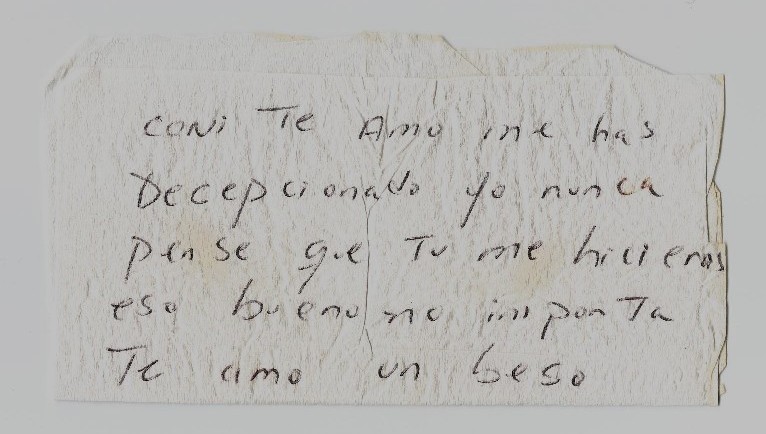
I rode on a 1953 hog driven by compañero Vladimir (Note: name has been changed to protect the guilty). Like most Cubans, he took the 3-hour ride as an opportunity to flirt and shower me with compliments – the scripted Cuban prologue to getting into a girl’s pants. Not a chance did Vlad have, but that never stops an island guy from trying. I was clear on this point, as were the other 100 or so Harlistas and their backseat Bettys, but poor Vlad tried his damnedest regardless. On the last night, there was a big fiesta, the booze flowed, Vlad got stupid drunk, and ended crying in a corner. His friends rallied, rousted him, and escorted him safely to bed. Upon their return, they passed me this note:
[
(Coni I love you. You betrayed me. I never thought you’d do that to me. Whatever. It doesn’t matter. I love you. A kiss)

Uproarious laughter ensued – we all knew Vlad’s blubbering had nothing to do with me and everything to do with dropping his bike in a drunken mishap. Lips pursed and blowing kisses, I snatched the forged note from Rodolfo’s hands, preventing him from making good on his threat to post it on Facebook.

Which is more important: food or sleep?
Automatic fail if you answered either because you’ll will go without both at some juncture here. Obnoxious reggaetón at 5am; pre-dawn Revolutionary Square rallies; and all-night parties will rob you of the latter, while shitty/non-existent restaurant service; midnight munchies with nowhere to sate them; and food just not worth ingesting, will rob you of the former.

Do you have personal space issues?
If ‘yes’ even crosses your mind, cross Cuba off your list: chronic housing and transportation shortages mean you’ll share rooms and beds, seats, sweat and oxygen with friends and even strangers at one point or another. Culturally, Cubans have a completely different approach to personal space – kissing, touching and rubbing up against each other is de rigueur, regardless of relation or circumstance. Even in the dog days of summer, folks greet each other with a kiss on the cheek, leaving behind a wet slick of sweat, a reality I’m still not sure how to deal with: do I let it ride and dry or swipe it away with a perdóname smile?

Are you more of a tits or ass person?
Cuban preference falls squarely on the latter which is a boon for bosom-challenged me, though I’m sorry to report that implants are making major inroads here, tweaking the standard of beauty towards the bust.

How do you feel about second-hand smoke?
Personally, I’m tired of tourists giving me dirty looks as I enjoy my habitual cigar. More than sex, rum, salsa, and solidarity, Cuba is known for its world-class tobacco. If you’re going to be here for any length of time, you’ll have to accept the fact that at one time or another, in places appropriate and not (e.g. windowless clubs, in hospitals, on buses), you’ll be breathing in the piquant, cancer-causing smoke of uncut black tobacco cigarettes and one peso cheroots.

Are you a hygiene freak?
If you’re one of those folks who has a trial-sized Purell bottle clipped to your bag, this isn’t the place for you. From stepping in street juice and gutter detritus to tolerating bugs or hair in your food (or as part of your food, as often happens with chicharrones), you’re going to experience it here. What’s more, every Cuban observes the five second rule: food dropped on the floor is entirely edible, as long as you retrieve it within five seconds. To wit: a couple of days ago I went to the panaderia for my daily ration of bread. As a nice neighbor helped me deposit the rolls in my sack, two fell to the sidewalk. Without pause the baker said: ‘give me those; I’ll replace them.’ He did, but only after placing those two tainted rolls back on the rack alongside the rest to be sold. Whomever came after me got those fallen rolls, none the wiser, poor soul. This happens all the time, and you will eat food that has kissed the ground, whether you know it or not.

Can you go without toilet paper/tampons/Internet/butter/speaking your native language for indeterminate and sometimes extensive, amounts of time?
We all go without these items down here, since to be in Cuba requires an adaptability many visitors I know simply don’t have but which Cubans possess in spades. No toilet paper? No problem – we use water like billions of other people around the world or the Communist daily cut into handy-sized squares. A diehard Tampax user before my move, I switched to pads a decade ago and many Cuban women still use swaths of cotton. Baking notwithstanding, oil is a good enough substitute for butter and while there is no substitute for Internet, being disconnected has its advantages – like actually interacting with real human beings.

On the language front, I’m embarrassed for expats who move to foreign countries and ensconce themselves in enclaves of their native tongue. These folks also like to foist that tongue on locals by talking REALLY LOUD or s-l-o-w-l-y in the odd, delusionary, and insulting belief that these strategies will result in success. If you’re going to live here, you need to speak Cuban, coño, which as any Spanish-speaking visitor knows, is an entirely different ball of wax from straight up Castellano.

Do you wither in the heat?
If so, don’t come here: you won’t be able to take it and frankly, you griping about it bums us out. We, on the other hand, can complain about it long, hard, and better than you – a right earned through innumerable August blackouts with no fan, AC, or ice water.

How is your tolerance for contradictions?
Every society has them and if you think otherwise, you’re not paying close enough attention. But the Cuban flavor of contradiction is particularly special. Married men, for instance, can keep multiple lovers (sometimes of both sexes). Married women? Not so much. Meanwhile, government laws promote private business but the bureaucrats charged with upholding those laws squelch incentive and drive; sex is the national pastime but making carnal noises the neighbors can hear and nude (even topless) sunbathing are taboo; artists keep profits from their work abroad but athletes don’t see a cent; and a taxi driver/tour guide/waitress/hairdresser earns more than a neurosurgeon. The media bears much guilt as well: you’ll very rarely hear trova legend Pablo Milanés crooning his immensely popular songs of love on the radio or TV, but sleazy reggaetón by the likes of Osmany García who beseeches chicas to suck his pinga gets airtime. Some of these contradictions are trying to work themselves out, but are proving as hard to cure as bed bugs and herpes.

Finally, do have untapped stores of inner strength (i.e. cojones)?
I hope so because to live here, you’re going to need them.

68 Comments

Filed under Americans in cuba, bureacracy, cigars, Cuban customs, Cuban economy, Cuban idiosyncracies, Expat life, Living Abroad, Relationships, Travel to Cuba

Crystal Balling Cuba

[tweetmeme source=”connergo” only_single=false]
Get your mind out of the gutter: this isn’t a pornographic post – which I know will be a great disappointment to some of you (I see every naughty and downright nasty search term used to find Here is Havana, you know). Rather, in this post I bring decades of capitalistic serfdom and 10 years of Cuban residence and observation to bear on Havana’s not-too-distant future. Making predictions is a dicey proposition and I will do it just this once, so pay attention. Here’s what I expect to unfold:

1. Bicycles are going to make a roaring comeback.
I mentioned this recently to a pair of Cuban journalists who fairly scoffed, decrying the idea as incredibly naïve and ill-informed. The hangover from the Special Period was too potent, they proclaimed in that annoying, know-it-all way, and the bike as a means of conveyance? Largely dead (and unlikely to be revived), it’s association with hard times, hunger, forced weight loss, and transport of last resort too fresh and caustic still.

I offered no rebuttal since Cuban journalists are not typically known for their insight or analytical chops (see note 1) and I was sure my theory on the resurgence of cycling would have been lost on, or worse, appropriated as their own.

What I didn’t say then but will now: as more people – young people especially – enter the private sector as wait staff, bartenders, hairdressers, parking attendants and in scores of other decent wage-earning jobs, they’re going to have to be at work on time. And public transportation is too unreliable. ‘La guagua no llegó’ was viable enough excuse when they toiled in a state cafeteria or the post office, but ‘the bus never arrived’ isn’t going to cut muster with their boss at the paladar or private spa. These gainfully employed folks will also have the resources to buy a bicycle. Moreover, I know intimately how efficient riding a bike to work or play can be. And if there’s one thing capitalism hammers into adherents early and often it’s find efficiencies or perish.

My Havana ride: Frances

A secondary and complimentary reason why bikes are going to come back into fashion is that Cuban women are beginning to feel the pressure to shape up. This isn’t a health craze, far from it. Instead, the pear/guitar-shaped figure that has always driven Cuban men mad is being supplanted by standards of developed world beauty. This super skinny/no hips archetype is problematic for a culture bred and bothered on fat asses and love handles – for centuries the ideal Cuban woman was one who had something you could grab onto. But slowly, surely, Cuba is headed for Barbie land – because buying into what they’re selling is what the “free” market does best. It makes me sad; one of the joys of this place for me is its proud nonconformity to dominant paradigms.

2. Pull back on car sales/private taxis.
Day by day, Havana’s streets become more dangerous, traffic-jammed, and accident-prone. This isn’t surprising considering the number of vehicles – new and rebuilt – that have been injected in a short period of time into a city laid out centuries ago. This is thanks to the relative ease with which cars can be bought and sold now, but there are other, less obvious, reasons why our streets are more perilous for motorists and pedestrians alike.

First, a small, but important change was made recently affecting the fixed taxi almendrones that ply main avenues around town: beginning last year, owners of those cars were permitted to subcontract out the vehicle to other drivers. Whereas previously only the owner could hack his car, now he can hire a driver to do the drudge work, freeing said owner to claim his spot at the domino table, slug back rum, and rake in cash. And the driving “skills” of some of these hired drivers are downright scary: they barrel down heavily-traveled thoroughfares at breakneck speeds; learn their routes – even how to drive – on the job; fight with unstable steering columns; and fiddle with the regguetón videos on their dashboard-mounted screens (thereafter becoming engrossed in the soft porn therein).

So bad drivers, in cars they know less intimately than some of their fares, is only part of the problem. The other part is that for the first time, SUVs are on the scene and in the hands of Cubans. This has a two-fold effect: first, these behemoths limit the sight lines of other drivers – I dare you to try and drive a Polski behind a Land Rover and test my assertion – and second, they give drivers an (increased) sense of invincibility.

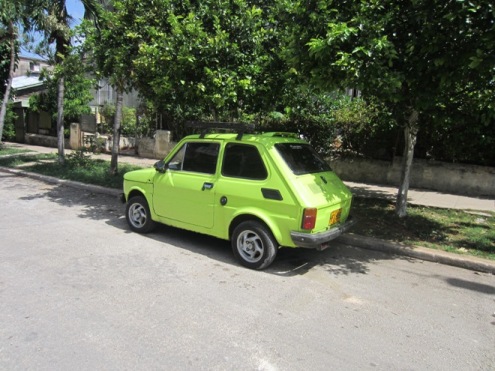
Itty bitty Polski, photo by Caitlin Gorry

So I predict pullback. The market itself will play its part since the number of Cubans who can afford cars is finite (and prices are insane right now: $8000 or so for a used Lada or one of the aforementioned Polskis). Furthermore, the state will also be motivated to cap the number of cars on the road since accidents are among the top five causes of death here. And there have been a lot of accidents in my neck of the woods lately.

3. People will tire of the 50 cent pepper and the 5 dollar shot.
While outsiders and the foreign press, farmers and their middlemen praise recent economic changes allowing for direct food sales, ag cooperatives, and prices based on what the market will bear, my opinion is decidedly…measured.

I’m not as gaga over these developments for the simple reason that I subscribe to Mandela’s sage observation that ‘where you stand depends on where you sit.’ And if you’re sitting on mountains (or even molehills) of disposable cash, the reforms affecting food production and sales are deliciously welcome. Tomatoes in July, avocadoes in October, exotic crops like broccoli, cauliflower – the diversity and availability of fresh fruits and vegetables is unlike anything I’ve seen in my 19-year love affair with Cuba. But if you’re struggling to make ends meet – if you’re sitting with the Cuban 99% – all of this is moot because you can’t afford any of it.

Green peppers, onions, and beans (staples all) are so astronomically priced these days, going to the agro can feel like a museum experience for many of us – except going to a museum feeds the soul, while food out of your financial reach just feeds your hunger and a simmering rancor (see note 2). In the veggie markets charging what they can (as opposed to state markets where prices are capped), produce is at least double the price. The guys wheeling carretillas from street to street, carts heavily-laden with bounty bought from those subsidized state markets, resell at triple the price.

Those who can afford exotic and not so produce at whatever price are largely oblivious to this I’ve noticed. They shop happily at the ‘diplo-agros’ (ie affordable only to the foreign diplomatic corps and other 1%-ers) for carrots, bok choy, white onions, parsley and lettuce – none of which are available, at any price, at the state markets where the rest of us shop.

Price distortions and places for “us” and others for “them,” are dangerous to the social fabric, especially because the gap isn’t only widening, it’s deepening. Translation: the types of goods and services available to only a select portion of the population is growing, while those locked out of those options is also growing.

I went to a “private” bar last weekend where cocktails started at $5 (see note 3) and topped out at $25 for a highball of Johnnie Walker Blue. Seems to me we’re on a bad course when my neighbors exist on rice and lentils; you can get laid by a working gal for $10; and too many people can’t afford toilet paper, but you can sidle up to a bar in your knock-off Blahniks and drop the average monthly Cuban salary on a glass of whiskey. It’s not only gastronomic that has gone astronomic: some state concert venues have doubled, and in some cases quadrupled, ticket prices, putting culture out of reach of many, as well (see note 4).

Don’t get me wrong: part of this distortion is due to decades of over-subsidizing and preferential pricing. But price spikes without concomitant salary increases is not only dangerous, it’s cruel: those punished are disproportionately poor or those doggedly dedicated to the revolutionary project who’ve tried to do good; do gooders never get rich, this much we know.

The price/salary disconnect is a hot topic around here these days and I predict backlash – a rash of failed restaurants which won’t make it selling $10 pasta and $15 pork; a rejection of easy and exotic, but expensive, options for procuring raw foods like from the uncapped markets and carretillas; and a growing gap and related aggravation between the haves and have nots.

4. Major changes in leadership.
Got your attention now, don’t I? But this is far from news: Raúl and the historic leadership are facing biological inevitabilities, plus, that same leadership recently instituted term limits of two consecutive five-year terms. So this is more affirmation than prediction, and while it remains to be seen who will walk the halls of power and policy in the coming years, I know there are some good and fair, wickedly smart, and hard working people to choose from. For their future and ours, I predict: no es fácil, pero tampoco imposible (it’s not easy, but neither is it impossible).

Notes
1. There are some notable exceptions of course: I worked with the fabulous Fabiola López while in Haiti after the earthquake; Julia Osendi, who covers sports for Televisión Cubana, has more guara than most; and Rolando Segura, who has been covering Africa and the Middle East lately, does a bang up job.

2. For this same reason I reject sidewalk cafes – you need only walk by such a place, once, your stomach knotted with hunger and no means to quell it, and smell a juicy burger to know the inherent cruelty in taunting hungry people with a meal close enough to touch, but out of reach. People, I beg you: take meals inside if there’s any chance a hungry soul will happen by (eg in big cities and on busy streets).

3. A non-drinker for years, I stuck to the $1.50 Tu Kola.

4. Just today I received a note about a new disco charging a $10 cover.

24 Comments

Filed under Americans in cuba, Cuban customs, Cuban economy, Cuban idiosyncracies, Cuban Revolution, Fidel Castro, Raul Castro