Tag Archives: cuba

Trilingual in English, Cuban and (Now) Dog

Dependent, smelly, costly and often filthy (all that butt sniffing/rolling around in dead things?!), flea-bitten, tick-ridden, and prone to humping whatever they can get their legs around – can you tell I’m not a dog person? They’re such a burden, nothing like their haughty, independent feline counterparts who you can leave with a bowl of kibble for days while you go off the grid and they’ll ration it, killing birds or rodents once it runs out. So no, I’m not too keen on dogs, but now I’m in deep – over my head deep. More proof that the universe is conspiring against me…

Two days before my 45th birthday, a stray dog wandered into Cuba Libro. Like I needed something breathing-eating-shitting extra to stress about. Within a day, the kids who work with me named him Toby. It was all over, I knew. I’m sure there are parents out there who know exactly what I’m talking about: once the kids you love give the flea-ridden, tick-bitten beast a name, you’re responsible, no backsies. He was awfully cute, it must be said. Adorable, to-die-for, irresistibly cute, but no one who works at Cuba Libro has the living conditions or lifestyle conducive to caring for a dependent – no matter how cute.
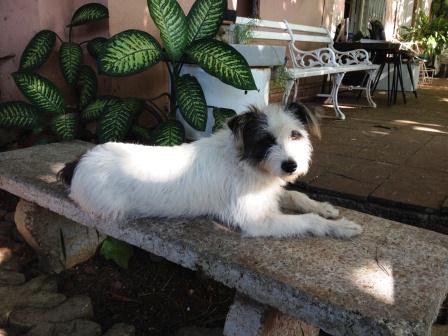
toby cubalibro

I was resigned to letting “Toby” live in the Cuba Libro garden, but two events changed all that. First, a friend walked in one day claiming: ‘I know this dog. He lives in my building.’ This seemed more than a bit far-fetched: Ariel lives in 10 de Octubre – at the other extreme of sprawling Havana – and besides, dogs are to some humans what Yuma are to some Cubans: they all look alike. But when Ariel picked up the phone and said, “señora, your dog is here in Vedado,” and she responded, “Oh! That’s not my dog. It’s my son’s. He’s doing his military service, but I’ll tell him” I knew this wasn’t a simple case of mistaken identity. An hour or two later, young buck Carlos showed up and was plastered with wet kisses by “Jason”. It was obvious the dog had once known and loved this fellow. But with nowhere to place Jason when he went into his military service, Carlos let loose the dog into Havana’s mean streets. As you may imagine, I thought Carlos an ass – not only had he given his dog a dumb dog name (J is pronounced H in Spanish), but he’d abandoned the animal, leaving him to his own devices. I may not be a dog person, but I’m not cruel.

Savvy pup that he is, Jason-now-Toby traveled clear across the city to cross our threshold with fleas, ticks, parasites and a sad look in his amber doll’s eyes. Just like Wilbur was “Some Pig,” I started getting the feeling that Toby was “Some Dog.” But I resisted – threatening to send him to the campo (in my case, this is not a euphemism: I was actively looking to place him with a farm family in those first few weeks). As my father once observed: ‘living with animals went out with Jesus,’ something I agree with wholeheartedly and cite often.
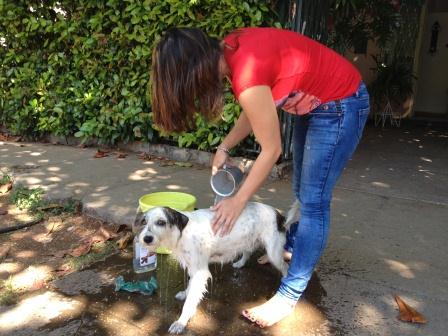
El Coquito was born.

El Coquito was born.

Toby’s second fate-deciding event happened one stormy day after about a week of eating spaghetti and living in Cuba Libro’s makeshift doghouse (a large suitcase donated by a neighbor for this purpose). Our weekly bike polo showdown was cut short when the skies opened up and started drumming a hard, cold rain across Vedado. And I remembered there was a dog I was somehow sort of responsible for. When I went to check up on the perrito, he was huddled in a corner of the garden shivering, ears plastered back as thunder and lightening crashed all around, every hair standing on end, soaked to the roots. I haven’t got much of the maternal/pet gene (if you missed that detail), but even I couldn’t resist his vulnerability (or cuteness). So I stuffed him in my knapsack as best I could, strapped it to my chest, and pedaled home through the rain. That was five months ago and we’ve been making the 6-day a week trek between my apartment and Cuba Libro ever since. And I’ve been forced to speak ‘dog.’

There’s a bark for ‘I have to pee.’
There’s a bark for ‘I have to poop.’
There’s a bark for ‘I’m hungry/horny’ (more on that later).
There’s a bark for ‘I’m scared.’
There’s a bark for ‘someone is at the door.’

As far as I can tell, it’s all the same damn bark. Thankfully I have a professional interpreter in Amaya who is Toby’s co-mother. She’s more than a dog whisperer: she’s a dog witch who anticipates his needs and directs his energies in a way I admire and hope to learn. Some things I’ve come to understand, like the one, two, three turns alternated with sniffs that I’ve dubbed the ‘doody dance.’ Meanwhile, standing on two hind legs and hugging me with the front two while he mews means ‘I missed you!’ But the other conversational pieces? They’re lost on me.

And as cute and adaptable and sociable as this dog is, he lived in the streets for at least 6 months we figure, and I wonder: what was his life like before? What mental and emotional baggage is he carrying from his previous life/lives? Deconstructing Toby’s personality isn’t helped by his slew of nicknames, different ones invoked depending on whom is addressing him and under what circumstances. At turns he is: Toby, El Tobito, The Tobes, Tobias Maximus, Tobito El Coquito (Toby the Little Coconut), Toby the Tuffy, El Peluche (The Stuffed Animal), El Macho, El Guapo, Ese Perro Toby, and Bipolar. This last arose after we caught him staring at walls, barking at dust and chasing his tail in an over-the-top, manic manner.

Beyond the communication problems, having a dog in Havana (something I never thought I’d be experiencing or writing about) is a challenge. Strays and pets (many trained to guard and attack) can be ferocious and we’ve taken to walking him armed with sticks and rocks after several run ins; dog food is sold, but only at very select stores and boutiques reserved for the super rich, so dog food has to be purchased and cooked almost daily (The Tobes is on a diet of rice and liver, with a little pizza and cake thrown in every so often because he’s too cute to resist 100% of the time); and Cubans are rabidly anti-neutering.

Little did I know that the neutering issue would kick up so much drama and debate – though given the machismo here, I should have expected it. I have to admit it’s kind of novel seeing testicles on a dog (where I come from, “fixing” pets is par for the course), especially Toby since he has the ‘one-eyed salute’ thing going on whereby his tail sticks straight up and you get a full-time, full-on view of his bunghole and junk. What’s more, he’s almost completely white, but his balls are black. When I announced my decision to fix him, citing concerns of rampant reproduction by any bitch he mounted, combined with the desire to tame his macho, aggressive tendencies, I got major pushback from all corners.

‘Why castrate him?! You’ve got the male dog. If he was a she, sure, but…’
‘It will make him fat and lazy.’
‘You can’t take away his manhood!’

When the vet came to examine Toby (yes, in Cuba, pet and people doctors make house calls), even he said it was emasculating to fix him and suggested a vasectomy instead. Doggie vasectomies?! For real? Then I learned that some pet owners up north actually have synthetic balls surgically attached to their neutered dogs. WHAT?! This was all a bit much and if you’ve seen how many neglected street dogs live in Havana, snipping him seemed like a no-brainer to me. But after 13 years here (this month!), I’ve ‘gone native’ in certain respects and I got to thinking: the vet estimates Toby to be between 1-1/2 and 2 years old. Has he ever had sex? Hard to know for sure, but likely not. Can I deny him this? Even if it’s not for pleasure, what about instinct? And do female dogs get knocked up every time they do it? What if it does make him fat and lazy? I don’t know anything about dogs and I was receiving conflicting information (if this happened to you, you’d likely hit the internet and find thousands of sites devoted to dog sex and fixing, but alas, a dial-up connection is not conducive…)
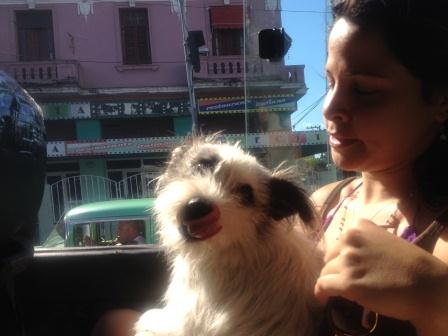
atbeachtoby

And then Dina, the dog who lives five houses up the way from Cuba Libro, went into heat. And Toby went into hysterics. He wouldn’t even run through the gate to greet Amaya and Douglas as he’d done every single work day. Instead, he’d run straight to Dina’s and pant and pace in front of her fence, planting himself there for hours with a sad, spurned suitor look on his face. ‘Just let them screw,’ you’re thinking. That’s what I was thinking, anyway. Until we learned that Dina is epileptic and El Macho could kill her with all that excitement. Which is why Toby spent many tormented days licking her swollen, red privates through the fence. ‘At least he’s getting something!’ people said. ‘Poor Dina,’ others said. ‘All she gets is oral’ (as if this were an altogether bad thing!). I thought we’d be able to ride out the horny epileptic episode until someone told me bitches stay in heat for three weeks. And Toby was going mad – like off his meds psychotic, following the owner (the owner, not even Dina, who was kept penned in for the duration) for blocks and blocks, across major intersections and trying to go into stores with her while she shopped. And she’d drag him back attached to her leg, whining and dry humping and making a fuss. So I had to leave him home a few days until it blew over.

The day we made our triumphant return to Cuba Libro, he disappeared for a bit (he has the run of the immediate neighborhood all day long) and returned, cool as a cucumber and plopped down. I swear he was smiling and I was sure he’d gotten laid. I wanted to offer him congratulations and a cigarette. Will there be little Tobies running around our little piece of Vedado soon? Maybe. And while I’m determined to get him fixed, I know his puppies would be damn cute.
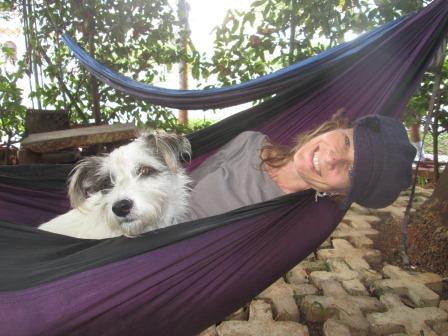
???????????????????????????????

As an old friend of mine so sagely observed: Darwin was wrong. It’s not survival of the fittest; it’s survival of the cutest. And Cubans know how to survive (and keep things cute). So I’m keeping Toby.

45 Comments

Filed under Americans in cuba, Cuban customs, Cuban idiosyncracies, Living Abroad, Uncategorized

Rock ‘n Roll Resurrection: Dead Daisies in Havana

I knew it was going to be a different kind of night when the heavy at the door started scrutinizing my press pass. It was from last year, true, but I’ve been accredited here for a decade plus and I didn’t have my new credential through no fault of my own.

‘This is you?’ he asked, in a not-too-friendly rumble.

I kept silent as he took a closer look. Here we go, I thought.

‘This isn’t you,’ he stated with some authority. ‘This is a mulata.’

I had to laugh. I don’t know what kind of caramel-colored glasses he was wearing or what hooch he was swilling, but I wanted some: a mulata? Me? These are words I never imagined applied to this white-like-leche, be-freckled chick. Luckily, our discussion was truncated by a group of kids sauntering up brandishing CUCs. He palmed the bills and waved us in to one of my all-time favorite Havana venues: El Salon Rosado de la Tropical.

—–

I have very few natural talents, but arriving precisely as the party starts to heat up and sensing when the pendulum is about to swing the other way – my signal to kiss and split – are probably my most utilized and useful. So it was for The Dead Daisies, the historic concert held this past weekend. I walked through the doors just as opening act David Blanco (who I’ve seen plenty) was finishing his set. I took a short cut to the dance floor, ran into friends, then some more, then more still. We danced ourselves as close to the stage as safety permitted, but the place was packed – frikis had begun arriving as early as 11am, from as far away as Camagüey, to hear members of their favorite bands (The Stones; Guns N Roses; Ozzy Osbourne; Motley Crüe) rock the Cuban capital.

For those who like to rock!

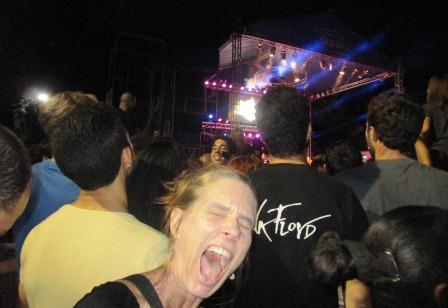
Already the Salon Rosado was puddled with vomit (not mine, don’t let the photo fool you).

Nothing new or novel there: knowing your ingestion limit, when and how to mix what, how to pace yourself – this is a tricky equation which many Cuban rockers have yet to get. I’m talking about the younger crowd mostly, but we had to scurry out of the way as security physically restrained and removed a middle-aged dude, fairly drooling, with eyes bulging rabidly. Vomit, condom ‘balloons’ batted airborne with verve, and bottles produced from backpacks – these are de riguer at whatever big Cuban concert and were in abundant evidence this Saturday night.

What set this concert and this group apart was the sheer power, pedigree and talent of the band, combined with the setting: the Salon Rosado is that rare combination of big enough to pack in a few thousand high-energy fans, while retaining the intimacy of a much smaller gig. It’s also a multi-tiered, open-air venue with major space given over to the floor, which means lots of room to dance and mosh and good bird’s eye views, for voyeur rock and rollers. As for The Dead Daisies: we’ve had some big bands blow through Havana during my tenure, including Audioslave, Sepultura, Kool and the Gang and Calle 13; but these concerts are always held in the ‘Protestódromo’ – the seaside, make-shift area designed for massive protests and rallies (it was built during the Elián trauma) and adapted for concerts more recently. I’ve had tons of fun at these shows, but as you may imagine: the audio is shitty. Crashing surf and whipping wind are not conducive to music appreciation. It’s also worth keeping in mind that the last big concert like this was in 2010.

So we were due.

I hate to admit it, but I didn’t recognize the names of any of the musicians (though I reserve the right to invoke the ‘stuck in Cuba’ defense). I had never heard of the band either and was skeptical – what kind of name was Dead Daisies anyway? Flowers, dead or alive, don’t evoke screaming, pulsating, orgasmic rock n roll, not in my mind and body anyway (no disrespect to Guns N Roses and especially Slash, who rocks it real, but Axl’s whiny voice has always rubbed me in all the wrong ways).

R Fortus

But damn, did The Dead Daisies come through. I’m a guitar-loving kinda gal and when I read that Richard Fortus (Guns N Roses) counted John McLaughlin, Jeff Beck, and Robert Fripp among his preferred players, I knew things would be just fine. Just how fine I didn’t realize until the first notes rung out from Fortus’ drop-dead gorgeous Gibson over the sea of banging heads. There is perhaps nothing more glorious than a Cuban crowd united by the joy, energy and electricity of music well made, played from the heart. And so it was.

Meanwhile, any band with Dead in its name evokes that other, more (in)famous band synonymous with long sets peppered with covers and standards, enthusiastic mind-altering substance use, and drum solos; I was pretty shocked to experience similarities at the Salon Rosado. My olfactory sense alerted me to someone nearby enjoying the mighty herb and the pierced, tattooed guy on all fours puking violently while simultaneously smoking a cigarette argued for abuse rather than just use (though it was an impressive example of multi-tasking). But when Brian Tichy (from Ozzy’s band) ripped a 15-minute drum solo, the entire crowd was transported to an alternate reality. Holy shit. This guy is a monster. I’m not much for tricks with sticks, but he got admirable air between trills and when he started beating the skins with his hands? We went wild. Well done man, well done.

The Dead Daisies in Havana

An indisputable highlight was The Dead Daisies’ version of Knockin’ on Heaven’s Door (yet another example that anyone covering a Dylan tune does it better than Bob), where the crowd of 3000-plus needed no encouragement to sing the chorus long and hard. It was just after this when I realized I was in the no-woman’s-land between two increasingly large and frenetic mosh pits – dangerous territory for anyone not looking for a random fist in the face or elbow to the ribs. I danced away from the mosh sandwich towards my friends, marvelling at how music unites people and ignites the collective soul.

The Dead Daisies gave us the gift of uplift – and boy we could use more of it.

10 Comments

Filed under Americans in cuba, dream destinations, Expat life, Living Abroad, Travel to Cuba

Havana for Careful Readers

Surrounded by punchy bright flowers, relaxing, windows thrown wide. The breeze and verdant hour and laughter of passersby intoxicate. Inventing parties, creating drama, swapping art and clothes and women, maintaining levity despite – and because of – life’s hardships: this is Havana. The unhinged enthusiasm dominoes, flirting, a robust buffet, and pelota (especially if it’s Industriales vs Matanzas like tonight) can occasion: this too, is Havana.

Barking dogs, erecting walls, crumbling sidewalks and streets, buildings, families and lives. Coin flipped: tinted cars, exclusive bars, fridge full and belly contento. Friends forever leaving, returning as visitors of a sort to eat congris, drink lager, dar cuero. Dancing. Laughing. Taking your vieja to the polyclinic and chama to Jalisco Park. Loading up carts to overflowing at El Palco or 70 y Tercera, getting right with the padrino, paying respects at Cementerio Colón. Public peeing and masturbation, gay play along the dark bastions of the Castillo de Principe, working girls working the boulevards of Miramar and the back alleys of Cayo Hueso. Going for the daily bread.

Genius composers, a farce of artists (but reams of the real deal, too), honest, sensitive young men breaking the mold and stereotype, moms working themselves ragged cleaning, cooking, shopping, caretaking and running ministries. Dads pregnant with beer bellies out on the town, suelto sin vacunar. Know-it-all and equally annoying clueless tourists who don’t study up enough beforehand resolve life for some, earning gratitude, fomenting envidia.

All of this is Havana. Come see for yourself.

16 Comments

Filed under Americans in cuba, Cuban customs, Cuban economy, Cuban idiosyncracies, Cuban phrases, Cuban Revolution, Expat life, Living Abroad, Travel to Cuba

Conner’s Letra del Año

I’m back in the swing of things here in Havana and if I’m reading the signs/between the lines correctly, it promises to be a memorable year. Already some unpredictable ($200,000 cars?!) and unexpected (Fidel rolling up at Romerillo?!) things have happened, about which I promise to post at a later date.

‘Surprising’ and ‘fast-paced’ are the catch phrases for the foreseeable future as far as I can tell. Indeed, 2014 has proven illuminating and educational, adrenaline-rushed and not a little bit hectic – and we’re only a few weeks in.

It’s exciting – I’m excited – but I get the feeling that this year is going to obligate us to work, HARD, to maintain balance; we will have to be master jugglers these next 12 months. It will be tricky keeping all our professional, personal, and spiritual balls in the air, but if we stay focused and true to course, I think the payoff will be well worth it.

In an effort to measure the tenor of our times and steer a tentative course through the exotic, but potentially choppy, waters of 2014, I offer you my Letra del Año. For those readers unfamiliar with this annual declaration, it’s a collaborative document issued each new year by the major Afro Cuban religious associations. It contains everything from conjugal advice and health warnings to what foods and saints should be offered and attended.

While I’m not an adherent, I, like innumerable others on the island, pay attention to each year’s Letra. When I read 2014’s, I was a bit shocked (and encouraged – maybe I’m on the right track!) to learn that one of the sacramental foods this year is the pomegranate. Not only is this extraordinarily rare in Cuba (so an odd sacrament, for any year), I’d bought one and shared it with a friend on New Year’s Eve before this year’s Letra was published.

And will my Letra del Año be prophetic? Maybe not at all or possibly in part, only time will tell, but here’s my take on 2014 and what we might expect:

Love is in the air:
I’ve known Alejandra since I moved here. She’s both family and friend and a helluva woman. She lives with her aging parents, works in a thankless job for 20 bucks a month and has struggled with mental health issues over the years. For the first decade I knew her, she was completely alone – ‘pobrecita,’ they said. I don’t remember her ever going on a date, even. Then, a year ago, Alejandra met Evaristo, a good and good looking guy, who helped around the house, got along with the parents, and had a decent job. And for whatever reason known only to them (or not even – love, after all, is one of life’s great and wonderful mysteries), they clicked and swooned and grooved.

Last weekend, they tied the knot in a beautifully simple ceremony in Alejandra’s front yard. The look on their faces, on that of their parents, siblings and every last guest was pure bliss. You could feel the love before the first teardrops of joy fell. I have another amiga getting married next month and a dear friend of mine for whom the seeds of love have been slowly, carefully sown over the last year or so and are about to bloom. Another few couples are marrying over the summer and well, all you need is love, right? I say: let’s spread it and do our part to silence the bitter and hateful.

Healthier habits and routines:
Whether or not related to love and matters of the heart, I foresee folks around me (and myself included, hopefully, but unlikely), adopting healthier habits. Smoking and drinking less, sleeping longer and more soundly, eating healthier and doing some exercise will be in the mix. Watching less TV (no matter how classic or well-made) and reading more and better literature fall under this rubric, as does consuming less “news”, which just serves to make us more anxious and at the same time apathetic if you ask me.

Globetrotting:
This will be a year of travel, people. Already my trip calendar is filling up fast, with Nicaragua, El Salvador, Ohio, Hawaii and Ireland on my itinerary. Cuban friends are also planning to travel (some ‘definitively’, as we say here, leaving us holding our aching hearts) to the usual places – Mexico, Miami, Madrid – but also to Canada, Germany, Amsterdam, and Thailand. Seems like everyone took a turn around the block with their luggage this December 31st, one of our year-end traditions/superstitions.

Consolidating creativity: I and many people I know put (too) many wheels in motion in 2013 – work projects and personal relationships, new businesses and novel challenges. Last year saw lots of this and now the time has come to focus, buckle down, and channel all this creativity into attainable goals. It’s important to emphasize attainable, since the majority of mi gente are overachievers and tend to set themselves up for defeat with all the complex, long-term (some life-long!) goals they set for themselves. We have the energy, we have the intelligence, we’re motivated and we’ve set 2014 up for success – let’s make it happen, one milestone at a time.

Time management challenges: Doesn’t it seem like everyone’s overworked, over-scheduled and just rushed overall? In my world, it looks and feels that way. Keeping everything together, tying up loose ends, leaving time for the people and things we love – this is going to be difficult in 2014. This is especially true in Havana and New York, the two places where I pitch my tent so to speak and where the rhythm of life is different and more hectic (increasingly so in Cuba) than other latitudes. Managing time, while still living in the moment and being present, will be even more difficult. Slowing down to smell the roses, sing to babies, and ask after our neighbors will be important this year. Please remind me when I forget.

Last but not least: have a fabulous and healthy 2014 everyone.

Let life be peachy.

13 Comments

Filed under Americans in cuba, Cuban economy, Cuban idiosyncracies, Cuban Revolution, Expat life, lonely planet guidebooks, Relationships, Travel to Cuba, Uncategorized

Havana Mantras

Cubans like their dichos. For just about any hairball situation life coughs up, they’ve got a palliative or folksy saying.

As you may imagine, the general difficulties of modern existence are fertile fodder. To cite just a few:

Al mal tiempo, buena cara.
(When times are bad, put on a good face).

To the question ‘how ya doin’? or ‘what have you been up to?’, Cubans invariably answer:

En la luchita.
(Struggling a little/lot).

And then there’s the ubiquitous:

No es fácil.
(It’s not easy).

It’s not easy can apply to anything – caring for aging parents with Alzheimer’s; pending paperwork and attendant bureaucracy; the quality of bodega rice; even the weather.

These sayings and many more like them have become mantras of sorts. Short, pithy and to the point, they help people fortify themselves and cope with the aging/bureaucracy/vagaries life never tires of throwing our way.

Recently several friends confided that they invoke their own original mantras when faced with challenging situations. They make me smile (the mantras, not the challenging situations) – in mal timepo, when things are especially difícil, and when it feels like the luchita might triumph once and for all. They’re funny in their way, these mantras, but also weighty since they reveal the resilience and resolve with which Cubans confront obstacles. And I have a feeling such resilience, not to mention resolve, will become increasingly – urgently – important in times to come.

_____

If you follow Cuba news, you know that we’ve been under a wet, windy cold front for the past several days. It looks like it’s finally moving on and none too soon: over 100 buildings collapsed completely or in part in Havana due to these torrential, biblical rains, reminding me of 2005’s Hurricane Wilma. Rain like this is problematic here, not only because it sends buildings tumbling – it also floods homes, damages worldly goods and grinds transport, sectors of the economy and much of the bureaucracy to a halt.

But it’s not just the wet: the cold is a problem too since so few of us have hot water in our homes. To be blunt: showering in this weather without hot water is a bitch. Sure, we heat up pots on the stove, decant it into a bucket, mix it with some cold and scoop it over us as fast as possible. It’s workable, but in those few seconds between scoops, you freeze your butt off. Ocassionally, it’s not practical to heat water – there’s no time, no gas for the stove, whatever. End result? We take a lot of cold showers around here, even in winter, even during the chilliest fronts.

As I was talking to my friend Julio Pedro about this, he told me he has a ritual – a mantra, mejor dicho – which he invokes before stepping into a cold shower. Bracing himself, he repeats over and over again, before and during the cold blast:

Soy un macho de pinga. Soy un macho de pinga.
(I’m the fucking man. I am the fucking MAN).

If you knew JP, you’d laugh, like we did, imagining this wisp of a guy incanting his cold shower mantra.

_____

The mantra topic came up again as another friend and I were planning a night out recently. We were headed to one of Havana’s largest theaters to see one of the country’s hottest acts. Neither of us had tickets and it was doubtful we could procure affordable (see note 1) entry the day of the show. I told her we’d only need one ticket since over the past decade, my foreign press pass has gained me entrance into even the most over-sold events, from Pablo Milanes to the Royal Ballet. My friend, who works for Prensa Latina, said she would use her work badge, a yellow and curling card encased in foggy plastic that says ‘Prensa’ in red letters.

‘Isn’t is expired?’ I asked her.
‘Yeah,’ she said. ‘But it has yet to fail me.’
‘Nice.’ I said.
Then she confessed: ‘but every time I use it, I think is it going to work? So just in case, I invoke my mantra:’

Soy la reina de la Habana. Soy la reina de la Habana.
(I’m the queen of Havana).

I’m not sure if it was the badge, the mantra or her killer smile, but the queen and I got into the concert.

_____

At this point, you’re probably wondering about my mantras. I’ve got mine, of course. Like everyone else, I’ve had to develop and hone my resilience and coping mechanisms over the years here. One I’ve known for a long time, but really started invoking it during my month-long stint covering the Cuban medical/disaster relief team in Haiti after the earthquake. Now, whenever I’m faced with particularly trying circumstances beyond my control, I tell myself:

No coge lucha. No coge lucha.
(Pay it no mind/Don’t fight it).

I’ve added another mantra lately which helps me with the haters and naysayers who for time immemorial have tried to keep down the dreamers and lovers and doers:

Que lástima odias tu vida.
(What a pity you hate your life).  

And a pity it surely is, but you know what? It’s not my problem so I’m not going to coger lucha.

Notes
1. Ticket scalping is a common and lucrative practice in Cuba’s double economy.

8 Comments

Filed under Uncategorized

Just When You Think You Know Cubans

Loud, machista, brand-loco, bossy, gold medal (but loose and slippery) lovers: one – or several – of these stereotypes applies to most of the Cubans I know. Judging by the search terms used to land here (‘why are Cubans so rude’; ‘Cuban men are controlling/known for being cheaters’; ‘STD from resort staff in Cuba’), many readers can relate.

It’s true Cubans tend to be noisy, romp with aplomb, and sow their oats with gusto and few regrets. They are also big talkers – waxing eloquent on topics about which they’re clueless or avoiding silence at all costs; I know a lot of women here, for instance, who never, and I mean ever, shut their mouths, talking about whatever minor thought skips across their brains (I always send a silent shot of strength to the spouse when I meet a woman like this). Then there’s the Cuban classic, which I call ‘blah, blah, blah’: giving a long, considered response – to an entirely different question than the one asked. Actions belying words also falls into this “classic” category.

These are all generalizations of course – but that doesn’t obviate their veracity. Indeed, stereotypes exist because they apply to huge swaths of a population. And if you know Cubans, you know that these generalizations are true for many or even most. Which is why I’ve become fascinated with stereotype-defying folks here. People who break the mold anywhere have always intrigued me, but Cuba has traditionally emphasized unity over individuality, is small and (relatively) isolated, meaning there are fewer mold-breakers.

These are what I call, for lack of a better term, ‘not-very-Cuban’ Cubans. Each one was born and raised here, lives on the island still, went to all the same schools, political rallies and lame concerts (Air Supply, ahem) as the rest, but exhibit few typically Cuban traits. Sure, they’re missing teeth, can be unreliable, and are prone to slack; in the end, they’re a product of their context and yet…not.

I’ve met a couple of their kind over the years, but recently I’ve come to know several fairly well – they intrigue and puzzle me in equal measure. For instance, not one of them has been off-island and each works for the state (as well as ‘por la izquierda’ because that’s how survival rolls here). Age might be a factor – the folks I write about are between 25 and 40 – but I’ll have to think more on that since I don’t have the analytical energy just now. By chance (or not), each person described below is also male, but again, my analytical reserves fail me.

What I’m coming to realize as I write this is that place – la siempre fidelíssima Isla de Cuba – has much to do with their character (each is proud to be Cuban), but little to do with their mold breaking: these people would be, and will be, who they are, no matter where they are.

The Musician: I’m not sure I’ve met a Cuban as callado as this guy in the nearly dozen years I’ve lived here. He’s so quiet he makes me nervous. Have I insulted him? Is he bored? Does he simply have nothing to say? This last I discount not only because he has that ‘still waters run deep’ thing going on, but also because when he’s on stage playing his cutting-edge compositions, he speaks volumes.

When I asked a mutual friend: ‘what gives with Daniel? I’ve known my share of strong, silent types, but he kind of takes it to the extreme, doesn’t he?’ She laughed. ‘Yeah, I’ve known him my whole life and I’d swear he was born in Europe instead of La Ceiba.’ Quiet, measured, urbane, and bling-free: he actually reminds me of some New Yorkers I know, this ‘not very Cuban’ Cuban.

The Born Again: One of Cuba’s new frontiers is being mapped out by pews and altars, chapels and collection plates (big, deep ones). As an agnostic skeptical of all organized religion and someone who has seen both the good and bad wrought by evangelical churches throughout Latin America, I have to say all the conversion going on around here has me concerned. The phenomenon is replicating itself from Sandino to Baracoa, with record numbers of converts packing pews most nights and some days too, as they attend bible study, Sunday school and other church-y activities (see note 1). The people I know in Havana who have been sucked in belong to these churches are usually either not too bright or dealing with some social issue – alcoholism or delinquency, for instance.

But not my ‘not very Cuban’ Cuban friend, who breaks even this mold: he’s smart, has a good job, a wife, his own transport, a nice place to live and two happy, well-adjusted children. Furthermore, he was always more of a rebel than a joiner, rejecting the mob mentality. Flash forward to any recent Sunday, however and he’s wholly subsumed by one of these churches – to the tune of several times a week for 8 hours at a clip. And the proselytizing has begun, with non-responders feeling the freeze-out.

The Gamer: Hyper observant and curious, this ‘not very Cuban’ Cuban takes people to task for littering and ‘envidia’ (see note 2), has lovely manners, smells naturally great in the heart of summer (see note 3), and pardons himself when he (infrequently) interrupts. He’s also vehemently anti-gossip and comfortable being alone – criteria enough to make him a peculiar Cuban. Surely this aversion to the maddening crowd is the gamer in him – he admits to shutting himself in for 8 hours or more when he’s mastering a new game – but I thought everyone here was hard-wired for social gad flying. To an extent, anyway. This guy, however, would hole up on a mountaintop with just the bare necessities given the chance, which sounds extreme even to me, a solitary mountain girl at heart.

In another inversion of a Cuban stereotype, he’s not afraid to ask questions, learn about what he doesn’t know, and pursue new experiences – including hard work. He’s got a hunger for knowledge and the confidence to seek it out I don’t see that often in Cuba’s 20-somethings. It’s refreshing and hopeful, especially because it comes from the next generation, too much of which has lost hope here.

Notes

1. Let me emphasize that I’m referring to anti-scientific, charismatic churches (what’s sometimes referred to as neo-charismatic or neo-Pentecostal), not the traditional kind where you go on Sunday to pray and catch up with the congregation. The kind that freak me out are the ones where the pastor fairly preys on his flock, encouraging adoration of him and distance from non-believing friends and family.

2. This is a very negative, very Cuban concept which literally translates as ‘envy’ but runs much deeper, to the roots of want, need, greed, and paranoia.

3. I’m currently preparing a post on Cubans and their cologne/perfume habits; gas mask anyone?

63 Comments

Filed under Americans in cuba, Cuban customs, Cuban idiosyncracies, Expat life, Travel to Cuba

Havana Vice: Titimanía

[tweetmeme source=”connergo” only_single=false]

I’m what’s known in these parts as a ‘temba.’ The term generally applies to anyone, male or female, over 40. It’s not a hard and fast rule – a younger person who looks older may be called a temba – nor does it infer, like other terms such as ‘tía’ and ‘pura,’ that the person is over the hill sexually, physically or otherwise. Temba is not derogatory; it’s simply a category of Cuban, used here to describe a state of being, similar to our use of descriptive terms like negro, chino, flaca, santero or maricón (see note 1).

One thing I love about Cuba is its integrated, inter-generational nature. This facilitates friendships with Cubans aged 12 to 84 – something I cherish and which is harder to achieve in the United States. Naturally, however, many of my colleagues and consortes are other tembas. Over years of observation and recently a more in-depth investigation into Cuban sexual practices and mores for a larger piece I’m writing, a couple of tendencies keep cropping up: flexible fidelity is one, titimanía is the other.

Simply put, titimanía is the compulsion temba men have to date impractically young women. This is not limited to Cuba, of course, but by parsing how universal behaviors play out here, I hope to provide insight into the particularities and peculiarities of the Cuban character – for all our sakes (see note 2).

Before proceeding, I should disclose that I’m no stranger to the attractions of older men: at 16, my first serious boyfriend was 26, an arrangement for which he could have been prosecuted in our hometown of New York. While I think statutory rape laws are ridiculous in cases where everyone consents to getting it on, I admit there is something creepier when the ages are more advanced and the age differences greater.

Take my friend Carlos. When I met him a decade ago, he was 40 and his live-in girlfriend was 18. Jenny was gorgeous, of course, but a child – intellectually, developmentally, and practically. Just out of high school, she’d never had to pay a bill, work, or worry about a leaking faucet or roof. After four years together, the relationship ended disastrously, with Jenny hightailing it to Miami taking Carlos’ expensive gifts – jewelry, clothes, electronics – with her. Pre-ordained, perhaps, but that didn’t faze Carlos.

He quickly “recovered” (I’ve noticed men, Cuban and otherwise, tend to rebound fast – but incompletely – from ravaged relationships) and before long had Tania living with him. Prettier than Jenny, smarter, and worldlier, Tania was 22. After a few years, that relationship also ended badly, worse even than the one previous. Tania and Carlos barely speak today, which is uncommon in Cuba where circumstances and reasons too complex to elaborate here fairly obligate exes to remain on good terms. Uncommon and sad: their kids from previous relationships had become siblings and when they split it signaled an end to their blended family to the detriment of everyone involved, even if they don’t realize it.

Today, Carlos is 50 and has recently taken a 20-year old wife. I haven’t yet met her but have heard through radio bemba (our grapevine) that she’s hot and terribly boring, limiting dinner conversations to her new shoes, so-so manicure, and how the sushi she tried last week ‘totally grossed her out’ (see note 3).

Not all 20-somethings are that vapid and clearly, I better understand what’s in it for the women. Older men tend to be better than their younger counterparts in bed (if less athletic and enduring); have more status and economic possibilities; and generally have a clearer idea of what they want in life and are already well on their way to getting it (or should be).

However, once men hit that temba threshold, what they want are girls young enough to be their daughters. My 48-year old friend Elena is finding this out the hard way: after 15 years of marriage, she’s divorced and dating. Elena’s not looking for a new husband or live-in (the two are synonymous here); far from it. She just wants a healthy, available guy for a good time. You’d think this would be easy in libidinous, gregarious Cuba. Not so for Elena. ‘No niños for me,’ she tells me. ‘I don’t want to teach them the art of the orgasm or have to finance our affair. I’ve got my own kids, I don’t need another.’

Elena is looking for someone age appropriate and therein lies the rub: every man her friends try and fix her up with is interested in women her daughter’s age. They are, in short, suffering from acute titimanía. She has actually been told to her face: ‘you’re too old.’ And although they always put it in the nicest way possible, it’s getting her down. Once you rule out the married, infantile (of which there are many), gay, and titimaniacal tembas, Elena’s roster of eligible men is as short as Fidel’s speeches were long. And she’s discouraged, pobrecita.

The titimanía phenomenon came up the other day while I was talking to our mutual friend Alejandro. Clever and fit, with a comely face that belies his 50 years, Alejandro is one of the guys posited – and rejected – as a possible hook up for Elena; he likes them younger. Cubans are very frank about such things, which is efficient at least: while men here might date fat, unemployed, gold-digging, or gap-toothed women, age is not negotiable and they don’t waste time saying flat out ‘you’re too old’ (in the nicest way possible).

Alejandro could tell I was irked by his titimanía and its inequitability. “What chance is there for Elena and her ilk, when you guys are chasing skirts just out of high school?”

Mira, mi amiga,” he said smiling, his eyes crinkling around the corners they way they do with happy people, “from the age of 15, girls try to look older and do all kinds of things to enhance their beauty and heighten their self-worth – fake nails, fake boobs, dyed hair, high heels, the works. Old guys like me don’t do any of that. Instead, we pump up our egos by dating young women.”

“So tembas like you have the mentality of a teenage girl?” I wanted to say, but didn’t.

Laying my indignation aside, I could see his point. It’s about the self-esteem boost for everyone involved. But where does this leave Elena? Alejandro couldn’t provide an answer beyond: “I don’t know, but she’s too temba for my taste.”

Notes

1. This last term, meaning ‘fag’ or ‘queer’ is used in Cuba to denote male homosexuals. And while it’s inherently homophobic – which is why I don’t use it – many highly-educated and cultured people use maricón to classify gay men (or derisively with their straight friends). I employ it here by way of illustration only.

2. Equally as interesting are behaviors which don’t manifest here. For example, the reverse – a young Cuban buck getting jiggy with a cougar or MILF hasn’t caught on here like in the United States (the 13-year old who couldn’t peel his eyes from my temba friend Lucia’s cleavage, declaring her ‘hot and chesty,’ notwithstanding). But I’ll leave this for another post.                                                                                                                                                             

3. While I predict this marriage will be short-lived, I have friends who have been in one of these May-December relationships for ten years. They’re healthy and happy and while it remains to be seen what that relationship will look like when she’s 35 and he’s 63, so far so good. More power to them.

41 Comments

Filed under Americans in cuba, Cuban customs, Cuban idiosyncracies, Cuban phrases, cuban words without translation, Expat life, Fidel Castro, Living Abroad, Relationships

Birth of a Biker Bitch

Fifteen or so years ago I was living above a taquería and across the street from one of San Francisco’s largest thrift stores. Community Thrift wasn’t the hippest or most swank, but it stocked the eclectic, second-hand zaniness that city is famous for. Living right across the street was dangerous: it made it all too easy to accumulate cool, cheap shit that ends up collecting dust.

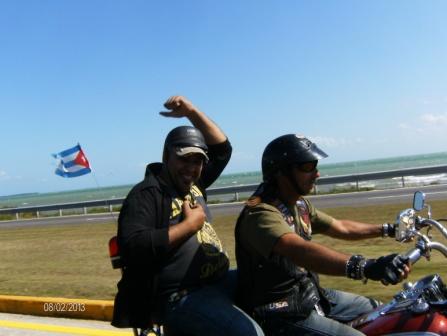
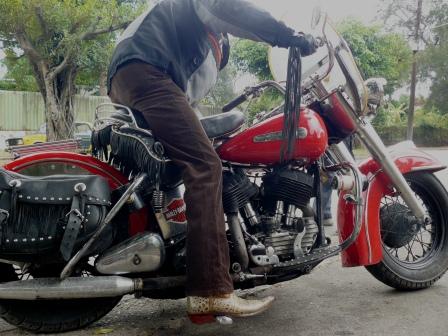
This is how I came across an $18 vintage Harley Davidson jacket. Little did I imagine all those years ago that one day I would be flying along the coast east of Havana on a 1948 Harley wearing that jacket (see note 1).

Seeds get planted, people. Cultivate them – however long it takes – and you shall see that flora flourish, I promise. The problem is, I’ve planted seeds I cannot tend alone – that are so profligate I can’t handle their abundance. When this happens, I write (to wit: this blog!). So while I had no intention of revisiting the Harley scene here at Here is Havana, my garden runs amok…

One of the 12 bikes Ive ridden on...

One of the 12 bikes Ive ridden on…

Some of you may have read my chronicle of last year’s Varadero Harley Rally/Encuentro de Harlistas Cubanos, my first taste of the HD world (save for one long mountain ride years ago, pre-vintage jacket, with a guy who couldn’t hold my attention). Long and short of that post about the Cuban rally? These pre-1960 bikes are impressive and the folks who keep them running and enjoy riding them more impressive still. When I was invited back for the second Encuentro, I was all game.

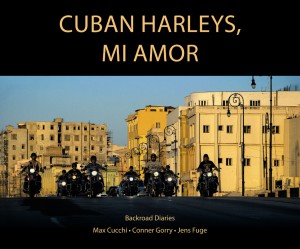
This year’s event was even better than last – for many reasons but the fundamental one for me was what occurred in the months between rallies: I’m now collaborating with Max Cucchi on his photography book about Cuban Harley riders. Since the 2012 rally, I’ve been hearing all the stories, learning the history, and interviewing the clan. I’m also riding on the bikes; 11 of them 12 of them to be precise and I anticipate trying out more (see note 2).

David Blanco, Harlista Cubano, musician, all around nice guy, rocks out the 2nd Encuentro.

David Blanco, Harlista Cubano, musician, all around nice guy, rocks out the 2nd Encuentro.

It’s true I cringed when that foreign photographer called me a bike dyke, but I have to admit it’s a hell of a lot of run riding on these thundering, troublesome machines. The thing is, riding can’t compare with driving and I know that’s where the real thrill lies (am I doomed to now accumulate a totally cool but not-at-all cheap piece of dust-collecting shit?!). Me acquiring a Harley Davidson is entirely theoretical since I can’t imagine abandoning my beloved bicycle and don’t have the money for anything motorized beyond a rikimbili (see note 3). But while interviewing Cuba’s only female Harley rider for The Book, she offered to let me take her 45 for a spin. Another seed planted, I’m afraid.

li and tony

I’m excited about The Book, in no small measure because it has opened up a whole new world to me, populated by extraordinarily fun, creative, and collaborative Cubans. Until further notice, however, I will be referring to this project as The Book. It had a proper title, which has since been relegated to a working title. Why? Because this is Cuba: things are complicated and being immersed in a rich, rare breed subculture like that of the island’s antique Harleys means being privy to all the gossip, tussles and intrigue therein. Good manners and my desire for everyone to get along prevent me from going into it here. Plus, I’m just the writer/rider so it’s best if I wait and see how it all shakes out. Until it does (in 12 months or so when we go to print), I shall be referring to this project simply as The Book (see note 4).

Cheito Puig, 103 years old and still on a Harley (he's featured in The Book).

Cheito Puig, 103 years old and still on a Harley (he’s featured in The Book).

Besides, none of that is important. What is important is that The Book has images by Max, text by me, and the passion of generations of Harlistas Cubanos.

Notes
1. There are no pictures of me en route, wearing said jacket, since my camera mysteriously disappeared the first night of the rally.

2. As I was readying this post for print a few days ago, I mounted my 12th Cuban Harley. The occasion was a beach BBQ with the gang – fun stuff. Unfortunately, the beast coughed, sputtered, and died two blocks from my house. During curbside repairs, the carburetor caught fire. ‘Socio, you got a fire going there,’ more than one passerby noted casually while eyeballing the red and chrome, leather-accented stallion. It took about an hour to get running again (watered-down gas direct from the Cupet seems to have been the culprit), but that was just the beginning of the 15-hour adventure. A key piece flew off as we flew down the highway; we had to stop at least have a dozen times to do repairs (correction: I watched as my driver and assorted others did repairs); the ‘suicide’ clutch kept getting stuck; and we ran out of gas at 1am in Centro Habana. I guess I’ve concluded the honeymoon phase with these Cuban Harleys…

Even breakdowns are fun in Havana!

Even breakdowns are fun in Havana!

3. These are bicycles outfitted with small motors, usually powered by a liter-and-a-half bottle holding kerosene.

4. Not to be confused with my abandoned memoir. Sigh.

14 Comments

Filed under Americans in cuba, Cuban customs, Cuban idiosyncracies, dream destinations, Expat life, Living Abroad, Travel to Cuba

Adventures of the Cuban Virgins: Part II

[tweetmeme source=”connergo” only_single=false]

We last left our protagonists – American musicians on the island for the first time – as they were figuratively deflowered by the temptress that is Cuba and literally robbed by her inhabitants.

With only 48 hours in country, they were already acquainted with water-borne bichos and explosive diarrhea; frolicked (and perhaps even fornicated) along the Malecón; and acquired groupies. In short, they were partying late, sleeping little, creating music, and making very merry.

The theft of the Fender bass after the Will Magid 4’s first Jazz Festival gig did little to dampen their spirits or enthusiasm for this place. On the contrary: the kind, well-equipped stranger who offered to loan us a bass for the next gigs only reinforced their admiration for Cubans and their ways.

Before you can say ‘pass the planchao, asere,’ it was Friday, hours before the gig that had everyone hot and bothered. It wasn’t a festival event, the crowd would be small by design (we had to keep it quiet in the interest of crowd control), and we weren’t sure how the band would fit in the performance space. But after another rehearsal in my living room, all we could talk about was the Guagua Loca.

Box o rum, at the nice price!

Box o rum, at the nice price!

It’s not really called the ‘Crazy Bus,’ (see note 1); that’s my name for it because it is a little loco (and muy cool) this gutted bus packed with Havana’s best DJs making music and fun on its midnight tour of the city. To date, the Guagua Loca had only made one voyage; my guys were excited to be the first foreigners invited to play this innovative mobile music party.

Clearly, a jazz quartet has no place on the Guagua Loca. But while the Will Magid 4 was here to play Jazz Fest, they aren’t really a jazz combo at all, but an amalgam of funk and groove, sampling and swing drawing on musical roots from New Orleans to Ghana. This is music to boogie and have revelations by and after just one gig, Cubans were already gaga for their delicious mix of live and electronic music. And after meeting Iliam and Alexis, (collectively known as I.A. Electronica, the brain trust behind the Bus), the feeling was mutual. Hopes were high for Friday night’s adventure.

As the sun set and excitement swelled as big as the almost-full moon, the Will Magid 4 + 4 dribbled in from their day’s explorations. I waited until all were assembled to give them the news: the Guagua Loca was off. For reasons beyond our control or comprehension, it had been cancelled by The Deciders. I was at pains to explain it – maybe it was a little too loco for this place and time? Regardless, everyone – the Will Magid 4, the other DJs, and fans – was saddened by this turn of events. So we turned to rum for succor and set our sights on Saturday night’s Jazz Festival gig.

_____

We were running late for the sound check and I was tasting the bane of all music managers: organizing musicians is like wrangling cats in heat. When my phone rang at 4 on the dot and it was Wil Campa asking “Where are you? We’ve got the bass and are waiting at the theater,” I started to fret for real. The bass was locked in, but now we were missing the bass player.

At the beginning of this trip, if I’d had to bet who would go missing, show up late, or somehow leave us hanging, my money would have been on the drummer. To my surprise, Terry turned out to be the only one at our early morning meeting after partying all night and was settled behind his kit on time, every time, earning him a new nickname: Mr Professional. Adam, meanwhile, had taken to Cuba like a drunk to an open bar (despite the theft of his bass), and he was out mixing and mingling somewhere when we had a sound check and a Cuban musician of international renown waiting on us.

Smile on his face and jaba in hand, Adam sauntered up at about 4:05 and we rushed to pack ourselves into an almendrón to the Bertol Brecht Theater. True to his word, Wil Campa and his wife Tony awaited us there with a beautiful six string Rickenbacker they were loaning Adam for the night.

Tony, Adamm & Wil Campa, post-gig

Tony, Adamm & Wil Campa, post-gig

“Please, please, please don’t let this bass out of your sight,” Tony implored.

Slipping the case on to his back, Adam said: “don’t worry, I won’t.”

After kisses and hugs all around, our saviors sped away in their late-model BMW to shoot a music video in the setting sun.
_____

The room was big and a few of our tribe were still suffering from bouts of explosive diarrhea forcing them into a step we’d dubbed ‘the clench and scurry.’ If you’ve ever been to a theater anywhere in Havana, you know how apocalyptic/toxic/disgusting the bathrooms can be. But everyone took this in (scurrying) stride, as they did all their Cuban experiences, from cockroaches in the bedroom to stolen instruments and cancelled gigs.

The Will Magid 4 set up – live electric bass and guitar, drums (with some sort of electronic component I never did grok), trumpet, MacBook, and sequencer – was presenting problems during the sound check. There weren’t enough outlets and we didn’t have the right adapters. We were short a few cables and there was a false contact somewhere between the amp and bass obligating Adam into his own dance and scurry. Little by little we worked together to get it together, but everything was running late and the 25-piece college ensemble following us fiddled with their instruments, anxious to get their sound check rolling. After a few false starts, things were finally set and I took a seat alongside Will’s parents. The first notes erupted from Will’s trumpet and I started to relax when suddenly everything went dark and silent.

Blackout.

Dios mío. Would Cuba pull any punches for these guys?

I followed Emilio, the laid back runner-of-things at the Brecht, onstage. In trembling sotto voce I asked: had the group’s rig blown the circuit?

“Some cables are down,” he explained. (Whew). “The electric company is on their way. Chill out for an hour or so with some beers and I’ll call you when we’re back online.”

Will packed up his Mac, Adam shouldered “his” bass, and we stowed the rest for safe keeping. After a couple of lagers and lively conversation with some Cuban musicians who told me there are only 8 or so fretless Fender Jazz basses in all of Havana (I will find you cabrón, whoever you are) and that both Carlos Varela and Liuba María Hevia had both suffered thefts of their guitars (the WM4 was in good company), Emilio’s call came through: llegó la luz; haul your asses back.

Once there, the sound check went quickly, I bought Emilio a Bucanero, and we cut loose until showtime. In spite of all the mishaps and low level stress (mine, not theirs), energy and hopes were high for this gig. It was indoors, so the sound would be better that at the previous show and we’d done a lot of publicity to get a good crowd. I’d set up two interviews for Will and invitations had already been extended for their return to Cuba.

_____

The Will Magid 4 went on after the talented Jorge Aragón Trio and though the crowd was thinner than we’d hoped, the potential was palpable. I prayed to whomever listens to me – that is, no one in particular – for good sound and functioning equipment. I knew the rest would be superbly attended by the four guys on stage.

WM 4 ADsmall

By the end of their first number, feet were tapping and heads bobbing as the audience got into it. The last notes of Cuban Swing were winding around and down when suddenly everything went dark and silent.

Blackout. (‘Shit!, again?!’)

“Thank you all and good night,” Ethan said into his mic, unplugging his guitar.

“¡Qué lástima!” Terry exclaimed, using his new favorite phrase.

Once again I followed Emilio onstage.

“Leave your rig and gear hooked up. We’re checking on the problem and you guys’ll continue once it’s solved.”

Will looked at the band, lit by the beam from Terry’s iPhone.

“I saw a stand up bass backstage,” Adam ventured.

“St James Infirmary. Acoustic. Let’s do it,” Will said.

And there in that dark theater, the quartet – now a trio as Ethan held the iPhone up high for light – gathered in close. Will began teasing out the first notes of what turned out to be the most soulful and novel version of that jazz-blues standard ever heard on these shores. The Cubans in the audience sat stunned and smiling. Emilio caught my eye with his big thumbs up and nothing could keep my goose bumps down. The notes from Will’s trumpet trembled and leapt through the dark in a visceral eulogy to life’s lost love. The rhythm section paced our emotion, carrying us through one of those impossible to plan and hard to forget only-in-Cuba moments.

It was musical alchemy. The band knew it. The audience felt it and we had the talent and solidarity, dreams, hard work and dedication of so many people, strangers and friends alike, to thanks. It was magic not unlike Cuba itself.

As the last stanzas enveloped us, the band was suddenly, glaringly, bathed in light.

Llegó la luz.

“Can’t we have a little more blackout?” someone in the audience asked.

They finished their impromptu number, Adam traded the stand up for the Rickenbacker, Ethan plugged in and the Will Magid 4 played out their set to a dancing crowd – small, but exultant.

2013? I’m chasing more musical alchemy. Won’t you join me?

My deepest thanks and respect to Will, Adam, Terry, Ethan, Larry, Patti, Julie, Josue, Wil Campa, Tony Massolin, I.A. Electronica, and all the organizers of Festival Jazz Plaza 2012 for helping make my dream of bringing US musicians to Cuba come true.

Notes
1. It’s real name is the ElectroBus; look for it.

1 Comment

Filed under Americans in cuba, Cuban customs, Cuban phrases, cuban words without translation, Expat life, Living Abroad, Travel to Cuba