Category Archives: Uncategorized

Trilingual in English, Cuban and (Now) Dog

Dependent, smelly, costly and often filthy (all that butt sniffing/rolling around in dead things?!), flea-bitten, tick-ridden, and prone to humping whatever they can get their legs around – can you tell I’m not a dog person? They’re such a burden, nothing like their haughty, independent feline counterparts who you can leave with a bowl of kibble for days while you go off the grid and they’ll ration it, killing birds or rodents once it runs out. So no, I’m not too keen on dogs, but now I’m in deep – over my head deep. More proof that the universe is conspiring against me…

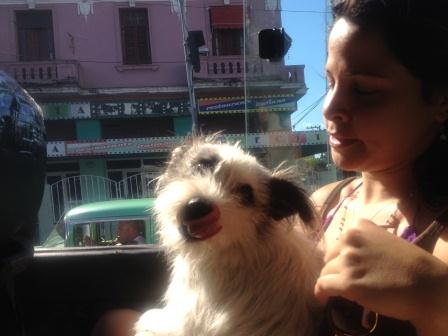
Two days before my 45th birthday, a stray dog wandered into Cuba Libro. Like I needed something breathing-eating-shitting extra to stress about. Within a day, the kids who work with me named him Toby. It was all over, I knew. I’m sure there are parents out there who know exactly what I’m talking about: once the kids you love give the flea-ridden, tick-bitten beast a name, you’re responsible, no backsies. He was awfully cute, it must be said. Adorable, to-die-for, irresistibly cute, but no one who works at Cuba Libro has the living conditions or lifestyle conducive to caring for a dependent – no matter how cute.

toby cubalibro

I was resigned to letting “Toby” live in the Cuba Libro garden, but two events changed all that. First, a friend walked in one day claiming: ‘I know this dog. He lives in my building.’ This seemed more than a bit far-fetched: Ariel lives in 10 de Octubre – at the other extreme of sprawling Havana – and besides, dogs are to some humans what Yuma are to some Cubans: they all look alike. But when Ariel picked up the phone and said, “señora, your dog is here in Vedado,” and she responded, “Oh! That’s not my dog. It’s my son’s. He’s doing his military service, but I’ll tell him” I knew this wasn’t a simple case of mistaken identity. An hour or two later, young buck Carlos showed up and was plastered with wet kisses by “Jason”. It was obvious the dog had once known and loved this fellow. But with nowhere to place Jason when he went into his military service, Carlos let loose the dog into Havana’s mean streets. As you may imagine, I thought Carlos an ass – not only had he given his dog a dumb dog name (J is pronounced H in Spanish), but he’d abandoned the animal, leaving him to his own devices. I may not be a dog person, but I’m not cruel.

Savvy pup that he is, Jason-now-Toby traveled clear across the city to cross our threshold with fleas, ticks, parasites and a sad look in his amber doll’s eyes. Just like Wilbur was “Some Pig,” I started getting the feeling that Toby was “Some Dog.” But I resisted – threatening to send him to the campo (in my case, this is not a euphemism: I was actively looking to place him with a farm family in those first few weeks). As my father once observed: ‘living with animals went out with Jesus,’ something I agree with wholeheartedly and cite often.
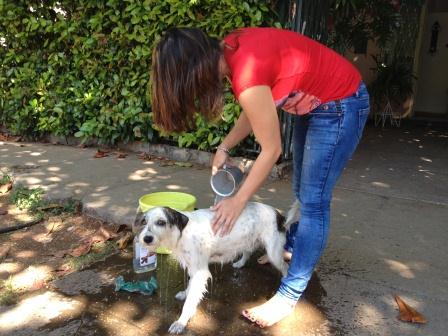
El Coquito was born.

El Coquito was born.

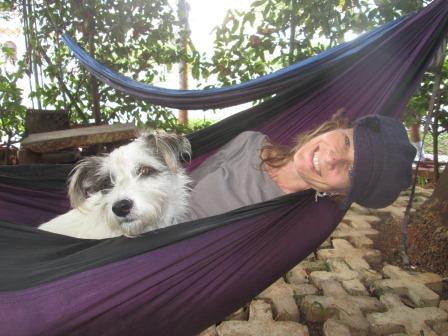
Toby’s second fate-deciding event happened one stormy day after about a week of eating spaghetti and living in Cuba Libro’s makeshift doghouse (a large suitcase donated by a neighbor for this purpose). Our weekly bike polo showdown was cut short when the skies opened up and started drumming a hard, cold rain across Vedado. And I remembered there was a dog I was somehow sort of responsible for. When I went to check up on the perrito, he was huddled in a corner of the garden shivering, ears plastered back as thunder and lightening crashed all around, every hair standing on end, soaked to the roots. I haven’t got much of the maternal/pet gene (if you missed that detail), but even I couldn’t resist his vulnerability (or cuteness). So I stuffed him in my knapsack as best I could, strapped it to my chest, and pedaled home through the rain. That was five months ago and we’ve been making the 6-day a week trek between my apartment and Cuba Libro ever since. And I’ve been forced to speak ‘dog.’

There’s a bark for ‘I have to pee.’
There’s a bark for ‘I have to poop.’
There’s a bark for ‘I’m hungry/horny’ (more on that later).
There’s a bark for ‘I’m scared.’
There’s a bark for ‘someone is at the door.’

As far as I can tell, it’s all the same damn bark. Thankfully I have a professional interpreter in Amaya who is Toby’s co-mother. She’s more than a dog whisperer: she’s a dog witch who anticipates his needs and directs his energies in a way I admire and hope to learn. Some things I’ve come to understand, like the one, two, three turns alternated with sniffs that I’ve dubbed the ‘doody dance.’ Meanwhile, standing on two hind legs and hugging me with the front two while he mews means ‘I missed you!’ But the other conversational pieces? They’re lost on me.

And as cute and adaptable and sociable as this dog is, he lived in the streets for at least 6 months we figure, and I wonder: what was his life like before? What mental and emotional baggage is he carrying from his previous life/lives? Deconstructing Toby’s personality isn’t helped by his slew of nicknames, different ones invoked depending on whom is addressing him and under what circumstances. At turns he is: Toby, El Tobito, The Tobes, Tobias Maximus, Tobito El Coquito (Toby the Little Coconut), Toby the Tuffy, El Peluche (The Stuffed Animal), El Macho, El Guapo, Ese Perro Toby, and Bipolar. This last arose after we caught him staring at walls, barking at dust and chasing his tail in an over-the-top, manic manner.

Beyond the communication problems, having a dog in Havana (something I never thought I’d be experiencing or writing about) is a challenge. Strays and pets (many trained to guard and attack) can be ferocious and we’ve taken to walking him armed with sticks and rocks after several run ins; dog food is sold, but only at very select stores and boutiques reserved for the super rich, so dog food has to be purchased and cooked almost daily (The Tobes is on a diet of rice and liver, with a little pizza and cake thrown in every so often because he’s too cute to resist 100% of the time); and Cubans are rabidly anti-neutering.

Little did I know that the neutering issue would kick up so much drama and debate – though given the machismo here, I should have expected it. I have to admit it’s kind of novel seeing testicles on a dog (where I come from, “fixing” pets is par for the course), especially Toby since he has the ‘one-eyed salute’ thing going on whereby his tail sticks straight up and you get a full-time, full-on view of his bunghole and junk. What’s more, he’s almost completely white, but his balls are black. When I announced my decision to fix him, citing concerns of rampant reproduction by any bitch he mounted, combined with the desire to tame his macho, aggressive tendencies, I got major pushback from all corners.

‘Why castrate him?! You’ve got the male dog. If he was a she, sure, but…’
‘It will make him fat and lazy.’
‘You can’t take away his manhood!’

When the vet came to examine Toby (yes, in Cuba, pet and people doctors make house calls), even he said it was emasculating to fix him and suggested a vasectomy instead. Doggie vasectomies?! For real? Then I learned that some pet owners up north actually have synthetic balls surgically attached to their neutered dogs. WHAT?! This was all a bit much and if you’ve seen how many neglected street dogs live in Havana, snipping him seemed like a no-brainer to me. But after 13 years here (this month!), I’ve ‘gone native’ in certain respects and I got to thinking: the vet estimates Toby to be between 1-1/2 and 2 years old. Has he ever had sex? Hard to know for sure, but likely not. Can I deny him this? Even if it’s not for pleasure, what about instinct? And do female dogs get knocked up every time they do it? What if it does make him fat and lazy? I don’t know anything about dogs and I was receiving conflicting information (if this happened to you, you’d likely hit the internet and find thousands of sites devoted to dog sex and fixing, but alas, a dial-up connection is not conducive…)
atbeachtoby

And then Dina, the dog who lives five houses up the way from Cuba Libro, went into heat. And Toby went into hysterics. He wouldn’t even run through the gate to greet Amaya and Douglas as he’d done every single work day. Instead, he’d run straight to Dina’s and pant and pace in front of her fence, planting himself there for hours with a sad, spurned suitor look on his face. ‘Just let them screw,’ you’re thinking. That’s what I was thinking, anyway. Until we learned that Dina is epileptic and El Macho could kill her with all that excitement. Which is why Toby spent many tormented days licking her swollen, red privates through the fence. ‘At least he’s getting something!’ people said. ‘Poor Dina,’ others said. ‘All she gets is oral’ (as if this were an altogether bad thing!). I thought we’d be able to ride out the horny epileptic episode until someone told me bitches stay in heat for three weeks. And Toby was going mad – like off his meds psychotic, following the owner (the owner, not even Dina, who was kept penned in for the duration) for blocks and blocks, across major intersections and trying to go into stores with her while she shopped. And she’d drag him back attached to her leg, whining and dry humping and making a fuss. So I had to leave him home a few days until it blew over.

The day we made our triumphant return to Cuba Libro, he disappeared for a bit (he has the run of the immediate neighborhood all day long) and returned, cool as a cucumber and plopped down. I swear he was smiling and I was sure he’d gotten laid. I wanted to offer him congratulations and a cigarette. Will there be little Tobies running around our little piece of Vedado soon? Maybe. And while I’m determined to get him fixed, I know his puppies would be damn cute.
???????????????????????????????

As an old friend of mine so sagely observed: Darwin was wrong. It’s not survival of the fittest; it’s survival of the cutest. And Cubans know how to survive (and keep things cute). So I’m keeping Toby.

45 Comments

Filed under Americans in cuba, Cuban customs, Cuban idiosyncracies, Living Abroad, Uncategorized

Cuba: Oh, the Absurdities

I’m writing this on February 14th (see note 1), which down this way is known as Día de Amor y Amistad – Day of Love and Friendship. In Conner-speak, it’s the Day to Stay Indoors since Cubans embrace St Valentine with the frenetic enthusiasm of a nine year old screeching a speech on high revolutionary holy days. (If you haven’t been subjected, count yourself lucky – it can be pretty disturbing). Interminably long lines at restaurants, theaters, clubs and shoddy bars are the norm here every February 14th. My advice? Stay close to home.


This fury for the Day of Love is the perfect opportunity for me to tackle the sticky issue of how absurd this place can be. Love, absurd? Indeed, but even more so here, where it’s as scarce as an honest butcher. Lust? It’s everywhere, a veritable epidemic of Eros we’ve got going on. Lasciviousness and overworked libidos? Cubans take the concepts to new heights (or lows, depending on how you look at/do it). But love? Love is something else entirely and aside from parental love for a child and elderly couples with decades of dedication, it’s not much in evidence as far as I can tell.   


And I’m not referring to what Cubans say – they talk a huge and charismatic love game – but rather what they do. Blackmail and brujería, lying (by omission or otherwise), cheating, unwillingness to compromise and difficulties/resistance to communicating are how many back up their grand claims of love, making the emphasis on Valentines look pretty absurd. And a lot of things other than love are looking this way lately – where folks walk the walk, but don’t talk the talk; where there’s a great and spreading maw between theory and reality; and where the policy contradicts the practice, resulting in paradoxes no one can wrap their heads around.


Some of Havana’s absurdities are simple (and simply ridiculous) like alarmingly long fingernails (which make picking up coins and masturbating problematic) and impractically high heels (which render women unable to walk). Personally, I find these killer nails and come-fuck-me-shoes (as Mom always calls them) absurd. Some other absurdities happening around here lately include:


$200,000 cars: The liberalization of car sales ‘no tiene nombre as we say in Cuba. Liberating car sales essentially means the authorities corrected one absurdity (i.e. buyers no longer need to navigate the onerous bureaucratic approval process to buy a car) by introducing another (i.e. cars would now be sold “freely” at prices set by the state). The logic goes that pricing cars high would bring in sorely-needed revenue to create a good, functional public transportation system. But who’s going to buy a car – and a French or Chinese one at that – for 900 times the sticker price? What sounded doable and looked good on paper (and whoever drafted, edited and approved that policy isn’t the sharpest knife in the drawer), bombed fantastically in practice. The new car sales scheme kicked up a firestorm of critical foreign press and dealt a low blow to the Cuban people, many of whom had been saving for years to buy a (normally-priced) car. Now they couldn’t even dream of it. People railed publically, loudly against the measure, creating new jokes to channel their frustration (see note 2). For instance, a cartoon popped up of the classic Cuban animated character Cucarachita Martina pondering whether she should spend a $200,000 windfall on a new car or Manhattan penthouse. Thinking she could buy more than a closet with 200 grand in New York is almost as absurd as the policy she’s lampooning.


Televisión Cubana: I love TV in Cuba – there are only 4 channels (5 in Havana), which makes choosing what to watch much easier than where you live (see note 3). There are also no commercials, just public service announcements explaining the importance of sharing; why parents need to spend quality time with their kids; and how to keep bacteria at bay through proper food handling (not that it always works). To boot, something like 50% of all programming is pirated from the USA. This has its good parts (August: Osage County; Inside The Actor’s Studio) and bad (Malcolm in the Middle; Royal Pains) but means I can get my English fix any day of the week.


Not surprisingly, TV Cubana can also be poignantly absurd. Recently, the national sports channel TeleRebelde was showing figure skating, giant slalom and bobsledding every night. This isn’t absurd in and of itself, but rather a welcome change from the usual baseball/futbol fare we’re fed. What is absurd, however, are the Cuban commentators calling the action from a booth in Vedado. Needless to say, they don’t know fuck all about winter sports. Still, I was heartened that they were sharpening their skills in the lead up to Sochi. Except Televisión Cubana isn’t showing the winter Olympic games. Other TV absurdities include an hour-long midnight aerobics program and a detailed segment on Japanese stationary stores with long, lingering shots of well-stocked aisles of papers and pens, chalk, crayons, ink, paints and markers – mountains of them in all colors and weights and manner of applications. This may accurately be called torture, as well as absurd.


Pirates of the Caribbean: When I moved here in 2002 (to say nothing of my virgin voyage in 1993), DVD players were the stuff dreams were made of: only the most worldly and wealthy Cubans had one of these new-fangled gadgets. Indeed, most of us only had VCR players (many still do) and ‘videotecas’ – libraries stocked with movies and soap operas did a brisk business. Oh, how things have changed. Today, you can buy five blockbuster movies for a buck, including those still in theaters near you, like Gravity and 12 Years a Slave. Most of these are decent copies, dubbed directly from those provided to festival and awards juries. Sure, there are some, like the version of Last Vegas I watched yesterday, filmed in movie theaters – you can see a head every time someone goes for popcorn or a pee and hear the audience laughing at the funny bits, but these are the exception. Havana is peppered with mom-and-pop shops selling these 5-movie ‘combos.’ There are also more technologically advanced options, like the service whereby a young buck comes to your house and copies whatever you fancy on to your computer – anti-virus software and updates provided free of charge. The newest innovation is a service where for $2, the young buck installs a potpourri of 250 gigabytes on your machine, with the bundle of movies, shows, and computer programs changing each week. Need the latest version of iTunes or the season finale of Breaking Bad? These are your gente.


What’s so absurd about this is multi-factorial. First, Cuba is signatory to international anti-pirating conventions. Second, it hurts Cuban artists as much as Hollywood and the rest since copyright infringement knows no nationality and you can just as easily procure pirated versions of the hot new Cuban movie Conducta as The Hobbit. Last, many of the movies and shows come with that threatening FBI anti-piracy warning. Very ironic. But what chaps my ass most and takes the absurdity to new, personal heights is the availability of pirated versions of my Havana Good Time app. You can’t download it legally from iTunes in Cuba (the site is blocked by the US government embargo; when you try to access the site, you’re informed of such) but you can easily get a bootleg copy. I don’t know how much it costs or what version they’re offering, but if you come across it, drop me a line – I’d love to know just how absurd this place can get.


Notes


1. But it probably won’t go live for weeks due to my crappy internet connection – which is so crappy, it conspires to make a quitter of me.


2. One notable change over the past 3 years has been the dearth of new jokes around town. Cubans are incredible jokers and love a good pun and humor serves as necessary catharsis here. I’ve been worried about the lack of new jokes recently – people are too anxious, stressed or depressed to devise and enjoy new jokes, until things take a turn for the really absurd, like we’re seeing with the state’s car prices.


3. Lack of Netflix and any other streaming video limits choice even more. 

38 Comments

Filed under Uncategorized

Conner’s Letra del Año

I’m back in the swing of things here in Havana and if I’m reading the signs/between the lines correctly, it promises to be a memorable year. Already some unpredictable ($200,000 cars?!) and unexpected (Fidel rolling up at Romerillo?!) things have happened, about which I promise to post at a later date.

‘Surprising’ and ‘fast-paced’ are the catch phrases for the foreseeable future as far as I can tell. Indeed, 2014 has proven illuminating and educational, adrenaline-rushed and not a little bit hectic – and we’re only a few weeks in.

It’s exciting – I’m excited – but I get the feeling that this year is going to obligate us to work, HARD, to maintain balance; we will have to be master jugglers these next 12 months. It will be tricky keeping all our professional, personal, and spiritual balls in the air, but if we stay focused and true to course, I think the payoff will be well worth it.

In an effort to measure the tenor of our times and steer a tentative course through the exotic, but potentially choppy, waters of 2014, I offer you my Letra del Año. For those readers unfamiliar with this annual declaration, it’s a collaborative document issued each new year by the major Afro Cuban religious associations. It contains everything from conjugal advice and health warnings to what foods and saints should be offered and attended.

While I’m not an adherent, I, like innumerable others on the island, pay attention to each year’s Letra. When I read 2014’s, I was a bit shocked (and encouraged – maybe I’m on the right track!) to learn that one of the sacramental foods this year is the pomegranate. Not only is this extraordinarily rare in Cuba (so an odd sacrament, for any year), I’d bought one and shared it with a friend on New Year’s Eve before this year’s Letra was published.

And will my Letra del Año be prophetic? Maybe not at all or possibly in part, only time will tell, but here’s my take on 2014 and what we might expect:

Love is in the air:
I’ve known Alejandra since I moved here. She’s both family and friend and a helluva woman. She lives with her aging parents, works in a thankless job for 20 bucks a month and has struggled with mental health issues over the years. For the first decade I knew her, she was completely alone – ‘pobrecita,’ they said. I don’t remember her ever going on a date, even. Then, a year ago, Alejandra met Evaristo, a good and good looking guy, who helped around the house, got along with the parents, and had a decent job. And for whatever reason known only to them (or not even – love, after all, is one of life’s great and wonderful mysteries), they clicked and swooned and grooved.

Last weekend, they tied the knot in a beautifully simple ceremony in Alejandra’s front yard. The look on their faces, on that of their parents, siblings and every last guest was pure bliss. You could feel the love before the first teardrops of joy fell. I have another amiga getting married next month and a dear friend of mine for whom the seeds of love have been slowly, carefully sown over the last year or so and are about to bloom. Another few couples are marrying over the summer and well, all you need is love, right? I say: let’s spread it and do our part to silence the bitter and hateful.

Healthier habits and routines:
Whether or not related to love and matters of the heart, I foresee folks around me (and myself included, hopefully, but unlikely), adopting healthier habits. Smoking and drinking less, sleeping longer and more soundly, eating healthier and doing some exercise will be in the mix. Watching less TV (no matter how classic or well-made) and reading more and better literature fall under this rubric, as does consuming less “news”, which just serves to make us more anxious and at the same time apathetic if you ask me.

Globetrotting:
This will be a year of travel, people. Already my trip calendar is filling up fast, with Nicaragua, El Salvador, Ohio, Hawaii and Ireland on my itinerary. Cuban friends are also planning to travel (some ‘definitively’, as we say here, leaving us holding our aching hearts) to the usual places – Mexico, Miami, Madrid – but also to Canada, Germany, Amsterdam, and Thailand. Seems like everyone took a turn around the block with their luggage this December 31st, one of our year-end traditions/superstitions.

Consolidating creativity: I and many people I know put (too) many wheels in motion in 2013 – work projects and personal relationships, new businesses and novel challenges. Last year saw lots of this and now the time has come to focus, buckle down, and channel all this creativity into attainable goals. It’s important to emphasize attainable, since the majority of mi gente are overachievers and tend to set themselves up for defeat with all the complex, long-term (some life-long!) goals they set for themselves. We have the energy, we have the intelligence, we’re motivated and we’ve set 2014 up for success – let’s make it happen, one milestone at a time.

Time management challenges: Doesn’t it seem like everyone’s overworked, over-scheduled and just rushed overall? In my world, it looks and feels that way. Keeping everything together, tying up loose ends, leaving time for the people and things we love – this is going to be difficult in 2014. This is especially true in Havana and New York, the two places where I pitch my tent so to speak and where the rhythm of life is different and more hectic (increasingly so in Cuba) than other latitudes. Managing time, while still living in the moment and being present, will be even more difficult. Slowing down to smell the roses, sing to babies, and ask after our neighbors will be important this year. Please remind me when I forget.

Last but not least: have a fabulous and healthy 2014 everyone.

Let life be peachy.

13 Comments

Filed under Americans in cuba, Cuban economy, Cuban idiosyncracies, Cuban Revolution, Expat life, lonely planet guidebooks, Relationships, Travel to Cuba, Uncategorized

Havana Mantras

Cubans like their dichos. For just about any hairball situation life coughs up, they’ve got a palliative or folksy saying.

As you may imagine, the general difficulties of modern existence are fertile fodder. To cite just a few:

Al mal tiempo, buena cara.
(When times are bad, put on a good face).

To the question ‘how ya doin’? or ‘what have you been up to?’, Cubans invariably answer:

En la luchita.
(Struggling a little/lot).

And then there’s the ubiquitous:

No es fácil.
(It’s not easy).

It’s not easy can apply to anything – caring for aging parents with Alzheimer’s; pending paperwork and attendant bureaucracy; the quality of bodega rice; even the weather.

These sayings and many more like them have become mantras of sorts. Short, pithy and to the point, they help people fortify themselves and cope with the aging/bureaucracy/vagaries life never tires of throwing our way.

Recently several friends confided that they invoke their own original mantras when faced with challenging situations. They make me smile (the mantras, not the challenging situations) – in mal timepo, when things are especially difícil, and when it feels like the luchita might triumph once and for all. They’re funny in their way, these mantras, but also weighty since they reveal the resilience and resolve with which Cubans confront obstacles. And I have a feeling such resilience, not to mention resolve, will become increasingly – urgently – important in times to come.

_____

If you follow Cuba news, you know that we’ve been under a wet, windy cold front for the past several days. It looks like it’s finally moving on and none too soon: over 100 buildings collapsed completely or in part in Havana due to these torrential, biblical rains, reminding me of 2005’s Hurricane Wilma. Rain like this is problematic here, not only because it sends buildings tumbling – it also floods homes, damages worldly goods and grinds transport, sectors of the economy and much of the bureaucracy to a halt.

But it’s not just the wet: the cold is a problem too since so few of us have hot water in our homes. To be blunt: showering in this weather without hot water is a bitch. Sure, we heat up pots on the stove, decant it into a bucket, mix it with some cold and scoop it over us as fast as possible. It’s workable, but in those few seconds between scoops, you freeze your butt off. Ocassionally, it’s not practical to heat water – there’s no time, no gas for the stove, whatever. End result? We take a lot of cold showers around here, even in winter, even during the chilliest fronts.

As I was talking to my friend Julio Pedro about this, he told me he has a ritual – a mantra, mejor dicho – which he invokes before stepping into a cold shower. Bracing himself, he repeats over and over again, before and during the cold blast:

Soy un macho de pinga. Soy un macho de pinga.
(I’m the fucking man. I am the fucking MAN).

If you knew JP, you’d laugh, like we did, imagining this wisp of a guy incanting his cold shower mantra.

_____

The mantra topic came up again as another friend and I were planning a night out recently. We were headed to one of Havana’s largest theaters to see one of the country’s hottest acts. Neither of us had tickets and it was doubtful we could procure affordable (see note 1) entry the day of the show. I told her we’d only need one ticket since over the past decade, my foreign press pass has gained me entrance into even the most over-sold events, from Pablo Milanes to the Royal Ballet. My friend, who works for Prensa Latina, said she would use her work badge, a yellow and curling card encased in foggy plastic that says ‘Prensa’ in red letters.

‘Isn’t is expired?’ I asked her.
‘Yeah,’ she said. ‘But it has yet to fail me.’
‘Nice.’ I said.
Then she confessed: ‘but every time I use it, I think is it going to work? So just in case, I invoke my mantra:’

Soy la reina de la Habana. Soy la reina de la Habana.
(I’m the queen of Havana).

I’m not sure if it was the badge, the mantra or her killer smile, but the queen and I got into the concert.

_____

At this point, you’re probably wondering about my mantras. I’ve got mine, of course. Like everyone else, I’ve had to develop and hone my resilience and coping mechanisms over the years here. One I’ve known for a long time, but really started invoking it during my month-long stint covering the Cuban medical/disaster relief team in Haiti after the earthquake. Now, whenever I’m faced with particularly trying circumstances beyond my control, I tell myself:

No coge lucha. No coge lucha.
(Pay it no mind/Don’t fight it).

I’ve added another mantra lately which helps me with the haters and naysayers who for time immemorial have tried to keep down the dreamers and lovers and doers:

Que lástima odias tu vida.
(What a pity you hate your life).  

And a pity it surely is, but you know what? It’s not my problem so I’m not going to coger lucha.

Notes
1. Ticket scalping is a common and lucrative practice in Cuba’s double economy.

8 Comments

Filed under Uncategorized

Apretando Mi Corazón: Cuban Emigration

[tweetmeme source=”connergo” only_single=false]

All my friends are talkin’ about leavin’, about leavin’

So goes the little pop ditty in heavy rotation on one of the satellite radio stations I favor. I’d bet my life Cuba never crossed the songwriter’s mind, but it so easily could have been written by my friend Alma, my prima Anabel, or my colleague Jorge.

Or me.

The song is entitled Ghosts and we’re surrounded by them here as certainly as the water which hems us in, as omnipresent and nebulous as the bureaucracy that hobbles Cuban greatness.

Can you hear me sighing? Crying? Thankfully not, but somewhere out there, not too far from where you read and where I write, there’s a Cuban pining for the friends that have left or for those they’ve left behind.

Or not.

Emigration is a little like death: everyone has their own way of grieving and no one has the right to judge – least of all me with the relative freedom of movement I enjoy. Some people block out departed loved ones as soon as that exit permit is stamped or the fast boat slips silently from shore. Until they’re due back for a visit, in which case copious gifts are expected. And they always do. Return, because the pull of this patria is too strong to resist indefinitely and bear gifts because the guilt – self-imposed and otherwise – of leaving is heavy. Besides, what better way to prove the grass is indeed greener than to come loaded with loot? (see note 1)

Where will her roots grow? Photo by Caitlin Gorry.

What it amounts to is ‘out of sight, out of mind.’ It’s a wholly common coping mechanism here, in fact. Or rather than a way to cope, it’s simply part of the cultural sofrito. After all, many a liaison – and even marriages – (mal)function due to ‘out of sight out of mind,’ and the related ‘what you don’t know won’t hurt you.’ Until you do, but that’s another story.

Some Cubans, meanwhile, go to the other extreme: they pine and fret and share each morsel of news with every person they meet. Iraida got her driver’s license; Alain saw his first St Patrick’s Day parade; Yoselvis likes Burger King, McDonald’s not so much. This is my approach for keeping close everyone I left behind in my own émigré drama. Willingly taking leave of a lifetime of friendships – most Cubans don’t realize we share this in common.

Emigration is a knotty business, muddled by politics vs. agency, needs vs. desires, illusions and disenchantment, resignation, empowerment, circumstance and happenstance. And I’ve faced a lot of loss and separation on this end. Many of my Cuban friends and family – relationships I’ve fed and nurtured over the past 10 years with all the creativity and passion my heart allows – are leaving. Invariably, I’m tipped off when they suddenly start speaking English and going to every doctor they can, even the dentist.

The details of leaving vary, but the reasons rarely do. Frustrated and fed up, my friends want meaningful work at a dignified salary; yearn to improve their families’ station; and itch to experience something beyond their block, barrio, or province. A leave-taker myself, and with what I know beyond this city, island, and hemisphere, our emigration conversations have been in-depth and interesting.

My 20-something friends ache for independence – from mom and the state – though many are clearly unprepared for the reality fleeing the nest and flying solo imply. My 40-something friends, meanwhile, are tired. Tired of only having water un día sí, un día no; tired of waiting on the bus, permissions, and promises that may never materialize; tired of hunger and boredom and heat without respite, tired of the shortages and struggle and slogans – the endless luchita that erodes the will to go on blackout by blackout.

Just today, after a rash of events that included death of the family dog, a trip to the pediatric hospital and stint at the police station (neither resulting in prolonged care or detention por suerte), a friend reached the end of her rope: “I’m a revolutionary, but there are limits to what a person can take. I can’t take any more. I’m ready to get on any lancha or plane to get me out of here.”

I relate to both groups: fiercely independent, I began working at 13 and left home four years later, so I get my young friends’ anti-dependence stance. What trips me up and out, though, is how they replicate the precise behavior they condemn: they don’t participate in any community endeavors like the block association, because they say the block association doesn’t get anything done. In turn, the association blames ineffectual municipal authorities, who blame overworked and gridlocked provincial authorities and on and on goes the blame game up the hierarchy in a cycle of non-action.

I ask if a renovation or re-thinking of these mechanisms is possible (obviously it’s desirable), but they give me ten reasons why it isn’t practical. When I suggest that they volunteer or campaign for those positions in local government where they might affect change, I get the same response. It’s a vicious cycle and self-fulfilling prophecy a la vez: things won’t get better because the people charged with improvements are ineffective and/or shackled so why even deign to try to fix what’s broken or work towards positive change? So they cross their arms and give in to the inertia – while eating grandma’s home cooking with provisions provided by her and the state, in clothes washed by mom, after which they shower in a bathroom they’ve probably never scrubbed themselves. They are resigned, leisurely.

Out of sight, out of mind? Photo by Conner Gorry.

I know that sounds harsh and as if I’ve written them off. But I feel for this generation. They did get the fuzzy end of the revolutionary lollipop after all. They were born into the hardship of the Special Period, just missing the halcyon Eastern Bloc boom, when you could take your honey out for dinner and dancing on the average salary. The emotional, exuberant revolutionary hey day when the entire country put their backs and minds into creating a more just, equitable society was also before their time. To boot, their lives were proscribed by all kinds of dubious innovations like ‘emerging teachers’, the camello, and reggaetón (see note 2).

But there have been positive changes in their lifetimes, too, and when I ask them about the relaxation of restrictions on private property and enterprise or the very public push for full integration of LGBT Cubans into society for instance, they say ‘too little, too late’ or cite non-causal factors for such strides. Many didn’t participate in the national debates that generated these changes, nor have they read or heard Raul’s speeches specifically dealing with these issues – and even thornier ones like travel and the meager salary problem.

When I point out that not all change is good and ask if they’re prepared to take the good with the bad, they say yes – reflexively. Change for the sake of change is their position. And it leaves me wondering what they believe in; I’m coming to think that even if they know, they aren’t prepared to fight for it.

On the whole, my 40-something friends are nostalgic for the late 80s and agree much has changed since then – for good and not so. Back then, you couldn’t even dream of procuring an exit permit to travel abroad (a restriction the majority believes should be lifted, though this involves complexities not everyone is willing or able to recognize). And they praise recent changes, though often such praise isn’t forthcoming without prompting. It makes their resignation doubly troubling – they have the historical context of how great this country was and the maturity to take the longer view (see note 3) but still they want out. When I ask these friends what they would change, they mention freedom to travel (something my own country doesn’t extend its own citizens – another thing we share in common) and less bureaucracy. Some say they want Liberty, capital L.

Mercurial, that liberty thing. Do they realize tyranny comes in many flavors? And that consumer capitalism, powered by its ‘save yourself if you can’ underpinnings, is among the most bitter?  And if you can’t save yourself? Tough luck.

For many, the choice is reduced to resignation or emigration. Neither of which will deliver the liberty or change they so desire, I’m afraid. To be clear: I wholeheartedly support my friends working towards leaving; after all, I did it myself, I left my country and I can leave this one too when I want to. But I miss them something awful once they’re gone.

To the resigned, I say – if you’re going to stick around, stick up for what you believe in. A better Cuba.

Notes

1. OK, so maybe that’s a little crass. Cubans know better than anyone how hard life is here and generally have a genuine desire to help out those back home. Still, doubt creeps in when I learn about the rent-a-bling businesses in southern Florida which lease chunky gold-plated watches, chains thick enough to moor a boat, and rings for every finger to Cubans returning to the island. These doubts are reinforced when I turn sad watching family ruptures at the airport and friends say: ‘that’s all a show, muchacha. Take it with a grain of salt.’

2. This program trained massive amounts of teachers in the minimum amount of time. The idea was to improve the teacher to student ratio, which took a nosedive as older, more experienced teachers retired – often to offer private, complimentary classes to those students who could afford them. More often than not, these emerging teachers weren’t much older than their charges and depended on videotapes and other teaching aides to compensate for their lack of experience. By all accounts, it wasn’t a good approach. Camellos were double-humped hulks pulled by big rig cabs that held over 300 passengers when packed. You still see them in the provinces, but they’ve been phased out in Havana. If you don’t know what reggaetón is, I envy you.

3. Difficulty in taking the long view is not just limited to Cuban youth, I’ve found.

51 Comments

Filed under Americans in cuba, Cuban economy, Cuban Revolution, Expat life, Uncategorized

Havana Bad Time (see note 1)

[tweetmeme source=”connergo” only_single=false]Times are exceedingly complex and anxiety-ridden on this side of the Straits. This is part of the reason I’ve chosen to accentuate the positive lately – both personally and generally. No one needs me griping about the small things and adding to the angst, I figure. Besides, here, like everywhere, you take the good with the bad, which is my stock answer for those who don’t believe (or cotton to) my choice to be in Cuba. And for me, the good has heavily outweighed the bad for 10+ years.

But these days, my life has gone a bit pear-shaped (see note 2), sending me to my surest, safest refuge: pen and paper (see note 3). Indulge me this one post and we’ll return to issues of more import, (not to mention fun), soon. Te prometo.

¡Apagones cojones! – Once upon a time, I was one of the 11 million here who withstood 10 hour black outs. Years later (before we’d hooked up with Hugo), the apagones were shorter – a couple, three hours – but still a fact of life. And in hurricanes, the electricity is cut when winds reach 40 miles per hour – one of the reasons Cuba suffers minimum loss of life compared to other places since many storm-related deaths are due to downed live wires. So I’ve known my share of blackouts.

But none of this explains why I came home last week after sol-to-sol meetings to a dead answering machine in my sala and defrosted pork parts in my freezer. Did my neighbors have lights? Yes. Had I paid my bill? Yes (see note 4).

‘Tis a puzzlement as the King once said and not in an intriguing, brain teaser kind of way, but rather in that ‘how am I going to cook dinner and keep cool?’ kind of way. The head scratching intensified once I located my meter amongst 18 others downstairs and found it in working order. Next, I went to the circuit breaker inside my house and found it in the ‘off’ position. I switched it to ‘on.’ A light sputtered to life, but I didn’t even have time to yell “Yay!” before it threw the breaker again.

I waited a bit before switching it again to ‘on.’ The light flickered and held. No electrician has been able to explain the mystery – I have no new appliances or anything additional plugged in – but I dare not turn on my old Russian AC. Send help if you don’t hear from me by August.

The concert that wasn’t – One of the undeniably greatest things about living here is the quantity of quality music happening almost always. So was the case last Saturday night when X Alfonso, Raúl Paz, Kelvis Ochoa, and Decemer Bueno were all playing at different, fabulous venues across the city.

How to choose?

For me, it was easier than most since I’ve seen them all perform multiple times and Decemer’s concert promised something special: invited guests included Israel Rojas from blockbuster group Buena Fe, plus Xiomara Laugart – an exile making her return to the Cuban stage. 

I highlighted his concert on my Facebook page. I invited friends and family and pedaled over some time after 10. I took my time: Cuba isn’t a particularly punctual place and these cats less so. I cruised up and ran into friends on an inaugural date, thrilled they’d chosen this concert over the others…

Once the clock reached 11:15 and the doors still hadn’t opened, my friends bailed. I hung in there and was relieved when they (finally!) started letting people in at midnight. I grabbed a Tu Kola at the swinging bar and headed into the theater where a full house waited. And waited. And waited and waited. At 1 in the morning, I bailed myself, my night of getting down, gone down – in flames (see note 5).

Yes You Can!=No You Can’t! – I’ve said it before, I’ll say it again: my life changed when I got a bike several months ago. It’s fun, it’s fast, it’s practical and represents independence and freedom – coveted states no matter where you live. But I still nursed a hangover from my first Cuban bike in 2002, when I had been stranded one time too many with nowhere to park my chivo.

Bike parking lots were as ubiquitous here during the Special Period as wannabe iMac users are today, but most car lots circa 2012 are reticent to accept bikes and those specifically for bicycles are few and far between. But so far, I’ve only had one run in – with a too-cool-for-school parqueador more concerned about his dwindling keratin supply than the vehicles he was paid to guard. Then I rolled up to the car/moto/bike lot adjacent to Coppelia. Here things took a fast turn for the douche absurd.

ME: Buenas tardes, compañera. I’d like to park my bike.

HER: Sure, put it right there in the rack. (She ties a chapita to the frame and hands me a matching metal ‘ticket,’ which I pocket).

ME: Great. Just need to lock it up.

HER: Oh no! You can’t lock it.

ME: ?!?!

HER: No, no. No locks.

ME: Compañera. I don’t understand. This lock provides added security for both of us.

HER: No. You can’t use a lock here. If you want to use a lock, do it on the street.

ME: But that’s illogical. Why wouldn’t you want more protection for me and you?

HER: Because we’ve had ‘situations.’

ME: What kind of ‘situations?’

HER: People have abandoned their locked up bikes here.

ME: ?!?!

So I wheeled Frances three feet away, on the other side of the rope from the official parking area, locked him to a tree and headed off for ice cream. Your 5 peso loss, lady.

Doggin’ me – This last was really the icing on the cake, the ill effects of which I’m still suffering. Last Sunday afternoon, like those before it, I was making my way to play bike polo. But this time I was escorting a friend, which is good news: our league suffers from a chronic shortage of bicycles. We had just made it around Havana’s hairiest rotunda at Ciudad Deportiva and turned onto the access road to our court. I glanced behind me to make sure my friend had made it through the rotary and when I turned around, there was a stray, mangy dog directly in front of my tire. 

I had no time to react – no swerve or brake or little hop was happening. I ran squarely  over him, passing with a thud over his flan-colored midsection, first with the front tire, then the back. He yelped. I fell. Folks nearby gasped. The dog ran off, leaving me with a badly sprained ankle and a serious hitch in my giddy up. If I wasn’t a dog person before…

Notes

1. This post was suggested (somewhat tongue in cheek) by Havana Good Time user Annabelle P after a visit here. Thanks chica!

2. And what follows is only what Politics, legal considerations, and my personal ethical code permit me to air publically.

3. For all two of you who were wondering: I still do all my first drafts the old fashioned way – by putting pen to paper.

4. The electric and phone company here are merciless when it comes to non-payment, cutting service one day past due. I experienced my share of cold nights and interrupted phone service growing up due to unpaid bills, but I don’t ever remember ConEd or AT&T being that cut throat. Ironic, eh?

5. Turns out they took the stage at 1:30am, having had to wait for the sound guy who was working one of the other concerts which also ran late. To boot, there was a short in Decemer’s mic, so he was getting shocked through his six song set before calling it quits. Friends tell me they’re going to make it up to their pissed public with a free concert soon.

26 Comments

Filed under Americans in cuba, Cuban customs, Expat life, Living Abroad, Uncategorized

Havana Es Un Pañuelo

[tweetmeme source=”connergo” only_single=false]

Have you heard of a postage stamp yard? Well Havana is a postage stamp city – a pañuelo as we say here. Don’t misunderstand: this place has always felt like a small pond to the New Yorker in me (in a good way – not in that inferiority complex-San Francisco kind of way), but lately it has become all too clear how this diminutive status affects human relations in the land of sociolismo.

It’s not simply the size of the population that makes it feel small, but also its static closeness. Therein lies the city’s incestuousness de verdad.

Until very recently, for example, moving to another neighborhood was a pipe dream for most, a torturous, time consuming affair for a select few. What this means in practice is that the people around you have been up in your grill – all up in your business – your entire life. They know your histories and dramas, betrayals and tendencies. The same can be said for your workplace, love life, organizaciones de masa and other extracurricular circles. (If your unfamiliar with Cubans, I should point out that all these circles are also moving the grist of the gossip mill but good, making things worse).

And not only do your neighbors, co-workers, and lovers know all the details and penas of your life, they’ve been amassing favors and calculating debts with you through each and every one of those penas, trading upon all those embarrassing and unfortunate details. I’m not passing judgment. On the contrary; I’m gaining a better, intimate understanding of my acculturation trajectory – because although I haven’t started doing it myself, I’ve started to accept and roll with it.

Does it scare me? Sure, a little. Especially since in the zero sum expat game, such insight into my adopted culture directly corresponds to me understanding my birth culture that much less.

My last trip back to the US was disturbingly jarring in this regard. I’ve had trouble putting it into words (the kiss of death for a writer!), but at its most simple, it has to do with what people up there value and how they behave themselves in pursuit of those values.

And you know the most curious thing? The different value system and how it manifests itself is precisely what bewitched me when I first came to Cuba in 1993.

I’ll keep this in mind the next time I’m faced with the other side of the small town coin: when I once again have to deal with my chismoso neighbor who takes pleasure in reporting me to the housing police (without cause of course); when I’m forced to work with someone who has dogged or betrayed me; and when I find myself in the same small space as someone who’s pursuing my man.

Es Cuba, mis amigos.

4 Comments

Filed under Americans in cuba, Cuban customs, Cuban idiosyncracies, Cuban Revolution, Expat life, Living Abroad, Uncategorized

Let Me Count the Ways…

[tweetmeme source=”connergo” only_single=false]
Ay Cuba.

What have you done to my heart, torn in so many directions but always aching for 23° 7′ 55″ North, 82° 21′ 51″ West? And my soul? Of, by, and for New York from birth, but now reconfigured into an alma cubana that whispers mysteries in Spanish I’m still unable to cipher.

I’m not sure when this happened – feeling betwixt there and between here – though I know it’s common to long-term expats. Hell, I’ve even parsed some of this awkward, never complete transition over the years, crafting a sort of road map to the cultural, linguistic, and romantic bumps in my road.

Despite my musings and analysis, I entered some unknown territory on my most recent trip off-island: in a nutshell, I did not want to leave. Maybe I’ve been hanging out too much with Moises and Rina, two friends who had to travel to the United States recently, but neither of whom had the ganas to do so. It wasn’t due to fear – both have traveled several times for work – nor was it because they’d traveled so extensively that trips abroad had become old hat and rote (see note 1). They just didn’t want to leave the island and these days, nor do I. It feels wrong and a bit scary, like kissing a cousin or sibling.

It makes me sad because I know the lengths so many Cubans take just for a chance to see what lies beyond all that water crashing against the Malecón. And it’s confusing, because on every previous trip, I too felt the need to ‘saca el plug’ (pull the plug) and ‘desconectar’ from the drama-rama that is Cuba. Trips out used to be exciting, emotional, and necessary.

But not this time. I didn’t want to cut whatever cord hooks fast into those of us crazy for Cuba, making us spend money we don’t have, go against our better judgment, and jeopardize job, health, and relationships to get back to the island. In an effort to untangle that cord (or loosen the noose, depending on your POV), I offer all these reasons why I love Cuba (see note 2).

The $1 lunch – Whether it’s a cajita across from the CUJAE or a knife and fork sit down at El Ranchón (one of my all-time favorites), Cuba has some kick ass $1 lunch with all the fixings. Even at the airport: on my recent trip off-island, I filled up at the cafeteria outside Terminal 2 (clearly one of the greatest benefits of the new economic regulations) with a plate overflowing with pork, congris, yucca, salad, and chips. It was so tasty a fellow diner said: ‘my congratulations to the cook – he must be from Pinar del Río!’ (see note 3).

Touching, hugging, and general closeness – Latinos have a different concept of personal space and Cubans, as is their wont, take it to an extreme. Men embrace and greet each other with kisses on the cheek, female friends walk hand in hand, and my best salsa partners have been girlfriends. All of this is to say that Cubans aren’t afraid to touch – your leg when telling a story, your back as they try to pass you in the hall, your shoulder as they ask: ‘how is your family?’ Cubans fill elevators to its maximum capacity and I always delight in watching a mixed Cuban-foreigner crowd boarding them for the mutual awkwardness that ensues. Up in the States, the awkwardness is mine every time I step into a nearly full elevator, encroaching somehow, though there is always room for one more. That weird, reactionary, and let’s be frank, harmful rule that teachers can’t hug students in the USA? My Cuban friends can’t even grasp the concept when I try to explain it.

The hello/goodbye kiss – Related to touching is the traditional Cuban greeting – one kiss on the right cheek no matter if you know each other or not. Even taking leave of big groups results in blowing a kiss to the crowd. I think we should start this trend up north. Our world couldn’t be any worse off with more kisses, could it? On my visit to the States recently, I leaned in towards my host and said: ‘you were wonderful tonight,’ touching his knee as I spoke. Did he misread my Cuban-ness? Interpret it as something more?, I wondered later as he slid his hand down my back to cup my ass. This doesn’t happen in Cuba unless the signal is an unequivocal green (ie the ass grab is mutual).

Fun in the sun – I was born and bred in northern climes, but I’m a winter wimp through and through. Sure I loved tobogganing and ice skating and snowball fights as a kid – still do in fact – but the bulky clothing, the cold that turns wet once the fun is done, and the squeak of day old snow that sounds like someone is packing Styrofoam in your ear isn’t my bag. I like loose clothing, walking in the sun, and smelling gardenias or fresh cut grass in December. Summer clothing is sexier I think we can all agree, and as white as I am, when my freckles fuse into a pseudo tan, I work those scanty, loose-fitting clothes to full effect.

Drink, smoke, & be merry – The 8am Bucanero; the post-feast cigarette; the incessant regguetón: Cubans milk the ‘party hearty, the rest of you be damned’ approach to its fullest. Believe me, I know. And should it slip my mind, my neighbors are quick to bust out their state-of-the-art karaoke machine and warble drunken, sappy ballads until the wee hours.

And the smoking, dios mío. I remember going for my first pap smear at my local doctor’s office here in Havana…hoisting my feet into the stirrups, I watched aghast as the doctor took one last drag of her filter-less cigarette and with a deft flick of her gloved hand sent it flying out the window before diving between my legs (see note 4). If you’re a non-drinker, non-smoker, or not into music appreciation, you’ll probably find Havana offensive. But for those who like an after dinner cigar, enjoy (or need) some hair of the dog once in a while, or are usually the first on the dance floor at parties and functions, I bet Cuba will float your boat.

It’s safer than where you live – Okay, that’s a broad stroke, I know: after all, I don’t know where you live, much less the crime rates. But I can tell you that the absence of crack cocaine, crystal meth, heroin, and guns means a generally safer city. I’m not saying drugs, prostitution, violence, and rackets don’t exist in Havana. They do. But as a longtime traveler and writer of guidebooks to some of Latin America’s most violent cities (Caracas, Guatemala City, San Pedro Sula, Tegucigalpa) and an eyewitness to NYC’s crack attack in the 80s, I can tell you that Havana is a gated community comparatively. Kids play unsupervised in the street here and I walk home alone at night frequently. (Truth be told, I took a short hiatus of walking home alone after a tall guy grabbed me from behind and thrust both hands between my legs one night in Vedado, but I conquered whatever uncertainty the event planted within me). Most of the crime here is of the opportunistic/snatch and grab variety and tends to peak between October and December when people are trying to rally resources for Christmas and New Years’ celebrations.

These are some of the reasons why I love Havana and if you’ve been thinking about coming here, let me leave you with one piece of advice: don’t put it off any longer. The only certain thing in life is that life is uncertain.

Notes
1. Yes, there are Cubans who get tired of traveling they do it so much: politicians, organizers, academics, musicians, and artists, typically.

2. For those interested in earlier thoughts on this subject, see my earlier post Things I Love about Cuba.

3. Country cooking like they do in Pinar del Río is unrivaled – trust me on this one and seek out a campesino lunch next time you’re in that wonderful province.

4. For new readers to Here is Havana, let me reiterate that all the stories found throughout these pages are entirely true, though some names have been changed to protect the guilty.

20 Comments

Filed under Americans in cuba, cigars, cuban cooking, Cuban customs, Cuban economy, Cuban idiosyncracies, Cuban phrases, dream destinations, Expat life, Living Abroad, lonely planet guidebooks, Relationships, Travel to Cuba, Uncategorized

Cuban Blockade: Cruel & Unusual

[tweetmeme source=”connergo” only_single=false]
It’s time again for the international community to remind the United States how absurd and futile their blockade of Cuba is. The vote to condemn the blockade is a UN affair (equally as absurd and futile perhaps, since the Cuba policy is largely a US domestic issue and UN votes are notoriously toothless) – the 20th of its kind. Last year, 185 countries condemned the blockade, with 2 nations dissenting: the USA and Israel (surprise! surprise!).

For those needing a bit of a primer, the US embargo was first enacted in 1962 – before many of us were even born. The purpose of the policy, then as now, is to isolate the country to such a degree as to foment regime change (seems they’re a bit obsessed up north with the ‘C’ word – in this case Castro). After about 30 years of the means failing spectacularly to attain the desired end, the policy was strengthened through the Helms-Burton and Torricelli Acts so brutally that today, it violates the most basic human right of 11 million Cubans – the right to self determination.

This chaps my ass. What also irks me is when analysts, academics, and others somehow hitching their wagon to Cuba’s star call the policy an ‘embargo’ when it is, in fact, an economic, commercial and financial blockade. Semantics you say? Not for those of us here suffering under it. And not for those who understand the difference between the two. It’s one thing to prevent your own government, people, and businesses from dealing with Cuba, it’s something entirely, extraterritorially else to penalize other countries for doing same.

Consider this explanation by Peter Schwab in his book Cuba: Confronting the US Embargo:The embargo blockade disallows Cuba from using US dollars in international trade, costing the country additional money for exchanging currencies. US regulations also disallow the export of US products from a third country, while products even developed through the use of US technology or design [emphasis mine] cannot be sold to Cuba.

Not only vicious, the policy is ridiculous in its application: there was the incident at the Mexico City Sheraton, when staff refused rooms to Cuban guests in 2007 in town for a conference; an Oslo hotel owned by Hilton repeated the gaffe with a Cuban trade delegation that same year. In October 2010, Twitter blocked messages originating from Cuban cell phones, citing the blockade as justification. Twitter quickly capitulated, but isn’t the convergence between the “free” market, politics and censorship interesting to consider? Taken together, all the elements petty and severe of the blockade have meant over $100 billion in losses for the island over the years.

What really boggles the mind, however, is the bang-your-head-against-the-wall determination with which the policy has been pursued, despite its failure to reach its stated goal. It puts me in mind of Einstein’s definition of insanity: doing the same thing over and over again and expecting different results.

Yes, folks, this is an insane policy. What policytroublemakers in South Florida, Jersey, and D.C. doggedly ignore and don’t want you to know is how this policy lowers quality of life, separates families, and kills people on both sides of the Straits. Before I rant about the specific ways in which this policy makes life harder here as well as there, allow me to extend my deepest condolences to all the families, Cuban and otherwise, who have suffered under the blockade. I’d also like to voice my deepest respect and admiration to all those working towards a change in policy and the 11 million Cubans – 70% of whom have only known life under the blockade – affected daily as a result.

So you might better understand how this translates on the ground, I offer these snapshots of how the blockade has affected me and my loved ones.

I can’t hear you! Can you hear me?! – Phone calls originating from the USA get routed through China, Argentina and who knows where and cost upwards of $1/minute (except to the US naval base at Guantanamo, adding insult to injury). Getting a call to actually connect may take half a dozen attempts and forget wishing someone well on Christmas, New Year’s or Mother’s Day, when over 1 million Cubans living off island are all trying to do the same.

When the call actually does come through, it sounds like my sister is underwater and my mom is in a cave so deep, her voice is echoing off the walls. My PBS producer, meanwhile, may as well be talking into a Dixie cup on a string the delay between what she says and I hear is that long. To give you an idea how severely this affects communication, consider that in almost 10 years living here, only two friends have called me a total of three times – and I have some very devoted, (albeit poor), friends. For all these reasons, you can understand why I maintain my PO Box here, though even letters from the USA sometimes don’t leave domestic soil due to blockade politics. Thankfully, FaceBook and other social media aren’t blocked by either country.

Can I connect? No, you cannot – Recently PayPal threatened legal action and said my account would be blocked for trying to access the site from an ‘embargoed country.’ This is more serious than it may seem: like many freelance writers, I receive earnings from some clients via PayPal, and this prevented me from collecting payment for services rendered. Only I after I enlisted my own counsel and provided voluminous paperwork proving that I’m a journalist with US Treasury permission to be here (another absurdity: the US prevents it’s residents and citizens from traveling freely to the country of their choice, in this case Cuba), did they reinstate my account. I still can’t access it though and so only have use of my funds when I’m off-island. Other sites blocked for the same reason are iTunes and Tiger Direct. LinkedIn is also LockedOut thanks to US embargo.

Cash on the barrelhead – If you’ve been to Cuba, you know US credit and debit cards don’t work here. When I first moved to Havana in 2002, I thought my HSBC card would work. Silly me. Despite being a London-based bank, HSBC has offices in the USA (like most banks worldwide), and therefore cannot do business with Cuba under the terms of the blockade. I love how globalization works for those holding the reins. For the rest of us? Salsipuede.

Think of all the things you do with plastic funds. How would you live without debit and credit cards 24/7/365? How would you pay for webhosting or buy a plane ticket or god forbid, get money in an emergency? Anyone from the USA who travels or is based in Cuba has to do everything in cash – no exceptions (see note 1).

You’re sick and will stay that way – Of the more than 300 major drugs on the market since 1970, nearly 50% are of US origin and effectively blocked from export to Cuba (see note 2). The stories of people on both sides of the Straits who are denied life-prolonging or -saving medication due to the collusion between US big pharma and politics are heartbreaking. There’s the US drug Prostaglandin E1 – used in children born with congenital heart defects – is denied to Cuba. In fact, 90% of the products used to correct these malformations are manufactured by US multinationals or their subsidiaries and therefore are not available here due to the blockade. Anesthesia, diagnostic equipment and parts, and the latest in antiretrovirals to treat HIV are likewise unavailable. Cruel? You tell me.

But sadly, the policy affects US folks too. A dear friend of mine recently died of lung cancer. Had the breakthrough Cuban therapy Cimavax-EGF been available to her, she could have lived up to 5 years longer (if recent clinical trials in Europe are any indication); even if she didn’t respond optimally to the treatment and lived another half decade, the therapy certainly could have improved her quality of life at the end. The same holds true for meningococcal B outbreaks in college campuses across the country. Were the Cuban vaccine for the disease VA-MENGOC-BC available, these outbreaks could be averted. These Cuban therapies and vaccines, along with Heberprot-P, used to treat diabetic foot (a major cause of morbidity in diabetics) and blue scorpion venom used in cancer patients, are unique in the world. Thanks to the blockade, if you’re in the USA, you can’t have them.

The blockade causes pain, suffering, and grief. But it also strengthens our resistance, creativity and resilience. To Obama on down I say: stick with your failed blockade policy. Over here, we have 52 years proving unequivocally that Yes We Can!Notes
1. The Canadian company Caribbean Transfers issues debit cards for use in Cuba and American Express Traveler’s Checks work in some banks here, but for the overwhelming majority of us, we’re forced to live entirely in a cash-based economy. This means carrying drug dealer type wads of cash on any Cuba trip.
2. See The Cuban Cure by S.M. Reid-Henry, pp 39.

61 Comments

Filed under Communications, Cuban economy, Cuban Revolution, Living Abroad, Uncategorized

Conner’s Cuba Rules

[tweetmeme source=”connergo” only_single=false]

Since I’m from the Estados Unidos (more fittingly known as ‘Estamos Jodidos,’ or the independent republic of ‘We’re Screwed’), very few friends have visited me here on the “wrong side” of the Straits (see note 1). The lengths the US goes to keep Cuba down makes me indignant, but also sad since my peeps haven’t been able to experience this place for themselves and draw their own conclusions as to how good (or not so) things are in my world.

Last week however, the friend blockade was broken by some dear old amigos who finally made the leap and turned up for a visit.

As you might expect, they had lots of questions about governance and control, salaries and employment, the burgeoning private sector, tourism, race relations, emigration and myriad other aspects of Cuban life. Their curiosity and desire to better understand the sometimes unfathomable reality that is Cuba, forced me into a thoughtful analysis of the mundane, germane, and slightly insane features of life here.

Since the contemporary Cuban reality is so complex and different from what most people know, I’ve developed several rules of thumb for travelers wanting to maximize their Cuba visit. Part philosophical, part practical, the following complement Trip Tips: Havana Independently, posted in these pages some time ago.

– 8 out of 10 people approaching you on the street want something. ‘Do you have the time?’ ‘Where you from?’ and ‘Hello, my fren! Francia?! Italia?!’ are the most common lines used on new arrivals by jineteros. These are always asked with a good dose of charm in some of the best English you’re likely to hear in Cuba and it usually takes a couple of days before visitors get clued in to the hustle.

Conner’s Rule of Thumb #1: Deny hustlers an easy opening by eschewing clothing or accessories that identify your nationality and learn a few deterring phrases. These might include ‘déjame en paz’ (leave me alone) or for those who won’t take no for an answer: ‘no te metes conmigo, coño’ (don’t mess with me damn it). If you’re a hustler magnet (or hater), consider steering clear of tourist hot spots in Habana Vieja and Centro Habana altogether. In the end, all foreigners are seen as rubes and marks regardless of station, education, or experience.

– Cubans tell you what they think you want to hear. As a rule, foreigners receive the ‘poor oppressed us’ line first. A sympathy ploy laced with political assumption, this tactic is tiresome for its banality and blatant disregard for facts. You’ll be told, for example, about the stiff penalties incurred for killing a cow, but this ‘woe’s me’ contingent will conveniently leave out the part about the government guaranteeing milk for all children under 7, pregnant women, and other vulnerable groups – the reason cows are protected property. Cubans renting rooms in their houses are notorious for this type of incomplete picture peddling, complaining to clients about the taxes levied upon their business. What they neglect to mention is that their income-earning homes are provided by the government virtually rent-free. Wanting a rent-free property to run a business and be tax exempt? That’s chutzpah.

But this cuts both ways. If, for instance, you evidence respect and awe for the Cuban Revolution, you’re likely to hear about free education and the wonders of organic farming. What you won’t necessarily hear about are the overcrowded dormitories with shitty food and water shortages or the country’s experiments with genetically-modified crops.

Conner’s Rule of Thumb #2: Cubans tend to see things as black and white, when the truth more often resides in the gray. When picking a Cuban’s brain, always consider the source and listen to the complainers very closely: you’ll likely hear the axe they’re grinding loud and clear.

– You can’t ‘fix’ Cuba. There’s an especially annoying type of tourist who after two weeks here is convinced they’ve got it all figured, that they know precisely how to fix what’s broken (see note 2). Their simplistic ideas often disregard the complexities of Cuban society and illustrate a woeful ignorance of history, geo-politics, even the weather. For example, if you think hurricanes have little connection to health and housing in Cuba, you might be this type of visitor. Even after living here for 9 years, I can’t figure it all out and while it’s possible some tourist is better positioned to analyze Cuba, it’s not likely.

Conner’s Rule of Thumb #3: The more you know about Cuba, the less you understand. Remember: it’s better to remain silent and appear a fool than open your mouth and prove it. If you’re truly keen to learn, read widely before your trip, ask lots of questions once here, and avoid declarations.

– The more things change, the more they stay the same. Huge, watershed changes are taking place here, but at its core, Cuba is still Cuba. It’s a cultural constancy that may be drawing to a close as market forces gather momentum, but I’m not so sure. Consider this quote:

 It is plain there is a good deal to be learned here…Things which we cannot do without, we must go out of the house to find, and those which we can do without we must dispense with. This is odd and strange, but not uninteresting and affords scope for contrivance and the exercise of influence and other administrative powers…I must inform myself on the subject of this strange development of capital over labor.”

– Richard Henry Dana, Jr.

 What’s so interesting about this observation is that it could have easily been made yesterday, but dates from 1859.

Conner’s Rule of Thumb #4: Cuba is evolving, but not necessarily in the direction or way you or I might think (or want). Though the steps people take to maintain balance might change, the fact that the ground is always moving never does. Do like Cubans and roll with it.

No coge lucha. Threats to national sovereignty notwithstanding, Cubans don’t take too much too seriously, preferring to get and go along over fussing and fighting. I’m convinced it has something to do with the weather – this heat is enough to wither anyone’s defenses – but is probably also related to the fact that there is so little housing and employment movement here, if you piss a neighbor or co-worker off, you’re in for a lifetime of problems.

Conner’s Rule of Thumb #5: Don’t get your knickers in a twist if things don’t go as planned or a government drone isn’t cooperating. Have a sense of humor, laugh it off and follow the old axiom: you catch more flies with honey than vinegar.

Writing all this, I realize I’d be wise to take my own advice!

Notes

1. For anyone new to this blog +/o US-Cuba relations, the freedom for US citizens and residents to travel to the island has been restricted for 50 years. As I type this, the House Appropriations Committee has just voted to reverse the small opening Obama offered US travelers wanting to travel to Cuba.

2. These types really chap my ass, almost as much as the Cuban émigré who hasn’t been here in 20 years or worse, the person sitting at their computer who has never been here.

57 Comments

Filed under Americans in cuba, Cuban customs, Cuban idiosyncracies, Cuban Revolution, dream destinations, Expat life, Living Abroad, Travel to Cuba, Uncategorized