Category Archives: Cuban economy

Black Market a lo Cubano

[tweetmeme source=”connergo” only_single=false]

If you follow my blog or any similarly semi-intelligent Cuba-related news outlet, you know that things are fast a-changin’ on this side of the Straits. For those out of the loop: in April, 2011, a series of unprecedented policies – which amount to a new (and not without substantial risk) economic paradigm for the country – were approved at the Sixth Communist Party Congress (see note 1).

Though some of my Cuban friends gripe that change isn’t happening fast enough, I’ve been surprised by how many new policies have come to pass as promised: private sales of homes and cars, relaxed regulations for paladares and casas particulares, and the approval of nearly 200 pursuits and services for private enterprise. Other movement towards so-called normalcy is slower and more complicated still: unifying the two official currencies, salary increases, and phasing out the permiso de salida (see note 2) among them.

What these changes will mean for the most vulnerable remains to be seen and I have not a few friends here tormented by uncertainty, anxiety, and a generalized malaise in the face of it all. Uppermost in their hearts and minds: what might these changes mean for the political, social, and ethical tenor of the revolutionary project so many have fought so long to strengthen and so hard to save?

Some days it feels like it’s all going kablooey – that the Cuba we’ve known is reserved now for dewy-eyed nostalgics fingering grainy photos of the 10 million ton harvest. And this is heart breaking to people who have survived so much drama and tragedy: the rending of families in the 60s and 70s, (plus the Bay of Pigs and Missile Crisis), followed by the Mariel boat lift and collapse of the Eastern Bloc in the 80s which led to the torturous Special Period of the 90s. Then there was Fidel passing the baton to hermanito Raúl which I guarantee looks different from your off-island perspective than from ours here in Havana. And let’s not forget the 50 years of sabotage (both bald-faced and covert) by the behemoth to the north, to say nothing of terrorist attacks by US-sheltered individuals and groups.

So before it all goes kaboom (a day late and a dollar short, perhaps?), I’m determined to document the Cuba I’ve known for the past 10 years and the attendant change as accurately, responsibly, and comprehensively as possible. Today, I turn to an examination of the black market.

Jeans and stilettos, perfume and gas. Cigars of course, but also ice cream (Coppelia, the country’s best), and iMacs, milk and meat: it’s all available on Havana’s black market – if you have the hookup or happen upon someone “repurposing” Cuban Clorox or café. In the interest of full disclosure, I have very little direct experience with the black market (or parallel market as Cubans call it) despite a decade in residence; I have no car, so no need for gas, I buy my meat off the cement, fly-spotted counters at my local carnicería, and would love a Mac but don’t earn enough to join that club. Besides, all that shit is stolen (see note 3) and I’ve had enough stuff vicked in my life to know that if you ain’t part of the stolen goods solution, you’re definitely part of the problem.

But then the moral high ground begins to shift (Cuba is funny like that).

—–

Every once in a while, a kind-faced granny shows up at my door selling either eggs (see note 4) or powdered milk – a key ingredient in the Cuban kitchen. Someone on the block must have told her an extranjera lives in Apt 5 because she came straight to my door that first time, knocked hard and called me La Rusa (“The Russian” – old stereotypes die hard). She’s a bit gnarled and I can tell from the edge in her voice and the fade of her blouse that times are tough for the milk-peddling abuelita. Unfortunately, when I need eggs, she has milk; when I want milk, she has eggs. So even though I was keen to help her out, our supply and demand algorithm never quite jived. Last week, her friendly face appeared anew at my door.

“I have eggs,” she said.

“So do I. How about milk?” I asked.

She didn’t have any that day but promised to “resolve” some; I promised to buy it once she did.
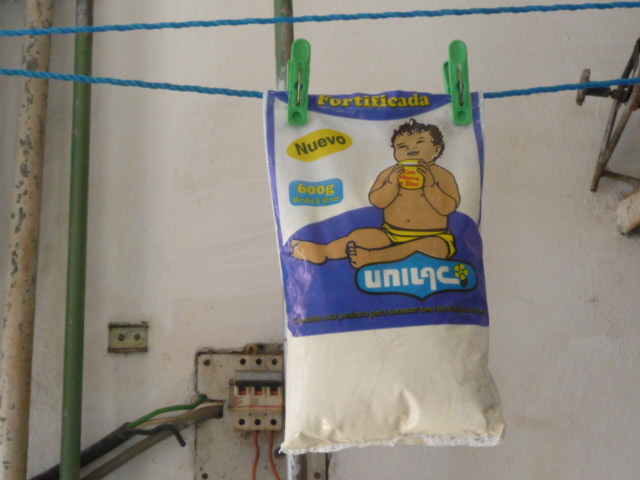
Sitting in my office yesterday whittling a Tweet down to 140 characters instead of working, I once again heard her hearty knock at my door. Smiling big, she told me she had three sacks of milk for sale at $2 a pop (a 50 cent savings over the official store price). I agreed to take one, glad I was finally getting the chance to help out granny. Until she pulled the sachet from her frayed knapsack: I, we both, were taking milk from the mouths of Cuban babes. What my elderly friend was selling was the milk the government guarantees to every child under 7 and I’d just purchased 600 grams of it. I knew that milk wasn’t going to be too tasty. 

—–

This transaction got me to thinking about where all this stolen stuff comes from and put me in mind of my friend Alberto. He has an old Lada on which his livelihood depends. Driving around recently, I noticed a balón de gas (the 20-lb tanks used here for home cooking) wedged behind his seat. Seems Alberto had converted his gas-powered car into a propane-propelled one.

This was a smart investment on his part: although the conversion kit cost $350 and had to be imported from abroad, Alberto fills that tank – which takes him 120 km or so – on the black market for just $5. By way of comparison, that same $5 would buy 15 liters of real gas on the black market; just over four at the pump. I’m glad Alberto has figured a way to enlarge his margins, but wonder about the families who show up to fill their kitchen tanks to be told “no hay” (there isn’t any).

This same pattern repeats itself with steaks and blocks of Gouda, stamps for official paperwork (I was surprised to be asked to produce receipts for my bank-bought stamps on my last visit to immigration) and cooking oil. And while I can appreciate the need for every last Cuban having to do something (or something extra-legal) to make ends meet, the more I parse the situation, the more unsettling it becomes.

And it makes me realize that a certain amount of that aforementioned moral ground is shifting below my feet. At these times I’m forced to ask myself: is this is a part of Cuban culture I wish to participate in? Unluckily for my milk-thieving granny, it is not. But I’m sure she’ll find other clients: as long as there are commodities like oil, meat, and milk to “redirect,” and resell for pure profit, folks will do it.

 As I said: old habits die hard.

 Notes

1. These political powwows are held every so often (the last was in 1997) or mejor dicho: whenever sufficient excrement threatens to make contact with the cooling element, if you know what I mean.

2. All of these issues came to the fore in nationwide public referendum-type debates held in late 2010. The permiso de salida is an exit permit which is mandatory for overseas travel by Cubans and residents. It earns the country revenue, but is also a barrier to travel – an issue that has to be reconciled somehow and soon.

 3. Except the goods in the black market Mac store. None of this is stolen, but rather all new, in-the-box gear with warranty and all, purchased in Miami and spirited into the country.

 4. Eggs aren’t usually stolen either, but rather the product of home-raised hens.

25 Comments

Filed under Americans in cuba, Cuban customs, Cuban economy, Cuban idiosyncracies, Cuban phrases, Cuban Revolution, Expat life, Fidel Castro, Living Abroad, Raul Castro, Travel to Cuba

The Cuban Food Question

[tweetmeme source=”connergo” only_single=false]Not questionable Cuban food, mind you, but questions about Cuban food which continue to dog me, even after 10 years here, like: why are there no croutons? Or guacamole? And why don’t Cubans cook with coconut (Baracoa excepted)? Or bacon? I mean, it’s not as if there aren’t enough cocos and pigs to go around. To be fair, bacon is making inroads (see note 1) and I’ve seen a couple of coconut dishes here in Havana, but a tasty use for stale bread and old avocados?! You’d think the frugal out of necessity and habit Cubans, people who always use a tea bag twice and for whom disposable diaper is an oxymoron would be all over these past expiration date preparations. But no.

As devoted readers of this blog well know, I’m preoccupied with food, maybe disproportionately so, but that’s what happens when your formative years are spent in a food insecure home (see note 2). Whether that’s the reason my mom and siblings are such avid, fantastic cooks, I can’t say, but it rubbed off on me. This devotion to inventive, well prepared food coupled with the hundreds of restaurants, bistros, cafés, buffets, and drive-ins (Hawaiian kine) I’ve had to review for guidebooks makes me an expert of sorts (the bad, overly critical kind perhaps, but hey, someone has to steer you clear of shitty food in your travels).

Not surprisingly, I’m both excited and wary about the explosion of new restaurants in Havana. Excited because the quality and diversity of menus are improving – even in state restaurants which seem to be upping their game in the face of stiffer competition. Wary because I know how horrifyingly crappy Cuban food can be and the tricks used to try and cover the fact. At the same time, I’m concerned for my fellow travelers since everyone is writing about these new eateries, including amateurs and hacks who are dangerously unqualified – either due to a lack of regard for good food in general or ignorance of Cuban cooking and context specifically. These poseurs shall remain nameless, (that would be tacky), but their “work” on the topic has motivated me to help out with some observations about eating in my fair city.

All the examples below are from new paladares which are currently or soon will be listed in my app Havana Good Time.

An Indian restaurant sans raita – So Cuba has its first “Indian” restaurant (note quotation marks people – punctuation has a function!). The space is quite lovely and the staff is attentive, but the food? Like the guy I lost my virginity to, being the first is not enough to win me over. I know, I know, I should be thankful that we even have an “Indian” restaurant here (see note 3), but you know what? I cook better Indian food and mine is accompanied by the requisite raita. For those not familiar with Indian cuisine, this traditional sauce is used to cut the spiciness of dishes while adding a dynamic flavor layer to the palate. And before you jump down my throat about the unavailability of certain ingredients here in Cuba: raita is yogurt, cucumbers, and garlic – three items that rarely go missing here in Havana.

“Vegetarian” spring rolls – It’s really too bad that the new Vedado paladar serving this toothsome finger food doesn’t heed punctuation as religiously as we do: when I cut into one of these rolls recently, out spilled bok choy, scallions, cabbage, carrots and…ham. When I asked the waitress (nicely, my shoulders unburdened of any NYC or foodie chip) what was in these rolls, she confirmed the presence of the ever-present pork. I pointed out that this could result in some serious problems – not only with vegetarians (see note 4), but also with Jews and Muslims too, who take as much solace as herbivores to see vegetarian selections on the typically pork-laden Cuban menu. When I asked why they call them “vegetarian,” she said with a straight face: ‘because there are lots of vegetables in there.’ 

Deep fried olives are considered nouvelle cuisine – I don’t know what was more shocking: seeing something besides Gouda cubes and croquettes as hors d’oeuvres or the realization that they had actually deep fried olives to serve to a group of foreign VIPs. While far from heart healthy, I have to admit these were disconcertingly tasty, which can be said for almost anything except the deep fried cucumbers I had last week. Both of these examples, by the way, hail from Habana Vieja, part of Eusebio Leal’s wickedly clever fiefdom (which is usually head and shoulders above regular state enterprises). Alas, sophistication is not an overly common Cuban trait, as evidenced by…

Oil & vinegar, the one and only dressing – Sure, you might get a nice honey Dijon in someone’s home, but in a high end paladar? Not likely, where the same tired oil-vinegar- salt trio prevails (lucky you if that exotic spice we call black pepper is available!).  A few places are starting to provide balsamic and olive oil, considering this the height of haute, showing how far we are from raspberry vinaigrettes or tahini-lemon dressing. Granted, raspberry vinegar and sesame paste are in short supply here, but honey, Dijon, blue cheese, anchovies, capers, soy sauce and many other ingredients for inventive dressings are available sin problema.  But this lack of sophistication is even more blatant in the place with…

Busty waitresses in low-cut blouses and Daisy Dukes – I don’t care how hot you are (or think you are or your manager thinks you are): I don’t want my steak served with more flesh in my face than Copacabana sees in summertime. In a word: inappropriate! Especially at this expensive high-end restaurant featured recently in several glossy magazines (which made a glaring omission of the “uniforms;” unsurprisingly, all the articles were written by men). Havana Hooters anyone?

The $4 fruit shake – Argue with me all you want (welcome to the club!), but this is simply wrong in our context and distorts the local economy like the thousands of bright-eyed NGO workers who rush into post-disaster Haiti or Indonesia and pay triple the going price for bananas, potable water, taxis, whatever. To all the new places offering the four dollar shakes and similar: consider yourself boycotted on GPs.

Musing about all this leads me to believe the absence of croutons, guacamole, and coconut-based dishes is due to lack of knowledge, experience, creativity, motivation, or a combination thereof.

What do you think readers? Any surprising omissions in your Cuban culinary travels?

Notes

1. I predict crispy bacon (not the flaccid, fatty crap at hotel buffet troughs) will explode in popularity as US visitors continue to pour in and restaurateurs realize the egg/bacon/toast triumvirate is as American as inequity.

2. Mom was a single mother of four which made her, out of necessity and habit, a creative, but stretched cook (and very Cuba in her way which is a big factor as to why I’ve been able to survive/thrive in the peculiar conditions on this side of the Straits. Epigenetics might have something to do with it too). We all remember with a shudder living on oatmeal for two weeks solid and the fight over who got more noodles. This fracas is still dragged out to this day – but in the best, sibling rivalry type of way now that our oatmeal and noodle days are behind us.

3. In the interest of full disclosure: everyone I’ve talked to who has eaten there – visitor and Cuban alike – was very impressed with the place which means one of two things: my standards are too high or theirs are too low.

4. I have seen a strict vegetarian take a bite into an egg roll he was told was 100% veggies and the resulting fisticuffs – never underestimate the strength and rage of a pissed off vegetarian!

41 Comments

Filed under cuban cooking, Cuban economy, Cuban idiosyncracies, Travel to Cuba

Conner’s Cuba Rules Part II

[tweetmeme source=”connergo” only_single=false] About six months ago I wrote Conner’s Cuba Rules, a super popular post that raised the ire of some readers. Rereading my musings six months later, I better understand some of the dissent offered by commenters. Given that much has changed here in Havana since then and I’ve had several opportunities to travel outside of the capital thanks to my day job, I’ve compiled a new, hopefully more positive, set of rules to complement the first ones.

The Revolution will be televised: I’ve met a lot of visitors (and even some foreign residents) who have never seen Televisión Cubana. Granted, there are only five channels here, but you’re missing out on a big chunk of Cuban culture if you don’t surf those five at least occassionally. For the intersection of politics and journalism, check out the Mesa Redonda (see note 1) and the prime time news. The latter is important in and of itself for the weather report; pay special attention if Dr José Rubiera is forecasting. Meanwhile, a good baseball game can rivet entire households, the novela even more so. Only if you watch TV here will you understand what Cubans mean when they say: “it was like the Saturday night movie” (see note 2). Meanwhile, the music shown down here – videos, documentaries, concerts and jam sessions – can be as moving as the live thing. I’ve seen Chucho Valdés, Clapton and Queen, the Festival of Modern Drumming and some guy from Uzbekistan singing Talk Boom, a riveting song I’m still trying to track down – all in a single night on Televisión Cubana. Watch it; you’ll like it (or at least get a good laugh or song lead).

Pack a sense of humor: It always amazes me when I read something that disregards, overlooks, or otherwise fails to recognize the Cuban sense of humor, which ranges from the side splitting to the sublime. The writer can be someone who knows and loves Cuba long time or a visitor who has parachuted in and out on vacation. No matter the source, the frequency with which folks miss the funny stuff here is alarming. It’s true, a lot depends on speaking Spanish (or a crackerjack translator), but however you resolve the language question, if you’re comparing Cuba to China, Vietnam, or the defunct USSR, you’re missing one of the most important ingredients in the Cuban character. These folks love to share stories, jokes, and the occassional tall tale, and use their verbal prowess to enliven, laugh, and woo; it is what has enabled these people to resist so much for so long. Even without Spanish skills or a translator, if you’re not laughing a lot on a visit here, you’re doing something wrong in my personal and professional opinion (see note 3).

Use pesos cubanos: If you know even a little about Cuba, you know we operate on a dual currency system with pesos cubanos and pesos convertibles circulating side by side. Since one of my goals of Here is Havana is to bust myths, I always take the opportunity to debunk one of the most pervasive: that foreigners cannot use pesos cubanos (AKA Moneda Nacional, MN), but only pesos convertibles (AKA divisa, chavitos, CUC). This is 100% false. Anyone can use either currency. It’s what each can buy where the difference lies. Certain goods and services, for example, are only available in CUC including cooking oil and butter, hotel rooms and the internet. But fruits and veggies, surprisingly pleasant cigars, fixed route taxis, movie tickets and lots of other stuff are sold in pesos cubanos – if you know where to look. My advice? Change some CUCs into MN (1:24) to experience firsthand how much pesos cubanos can buy and how the double economy works.

So as to avoid confusion +/o more myths: you can always pay for goods and services priced in pesos cubanos with hard currency pesos convertibles but never the other way around. And some services (interprovincial buses, concert and ballet tickets) are sold in pesos cubanos to Cubans and residents, but in hard currency to visitors.

Bring your own reading material: Rarely a week goes by when someone isn’t griping to me about the lack of English-language books and magazines here. What is available is largely limited to historical and political titles and they are very expensive (and make for dull beach reading besides). The Kindle can be handy in this regard, but the bonus to bringing print publications is that you can pass them along to some avid English reader (like me!) upon departure. Drop me a line if you have some good (ie no romance novels or sci fi pulp) English-language reading material to donate to the cause.

Hightail it out of Havana: This may seem contradictory, given that I have an iApp to the city and I recommend in my guidebooks and elsewhere that visitors consider basing their entire trip in Havana. But things are changing fast here and though I’m a city girl by birth and breeding, I’m back peddling a bit on that advice. Havana, with its dirt, garbage, and graft, noise and air pollution, and materialistic ways (I did call Habaneros ‘logo whores’ after all) is distorting Cuba’s image. In short, Havana is not Cuba, which can be said of every major city around the world from New York to Manila, Managua to Dakar. But since visitors often request recommendations for “authentic” experiences and how to discover the “real” Cuba, I now find it prudent to advise getting out of Havana and exploring farther afield. With more flights, both charter and commercial, to provincial capitals like Holguín, Camagüey, and Santiago de Cuba, this is also a more practical proposition than ever.

Above all, have fun and keep your head about you!

Notes

1. The Mesa Redonda (Round Table) is a nightly “debate” show which discusses a topic (US aggression overseas; Latin American intregration) on which all four guests and the modeator agree.There are many jokes in these parts about the program; the shortest and sweetest calls it the Mesa Cuadrada, meaning ‘Square Table’ in literal Spanish, but meaning something more along the lines of ‘Dogmatic Table’ in Cuban.

2. The Saturday night movie here is prefaced by a parental warning, the most common of which alerts viewers that the Hollywood action shlock about to be shown contains Nudity, Violence, & Foul Language. To wit: the old, slow, over-crowded camello buses (of which I took many), were always called ‘the Saturday night movie.’ [NB: did it annoy you to have to scroll down to read this note? Yeah, me too, but I haven’t been able to figure out how to hyperlink notes within posts; if someone has a solution, please get in touch].

3. Trying to connect to and use the internet excepted. Even casual visitors know that connectivity is no laughing matter here. Indeed, I flirted with the ledge and sharp knives today as I frittered away several hours trying to connect. Once I “succeeded,” it topped out at 9.6kbps – not nearly fast enough to load even a simple web page before timing out.

30 Comments

Filed under Americans in cuba, cigars, Communications, Cuban customs, Cuban economy, Cuban idiosyncracies, Cuban Revolution, Expat life, Living Abroad, lonely planet guidebooks, Travel to Cuba

Cuba Contradictory

[tweetmeme source=”connergo” only_single=false]While other bloggers are making their end-of-year lists, I’m just waiting for this year to end. Loss and sorrow is what 2011 has meant for me and while a turn of the calendar page won’t cure what ails me, you, or the world, it can provide a dose of hope – false and fleeting as it may be – to help us keep on stepping. Like a car with an empty gas tank, the warning light red and taunting, we know we’re running on fumes, but moving forward nonetheless; ‘bound to cover just a little more ground,’ as the song goes.

Havana circa December 2011 feels similar: we may be running on fumes, but at least we’re still running.

But that’s today. Other days, Havana hops with energy and enthusiasm and drive, where the theme song is instead ‘How do you like it? How do you like it? More, more, more’ – more millennial and hip, more sophisticated and noteworthy. This fuel injection comes from new economic regulations permitting private businesses, the buying and selling of cars and homes, and relaxed travel rules by Obama for Cubans in the USA wanting to visit family on the island (see note 1).

So how Havana feels largely depends on the day you measure her. And your outlook, what you see and experience, and who you talk to. Just like anywhere else, I suppose (if you’re paying close enough attention), except this place is like nowhere else. The contradictions are starker, more frequent, funnier.

Here are some that have caught my attention recently:

The Limousine/Ox-Drawn Cart

When Cubans of a certain means and bent get married, the bride and groom tour around town in a convertible festooned with satin bows, the novia perched atop the back seat waving to passersby while the driver lays on the horn (some honk out the wedding march, others the Godfather theme). But a few days ago, I crossed paths with the newest fad of the nouveau riche: the black tinted stretch limo (there’s only one) rented from Rex Autos covered in the same satin bows. There was no horn honking, however, and no visible bride – defeating entirely the purpose of showing off to plebes and passersby. I guess the thrill of a limo ride is reward enough for some and it did turn heads, including mine.

A short time later, I waited as two oxen were maneuvered with coos and stick by their expert handler. They carted behind them the water tank (known as the pipa in these parts), that makes the rounds of neighborhoods without municipal water. The pipa is the savior of all those homes and families which only have water un día sí, un día no (or even more infrequently).

Stretch limos and oxen carts; conspicuous consumption and water shortages: Es Cuba, my friends.

Penthouse Too Big/House Too Small

Estrella lives in a propiedad horizontal – a floor-through apartment. And it’s a penthouse no less. These huge, luxurious flats are found throughout Vedado high-rises and are more reminiscent of Manhattan than Havana. They usually feature phenomenal city and sea views but are also a pain in the ass – hard to clean and maintain, they’re also a real liability during hurricanes when their height, exposure, and plate glass windows put them in direct path and danger of the elements. For these reasons, Estrella is looking to permutar her penthouse for something closer to the ground, a more manageable home in short.

Contrast this with my friend Gloria – 68 and a spitfire who has dedicated her life’s work to helping the revolution work, she shares a bedroom with her 6-year old grandson and 10-year old granddaughter. If you know Cuba and the housing crisis we’re in, you know multi-generational sleeping arrangements are common. Except in Gloria’s case, she not only shares the room with her grandkids, but a double bed with the boy to boot. Sadly, this is also not terribly uncommon.

Both Estrella and Gloria are equally revolutionary and politically committed; this too, is Cuba, dear readers.

Chocolate-filled Churros/Pallid Pizza

As the new economic regulations gel, Cubans are figuring ways to live with the Gordian Knot that is capitalism. Folks with money to invest and a head for business are differentiating their products and services – and making money hand over fist as a result. The full-service car wash that everyone is talking about is one example of entrepreneurial pluck and vision, as is the nearby scuba school. Since I have no car and don’t dive, these are simply a curiosity for me. Not so the cafeteria selling chocolate-filled churros; jamaliche that I am, this development piqued my interest. Using a machine imported from Ecuador, these folks crank out a fried, filled sweet treat that drives Cubans gaga – and all for the nice price of 3 pesos (less than 15 cents). Also taking the city by storm is the burger and pizza joint with one of those inflatable playhouses kids love so much in the yard. While the kids jump and play, their parents nosh and drink, dropping a bundle in the process. According to my sources, this cafeteria is netting 1500 pesos a day (around $62 – not bad for a startup here).

Meanwhile, block upon block of new cafeterias sell the same forgettable hot dogs and egg sandwiches, bread spread with cloying mayo or croquettes. Some of these places serve terrible food – tasteless or cold, on day old bread or presented to customers just after the flies have been swatted away. Last week, I stopped by a new cafeteria in my neighborhood selling the smallest, palest, saddest pizza I’ve ever seen. With cheese congealing (despite being placed beneath an office lamp), the pathetic pizza sold at Rapidos around town look delectable in comparison. No wonder the government estimates 80% of these new businesses will fail within a year.

The contradictions abound caballeros. Every human and society has them. But we’ve recently had many complexities introduced into our reality here on the island which are deepening these contradictions. It’s a confusing time – anxiety-ridden once you scratch the surface – but it seems these complexities have also sparked a new line of critical thinking and reflection.

Over several visits with different friends and families over the past week, discussions have turned on the theory and opinion that what we’re experiencing today can largely be chalked up to the Special Period – that time in the 90s when the Cuban economy crashed and burned, threatening to take the Revolution with it. So that wouldn’t come to pass, people tightened their belts, took a hold of their bootstraps, and sallied forth. But at a cost. These conversations didn’t focus on what the new economy is or isn’t doing for our present, but rather the hard times of the past and how they eroded values, placed the pursuit of things over relationships, and planted the seeds of individual survival over the collective.

“We used to live here so naturally.”

“People changed overnight.”

“It was 180° turn, fast and dizzying.”

These are some of the comments made to me recently about those trying years, but in relation to our current situation. Interesting food for thought and worth recalling, 20 years hence, as we contemplate the changes in Cuba circa 2011.

Notes

1. You should see what folks are bringing in from abroad to start their families’ businesses here – everything from car parts and coolers to snorkel masks and jungle gyms. Permissions for Cuban families from the USA to travel here is being threatened by political (but powerful, ojo) dinosaurs in Congress. Although it seems Obama isn’t going to let this happen, I encourage all Here is Havana readers to keep the pressure on to lift both the travel ban and the blockade.

21 Comments

Filed under Americans in cuba, cuban cooking, Cuban customs, Cuban economy, Cuban idiosyncracies, Cuban phrases, Relationships, Travel to Cuba

Let Me Count the Ways…

[tweetmeme source=”connergo” only_single=false]
Ay Cuba.

What have you done to my heart, torn in so many directions but always aching for 23° 7′ 55″ North, 82° 21′ 51″ West? And my soul? Of, by, and for New York from birth, but now reconfigured into an alma cubana that whispers mysteries in Spanish I’m still unable to cipher.

I’m not sure when this happened – feeling betwixt there and between here – though I know it’s common to long-term expats. Hell, I’ve even parsed some of this awkward, never complete transition over the years, crafting a sort of road map to the cultural, linguistic, and romantic bumps in my road.

Despite my musings and analysis, I entered some unknown territory on my most recent trip off-island: in a nutshell, I did not want to leave. Maybe I’ve been hanging out too much with Moises and Rina, two friends who had to travel to the United States recently, but neither of whom had the ganas to do so. It wasn’t due to fear – both have traveled several times for work – nor was it because they’d traveled so extensively that trips abroad had become old hat and rote (see note 1). They just didn’t want to leave the island and these days, nor do I. It feels wrong and a bit scary, like kissing a cousin or sibling.

It makes me sad because I know the lengths so many Cubans take just for a chance to see what lies beyond all that water crashing against the Malecón. And it’s confusing, because on every previous trip, I too felt the need to ‘saca el plug’ (pull the plug) and ‘desconectar’ from the drama-rama that is Cuba. Trips out used to be exciting, emotional, and necessary.

But not this time. I didn’t want to cut whatever cord hooks fast into those of us crazy for Cuba, making us spend money we don’t have, go against our better judgment, and jeopardize job, health, and relationships to get back to the island. In an effort to untangle that cord (or loosen the noose, depending on your POV), I offer all these reasons why I love Cuba (see note 2).

The $1 lunch – Whether it’s a cajita across from the CUJAE or a knife and fork sit down at El Ranchón (one of my all-time favorites), Cuba has some kick ass $1 lunch with all the fixings. Even at the airport: on my recent trip off-island, I filled up at the cafeteria outside Terminal 2 (clearly one of the greatest benefits of the new economic regulations) with a plate overflowing with pork, congris, yucca, salad, and chips. It was so tasty a fellow diner said: ‘my congratulations to the cook – he must be from Pinar del Río!’ (see note 3).

Touching, hugging, and general closeness – Latinos have a different concept of personal space and Cubans, as is their wont, take it to an extreme. Men embrace and greet each other with kisses on the cheek, female friends walk hand in hand, and my best salsa partners have been girlfriends. All of this is to say that Cubans aren’t afraid to touch – your leg when telling a story, your back as they try to pass you in the hall, your shoulder as they ask: ‘how is your family?’ Cubans fill elevators to its maximum capacity and I always delight in watching a mixed Cuban-foreigner crowd boarding them for the mutual awkwardness that ensues. Up in the States, the awkwardness is mine every time I step into a nearly full elevator, encroaching somehow, though there is always room for one more. That weird, reactionary, and let’s be frank, harmful rule that teachers can’t hug students in the USA? My Cuban friends can’t even grasp the concept when I try to explain it.

The hello/goodbye kiss – Related to touching is the traditional Cuban greeting – one kiss on the right cheek no matter if you know each other or not. Even taking leave of big groups results in blowing a kiss to the crowd. I think we should start this trend up north. Our world couldn’t be any worse off with more kisses, could it? On my visit to the States recently, I leaned in towards my host and said: ‘you were wonderful tonight,’ touching his knee as I spoke. Did he misread my Cuban-ness? Interpret it as something more?, I wondered later as he slid his hand down my back to cup my ass. This doesn’t happen in Cuba unless the signal is an unequivocal green (ie the ass grab is mutual).

Fun in the sun – I was born and bred in northern climes, but I’m a winter wimp through and through. Sure I loved tobogganing and ice skating and snowball fights as a kid – still do in fact – but the bulky clothing, the cold that turns wet once the fun is done, and the squeak of day old snow that sounds like someone is packing Styrofoam in your ear isn’t my bag. I like loose clothing, walking in the sun, and smelling gardenias or fresh cut grass in December. Summer clothing is sexier I think we can all agree, and as white as I am, when my freckles fuse into a pseudo tan, I work those scanty, loose-fitting clothes to full effect.

Drink, smoke, & be merry – The 8am Bucanero; the post-feast cigarette; the incessant regguetón: Cubans milk the ‘party hearty, the rest of you be damned’ approach to its fullest. Believe me, I know. And should it slip my mind, my neighbors are quick to bust out their state-of-the-art karaoke machine and warble drunken, sappy ballads until the wee hours.

And the smoking, dios mío. I remember going for my first pap smear at my local doctor’s office here in Havana…hoisting my feet into the stirrups, I watched aghast as the doctor took one last drag of her filter-less cigarette and with a deft flick of her gloved hand sent it flying out the window before diving between my legs (see note 4). If you’re a non-drinker, non-smoker, or not into music appreciation, you’ll probably find Havana offensive. But for those who like an after dinner cigar, enjoy (or need) some hair of the dog once in a while, or are usually the first on the dance floor at parties and functions, I bet Cuba will float your boat.

It’s safer than where you live – Okay, that’s a broad stroke, I know: after all, I don’t know where you live, much less the crime rates. But I can tell you that the absence of crack cocaine, crystal meth, heroin, and guns means a generally safer city. I’m not saying drugs, prostitution, violence, and rackets don’t exist in Havana. They do. But as a longtime traveler and writer of guidebooks to some of Latin America’s most violent cities (Caracas, Guatemala City, San Pedro Sula, Tegucigalpa) and an eyewitness to NYC’s crack attack in the 80s, I can tell you that Havana is a gated community comparatively. Kids play unsupervised in the street here and I walk home alone at night frequently. (Truth be told, I took a short hiatus of walking home alone after a tall guy grabbed me from behind and thrust both hands between my legs one night in Vedado, but I conquered whatever uncertainty the event planted within me). Most of the crime here is of the opportunistic/snatch and grab variety and tends to peak between October and December when people are trying to rally resources for Christmas and New Years’ celebrations.

These are some of the reasons why I love Havana and if you’ve been thinking about coming here, let me leave you with one piece of advice: don’t put it off any longer. The only certain thing in life is that life is uncertain.

Notes
1. Yes, there are Cubans who get tired of traveling they do it so much: politicians, organizers, academics, musicians, and artists, typically.

2. For those interested in earlier thoughts on this subject, see my earlier post Things I Love about Cuba.

3. Country cooking like they do in Pinar del Río is unrivaled – trust me on this one and seek out a campesino lunch next time you’re in that wonderful province.

4. For new readers to Here is Havana, let me reiterate that all the stories found throughout these pages are entirely true, though some names have been changed to protect the guilty.

20 Comments

Filed under Americans in cuba, cigars, cuban cooking, Cuban customs, Cuban economy, Cuban idiosyncracies, Cuban phrases, dream destinations, Expat life, Living Abroad, lonely planet guidebooks, Relationships, Travel to Cuba, Uncategorized

Lost in Translation II: Gringa Says What?!

[tweetmeme source=”connergo” only_single=false]
Liza may think life is a Cabaret, but for the rest of us, it’s rather a paradox. Take me for instance: I can turn a quick, clever phrase in English without trouble and indeed, have cobbled together a career of it. But ironically (sometimes I think cruelly), I’ve little facility with foreign languages. Nearly 10 years living full time here and I still struggle. Cuban Spanish? Let’s just say it’s as particular and odd as the island itself. To be honest, sometimes my cup of foreign language frustration runneth over…

For all its myriad benefits, living in a foreign culture is also a burden. I figure most expats would agree, whether they’ve thrown down roots in Beirut or Rabat, Paris or Istanbul. And while 20 or 30 years living in a foreign land may put you in tune, teach you a thing or three, and imprint that culture on your heart, you’ll never be of that culture. This isn’t culture shock – blatant and determinate – but rather a more subtle, low frequency current that pulses beneath every waking moment, reminding us that we are somehow “other.” Facing an unknown word or discordant concept? That’s when this outsider feeling hits particularly square and fast.

But live long enough in a foreign country and eventually this cultural disconnect will get flipped on its head. In my case, every once in a while I have to try and explain to Cubans certain US tendencies, words or quirks that just don’t compute. The pillow talk and technical sex terms alone could fill several pages, for example.

It’s frustrating, receiving that blank stare when I’m explaining something important or impassioned about my life ‘up there.’ Along with the frustration, a string of nostalgia gets plucked and motes of homesickness settle on my psyche. To swipe that dusty corner clean and set those notes of nostalgia free, I offer this list of terms and concepts which just don’t translate into Cuban.

“I don’t drink” – Before I moved to Cuba, I was a liquid dinner kind of gal, forsesaking food for whatever would get me off – martinis, whisky, and wine mostly. I come from a long line of accomplished drinkers, so I could handle it. And I tended to handle it in one of two ways: I was the life of the party when the good head was on, a scattershot bitch when that head turned bad – an unsustainable and pitiable state of affairs. Thankfully, an ultimatum by my ex-lover/partner/husband (see note 1) made me lay down the liquor for good. This doesn’t compute in Cuba. Here’s a typical exchange at parties:

“Conner, do you want a trago? A mojito or Cuba libre?”

“No, thanks. I don’t drink.”

“OK. How about a beer?”

“No, I don’t drink.”

“A glass of wine, then.”

“I’m married” Fidelity and marriage step to the beat of a completely different here. Men maintaining secret families or boy toys (see Gaydar, below); women faking adoration for material gain or immigration papers; and everyone sneaking off with weekend loves – frankly, I’m not down with any of it. So I know I shouldn’t be surprised when Cuban men hit on me and the ‘I’m married’ parry doesn’t have the desired, deterring effect. ‘And?’ is the standard response, followed by the perennial popular: ‘Don’t worry. He won’t find out.’

“Gaydar” – It has taken too long, but after nearly a decade, I’ve finally started to tap into the gay community which was such an important part of my other life. Why it took so long and the LGBT differences between here and there are best saved for another post, but after thinking long and hard about it, I’m still stumped by the absence of Cuban gaydar.

For those unfamiliar with the concept, gaydar is a play on radar and means what you might guess: it’s a beeping signal or blip that goes off when you sense someone is gay. For those with the finest tuned gaydar, it doesn’t matter if the person is out or not – the alarm will sound regardless. As you may imagine, there’s a lot of ‘passing’ in macho Cuba (pretending to be heterosexual, keeping a wife and kids for example, while grooving with guys on the side), and my gaydar goes off pretty often. So I started asking my gay friends here if there was a comparable expression in Cuban for queer folks flying low, below the radar so to speak. My query received the telltale blank expressions. Only after going round and round, trying to explain the concept, did my friends offer a loose equivalent: ‘aquello tiene plumas’ (that one has feathers), like a pajarito (little bird), a slang term for a gay man.

“Blue-eyed soul” – Cubans, it goes without saying, are phenomenal musicians – no matter if it’s rock, salsa, son or chamber music in question. But the island has been blockaded by the USA for over 50 years, which means it has been cut off from certain musical paradigms I just can’t live without. Soul, R&B, and funk especially, enter only episodically into the Cuban musical vernacular. Sure, they know Aretha and Ray Charles, Stevie Wonder and a handful of other luminaries. But when I mention Bill Withers, the Bar Kays, George Clinton or Curtis Mayfield, I’m getting the 1,000-mile stare again. The likes of Hall & Oates and other blue-eyed soulsters? Fugget about it (see note 2). The same holds true for straight up blues – a genre you’d think Cubans would easily adopt and adapt, given all their trouble and woe.

“Self-Storage” – Having so much stuff – valuable stuff, not the termite-eaten and rusty shit that every Cuban has stashed somewhere in their house – that you require off-site storage: this is a foreign concept for Cubans (and most other folks from the Global South, I imagine). But mark my words: within a decade or two, Havana will have its U-Store-It or Guardando Tareco or similar.

“Marketing” – In case you haven’t heard, we’re undergoing an ‘economic opening,’ a ‘relaxation,’ a ‘new way forward.’ Whatever you call it, what it amounts to is the revolution’s most aggressive experiment with capitalism to date. More than 180 activities and services previously the sole domain of the state and attendant black market are now open for private business. Havana is a hive of entrepreneurial activity – private gyms overflow with hard body wannabes, ice sellers do a brisk business, and street food (some toothsome, some inedible) is sold from Centro to Santo Suárez. There’s even a Cuban Kinko’s now.

But not all entrepreneurs are created alike, which becomes glaringly obvious with the banal marketing behind all these new businesses. Rainbow umbrellas are the universal signs for cafeterias and all the same horror DVDs, with all the same faded covers, displayed on cookie cutter racks are sold in every neighborhood. Meanwhile second-hand clothes hang limply from iron gates, advertising themselves. Indeed, sophisticated marketing here is a string of blinking Christmas lights and a garish LCD ticker advertising batidos and comida criolla.

This, however, will change. Already websites and social media are being exploited by the savviest restaurateurs and a new English-language weekly for tourists called The Havana Reporter will soon be chock-a-block full of local ads if my predictions are correct. This is just the beginning and I can’t wait for the day when my favorite eateries advertise their no Styrofoam policy or proclaim they’re a regguetón- or TV-free zone (two plagues in Cuban bars and restaurants). Better yet, I look forward to gorgeous guys joining the hot mulattas who now dominate ad campaigns and efforts. I only hope it happens before I’m too old and grey to enjoy ogling the talent!

Notes
1. Live in: another hard-to-translate concept. Not legally spouses, but more than lovers, we eventually settled on partners, a term I never liked. It sounds weird in any language and implies business dealings or sexual orientation.

2. I should point out that many Cubans have a sap-sap-sappy streak and get all dewy-eyed for love songs and ballads and other music that I generally associate with elevators and the dentist chair (to wit: last week I got into a collective taxi blasting Air Supply). So while the lighter side of soul and R&B may be known by some, the funky side ain’t.

52 Comments

Filed under Americans in cuba, Communications, Cuban economy, Cuban idiosyncracies, Cuban phrases, Expat life, Living Abroad

Cuban Blockade: Cruel & Unusual

[tweetmeme source=”connergo” only_single=false]
It’s time again for the international community to remind the United States how absurd and futile their blockade of Cuba is. The vote to condemn the blockade is a UN affair (equally as absurd and futile perhaps, since the Cuba policy is largely a US domestic issue and UN votes are notoriously toothless) – the 20th of its kind. Last year, 185 countries condemned the blockade, with 2 nations dissenting: the USA and Israel (surprise! surprise!).

For those needing a bit of a primer, the US embargo was first enacted in 1962 – before many of us were even born. The purpose of the policy, then as now, is to isolate the country to such a degree as to foment regime change (seems they’re a bit obsessed up north with the ‘C’ word – in this case Castro). After about 30 years of the means failing spectacularly to attain the desired end, the policy was strengthened through the Helms-Burton and Torricelli Acts so brutally that today, it violates the most basic human right of 11 million Cubans – the right to self determination.

This chaps my ass. What also irks me is when analysts, academics, and others somehow hitching their wagon to Cuba’s star call the policy an ‘embargo’ when it is, in fact, an economic, commercial and financial blockade. Semantics you say? Not for those of us here suffering under it. And not for those who understand the difference between the two. It’s one thing to prevent your own government, people, and businesses from dealing with Cuba, it’s something entirely, extraterritorially else to penalize other countries for doing same.

Consider this explanation by Peter Schwab in his book Cuba: Confronting the US Embargo:The embargo blockade disallows Cuba from using US dollars in international trade, costing the country additional money for exchanging currencies. US regulations also disallow the export of US products from a third country, while products even developed through the use of US technology or design [emphasis mine] cannot be sold to Cuba.

Not only vicious, the policy is ridiculous in its application: there was the incident at the Mexico City Sheraton, when staff refused rooms to Cuban guests in 2007 in town for a conference; an Oslo hotel owned by Hilton repeated the gaffe with a Cuban trade delegation that same year. In October 2010, Twitter blocked messages originating from Cuban cell phones, citing the blockade as justification. Twitter quickly capitulated, but isn’t the convergence between the “free” market, politics and censorship interesting to consider? Taken together, all the elements petty and severe of the blockade have meant over $100 billion in losses for the island over the years.

What really boggles the mind, however, is the bang-your-head-against-the-wall determination with which the policy has been pursued, despite its failure to reach its stated goal. It puts me in mind of Einstein’s definition of insanity: doing the same thing over and over again and expecting different results.

Yes, folks, this is an insane policy. What policytroublemakers in South Florida, Jersey, and D.C. doggedly ignore and don’t want you to know is how this policy lowers quality of life, separates families, and kills people on both sides of the Straits. Before I rant about the specific ways in which this policy makes life harder here as well as there, allow me to extend my deepest condolences to all the families, Cuban and otherwise, who have suffered under the blockade. I’d also like to voice my deepest respect and admiration to all those working towards a change in policy and the 11 million Cubans – 70% of whom have only known life under the blockade – affected daily as a result.

So you might better understand how this translates on the ground, I offer these snapshots of how the blockade has affected me and my loved ones.

I can’t hear you! Can you hear me?! – Phone calls originating from the USA get routed through China, Argentina and who knows where and cost upwards of $1/minute (except to the US naval base at Guantanamo, adding insult to injury). Getting a call to actually connect may take half a dozen attempts and forget wishing someone well on Christmas, New Year’s or Mother’s Day, when over 1 million Cubans living off island are all trying to do the same.

When the call actually does come through, it sounds like my sister is underwater and my mom is in a cave so deep, her voice is echoing off the walls. My PBS producer, meanwhile, may as well be talking into a Dixie cup on a string the delay between what she says and I hear is that long. To give you an idea how severely this affects communication, consider that in almost 10 years living here, only two friends have called me a total of three times – and I have some very devoted, (albeit poor), friends. For all these reasons, you can understand why I maintain my PO Box here, though even letters from the USA sometimes don’t leave domestic soil due to blockade politics. Thankfully, FaceBook and other social media aren’t blocked by either country.

Can I connect? No, you cannot – Recently PayPal threatened legal action and said my account would be blocked for trying to access the site from an ‘embargoed country.’ This is more serious than it may seem: like many freelance writers, I receive earnings from some clients via PayPal, and this prevented me from collecting payment for services rendered. Only I after I enlisted my own counsel and provided voluminous paperwork proving that I’m a journalist with US Treasury permission to be here (another absurdity: the US prevents it’s residents and citizens from traveling freely to the country of their choice, in this case Cuba), did they reinstate my account. I still can’t access it though and so only have use of my funds when I’m off-island. Other sites blocked for the same reason are iTunes and Tiger Direct. LinkedIn is also LockedOut thanks to US embargo.

Cash on the barrelhead – If you’ve been to Cuba, you know US credit and debit cards don’t work here. When I first moved to Havana in 2002, I thought my HSBC card would work. Silly me. Despite being a London-based bank, HSBC has offices in the USA (like most banks worldwide), and therefore cannot do business with Cuba under the terms of the blockade. I love how globalization works for those holding the reins. For the rest of us? Salsipuede.

Think of all the things you do with plastic funds. How would you live without debit and credit cards 24/7/365? How would you pay for webhosting or buy a plane ticket or god forbid, get money in an emergency? Anyone from the USA who travels or is based in Cuba has to do everything in cash – no exceptions (see note 1).

You’re sick and will stay that way – Of the more than 300 major drugs on the market since 1970, nearly 50% are of US origin and effectively blocked from export to Cuba (see note 2). The stories of people on both sides of the Straits who are denied life-prolonging or -saving medication due to the collusion between US big pharma and politics are heartbreaking. There’s the US drug Prostaglandin E1 – used in children born with congenital heart defects – is denied to Cuba. In fact, 90% of the products used to correct these malformations are manufactured by US multinationals or their subsidiaries and therefore are not available here due to the blockade. Anesthesia, diagnostic equipment and parts, and the latest in antiretrovirals to treat HIV are likewise unavailable. Cruel? You tell me.

But sadly, the policy affects US folks too. A dear friend of mine recently died of lung cancer. Had the breakthrough Cuban therapy Cimavax-EGF been available to her, she could have lived up to 5 years longer (if recent clinical trials in Europe are any indication); even if she didn’t respond optimally to the treatment and lived another half decade, the therapy certainly could have improved her quality of life at the end. The same holds true for meningococcal B outbreaks in college campuses across the country. Were the Cuban vaccine for the disease VA-MENGOC-BC available, these outbreaks could be averted. These Cuban therapies and vaccines, along with Heberprot-P, used to treat diabetic foot (a major cause of morbidity in diabetics) and blue scorpion venom used in cancer patients, are unique in the world. Thanks to the blockade, if you’re in the USA, you can’t have them.

The blockade causes pain, suffering, and grief. But it also strengthens our resistance, creativity and resilience. To Obama on down I say: stick with your failed blockade policy. Over here, we have 52 years proving unequivocally that Yes We Can!Notes
1. The Canadian company Caribbean Transfers issues debit cards for use in Cuba and American Express Traveler’s Checks work in some banks here, but for the overwhelming majority of us, we’re forced to live entirely in a cash-based economy. This means carrying drug dealer type wads of cash on any Cuba trip.
2. See The Cuban Cure by S.M. Reid-Henry, pp 39.

61 Comments

Filed under Communications, Cuban economy, Cuban Revolution, Living Abroad, Uncategorized

Cuba: Going to the Dogs?

[tweetmeme source=”connergo” only_single=false]
In my forthcoming article for NY Magazine, I write a bit about Havana’s newly-moneyed. Whether it comes from remittances, self-employed work, or working over tourists is irrelevant. What piques my interest (and hopefully retains yours, dear readers), is how wealth – relative as it may be – manifests itself here, how it changes behavior and tweaks norms heretofore adhered to.

Faithful followers of Here is Havana will remember my thinly-veiled diatribe against Cuban marca mania – if I’m not mistaken, I actually called my compatriots ‘logo whores.’ I repeat: not all Cubans, everywhere, but there does seem to be an inordinate amount of importance placed on logos and bling here. I understand why Cubans are attracted to shiny, pretty things, but at the same time I’m biased: one of my abiding principles holds that nothing you can buy builds character (except maybe psychotherapy). The whole status symbol compulsion and keeping up the Joneses – is it inherently bad? I don’t know, but I do know I’m hard pressed to find anything good about it.

These days status symbols are displayed with as much pride as cadres display their photo with Fidel (see note 1). Gold teeth and braces, anything Mac (even if it’s just the iconic white apple sticker), cell phones (working or not), and pure-bred dogs. It stands to reason that Cubans are drawn to perros de raza since they’re a walking (shitting and barking) status symbol.

Now, those of you of my personal acquaintance know I’m not a pet person. A tortoise, perhaps, or a crafty cat that can paw open the door and hunt down a bird when it’s hungry, I’m down with. But a dog? They’re dependent, they shed, they smell, fleas like them, and often they age poorly – farting as they lumber about on rickety bones and bump into furniture with their cataracts. Plus, they hamper travel. Sorry to Sam, Sadie, Paka, Bob, and all the other great dogs I’ve known, but when it comes to canines, I subscribe to my Dad’s axiom: ‘living with animals went out with Jesus.’

But let’s put this dog question into context: I’m sure the average Cuban doesn’t give much thought to any of this. A dog here – whether in the city or campo – means added security. Dogs keep vermin of all types at bay and sound the alarm. In Havana, I’m sure you’ve noticed, folks are very concerned about the safety of their stuff and enclose entire houses – balconies, doors, windows, all – in rejas (iron bars and gates). Even taillights on motorcycles have their rejitas; check it out next time you’re in town.

So a dog is an added source of protection. I get it. But it’s also another mouth to feed and represents all manner of unanticipated expenses like when they get parasites (and they all do) or when the heat wreaks havoc on their fur (hairless perritas chinas excepted of course). They also need to be walked, adding another task to already overworked Cuban women, who, if my observations are accurate, do most of the dog care. In practical terms therefore, I’m not convinced that the benefits outweigh the costs of keeping a dog here. But what I simply can’t get my mind around is Havana’s new status symbol: Siberian Huskies.

They are all the rage: from the grimy streets of inner Habana Vieja to the bourgeoisie boulevard of 5ta Avenida, you’ll see people trying to walk, train, and tame these über Alpha dogs. And what about the heat? Have you been here in August? Just being in your own skin is a sauna – imagine if you had a pelt adapted for permafrost. It disturbs me inordinately, so I’ve started asking around…

According to my dog trainer friend Yamel, these dogs make challenging pets under the best circumstances. They’re a bitch to train because they’re bred for dominance and it’s difficult to establish supremacy. Even Yamel – who works his magic with rowdy shepherds, disobedient Dalmatians and other maladjusted dogs – says he’d never have one for this reason.

My neighbor is case in point with her trio of Huskies. They pull their leashes taut, dragging her behind, paying her no never mind. Recently, I’ve seen her working with a trainer (another expense) in the park nearby. I’m sure she watches Cesar Milan – prime time TV fodder here – religiously. Then there’s the heat. Yamel tells me they adjust, but I’m dubious: I know of at least one retriever who died of heat exhaustion here.

I was completely taken aback on a recent visit to my dear friend Carmita to see she had acquired a Husky pup. This is an unlikely pet for an unfortunate household. She’s an 84-year old pensioner living with her college-age grandson. They get a little economic help from Miami and other points north and are church-going, so have some support, once in a while, from the congregation. But Iker – named for the Real Madrid goalkeeper – is no black market Husky; he’s the real deal. Offspring of Massimo Zar de la India and Bella Bon (I’m not making this up!), Iker was purchased at one of the periodical dog shows here (see note 2) for the exorbitant price of $200. Despite my prejudices, I put a good spin on it to Carmita.

“That’s great! Now you have company while Maykel’s in class.”

She makes that smacking, sucking sound which in Cuban means ‘bullshit.’

“He’s a pain in the ass and makes a mess of everything.”

Gotta love Carmita.

We don’t mention how much his food and care must cost. Why bother?

To be fair, the vet school here has services available in both pesos cubanos (24 to the dollar) and CUCs (one to the dollar), so are technically accessible cost-wise. The CUC section of the school is sparkling, there’s no line to wait in, and medicines are available. Meanwhile, the peso cubano section swelters with people and pets waiting their turn and the pharmacy may or may not have what your dog needs that day.

But the differences don’t end there: In the waiting room of the CUC services, snappy, pretty posters extol the benefits of pure breeds; above all, the posters underscore the beauty of these dogs. Shuffle over to the peso cubano waiting room and the script is different. Here, the posters are yellow and curling and don’t celebrate poodles, spaniels, and Afghans, but instead list the virtues of mutts, pointing up their strength, resilience, and force of character.

Pure breed or mutt? Pesos convertibles or pesos cubanos? Welcome to today’s Havana: suelta sin vacunar (on the loose, without her shots).

Notes

1. Every visit with The Comandante is documented by a state photographer. A few days after the meeting, a 6×8 matte photograph of you and Fidel arrives at your door.

2. While not Westminster, dog shows are serious business here, with breeders showing their stuff and buyers perusing their pups like johns trolling for ‘company.’ When purchased, Iker’s name was Kritop D’Spiritu Libre.

34 Comments

Filed under Americans in cuba, Cuban customs, Cuban economy, Cuban idiosyncracies, Cuban phrases, Cuban Revolution

Cuba’s ‘New Normal’

[tweetmeme source=”connergo” only_single=false]

Things are pretty tense around here. And it doesn’t help that Hurricane Irene is heading towards Port-au-Prince as I write this. When it’s threatening this close, we swing into action (see note 1). 2011 is a particularly harrowing hurricane season because we’ve escaped major damage for 2 years running (toca madera/knock on wood). Like an unfaithful spouse who spends too many Saturdays ‘at the office’ or ‘runs errands’ at odd hours, you just know the luck is going to run out one of these days. But I digress.

Followers of Here is Havana know that I’ve been covering the changes in Cuba (however sporadically and anecdotally; see note 2). And now – as marriages fail; savvy metrosexuals return from exile to launch private businesses; and the bourgeoisie distract themselves with whiskey and Facebook – seems like a good time for an update.

This installment focuses on ground level detail and how Cuba’s newest capitalist forays are affecting us, the hoi polloi. I’m talking about viejitas selling knick knacks and caps from their crumbling porticos and gentrification of neighborhoods which for generations have been mixed. Meanwhile, rainbow umbrellas signposting private cafeterias sprout like mushrooms in cow shit and ever-more-evident class divisions, combined with a certain impatience and market madness, weigh heavy on my mind.

Hanging on for dear life: I don’t have a car, which is an anomaly for most foreigners here and has drawbacks, clearly, but is also advantageous since it obligates me to navigate the public transportation system. In practice, this means I have no problem getting a bus from the Capitolio to Marianao or the Cine Chaplin to La Copa (see note 3).

Since I make much more than the average Cuban (but much less than the average resident foreigner – a hard concept for most Cubans), I also take the 40 cent fixed route/collective taxis that ply Havana’s streets. However, a significant change in the law regulating these taxis is putting our lives at risk: whereas it used to be only the owner of the almendrones (those pre-1959 hulks tourists go gaga over) could drive it for fares, now they can subcontract driving duties.

This small change on paper has meant big changes on Havana’s streets. Drivers are now young, restless, and reckless; it’s plain some of them have never even driven before (and are unlicensed, if one of my insider sources is to be believed). Others are so blatantly young even Cuban law would prosecute me were I to bed one down.

The result? Tank-like Dodges, Buicks, and Fords caroming along major arteries like Línea and 23, Calzada del Cerro and Calle 51 at high speeds, only to peel out of traffic with a hard turn of the wheel and screech up to the curb to snatch another 10 peso fare. I’m not the only one who lets these wild child choferes continue on their way, opting to wait for an older, more seasoned driver who cares at least for his car, if not his clients.

Ration cuts: Slowly but surely, the monthly rations (really fortnightly rations since they only last that long, and only then for the thriftiest and most creative cooks) are being cut. Not everyone needs them, let’s be frank, but for the millions that do, this is a problem. In Cuba, libreta rations aren’t free, but almost; since they’re so highly subsidized, payment is a token gesture. But hard times call for hard cuts and some rations – beans, most notably – have been reduced, while others (soap, toothpaste, laundry detergent, cigarettes), have been eliminated entirely. This can be crippling for old folks especially, but also working class families and other vulnerable groups.

But that’s not the only effect of this new policy. Take the cut in the salt ration for instance. Once upon a time, each household received a kilo of salt every three months. That ration has now been halved and may be discontinued altogether, meaning when you run short, salt has to be purchased at ‘parallel markets’ in pesos cubanos or hard currency “dollar stores,” (I suppose people peddle the white crystals on the black market, but I’ve little energy for that particular hassle and hustle). Either way, salt is now a pricey commodity.

The subsidy slash, combined with the cost of salt outside the libreta, make it virtually impossible for those unfortunate enough not to have access to hard currency to augment their salt stores. No salt means blander food, of course, but it also means we no longer knock on our neighbors’ door asking for a bit of salt – not at the new prices. Borrowing sugar, lending salt: these are diehard habits in Cuba and are among the daily threads which give the mantle of solidarity heft on the island. Let’s see how it holds up moving forward.

Cafeterias ad nauseam: One of the most immediate and visible effects of the new regulations has been the veritable explosion of private cafeterias and snack shacks across Havana (see note 4). No matter that each of them has an identical menu of fruit shakes, egg sandwiches and cajitas (to be fair, the ones that are good tend to be great – at least at the outset anyway). And no matter that some of them are churning out such poor quality fare I’ve actually seen people dumping food into the closest trash bin.

That said, some families are really making a go of it. However, just as the taxi sub-contracting policy and striking salt from the ration card are having unintended side effects, I suspect this cafeteria mania is too: I fear it’s making people sick. Sure, there’s always an uptick of stomach viruses in the summer, but this season, I know a lot more people with explosive diarrhea, fever, and projectile vomiting – usually all at once. While I have zero proof, poor food preparation and storage, plus sketchy hygiene, can mean food-borne illnesses. And since the government doesn’t have the inspectors necessary to inspect and monitor all these new cafeterias…Indeed, e coli warnings have begun appearing – a first for me in 9+ years of living here.

Marketing learning curve: The operative word here is steep – very, very steep. Forget that every cafeteria is making the same sandwich and that the same pirate DVDs are sold everywhere, from Vedado thoroughfares to dark entryways in Centro Habana. Lack of product differentiation is only one of the problems with the emerging capitalist experiment. The real question is: how do you distinguish your pan con jamón from the next gal’s or make your Jackie Chan ‘combo’ stand out from the rest?

This isn’t a query occurring to most entrepreneurs here, if the twinkly Christmas lights and hand-lettered signs around town are any indication. But some folks – whether they’re returned exiles, have advice coming in from Miami, or are just putting Cuban ingenuity to a new test – are on it. At major intersections and big grocery stores for example, hot, young Cubans pass out flyers advertising the newest paladares, some of which I’ve had the pleasure to try thanks to this publicity (the best are included in the newest version of Havana Good Time, out next week).

But one mode of advertising which has recently appeared in my neighborhood and is insoportable wherever it’s found are mobile megaphone announcements. Loud, obnoxious, and largely unintelligible (I still haven’t been able to divine a single good or service advertised by these noise polluters), these ads are delivered by enthusiastic barkers via bicycle, motorcycle or car-mounted megaphones. This is annoying enough, but I fear these ads may be the death knell for the sing-song call of the pregoneros – hawkers who pound the pavement advertising their wares in a melodic, iconic incantation. These were effective – it’s how I got my new mattress, after all.

Stay tuned for more on-the-ground impressions of evolving Cuba.

Notes
1. For the curious: I’ve passed so many hurricanes in Havana I’ve lost count and Cuban preparedness and response is efficient, effective, and a wonder to behold. Lives are very rarely lost – even in the most heinous, category 5 cyclones – which underscores the absurd tragedy that is adverse weather events in the USA à la Katrina or the recent Missouri River floods.

2. Dedicated fans will be happy to learn Here is Havana The Book is finally receiving some overdue attention; I hope to have it out by this time next year. Stay tuned!

3. Bus travel in Havana is generally a bitch, but for visitors who speak Spanish, I suggest taking at least one to eavesdrop: there is probably no more effective way to take the pulse of the population than to listen to a busload of Habaneros quibble and kvetch.

4. As of April 2011, 20% of the nearly 222,000 permits issued to private businesses have been for food service. The government estimates 80% of these start ups will fail in the first year.

31 Comments

Filed under Americans in cuba, Cuban customs, Cuban economy, Cuban idiosyncracies, Cuban Revolution, Expat life, Living Abroad