Category Archives: Cuban customs

Just When You Think You Know Cubans

Loud, machista, brand-loco, bossy, gold medal (but loose and slippery) lovers: one – or several – of these stereotypes applies to most of the Cubans I know. Judging by the search terms used to land here (‘why are Cubans so rude’; ‘Cuban men are controlling/known for being cheaters’; ‘STD from resort staff in Cuba’), many readers can relate.

It’s true Cubans tend to be noisy, romp with aplomb, and sow their oats with gusto and few regrets. They are also big talkers – waxing eloquent on topics about which they’re clueless or avoiding silence at all costs; I know a lot of women here, for instance, who never, and I mean ever, shut their mouths, talking about whatever minor thought skips across their brains (I always send a silent shot of strength to the spouse when I meet a woman like this). Then there’s the Cuban classic, which I call ‘blah, blah, blah’: giving a long, considered response – to an entirely different question than the one asked. Actions belying words also falls into this “classic” category.

These are all generalizations of course – but that doesn’t obviate their veracity. Indeed, stereotypes exist because they apply to huge swaths of a population. And if you know Cubans, you know that these generalizations are true for many or even most. Which is why I’ve become fascinated with stereotype-defying folks here. People who break the mold anywhere have always intrigued me, but Cuba has traditionally emphasized unity over individuality, is small and (relatively) isolated, meaning there are fewer mold-breakers.

These are what I call, for lack of a better term, ‘not-very-Cuban’ Cubans. Each one was born and raised here, lives on the island still, went to all the same schools, political rallies and lame concerts (Air Supply, ahem) as the rest, but exhibit few typically Cuban traits. Sure, they’re missing teeth, can be unreliable, and are prone to slack; in the end, they’re a product of their context and yet…not.

I’ve met a couple of their kind over the years, but recently I’ve come to know several fairly well – they intrigue and puzzle me in equal measure. For instance, not one of them has been off-island and each works for the state (as well as ‘por la izquierda’ because that’s how survival rolls here). Age might be a factor – the folks I write about are between 25 and 40 – but I’ll have to think more on that since I don’t have the analytical energy just now. By chance (or not), each person described below is also male, but again, my analytical reserves fail me.

What I’m coming to realize as I write this is that place – la siempre fidelíssima Isla de Cuba – has much to do with their character (each is proud to be Cuban), but little to do with their mold breaking: these people would be, and will be, who they are, no matter where they are.

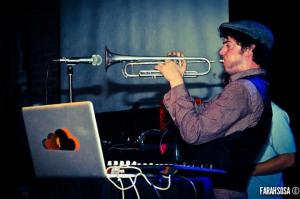
The Musician: I’m not sure I’ve met a Cuban as callado as this guy in the nearly dozen years I’ve lived here. He’s so quiet he makes me nervous. Have I insulted him? Is he bored? Does he simply have nothing to say? This last I discount not only because he has that ‘still waters run deep’ thing going on, but also because when he’s on stage playing his cutting-edge compositions, he speaks volumes.

When I asked a mutual friend: ‘what gives with Daniel? I’ve known my share of strong, silent types, but he kind of takes it to the extreme, doesn’t he?’ She laughed. ‘Yeah, I’ve known him my whole life and I’d swear he was born in Europe instead of La Ceiba.’ Quiet, measured, urbane, and bling-free: he actually reminds me of some New Yorkers I know, this ‘not very Cuban’ Cuban.

The Born Again: One of Cuba’s new frontiers is being mapped out by pews and altars, chapels and collection plates (big, deep ones). As an agnostic skeptical of all organized religion and someone who has seen both the good and bad wrought by evangelical churches throughout Latin America, I have to say all the conversion going on around here has me concerned. The phenomenon is replicating itself from Sandino to Baracoa, with record numbers of converts packing pews most nights and some days too, as they attend bible study, Sunday school and other church-y activities (see note 1). The people I know in Havana who have been sucked in belong to these churches are usually either not too bright or dealing with some social issue – alcoholism or delinquency, for instance.

But not my ‘not very Cuban’ Cuban friend, who breaks even this mold: he’s smart, has a good job, a wife, his own transport, a nice place to live and two happy, well-adjusted children. Furthermore, he was always more of a rebel than a joiner, rejecting the mob mentality. Flash forward to any recent Sunday, however and he’s wholly subsumed by one of these churches – to the tune of several times a week for 8 hours at a clip. And the proselytizing has begun, with non-responders feeling the freeze-out.

The Gamer: Hyper observant and curious, this ‘not very Cuban’ Cuban takes people to task for littering and ‘envidia’ (see note 2), has lovely manners, smells naturally great in the heart of summer (see note 3), and pardons himself when he (infrequently) interrupts. He’s also vehemently anti-gossip and comfortable being alone – criteria enough to make him a peculiar Cuban. Surely this aversion to the maddening crowd is the gamer in him – he admits to shutting himself in for 8 hours or more when he’s mastering a new game – but I thought everyone here was hard-wired for social gad flying. To an extent, anyway. This guy, however, would hole up on a mountaintop with just the bare necessities given the chance, which sounds extreme even to me, a solitary mountain girl at heart.

In another inversion of a Cuban stereotype, he’s not afraid to ask questions, learn about what he doesn’t know, and pursue new experiences – including hard work. He’s got a hunger for knowledge and the confidence to seek it out I don’t see that often in Cuba’s 20-somethings. It’s refreshing and hopeful, especially because it comes from the next generation, too much of which has lost hope here.

Notes

1. Let me emphasize that I’m referring to anti-scientific, charismatic churches (what’s sometimes referred to as neo-charismatic or neo-Pentecostal), not the traditional kind where you go on Sunday to pray and catch up with the congregation. The kind that freak me out are the ones where the pastor fairly preys on his flock, encouraging adoration of him and distance from non-believing friends and family.

2. This is a very negative, very Cuban concept which literally translates as ‘envy’ but runs much deeper, to the roots of want, need, greed, and paranoia.

3. I’m currently preparing a post on Cubans and their cologne/perfume habits; gas mask anyone?

63 Comments

Filed under Americans in cuba, Cuban customs, Cuban idiosyncracies, Expat life, Travel to Cuba

Cuba: What You Know but Don’t Realize

Over the years, I’ve dedicated (probably too) many hours analyzing, writing, editing, and commenting about the differences between here and there. The ‘there’ of which I speak is the US – from where I hail – but could easily be anywhere North, whither Big Macs and reality television conspire to make people fat and stupid.

Did I just say that? You betcha. I’m sorry if that applies to you, but my internal editor has been on sabbatical ever since a guy richer than Croesus got all up in my grill dissing Cuba like he actually knew what he was talking about.

Which is part of what sparked this post.

There’s a type of visitor here – usually imperious, moneyed men skidding down the hill of middle age towards moldering (and the aforementioned rich fulano fits the bill) – who has Cuba all figured after four days here. Sometimes even before getting here. Cuba is more complex than you could have imagined, you’re more close-minded than you care to admit, and your facile analysis belies the intelligence I’m sure you evidence in your back home life. For those in this category, I’ve crafted this post to clue you in. Just a little.

First, we’re facing a wave of economic, paradigmatic change here without precedent. It roils with an energy confusing, contradictory and encouraging (in its way), towards our shores. Indeed, already it’s breaking on our eroding sands. Like a tow surfer (see note 1) whose very survival depends on accurately calculating wave height, speed, and interval, while accounting for hidden (i.e. underwater) and surface (i.e. other surfers and their support crews) factors, we’re gauging the wave, trying to maintain balance, remain upright, and most importantly, keep from being sucked under.

But as any tow surfer will tell you: surviving a 75-foot wave and riding it are two entirely different experiences – as different as summiting Everest with throngs of weekend warriors as attaining the peak without oxygen. One simply takes money and some machismo and motivation; the other requires experience, training, skill, meticulous preparation, and a measure of karma and respect born of intimacy with the context.

So as this monster, freak wave feathers and breaks over Havana, I want to ride it, not simply survive it. And to do that, I – we – have to measure and analyze the conditions, bring our skills and knowledge to bear, channel positive energy, and ensure our fear is healthily spiked with faith. The first step in successfully positioning ourselves to ride this wave, it seems to me, is to understand the culture, in all its contradictory complexities, which brought us to…right…now…

While many emphasize the differences between here and there, between the land of Big Macs and the tierra de pan con croqueta, I take this opportunity to explain how we are the same:

Opinions vary: One of the questions I field most often is: do people like Fidel/Raúl/socialism/the revolution? This is as absurd as asking do people like Obama/capitalism/federalism? Setting aside the fact that the question itself is unsophisticated and dopey (governance and mandate are not about like or dislike but rather about measurable progress and peace within a society, plus, any –ism is just theory; it’s how it works in practice that counts), I posit that it all depends on whom you ask. Up there, a brother from the Bronx is unlikely to share views with a Tea Party mother of two. Similarly, an 18-year old from Fanguito won’t agree with a doctor from Tercer Frente.

It’s obvious, but visitors tend to forget that here, like there, you must consider the source when posing such questions. Less obvious is that here, it also depends on how you ask the question. But that’s a more advanced topic beyond the purview of this post.

People like stuff: On the whole, Cubans are voracious shoppers – always have been, always will be. Whether it’s shoes, books, handbags, wooden/porcelain/glass/papier mâché tschotskes, fake flowers, clothes, or packaged food, Cubans will buy it. Or at the very least browse and touch and dream of buying it. Some folks – like the ones who inspired this post – deny capitalist, consumerist culture ever existed in Cuba before now, revealing their lack of knowledge. I’m embarrassed for them; on the upside, it means many up there are clueless to fact that if you dropped a jaba bursting with a new pair of Nikes and Ray Bans, iPod (or better yet, Pad), some Levis, a pound of La Llave, gross of Trojans, and a couple bottles of Just For Men on every Cuban doorstep, with a note instructing them to come over to the imperialist dark side, a lot, the majority even, would do it. Being Cuban, a lot would pledge to ditch and switch just for the swag, of course, but that too, is an advanced topic beyond the purview of this post.

Until that day, folks here are gobbling up stuff as fast as the shelves can be stocked. In short, todo por un dolar is rivaling hasta la victoria siempre as most popular slogan around here.

It’s all about the kids: Here, as there, parents want a better life for their kids. While what constitutes “better” (again, here as there) depends on whom you ask, this desire to leave a more comfortable/equitable/safe/luxurious life and legacy to one’s kids is human nature. It drives people to rickety rafts, May Day parades, and long, hard overseas postings. It makes parents compromise their own mental health, spend beyond their means and completely subsume their own lives to their children’s. Case in point: have you ever seen what a Cuban goes through – psychically, financially – to celebrate a daughter’s quince? Hundreds, thousands of dollars and days, months, years of preparation are spent for the all-important photos, party, clothes, and gifts for their darling little girls. Families living six to a room in Centro Habana spending $5000 for their 15-year old’s celebration remind me of US folks who scrimp, struggle, and sacrifice to pay for their kid’s wedding/down payment/tuition. Children first – at all cost and any price, here as there.

We are the best in the world: Drop in anytime, anywhere in Cuba or the US and whomever you encounter will profess their country is the best. Greatness or weakness such bravado and pride? A little of both, I figure. That such hubris has contributed to where we are today, riding the wave, I have no doubt.

Notes
1. I’ve just finished reading The Wave, a spectacularly, adventurously researched and highly readable book on giant waves and the guys – tow surfers – who live to ride them. Check it out.

31 Comments

Filed under Americans in cuba, Cuban customs, Cuban economy, Cuban idiosyncracies, Cuban phrases, Cuban Revolution, dream destinations, Expat life, Fidel Castro, Living Abroad, Raul Castro, Travel to Cuba

Pushing Your Luck in Cuba

The querida phenomenon; why locals love iron bars and pure-bred dogs; and the story behind those ridiculous ‘dos: Here is Havana is your go-to resource for the inside scoop on all sorts of Cuban cultural minutiae.

This place is so intriguing and complex, I’m constantly heeding Mom’s advice to ‘learn something new every day.’ If you’ve been here, you know this perpetual learning curve of which I speak, surely. Or maybe you live somewhere/somehow that, like Cuba, allows – indeed forces – you to learn something new every day. If so, I salute you.

What’s holding my fascination and providing ‘ah ha!’ moments lately is the long-standing, deeply-rooted Cuban tradition known as La Bolita.

From Ciego’s piña-studded campo to the listing wooden houses of Regla, Cubans are playing the numbers. Like an underground Powerball, La Bolita is technically illegal but in practice allowed to function (not unlike other things here including the world’s oldest profession; two houses sharing one phone line; and foreigners buying property). Not only does it function, La Bolita flourishes as a twice-daily gambling habit nursed across the country.

I was quite surprised to discover how many people I know play La Bolita – work colleagues, neighborhood doctors, Harley dudes, government guys, grannies, ballet dancers. So diverse are the Cubans playing the numbers, I think it may be one of the most genuinely and naturally integrated and equitable systems in contemporary Cuba. La Bolita leaps across class, race, gender, and geographical lines and though I haven’t made a point of asking, I’m sure my LGBT friends are also placing their daily bets (see note 1). In short: La Bolita doesn’t discriminate.

First a little background: Most HIH readers know that until los barbudos rolled into Havana in 1959, Cuba was a viper’s nest of dissolution – rotten with drugs, prostitutes, gin joints, and gambling (no wonder Hemingway called it home!). In those days, fun seekers and ne’er-do-wells from the US used to hop down to use the island like college kids do Cancún and the ghetto: a place to score, get sloppy and slum, before returning to safe, cushy lives back home.

The Revolution put an end to all that (mostly, technically, anyway) and gambling was especially targeted and vilified. Big, lucrative casinos in nightclubs like the Tropicana and Sans Souci and hotels including the Riviera and Capri were shut down, along with smaller enterprises in the back alleys of Barrio Chino and out in Boyeros. La Bolita, however, was a national pastime, a traditional pursuit and while publically and officially banned, has survived all these years. The daily numbers, for those wondering, are drawn in Miami and Caracas, if my sources are correct (see note 2).

From why folks emigrate to how Cubans (mis)behave at all-inclusive resorts, I find all aspects of culture intriguing here. But La Bolita captures my fascination beyond what may be rational. To wit: I recently placed my first bet. I thought this was just a question of picking a series of numbers from the 100 in play and laying down my money á la the NY Lotto. Silly me. This is some really complicated shit and I needed a tutorial from my friend Aldo to place my bet correctly.

>Here’s what I learned:

Numbers range from 1 to 100. Nothing complicated there. But each number corresponds to a symbol – think Mexican lotería.
loteria mexicana
The symbols are key and transcend simple number-figure association, however. For instance, Cubans often play numbers appearing in dreams: if you’re chased by a Doberman while dreaming, you should play 95 (big dog), if it’s a Dachshund, 15 (little dog) is more appropriate. Beware dreams of 63 leading to 8, because that will land you in 78 and finally 14 (murder, death, casket, cemetery). Scary. When this happens, do you play these numbers, just in case?

Folks also bet numbers they see in their daydreams – I’m sure you know someone who hopes to get a 100 or some 38 (car, money) or a Cubana who has already made their dreams come true through a 62 (marriage) to a foreigner.

The numbers and their corresponding symbols have also passed into common vernacular. Fidel is called the caballo (1) for obvious reasons and for those who doubt my claim that Cuban Spanish can stump even fluent, native speakers, what would you do if your taxi driver said you owe a fish and a nun? Would you hand over $5? $20? $50? You’d be ripping either yourself or him off if you did (see note 3).

My life (like everyone’s if we choose to pay attention) is riddled with symbols and I had no problem knowing what numbers I would play. In fact, I determined not to let this year go by without playing La Bolita as soon as I learned 43 (my age) stands for scorpion (my sign). What could be more propitious?

But how to play? I knew I’d have Aldo place the bet because I didn’t want to show my foreigner face at any of the neighborhood ‘bancos’ – Cuban for Bolita bookie – lest I make them  nervous; it is illegal after all. So I’d play 43 and if I needed to pick a bonus number, I figured I’d go with 52 in honor of my beloved Frances.

Were it that easy.

As it turns out, there are all kinds of variations you can play, including the ‘parlé’ (a type of trifecta); a fixed number with additional jackpot numbers; and other combinations which still confuse me. There’s also a specific way to note your numbers on a piece of paper that needs to be folded a special way when you place your bet. The minimum bet is 1 peso cubano (about 4 cents)  but most people wager more; payoffs can be huge – Aldo recently hit for 700 pesos and another friend’s uncle once won 5,000. Of course, he’d bet much more over the course of his lifetime, but that’s the gambler’s carrot and curse, no?

En fin: like many things Cuban, I’m sure La Bolita is played differently in different latitudes (see note 4) – including in South Florida where it thrives. What I relate here is simply how it went down in my corner of Cuba. I ended up playing scorpion-San Lazaro-machete (43-17-94) in keeping with various symbolic occurrences lately. Alas, my 37 (brujería) proved powerless: I lost my 25 pesos.

Oh well, there’s always tomorrow for learning something new (and placing another bet).

Notes

1. Let me take this opportunity to wave the rainbow flag: every May, Cuba celebrates the ‘jornada de anti-homofobia’ known as IDAHOBIT globally – and it’s one helluva good time. This year’s festivities kick off May 7 and run through May 18 in Havana and this year’s host province, Ciego de Ávila.

2. Over several years of writing this blog, it has become clear that Here is Havana readers are hip, informed, and sit upon a wealth of knowledge; if anyone has light to shed on the mecánica or history of La Bolita, please share!

3. A nun is 5 and a fish is 10; your taxi ride cost $15.

4. While researching this post in fact, a friend of mine and closet bet-placer, told me about La Charada (traditionally la charada china). This predates La Bolita, which takes its first 36 numbers (horse/caballo through pipe/cachimba) from the older chinese tradition. This numbers game dates from the 1800s when Chinese workers arrived on these shores. According to one source, in 1957, Cubans wagered between $90 and 100 million on La Charada, la Bolita and other numbers’ games.

18 Comments

Filed under Cuban customs, Cuban idiosyncracies, Cuban phrases, Cuban Revolution, Fidel Castro, Living Abroad

Havana Vice: Titimanía

[tweetmeme source=”connergo” only_single=false]

I’m what’s known in these parts as a ‘temba.’ The term generally applies to anyone, male or female, over 40. It’s not a hard and fast rule – a younger person who looks older may be called a temba – nor does it infer, like other terms such as ‘tía’ and ‘pura,’ that the person is over the hill sexually, physically or otherwise. Temba is not derogatory; it’s simply a category of Cuban, used here to describe a state of being, similar to our use of descriptive terms like negro, chino, flaca, santero or maricón (see note 1).

One thing I love about Cuba is its integrated, inter-generational nature. This facilitates friendships with Cubans aged 12 to 84 – something I cherish and which is harder to achieve in the United States. Naturally, however, many of my colleagues and consortes are other tembas. Over years of observation and recently a more in-depth investigation into Cuban sexual practices and mores for a larger piece I’m writing, a couple of tendencies keep cropping up: flexible fidelity is one, titimanía is the other.

Simply put, titimanía is the compulsion temba men have to date impractically young women. This is not limited to Cuba, of course, but by parsing how universal behaviors play out here, I hope to provide insight into the particularities and peculiarities of the Cuban character – for all our sakes (see note 2).

Before proceeding, I should disclose that I’m no stranger to the attractions of older men: at 16, my first serious boyfriend was 26, an arrangement for which he could have been prosecuted in our hometown of New York. While I think statutory rape laws are ridiculous in cases where everyone consents to getting it on, I admit there is something creepier when the ages are more advanced and the age differences greater.

Take my friend Carlos. When I met him a decade ago, he was 40 and his live-in girlfriend was 18. Jenny was gorgeous, of course, but a child – intellectually, developmentally, and practically. Just out of high school, she’d never had to pay a bill, work, or worry about a leaking faucet or roof. After four years together, the relationship ended disastrously, with Jenny hightailing it to Miami taking Carlos’ expensive gifts – jewelry, clothes, electronics – with her. Pre-ordained, perhaps, but that didn’t faze Carlos.

He quickly “recovered” (I’ve noticed men, Cuban and otherwise, tend to rebound fast – but incompletely – from ravaged relationships) and before long had Tania living with him. Prettier than Jenny, smarter, and worldlier, Tania was 22. After a few years, that relationship also ended badly, worse even than the one previous. Tania and Carlos barely speak today, which is uncommon in Cuba where circumstances and reasons too complex to elaborate here fairly obligate exes to remain on good terms. Uncommon and sad: their kids from previous relationships had become siblings and when they split it signaled an end to their blended family to the detriment of everyone involved, even if they don’t realize it.

Today, Carlos is 50 and has recently taken a 20-year old wife. I haven’t yet met her but have heard through radio bemba (our grapevine) that she’s hot and terribly boring, limiting dinner conversations to her new shoes, so-so manicure, and how the sushi she tried last week ‘totally grossed her out’ (see note 3).

Not all 20-somethings are that vapid and clearly, I better understand what’s in it for the women. Older men tend to be better than their younger counterparts in bed (if less athletic and enduring); have more status and economic possibilities; and generally have a clearer idea of what they want in life and are already well on their way to getting it (or should be).

However, once men hit that temba threshold, what they want are girls young enough to be their daughters. My 48-year old friend Elena is finding this out the hard way: after 15 years of marriage, she’s divorced and dating. Elena’s not looking for a new husband or live-in (the two are synonymous here); far from it. She just wants a healthy, available guy for a good time. You’d think this would be easy in libidinous, gregarious Cuba. Not so for Elena. ‘No niños for me,’ she tells me. ‘I don’t want to teach them the art of the orgasm or have to finance our affair. I’ve got my own kids, I don’t need another.’

Elena is looking for someone age appropriate and therein lies the rub: every man her friends try and fix her up with is interested in women her daughter’s age. They are, in short, suffering from acute titimanía. She has actually been told to her face: ‘you’re too old.’ And although they always put it in the nicest way possible, it’s getting her down. Once you rule out the married, infantile (of which there are many), gay, and titimaniacal tembas, Elena’s roster of eligible men is as short as Fidel’s speeches were long. And she’s discouraged, pobrecita.

The titimanía phenomenon came up the other day while I was talking to our mutual friend Alejandro. Clever and fit, with a comely face that belies his 50 years, Alejandro is one of the guys posited – and rejected – as a possible hook up for Elena; he likes them younger. Cubans are very frank about such things, which is efficient at least: while men here might date fat, unemployed, gold-digging, or gap-toothed women, age is not negotiable and they don’t waste time saying flat out ‘you’re too old’ (in the nicest way possible).

Alejandro could tell I was irked by his titimanía and its inequitability. “What chance is there for Elena and her ilk, when you guys are chasing skirts just out of high school?”

Mira, mi amiga,” he said smiling, his eyes crinkling around the corners they way they do with happy people, “from the age of 15, girls try to look older and do all kinds of things to enhance their beauty and heighten their self-worth – fake nails, fake boobs, dyed hair, high heels, the works. Old guys like me don’t do any of that. Instead, we pump up our egos by dating young women.”

“So tembas like you have the mentality of a teenage girl?” I wanted to say, but didn’t.

Laying my indignation aside, I could see his point. It’s about the self-esteem boost for everyone involved. But where does this leave Elena? Alejandro couldn’t provide an answer beyond: “I don’t know, but she’s too temba for my taste.”

Notes

1. This last term, meaning ‘fag’ or ‘queer’ is used in Cuba to denote male homosexuals. And while it’s inherently homophobic – which is why I don’t use it – many highly-educated and cultured people use maricón to classify gay men (or derisively with their straight friends). I employ it here by way of illustration only.

2. Equally as interesting are behaviors which don’t manifest here. For example, the reverse – a young Cuban buck getting jiggy with a cougar or MILF hasn’t caught on here like in the United States (the 13-year old who couldn’t peel his eyes from my temba friend Lucia’s cleavage, declaring her ‘hot and chesty,’ notwithstanding). But I’ll leave this for another post.                                                                                                                                                             

3. While I predict this marriage will be short-lived, I have friends who have been in one of these May-December relationships for ten years. They’re healthy and happy and while it remains to be seen what that relationship will look like when she’s 35 and he’s 63, so far so good. More power to them.

41 Comments

Filed under Americans in cuba, Cuban customs, Cuban idiosyncracies, Cuban phrases, cuban words without translation, Expat life, Fidel Castro, Living Abroad, Relationships

Cuba: The Eternal Education

Some of you may remember my catharsis about know-it-all Cubans, a semi-measured rant dissecting the Cuban ardor for being right – even when they’re talking out their ass.

Not surprisingly, there’s a similar breed of foreigner, an expert on Cuba after two weeks, two years or tenure (see note 1). Maybe you’ve overheard them at the next table at one or another of Havana’s overhyped paladares prattling on about how to unify the currencies or make Cubans more efficient (the most vulnerable rarely have a seat at this table, literally and figuratively). Perhaps you read a blog written by an absentee/wannabe Cubanologist or transient traveler who proclaims to be an authority on political bell weathers or sexual proclivities here.

No matter the source: those claiming to have Cuba pegged are usually off base or worse – not even in the ballpark. Whereas it used to be difficult to understand things on the ground from afar, today it is near impossible since economic reforms are changing the landscape here fast. For us living it, we’re learning something new every day, the details and mechanisms of which cannot be fully known from wherever you are reading this.

Although the economic changes are injecting a level of uncertainty and accelerating individualism (here in Havana at least) that trouble me, I still give daily thanks – or try to – that I live in a time and place that continually teaches me new things. After all, learning something new every day is one of the key ingredients in the ajiaco of life – another reason why I love Cuba. Judging by the experience of certain friends, I’m confident the eternal education Cuba provides is a constant regardless of outside forces or how long you’ve been here.

Take my friends Ann and Alicia. North Americans both, they’ve lived here full-time for a collective 55 years and are still learning. Recently they separately admitted to having just learned that the red ribbon hanging from the undercarriage of 6 out of 10 cars here is to ward off the evil eye. And they both own cars! Such discoveries after so much time in residence encourage me to keep observing, keep meeting and talking to new people, having new experiences, and writing about this complex place where there’s always something new to be learned. In the past several weeks alone, my Cuban education has schooled me thus:

El Torniquete: The observant among you have likely noticed women and young girls chancleteando through the streets of Centro Habana or La Vibora with empty rolls of toilet paper spooled tightly around their tresses and piled atop their heads. This is knows as the ‘tourniquet’ and is a simple, free way to produce a fancy, going out ‘do. Although I’ve long marveled at the ingenuity, I never knew this technique had a name until a friend helping to gussy me up showed me how it’s done. For those wondering, I’ve only been partially successful in my gambit to improve my “look” due to my rabid aversion to shopping and my preference for substance over style. Furthermore, with only 24 hours in a day, other pursuits (e.g. cooking; bike polo; visitas) take priority of personal primping. Clearly, I still have a lot to learn from my impeccably turned out Cubana counterparts.

4/4 Time Dies Hard: I’ve recently taken up salsa lessons which have been measurably more successful than my half-hearted attempts at honing my fashion chops and style. I have an amazing dance teacher – talented, patient, encouraging, and easy on the eyes – which is a large part of the equation. Last class he admitted: ‘I thought it was going to be much harder to teach you’ and after just a few lessons, we’re both impressed that I’m already spinning around the dance floor without spinning off beat. But a lifetime 4/4 habit is a bitch to break, I’m learning, and I still tend to misstep, especially when in the arms of a taller, drunker, or clumsier partner than my teacher.

El Baile de Perchero: Along with salsa, I’ve recently become privy to another dance form known as the Hanger Dance. Surely a Cuban invention, this is when a couple dances themselves out of their clothes and on to more carnal endeavors and pleasures. It’s a testament to Cuban propriety that the name of the dance involves hangers: my clothes usually end up on the floor.

Vestido de Iwayó: Admittedly I know very little about Afro-Cuban religions – Yoruba, Palo Monte, Abakua, et al. But I, like many readers I assume, can’t fail to notice initiates walking around in these parts wearing head-to-toe white clothing. Even accessories – headbands and hand bags, hats and umbrellas – must be white for those haciendo santo and formally entering the religious ranks. It’s one of the most obvious outward manifestations of Afro Cuban religions here, but I’ve only recently learned that it’s called dressed as/for iwayó.

Life on the Inside: Given my insatiable craving for learning about new Cuban customs and culture, I’m very grateful to a friend who admitted he spent five years in a maximum security prison here. For my/our purposes, it matters not the crime for which he did time (though it was non-violent), so I won’t go there. What is important is the crash course he gave me about life inside a Cuban jail. He graciously endured and answered hours of my questions on everything from food and escape attempts to rape and overcrowding. Suffice to say that what I learned was so fascinating, I’m writing an article about the cultural dark side here entitled Havana Black & Blue. Any interested editors reading this are heartily encouraged to contact me as I look for an outlet for this piece.

Of course, the one thing everyone here – visitor and resident alike, whether they like it or not – is always learning, is how to maintain patience and good humor in this sometimes frustrating, but never dull island….

Notes
1. The so-called ‘Cubanologists’ who sit in their ivory tower offices in developed world academies of higher learning (or their cubicles in think tanks), espousing how it is in Cuba (where they visit once a year, perhaps), especially chap my ass.

30 Comments

Filed under Americans in cuba, Cuban customs, Cuban idiosyncracies, Cuban phrases, Living Abroad, Relationships, Travel to Cuba

Birth of a Biker Bitch

Fifteen or so years ago I was living above a taquería and across the street from one of San Francisco’s largest thrift stores. Community Thrift wasn’t the hippest or most swank, but it stocked the eclectic, second-hand zaniness that city is famous for. Living right across the street was dangerous: it made it all too easy to accumulate cool, cheap shit that ends up collecting dust.

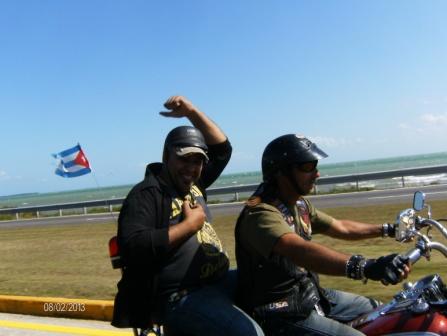
This is how I came across an $18 vintage Harley Davidson jacket. Little did I imagine all those years ago that one day I would be flying along the coast east of Havana on a 1948 Harley wearing that jacket (see note 1).

Seeds get planted, people. Cultivate them – however long it takes – and you shall see that flora flourish, I promise. The problem is, I’ve planted seeds I cannot tend alone – that are so profligate I can’t handle their abundance. When this happens, I write (to wit: this blog!). So while I had no intention of revisiting the Harley scene here at Here is Havana, my garden runs amok…

One of the 12 bikes Ive ridden on...

One of the 12 bikes Ive ridden on…

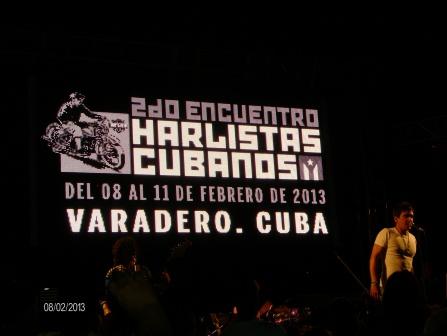
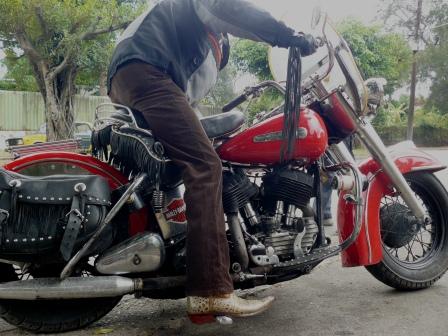
Some of you may have read my chronicle of last year’s Varadero Harley Rally/Encuentro de Harlistas Cubanos, my first taste of the HD world (save for one long mountain ride years ago, pre-vintage jacket, with a guy who couldn’t hold my attention). Long and short of that post about the Cuban rally? These pre-1960 bikes are impressive and the folks who keep them running and enjoy riding them more impressive still. When I was invited back for the second Encuentro, I was all game.

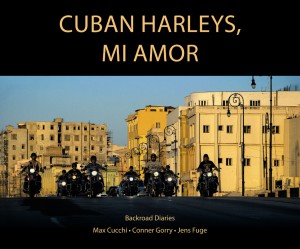
This year’s event was even better than last – for many reasons but the fundamental one for me was what occurred in the months between rallies: I’m now collaborating with Max Cucchi on his photography book about Cuban Harley riders. Since the 2012 rally, I’ve been hearing all the stories, learning the history, and interviewing the clan. I’m also riding on the bikes; 11 of them 12 of them to be precise and I anticipate trying out more (see note 2).

David Blanco, Harlista Cubano, musician, all around nice guy, rocks out the 2nd Encuentro.

David Blanco, Harlista Cubano, musician, all around nice guy, rocks out the 2nd Encuentro.

It’s true I cringed when that foreign photographer called me a bike dyke, but I have to admit it’s a hell of a lot of run riding on these thundering, troublesome machines. The thing is, riding can’t compare with driving and I know that’s where the real thrill lies (am I doomed to now accumulate a totally cool but not-at-all cheap piece of dust-collecting shit?!). Me acquiring a Harley Davidson is entirely theoretical since I can’t imagine abandoning my beloved bicycle and don’t have the money for anything motorized beyond a rikimbili (see note 3). But while interviewing Cuba’s only female Harley rider for The Book, she offered to let me take her 45 for a spin. Another seed planted, I’m afraid.

li and tony

I’m excited about The Book, in no small measure because it has opened up a whole new world to me, populated by extraordinarily fun, creative, and collaborative Cubans. Until further notice, however, I will be referring to this project as The Book. It had a proper title, which has since been relegated to a working title. Why? Because this is Cuba: things are complicated and being immersed in a rich, rare breed subculture like that of the island’s antique Harleys means being privy to all the gossip, tussles and intrigue therein. Good manners and my desire for everyone to get along prevent me from going into it here. Plus, I’m just the writer/rider so it’s best if I wait and see how it all shakes out. Until it does (in 12 months or so when we go to print), I shall be referring to this project simply as The Book (see note 4).

Cheito Puig, 103 years old and still on a Harley (he's featured in The Book).

Cheito Puig, 103 years old and still on a Harley (he’s featured in The Book).

Besides, none of that is important. What is important is that The Book has images by Max, text by me, and the passion of generations of Harlistas Cubanos.

Notes
1. There are no pictures of me en route, wearing said jacket, since my camera mysteriously disappeared the first night of the rally.

2. As I was readying this post for print a few days ago, I mounted my 12th Cuban Harley. The occasion was a beach BBQ with the gang – fun stuff. Unfortunately, the beast coughed, sputtered, and died two blocks from my house. During curbside repairs, the carburetor caught fire. ‘Socio, you got a fire going there,’ more than one passerby noted casually while eyeballing the red and chrome, leather-accented stallion. It took about an hour to get running again (watered-down gas direct from the Cupet seems to have been the culprit), but that was just the beginning of the 15-hour adventure. A key piece flew off as we flew down the highway; we had to stop at least have a dozen times to do repairs (correction: I watched as my driver and assorted others did repairs); the ‘suicide’ clutch kept getting stuck; and we ran out of gas at 1am in Centro Habana. I guess I’ve concluded the honeymoon phase with these Cuban Harleys…

Even breakdowns are fun in Havana!

Even breakdowns are fun in Havana!

3. These are bicycles outfitted with small motors, usually powered by a liter-and-a-half bottle holding kerosene.

4. Not to be confused with my abandoned memoir. Sigh.

14 Comments

Filed under Americans in cuba, Cuban customs, Cuban idiosyncracies, dream destinations, Expat life, Living Abroad, Travel to Cuba

Adventures of the Cuban Virgins: Part II

[tweetmeme source=”connergo” only_single=false]

We last left our protagonists – American musicians on the island for the first time – as they were figuratively deflowered by the temptress that is Cuba and literally robbed by her inhabitants.

With only 48 hours in country, they were already acquainted with water-borne bichos and explosive diarrhea; frolicked (and perhaps even fornicated) along the Malecón; and acquired groupies. In short, they were partying late, sleeping little, creating music, and making very merry.

The theft of the Fender bass after the Will Magid 4’s first Jazz Festival gig did little to dampen their spirits or enthusiasm for this place. On the contrary: the kind, well-equipped stranger who offered to loan us a bass for the next gigs only reinforced their admiration for Cubans and their ways.

Before you can say ‘pass the planchao, asere,’ it was Friday, hours before the gig that had everyone hot and bothered. It wasn’t a festival event, the crowd would be small by design (we had to keep it quiet in the interest of crowd control), and we weren’t sure how the band would fit in the performance space. But after another rehearsal in my living room, all we could talk about was the Guagua Loca.

Box o rum, at the nice price!

Box o rum, at the nice price!

It’s not really called the ‘Crazy Bus,’ (see note 1); that’s my name for it because it is a little loco (and muy cool) this gutted bus packed with Havana’s best DJs making music and fun on its midnight tour of the city. To date, the Guagua Loca had only made one voyage; my guys were excited to be the first foreigners invited to play this innovative mobile music party.

Clearly, a jazz quartet has no place on the Guagua Loca. But while the Will Magid 4 was here to play Jazz Fest, they aren’t really a jazz combo at all, but an amalgam of funk and groove, sampling and swing drawing on musical roots from New Orleans to Ghana. This is music to boogie and have revelations by and after just one gig, Cubans were already gaga for their delicious mix of live and electronic music. And after meeting Iliam and Alexis, (collectively known as I.A. Electronica, the brain trust behind the Bus), the feeling was mutual. Hopes were high for Friday night’s adventure.

As the sun set and excitement swelled as big as the almost-full moon, the Will Magid 4 + 4 dribbled in from their day’s explorations. I waited until all were assembled to give them the news: the Guagua Loca was off. For reasons beyond our control or comprehension, it had been cancelled by The Deciders. I was at pains to explain it – maybe it was a little too loco for this place and time? Regardless, everyone – the Will Magid 4, the other DJs, and fans – was saddened by this turn of events. So we turned to rum for succor and set our sights on Saturday night’s Jazz Festival gig.

_____

We were running late for the sound check and I was tasting the bane of all music managers: organizing musicians is like wrangling cats in heat. When my phone rang at 4 on the dot and it was Wil Campa asking “Where are you? We’ve got the bass and are waiting at the theater,” I started to fret for real. The bass was locked in, but now we were missing the bass player.

At the beginning of this trip, if I’d had to bet who would go missing, show up late, or somehow leave us hanging, my money would have been on the drummer. To my surprise, Terry turned out to be the only one at our early morning meeting after partying all night and was settled behind his kit on time, every time, earning him a new nickname: Mr Professional. Adam, meanwhile, had taken to Cuba like a drunk to an open bar (despite the theft of his bass), and he was out mixing and mingling somewhere when we had a sound check and a Cuban musician of international renown waiting on us.

Smile on his face and jaba in hand, Adam sauntered up at about 4:05 and we rushed to pack ourselves into an almendrón to the Bertol Brecht Theater. True to his word, Wil Campa and his wife Tony awaited us there with a beautiful six string Rickenbacker they were loaning Adam for the night.

Tony, Adamm & Wil Campa, post-gig

Tony, Adamm & Wil Campa, post-gig

“Please, please, please don’t let this bass out of your sight,” Tony implored.

Slipping the case on to his back, Adam said: “don’t worry, I won’t.”

After kisses and hugs all around, our saviors sped away in their late-model BMW to shoot a music video in the setting sun.
_____

The room was big and a few of our tribe were still suffering from bouts of explosive diarrhea forcing them into a step we’d dubbed ‘the clench and scurry.’ If you’ve ever been to a theater anywhere in Havana, you know how apocalyptic/toxic/disgusting the bathrooms can be. But everyone took this in (scurrying) stride, as they did all their Cuban experiences, from cockroaches in the bedroom to stolen instruments and cancelled gigs.

The Will Magid 4 set up – live electric bass and guitar, drums (with some sort of electronic component I never did grok), trumpet, MacBook, and sequencer – was presenting problems during the sound check. There weren’t enough outlets and we didn’t have the right adapters. We were short a few cables and there was a false contact somewhere between the amp and bass obligating Adam into his own dance and scurry. Little by little we worked together to get it together, but everything was running late and the 25-piece college ensemble following us fiddled with their instruments, anxious to get their sound check rolling. After a few false starts, things were finally set and I took a seat alongside Will’s parents. The first notes erupted from Will’s trumpet and I started to relax when suddenly everything went dark and silent.

Blackout.

Dios mío. Would Cuba pull any punches for these guys?

I followed Emilio, the laid back runner-of-things at the Brecht, onstage. In trembling sotto voce I asked: had the group’s rig blown the circuit?

“Some cables are down,” he explained. (Whew). “The electric company is on their way. Chill out for an hour or so with some beers and I’ll call you when we’re back online.”

Will packed up his Mac, Adam shouldered “his” bass, and we stowed the rest for safe keeping. After a couple of lagers and lively conversation with some Cuban musicians who told me there are only 8 or so fretless Fender Jazz basses in all of Havana (I will find you cabrón, whoever you are) and that both Carlos Varela and Liuba María Hevia had both suffered thefts of their guitars (the WM4 was in good company), Emilio’s call came through: llegó la luz; haul your asses back.

Once there, the sound check went quickly, I bought Emilio a Bucanero, and we cut loose until showtime. In spite of all the mishaps and low level stress (mine, not theirs), energy and hopes were high for this gig. It was indoors, so the sound would be better that at the previous show and we’d done a lot of publicity to get a good crowd. I’d set up two interviews for Will and invitations had already been extended for their return to Cuba.

_____

The Will Magid 4 went on after the talented Jorge Aragón Trio and though the crowd was thinner than we’d hoped, the potential was palpable. I prayed to whomever listens to me – that is, no one in particular – for good sound and functioning equipment. I knew the rest would be superbly attended by the four guys on stage.

WM 4 ADsmall

By the end of their first number, feet were tapping and heads bobbing as the audience got into it. The last notes of Cuban Swing were winding around and down when suddenly everything went dark and silent.

Blackout. (‘Shit!, again?!’)

“Thank you all and good night,” Ethan said into his mic, unplugging his guitar.

“¡Qué lástima!” Terry exclaimed, using his new favorite phrase.

Once again I followed Emilio onstage.

“Leave your rig and gear hooked up. We’re checking on the problem and you guys’ll continue once it’s solved.”

Will looked at the band, lit by the beam from Terry’s iPhone.

“I saw a stand up bass backstage,” Adam ventured.

“St James Infirmary. Acoustic. Let’s do it,” Will said.

And there in that dark theater, the quartet – now a trio as Ethan held the iPhone up high for light – gathered in close. Will began teasing out the first notes of what turned out to be the most soulful and novel version of that jazz-blues standard ever heard on these shores. The Cubans in the audience sat stunned and smiling. Emilio caught my eye with his big thumbs up and nothing could keep my goose bumps down. The notes from Will’s trumpet trembled and leapt through the dark in a visceral eulogy to life’s lost love. The rhythm section paced our emotion, carrying us through one of those impossible to plan and hard to forget only-in-Cuba moments.

It was musical alchemy. The band knew it. The audience felt it and we had the talent and solidarity, dreams, hard work and dedication of so many people, strangers and friends alike, to thanks. It was magic not unlike Cuba itself.

As the last stanzas enveloped us, the band was suddenly, glaringly, bathed in light.

Llegó la luz.

“Can’t we have a little more blackout?” someone in the audience asked.

They finished their impromptu number, Adam traded the stand up for the Rickenbacker, Ethan plugged in and the Will Magid 4 played out their set to a dancing crowd – small, but exultant.

2013? I’m chasing more musical alchemy. Won’t you join me?

My deepest thanks and respect to Will, Adam, Terry, Ethan, Larry, Patti, Julie, Josue, Wil Campa, Tony Massolin, I.A. Electronica, and all the organizers of Festival Jazz Plaza 2012 for helping make my dream of bringing US musicians to Cuba come true.

Notes
1. It’s real name is the ElectroBus; look for it.

1 Comment

Filed under Americans in cuba, Cuban customs, Cuban phrases, cuban words without translation, Expat life, Living Abroad, Travel to Cuba

Adventures of the Cuban Virgins: Part I

[tweetmeme source=”connergo” only_single=false]Honeyed, late-afternoon rays streak down Línea illuminating two men, each carrying a conga in one hand, a cajón in the other. An old Dodge, Ford, then Buick rumble past a tattooed youth helping a blind woman across the street and the smell of baking bread lifts even the darkest mood.

“Can I stay here forever?” the bassist asks so soon after arriving I haven’t yet learned his name.

“Slow down, caballero. You haven’t even been here a night and day. Let’s talk tomorrow.”

I am anxious about this visit: somehow, I’d convinced eight complete strangers to come to Cuba and I’m not sure how they’ll handle it (not everyone can). I know Will in passing – the raison d’être for this descent of California talent upon Havana for the jazz fest – but at this point, the rest are simply the guitar player, the drummer, the bassist, the girlfriend, and the parents. Months in the making, this visit is a dream realized for me: ever since my first trip here in 1993 when Cubans across the island begged me for Kenny G cassettes, I’d felt a moral obligation to share with them higher quality sounds from my patria. This was my chance, but I’d never been involved in a music festival beyond being in the audience – enthusiastically, deliriously, but still.

What was I thinking?!

I didn’t grow up in a musical home and don’t play an instrument. While I’d love to learn to play guitar, until now, I’ve only collected guitarists. I envy the universality, the pure luxury, of music: as a writer, I’m limited to (mostly) one language, but ripping through a riff or pounding out a rhythm needs no translation to move your audience. Despite my vicarious relation to the craft, I’m convinced music holds some key to happiness. When a friend took me to see an act he manages in San Francisco, that key met tumblers and things started to click. With a surfeit of talent and energy and plenty of solos to go around, the Will Magid Four (see note 1) created a transformative, happy conversation between musicians and audience. I knew these guys had to play Cuba.

Will Magid: doing that voodoo that he does so well.

Will Magid: doing that voodoo that he does so well.

This I how I find myself waiting for eight strangers at Terminal 3. I had worked hard to square away details for their participation in Jazz Plaza 2012 – probably doubly so since I’ve never been on the organizational end of music before and this is Havana after all, where things are often needlessly, maddeningly difficult. To boot, only two of the eight had ever set foot in Cuba prior. The potential for disaster is high. Even as they do their first sound check, I’m still not sure it will come off – there are technical and electrical problems, the guitar player is laid flat by explosive diarrhea, and organizers are quietly voicing anxiety about the upcoming show to no one in particular.

But when the eight of them pile all their gear, luggage and laughter into the mini-van from the airport Cuban clown-car-style, I know my misgivings are misplaced. Grossly so: by the end of that first night, I’m marveling at how these folks roll with the Cuban flavor. When I lay out possibilities and options, they choose cajitas over paladars; 10 peso maquinas over hard currency taxis; Serrano over Cubita in the never-ending flow of espresso, and forgo sleep for fiestas. When Adam (AKA “Bass Face;” see note 2) sits down with cardboard, scissors, and glue to fashion sleeves for his CDs he’s giving away, I wonder what strange twist of fate dosed these folks with Cuban blood. It’s not only me: highballs of Havana Club in hand, they fill my apartment with such sweet sounds, my 8-year old neighbor sits rapt throughout the rehearsal whispering to me: ‘Conner! We don’t have music like this in Cuba!’ When I ask if he likes it he replies ‘Yesssssss!’ with a swivel of his hips.

Rehearsal in my living room, Will Magid 4, Havana

Rehearsal in my living room, Will Magid 4, Havana

“I love this city,” Josue would say randomly and repeatedly over the course of his stay. He spoke for himself, me, the group and probably you, if you’re still reading this.

_____

On the day of the first gig, we’re one credential short and every member of the group has spent their pre-dawn, post-party hours sprinting to the baño with crippling diarrhea, fever, and sleep-robbing nausea. Julie projectile vomited a couple of times and Ethan isn’t going anywhere. While this would be enough to sour the experience for most, I’m hunting down another credential, we’re taking Ethan’s guitar to sound check, and those still standing pop some ‘cork you up’ pills courtesy of my neighbor. The rest we tuck in with chamomile tea and crackers, hoping they’ll rally by nightfall. I counsel them to slow down a notch, go easy on the rum, and to eschew 5am batidos from now on. ‘No one can party ‘til pre-dawn for five days straight,’ I tell them (in this, I am proven quite wrong). With nothing left to do, we set out for the sound check.

We flag a maquina, load in the gear, and arrive at the Casa de Cultura a lo cubano. After some questions and clever resolving on the part of the venue’s crew – few here know how to hook up and mix a sequencer and Macbook with live players – the sound check goes off without a hitch. In the middle, Ruben, the artistic director, sidles up beside me and says ‘these guys are amazing.’ I agree, pointing out that not only are they stellar musicians but humans as well: Adam is donating his Fender Jazz Bass once the Festival is over and the group brought an entire suitcase of medicines and hard-to-get items to leave behind.

Patti, Adam, Larry, Julie, Josue & El Loco - faces alight post-WM4 set.

Patti, Adam, Larry, Julie, Josue & El Loco – faces alight post-WM4 set.

It doesn’t matter that the huge screen behind the stage says ‘Will Magio 4’ or that the crowd is thinner than expected. Terry would like a few more minutes to get his gig head on before getting behind his kit and I imagine Ethan is willing his sphincter into submission. In spite of it all, they exuded an equáname – a Cuban kind of go-with-the-flow – I very rarely see in North American visitors. Will leads the band in this and every sense, deftly maneuvering from sequencer to laptop to trumpet with magisterial ease and intent. Although their set is absurdly short, they win hearts and minds with their infectious energy and earnest words – in Spanish – for this opportunity to play in Cuba.

L-R: Terry, double fisting the double economy, Mayabe in one hand, Havana Club in the other; Will, fetchingly pensive; Julie, her smile says it all; and Ethan, seeing the light after a knock-down, drag-out fight with the porcelain god.

R-L: Terry, double fisting the double economy, Mayabe in one hand, Havana Club in the other; Will, fetchingly pensive; Julie, her smile says it all; and Ethan, seeing the light after winning a knock-down, drag-out fight with the porcelain god.

Bottle of Havana Club in hand (with a splash for los santos first), they join the crowd after their set to dance and swing to Wil Campa, the night’s headliner. I have never heard of this Pinar del Río artist and his Cuban music extravaganza, but from the looks of his late-model BMW, he is well known beyond these shores.

Already the WM4 rhythm section is making time with the ladies and a smiling Will is passing out discs. We dance and drink and soak up the Cubanía in a mutual love fest, while ‘El Loco,’ a friend from bike polo, gets it all on video. I feel my musical sixth sense being validated: I didn’t know why these cats had to come play Cuba, but knew magic might happen if they did.

El Loco and Terry, his 'brother from another mother'

El Loco and Terry, his ‘brother from another mother’

When we stop to care, it’s 1am – time to move on to the next fiesta. Little by little we move equipment, band, and ‘frens’ (see note 3) to the sidewalk and talk about where to go and what to do. Adam is the last to saunter out, his Bass Face, traded long ago in for his Cuban perma-grin.

“We ready?” he asks looking from face to beaming face, lingering on the torpid eyes of the mulata by his side.

Vamos!” we sing out.

“Where’s your bass?” someone asks.

He looks around expectantly. The group looks around hopefully, but I know. In the euphoria of their debut set, combined with the sassy, brassy salsa of Wil Campa, and the dancing frenzy fueled by 7-year old rum, ladrones had struck: some cheeky Cuban walked with that fretless Fender bass. I watch the Festival come to a screeching halt for the Will Magid 4.

“I don’t know where to get a bass on such short notice,” I say when someone suggests it.

“You’re not going to see that bass again,” one of the Insta-Groupies adds unhelpfully.

Feo, feo, feo,” one of the Cuban musicians says shaking his head.

Ugly indeed and I feel completely responsible. I could and should have warned them of certain dangers and risks.

“Well, I made the donation,” Adam says, taking the theft in elegant stride. “And at least I know it will get to a musician who needs it.”

Just then, a chic woman appears speaking perfect English, asking what happened. At her elbow is a good-looking blond guy with ojos claros nodding along with the growing crowd of musicians as she explains Cuban realities and how robberies spike at the end of the year. Feeling responsible for the mierda that has gone down and remiss for not warning them, I wonder aloud how they’ll play their next gigs.

“I’ll loan you a bass,” ojos claros says with authority.

“This is Wil Campa. I’m his wife Tony,” the chic woman explains. “Here’s my cell – call when you’re ready to sound check tomorrow and we’ll bring it by.”

My heart swells and I swoon – once again – for this island where one minute you’re the victim of a robbery and the next the recipient of generosity and solidarity unparalled.

The show (and party) would indeed go on…

Stay tuned for Adventures of the Cuban Virgins Part II.

Notes
1. The line up stateside is actually the Will Magid Trio, but grew to four, plus four, for the trip south proving the Cuban mantra: the more the merrier.

2. By the end of the trip, most everyone, (again, getting their Cuban on), had a nickname: Terry is “Fancy LA,” Josue is the “Dairy Fairy,” Adam is “Bass Face/Rubiocito,” Ethan is “Emerson,” and Julie is….in solidarity with my rock ‘n roll sistah, I will not reveal the nickname pinned on her the last night.

3. A good band always attracts hangers-on and it doesn’t surprise me that within 48 hours, these handsome/talented/foreign musicians are surrounded by pretty/charming/bored Cubanas.

17 Comments

Filed under Americans in cuba, Cuban customs, dream destinations, Expat life, Living Abroad, Travel to Cuba

Queer Cuba

[tweetmeme source=”connergo” only_single=false]
I’m what’s known in the vernacular as a ‘fag hag.’ It was not choice, calling or custom that threw me into the gay orbit at an early age, but rather a fortuitous convergence of nature and nurture. My family is peppered with homosexuals and my oldest brother loved to tell us of his escapades with The Eagle Scout, The Priest, and The ‘Straight’ Guy. As a tween, I was already accustomed to seeing men kiss and knew about the dark and personal horrors of the closet (from the likes of The Priest and Eagle Scout, not my brother who was loud, proud, and occasionally obnoxiously, gay; see note 1).

I’ve been to leather bars, bear bars, piano bars and clubs where the dress code is naked and go-go boys dance in cages. I remember one of our tribe – the hottest, most coveted among them – telling me he wished he was straight so he could get with me. I love the humor and the hubris, honesty and fashion/design sense of my gay friends. I go to them for sex tips and appreciate having escorts who won’t try to grope me. They throw the best parties and usually have kismet with the downtrodden, being an oppressed group themselves.

By way of context, I’m talking about pre-AIDS New York City, when there were still dungeon clubs and working “girls” in the offal-slicked streets of the Meatpacking District (see note 2). Back then, bath houses called on gloomy days and condoms were for breeders. But most relevant to this post: straight girls like me were part of the gang.

This wasn’t the case in San Francisco where I lived for seven years after NYC. The queer scene there, to me, felt hyper segmented, with gay men, women, and everyone everywhere along the sexual diversity spectrum siloed in their individual worlds. It smacked suspiciously of tolerance, a weak and non-sustainable stand-in for the unity and community I’d known in New York.

Back here on this island, I’m happy to report that years of tireless, often unappreciated and highly criticized, work by CENESEX (headed by Mariela Castro), the HIV-STI Prevention Center, El Mejunje, advocacy groups like GPSIDA, MSM (Men who have Sex with Men), and the straight allies who support them, is gaining traction.

sorry girls Im gayteeny

Nowadays, men hold hands in public (in Havana anyway), transgendered folks go shopping, clubbing, and to work as their real selves and there are more and more places for the community to convene (see note 3). And every year, Cuba’s International Day Against Homo/Transphobia grows bigger, more fabulous, and better focused. Last night, I attended the World AIDS Day gala which was as sexy, saucy, and talented as you’d expect of this place and the theater was SRO with the entire rainbow representing. I hesitate to say it’s a movement which is a bit of a dirty word here, but I’m heartened to see my queer friends and compatriots finding their stride. It feels like pride, but that’s another questionably good concept in the Cuban context since it implies superiority of one group over another and replicates hegemonic constructs they’re trying to break down and through.

But there’s rhetoric and there’s reality and as the wave of sexual diversity rolls towards a crest, I’m asking myself: will it manifest like NY, SF, or something altogether different? The evidence is conflicting, the analysis complex, and even after talking to lots of friends – gay, straight, and in between – from here and away, I’m still not sure where all this is going. But here are some factors at play in gay Cuba:

The Machismo Hydra – Once again, the scepter of male dominance and perceived superiority rears its ugly head (no pun intended) and underscores human relations here. I’m fairly certain this is part of the reason gay men have more visibility, mobility, and are more tolerated (there’s that sticky wicket again) here than gay women. Just yesterday I overheard this exchange between four friends hanging around their Lada slinging back Bucaneros: “who care if there are fags there? Deep down we’re all fags” (see note 4). The underlying meaning? Men-on-men action is not only within the realm of possibility – no matter how subconscious – but could even be desirable. Is it the power two men together represent, the simple carnality of it? Is it a way to neutralize machismo in an effort to liberate mind and body somehow? Once again, I’m not sure, but while a Cuban guy can say ‘deep down we’re all fags,’ chances are high that same fellow would say of a lesbian: ‘she just hasn’t had the right macho’ (and immediately propose himself as the one to convert her). Almost to a one, lesbians here, foreign and Cuban, have confirmed my impression that a) it never occurs to most men here that a woman can only be into women and b) once they know, it’s simply a question of ‘having the right macho’ to show them what they’re missing. What’s more, lesbian friends often mention the discrimination, including derogatory terms, leveled at them by gay men. This is troubling.

alejandra

The DINK Phenomenon – DINK stands for Double Income No Kids and savvy marketers have long carved out a niche among gay men who on the whole have more disposable cash and fewer familial responsibilities than straight and lesbian couples. So it’s no surprise that many of the loveliest, most successful new bars and restaurants here are owned and operated by gay men – out and not, it’s worth noting. This is great – the boys are cute, the décor classy (or camp), and the food and drink of high standard. I’ve had memorable times at several gay-owned establishments. At a few however, the vibe is decidedly cold shoulder, reminding me of San Francisco, i.e. you’re not one of us, but we’re running a business so we’ll put up with you. Again: troubling.

The Generation Gap – The older I get, the more I understand how age affects human relations, which is one of the reasons I so energetically nurture relationships with people of all ages. Queer relations in Cuba are no different. Talk to a gay men of 60 here and you’ll get a very different perspective from that provided by the 20-something set. The younger generation generally, has a much more open and organic take on sexual diversity – regardless of gender. I remember one night at the Cine Club Diferente film debate here when an elder gay icon stood up and expressed his opinion on the gay politics reflected in the film and its relevance to Cuba. He was followed by a young university student who said he respected the older gent’s opinion and experience, but didn’t share them. And then he told the story of arriving at his dorm the first day of school and telling his roommate: ‘I want you to know I’m gay and if you have a problem with that, we’ll have to make a change.’ The other fellow had no problem with it, they became roommates, and remain so a couple of years on. Meanwhile, young women are increasingly experimenting with other women and although a friend assures me this is just a fad, I have to ask: And? Even if it is a fad – one of those ‘yeah, there was that one night with a friend in college’ type things – doesn’t it open people’s minds, expand their horizons, and break down bias?

Of course, all of this has to be couched in the Cuban context, where there’s a housing crisis, with its attendant lack of privacy (keeping many folks in the closet); salaries are absurdly low (affecting entertainment options, autonomy, and a whole host of other issues related to mental health); and sexually diverse people have experienced very real discrimination. And while friends from the States tell me all of this (i.e. the discrimination, alienation, confusing orientation with preference, etc) sounds familiar, I do think it’s substantively – at least legislatively – different here. Voters in Villa Clara have just elected their first transsexual public official for example, gender reassignment surgery is provided free for those who qualify, and same sex unions will soon be legal nationally.

I guess what I’m trying to say is I love gay culture and sensibilities and while I don’t know where we’re going, I hope to continue to be a part of it. Remember: though we may be straight, that doesn’t mean we’re narrow.

Notes

1. Is that politically incorrect? You let me know, but those who knew Bruce know he could be obnoxious – charmingly so, but obnoxious all the same.

2. R.I.P. My last Giuliani/Bloomberg nerve snapped when I dared to venture down to my old stomping grounds around Little West 12th Street last year. I never thought I’d see New York go generic, but there it was; it could have been Any City U.S.A. (Yes, I’m bitter about “progress” in Manhattan).

3. My Havana Good Time app has a dedicated LGBT category if you’re interested.

4. As with all things, conversations, and events related at Here is Havana, this is 100% true.

21 Comments

Filed under Cuban customs, Cuban idiosyncracies, Expat life, health system, lonely planet guidebooks, Relationships, Travel to Cuba

Havana’s Happy Ending Massage

[tweetmeme source=”connergo” only_single=false]
Next to a full-blown orgasm, there’s nothing more relaxing than a full-body massage in my book. A good massage even beats out great masturbation if you ask me, and while I’ve had massages in places as far flung as Hawaii and the Bronx, Guatemala and the Yucatán, I’ve been reticent to explore such carnal (albeit platonic) pleasures in Havana. It’s not a question of cost – a full one-hour massage is as little as $10 here – but rather the 1-2 combo of Cubans’ notoriously lascivious nature and a rabidly jealous Scorpion husband (see note 1). Who knew what would go down on that table, yours truly lying there nude, a strange man’s hands roaming all about?

But recently, a different 1-2 combo struck, sending me to that table: first, the need for release and relaxation was too pressing to ignore and then a friend opened a full-service spa. Permissible under Cuba’s new consumer capitalism regime, this privately-owned spa is in a privileged corner of an upscale neighborhood and offers everything from spinning classes and yoga to Brazilian wax jobs and microabrasions.

It seemed like the golden opportunity to invite the strong, well-oiled hands of an unknown Cuban macho to get acquainted with my body…

But before getting down to the nitty gritty, I wonder what you imagine when you hear the word ‘spa?’ Is it some oasis serving cucumber water and salmon/watercress baguettes on Little Palm Island? Or a strip mall in the Valley specializing in waxing, wrapping, threading, and peeling? Whatever images the word ‘spa’ conjures in your corner of the world, I bet it’s nothing like what we have in Havana.

All of the spas I know here (see note 2), are mansions or grand homes at least, with living rooms converted to fully-equipped gyms, bedrooms repurposed for Pilates, and closets retrofitted as saunas. My friend’s spa falls under this rubric, though as educated, well-traveled and cultured as she is, her spa is mucho más allá, offering nutrition consultations, medicinal plants for sale on the landscaped patio, and self-defense classes for women.

Bright, clean and spacious, the spa was welcoming but exuded the contradictory energy typical to Cuba at today’s crossroads: phones rang, appointments were made and administrators made sure it hopped with the hustle and bustle of a profit-making/seeking enterprise, while employees sat around picking their nails and contemplating their navels.

I was shown to a Swiss-clean room with AC, professional massage table, and linens monogrammed with the spa’s logo. In the gleaming, marble bathroom, I was instructed to change into the robe provided. Just then, the masseur appeared. I’ll call him Henry. He was big not wide, which was good, and had the sculpted muscles of a gym rat, nicely displayed in a skin-tight wife beater. Except for his braces (adult orthodontia is big here), he was easy on the eyes, which is neither here nor there since my baby blues would be closed, but like having an unattractive or downright ugly gynecologist, it never hurts. Henry had the smooth, lustrous skin privy to youth and would be considered a hottie by anyone’s standards.

Expectations for popping my Cuba massage cherry were high…

I assumed the position face down on the table and Henry spoke the only words he’d utter to me over the next hour: “would you like your gluteus and breasts massaged as well?”

Wait, what?! I was sure I’d heard right, but was struck dumb for a second as yells of “you can do it señora! Feel the burn!!!” bellowed through the thin walls from the spinning class next door. My mind flew into high gear, considering his query:

– Is a tit massage standard procedure?
– Had I ever even been asked this before by a professional masseur?
– Do boobs even have muscles to massage?
– If the answer to the above questions is no, was there a hidden subtext?
– If I answer yes to the tit kneading, does it open the possibilities for a “happy ending” which, considering the cut of Henry’s jib, wouldn’t be the most unpleasant thing to happen to me today?

“Just the gluteus,” I told him when I’d regained my senses. He got busy.

Things started off suavecito, suavecito and my first thought was ‘Is this a massage or foreplay?’ It was too light and fluttery, nothing that would route out my many sore muscles and overworked tendons. ‘Maybe he’s just warming up,’ I reasoned.” But he kept on killing me softly, even on both feet, committing that all-too-common infraction: neglecting the feet in massage quality and quantity.

When it became clear Mr. Muscle wasn’t going to apply himself, I sucked up the string of drool crawling across my cheek and said: “please: do it a lot harder.” And I think he tried – for half a calf at least, but then lapsed back into the massage mode I call “How to Relax Housewives and Pleasure Slackers.” I imagined him learning the techniques at an intensive weekend workshop somewhere bucolic like Las Terrazas or Viñales. Needless to say, this masajito was doing nothing for the knots tucked deep beneath my shoulders and my related stiff neck. Henry’s approach released no toxins and alleviated stress for about as long as takes you to finish reading this sentence.

His hands were big and strong and my mind’s eye saw them kneading whiter skin than he had probably ever touched. ‘Litro de leche’ Cubans often call my skin tone – not always in a good way. When it came time for me to turn my lily white self over, the draping acrobatics commenced. Since I’d declined the boob massage, he had to flip me while keeping both my genitals and chest strategically covered. He was fairly deft at it, though somewhat mechanical, and I imagined a full third of that weekend workshop in Viñales dedicated to ‘How to Drape Your Client without Exposing Popular Erogenous Zones.’

I asked him once again to put more oomph into it, but he didn’t. I resigned myself to the fact that my mind and body were not going to attain any bliss today. Just then there was a knock on the door; a muchacha entered asking if she could leave her bag in the massage room. Busting in on a naked (albeit draped) me didn’t really rankle: I was used to people barging in here – during couples’ therapy, on the toilet, in the throes. Privacy in Cuba is one of the island’s enduring oxymorons and one you have to cope with if you fancy spending large amounts of time here.

My faux/flojo massage was almost over and I realized the only happy ending was for Henry, when I left him a nice tip – just for trying.

Notes
1. In 10 years here, most of those covering the health system (where almost all massage therapists train and work at some time), I’ve never met a female therapist – something which I predict is going to change fast as more foreigners drop into Havana’s day spas.

2. Watch for my upcoming article on Havana’s spas and their inclusion in the next update of my Havana Good Time iapp. It’s worth pointing out that there are both state-run and privately-owned spas here now.

48 Comments

Filed under Americans in cuba, Cuban customs, Cuban economy, Cuban idiosyncracies, Expat life, health system, Living Abroad, Relationships, Travel to Cuba