Category Archives: Cuban Revolution

Let Us Pray

[tweetmeme source=”connergo” only_single=false] I ventured once again outside my comfort zone yesterday here in Havana: I went to mass. It was as oppressive (and let’s be frank – hypocritical) as I remember from Jesuit high school (see note 1), although this one was presided over by the big Catholic kahuna himself, Pope Benedict XVI. It was also mercifully short.

While I’m sure you’re oversaturated with ‘The Pope in Cuba’ news up your way, one of the indelible lessons I’ve learned in my 10 years of island residency is that the picture you get of here from there – especially when refracted through the lense of reporters sent to cover such an event – does not accurately reflect what we’re experiencing on the ground. It’s not only that every media outlet from The Militant to FoxNews has an agenda. The view is skewed also because Cuba newbies rarely grasp the complexities of our context (see note 2), nor the attendant history influencing those complexities. You don’t get this perspective unless you’ve been around and stick around and only if you speak Spanish – even a translator is no guarantee (see note 3).

So let me tell you about the mass I attended yesterday under a blazing sun, delivered by a frog-like man in a funny hat.

What folks are saying: One of the pervasive myths about Cubans is that they’re afraid to speak their minds or offer opinions, and that self-censorship is rampant. While it’s undeniable that people keep their heads far below the parapet in the workplace and have the tendency to adjust responses to what they think people want to hear, I’ve always found Cubans to be fiercely opinionated – once you get to know them. Or more to the point: once they get to know you.

The Pope’s visit confirmed this impression.

“I’m so sick of this Pope.”

“Wasn’t he a Fascist?”

“I’ll come by your house once The Almighty Pope leaves and things calm down.”

“Son of a b@&*h! The Pope took our Internet.” (see note 4)

“Faith, hope, and peace: that’s what it’s all about.”

Rocking our rum-pork-party holy trinity: Another element piquing my interest was how Cubans approached this whole Papal visit. Essentially, yesterday felt much like hurricane preparation and landfall: people laid in stores and stayed home watching events unfold on TV, with some chicharrones and a bottle of rum close at hand. Except – and this was a rude awakening for several of my unprepared friends – authorities instituted a booze ban the evening before, which lasted until the Pope Mobile and its cargo were safely at the airport. So those who didn’t lay in the ron were homebound with pork, friends, and family, but no curda. In my decade here, I only recall a few alcohol-free events: election days are always dry and if I’m not mistaken, they did the same during the Non-Aligned Summit here in 2006. Let me tell you: no rum makes Havana kinda grumpy.

Revenue coup: The cleverness of Cuba never ceases to amaze me and yesterday didn’t disappoint once I saw the huge numbers of tourists in the Plaza for mass. My first clue was the distinguished older gentleman of means dressed in khakis, a pink Oxford, and penny loafers, with not a gin and tonic in sight; clearly not one of us. I started looking closely at the crowd and their clothes and distinguishing different accents. Nicaragua, Argentina, Chile, Panama, the DR, USA, PR, Mexico, Venezuela – flags from all across Latin America snapped in the wind whipping across the Plaza and I realized that aside from the pride and so-called “soft power” the Papal visit signified, it also represented a hugely-needed and greatly-appreciated influx of tourist cash. There wasn’t a hotel room to be found; paladares overflowed; extra charter flights were added from Florida. And all Habaneros (save for cops and docs), were given a paid day off. This is the type of devotion we could use more of and we thank you for supporting the cause.

The US matters less: After Juan Pablo II’s visit in 1998, Bill Clinton’s White House issued a press release announcing new policies ostensibly resulting from this historic trip. Most importantly, the release approved people-to-people visits in order to foment “regime change” and “promote a peaceful transition to democracy” – concepts mentioned no fewer than six times in the short document. Blatantly threatening the national sovereignty of an independent and peaceful country thusly is absurd enough, but that Obama maintains precisely the same policies and parrots exactly the same rhetoric 14 years later – that’s just loco. While the US is embarrassingly and unjustly static in its policy, the world and importantly, Cuba has changed, is changing still. Raúl is a different bird from his brother and that manifests itself in many ways, including less of the ping pong policy-making that based decisions on what the bully to the North was doing. That’s how it looks publically anyway.

holy jama!


As anti-climactic as the Immaculate Conception: I’m sure you’ve already divined that the religious importance of having his Holiness here held no interest for me and in this I’m not alone: I’ve never seen an event so thinly attended in the iconic Plaza de la Revolución in my 10 years here. In fact, we strolled into the central area just a few moments before the 9:30 mass kicked off and were going against the current of people streaming away from the square. “I came and took the pictures I wanted; I’m going home,” a friend I ran into said. The curiosity seekers and thin crowds were surprising but make sense: as a whole, Cubans just aren’t that church-y. Religious and faith-bound, yes, but that’s different from kneeling before a man in a dress and goofy hat while he proselytizes a doctrine peppered with sins bound to doom your mortal soul. Cubans just aren’t down with that, but they do love a spectacle: one of my favorite moments was when a women who wanted to taste the host tried to fake her way through the motions while the priest held the wafer aloft. When he caught on, he patted her on the head and returned the host to his jaba. Though the Pope himself failed to inspire, Cubans never do.

Notes

1. This, Fidel and I have in common, except those same Jesuits expelled me my junior year (another story entirely!)

2. A simple example: journalists arrive here and compose some flaccid or purply prose (even leading with it occasionally, dios mío) about all the old cars rumbling about. For those of us with continuity here, that’s ‘dog bites man.’ The more compelling, ‘man bites dog’ story is the unbelievable amount of new cars on the road and what that means for traffic, transport options, pollution, etc.

3. The press conference by Foreign Minister Bruno Rodriguez upon the Pope’s arrival is case in point: his response to an English-speaking reporter about “freedom of consciousness” was elegant and sweeping in the original Spanish, mangled and less inspired in English.

4. Cuba has limited bandwidth due to the US embargo-cum-blockade which prohibits the island from connecting to underwater cables running nearby. Instead, the connection for the entire island is provided by a sole, slow Italian satellite. This bandwidth was prioritized for visiting press so they could report live from Cuba. It’s back now, thankfully, obviously.
19 Comments

Filed under Americans in cuba, Cuban customs, Cuban idiosyncracies, Cuban Revolution, Expat life, Fidel Castro, Living Abroad, Raul Castro, Travel to Cuba

Black Market a lo Cubano

[tweetmeme source=”connergo” only_single=false]

If you follow my blog or any similarly semi-intelligent Cuba-related news outlet, you know that things are fast a-changin’ on this side of the Straits. For those out of the loop: in April, 2011, a series of unprecedented policies – which amount to a new (and not without substantial risk) economic paradigm for the country – were approved at the Sixth Communist Party Congress (see note 1).

Though some of my Cuban friends gripe that change isn’t happening fast enough, I’ve been surprised by how many new policies have come to pass as promised: private sales of homes and cars, relaxed regulations for paladares and casas particulares, and the approval of nearly 200 pursuits and services for private enterprise. Other movement towards so-called normalcy is slower and more complicated still: unifying the two official currencies, salary increases, and phasing out the permiso de salida (see note 2) among them.

What these changes will mean for the most vulnerable remains to be seen and I have not a few friends here tormented by uncertainty, anxiety, and a generalized malaise in the face of it all. Uppermost in their hearts and minds: what might these changes mean for the political, social, and ethical tenor of the revolutionary project so many have fought so long to strengthen and so hard to save?

Some days it feels like it’s all going kablooey – that the Cuba we’ve known is reserved now for dewy-eyed nostalgics fingering grainy photos of the 10 million ton harvest. And this is heart breaking to people who have survived so much drama and tragedy: the rending of families in the 60s and 70s, (plus the Bay of Pigs and Missile Crisis), followed by the Mariel boat lift and collapse of the Eastern Bloc in the 80s which led to the torturous Special Period of the 90s. Then there was Fidel passing the baton to hermanito Raúl which I guarantee looks different from your off-island perspective than from ours here in Havana. And let’s not forget the 50 years of sabotage (both bald-faced and covert) by the behemoth to the north, to say nothing of terrorist attacks by US-sheltered individuals and groups.

So before it all goes kaboom (a day late and a dollar short, perhaps?), I’m determined to document the Cuba I’ve known for the past 10 years and the attendant change as accurately, responsibly, and comprehensively as possible. Today, I turn to an examination of the black market.

Jeans and stilettos, perfume and gas. Cigars of course, but also ice cream (Coppelia, the country’s best), and iMacs, milk and meat: it’s all available on Havana’s black market – if you have the hookup or happen upon someone “repurposing” Cuban Clorox or café. In the interest of full disclosure, I have very little direct experience with the black market (or parallel market as Cubans call it) despite a decade in residence; I have no car, so no need for gas, I buy my meat off the cement, fly-spotted counters at my local carnicería, and would love a Mac but don’t earn enough to join that club. Besides, all that shit is stolen (see note 3) and I’ve had enough stuff vicked in my life to know that if you ain’t part of the stolen goods solution, you’re definitely part of the problem.

But then the moral high ground begins to shift (Cuba is funny like that).

—–

Every once in a while, a kind-faced granny shows up at my door selling either eggs (see note 4) or powdered milk – a key ingredient in the Cuban kitchen. Someone on the block must have told her an extranjera lives in Apt 5 because she came straight to my door that first time, knocked hard and called me La Rusa (“The Russian” – old stereotypes die hard). She’s a bit gnarled and I can tell from the edge in her voice and the fade of her blouse that times are tough for the milk-peddling abuelita. Unfortunately, when I need eggs, she has milk; when I want milk, she has eggs. So even though I was keen to help her out, our supply and demand algorithm never quite jived. Last week, her friendly face appeared anew at my door.

“I have eggs,” she said.

“So do I. How about milk?” I asked.

She didn’t have any that day but promised to “resolve” some; I promised to buy it once she did.

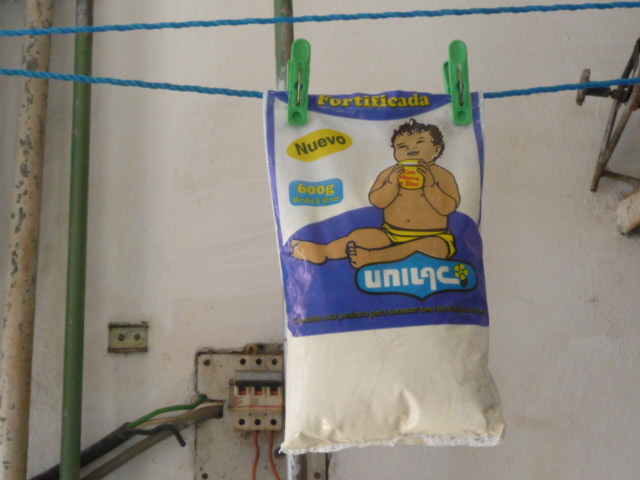
Sitting in my office yesterday whittling a Tweet down to 140 characters instead of working, I once again heard her hearty knock at my door. Smiling big, she told me she had three sacks of milk for sale at $2 a pop (a 50 cent savings over the official store price). I agreed to take one, glad I was finally getting the chance to help out granny. Until she pulled the sachet from her frayed knapsack: I, we both, were taking milk from the mouths of Cuban babes. What my elderly friend was selling was the milk the government guarantees to every child under 7 and I’d just purchased 600 grams of it. I knew that milk wasn’t going to be too tasty. 

—–

This transaction got me to thinking about where all this stolen stuff comes from and put me in mind of my friend Alberto. He has an old Lada on which his livelihood depends. Driving around recently, I noticed a balón de gas (the 20-lb tanks used here for home cooking) wedged behind his seat. Seems Alberto had converted his gas-powered car into a propane-propelled one.

This was a smart investment on his part: although the conversion kit cost $350 and had to be imported from abroad, Alberto fills that tank – which takes him 120 km or so – on the black market for just $5. By way of comparison, that same $5 would buy 15 liters of real gas on the black market; just over four at the pump. I’m glad Alberto has figured a way to enlarge his margins, but wonder about the families who show up to fill their kitchen tanks to be told “no hay” (there isn’t any).

This same pattern repeats itself with steaks and blocks of Gouda, stamps for official paperwork (I was surprised to be asked to produce receipts for my bank-bought stamps on my last visit to immigration) and cooking oil. And while I can appreciate the need for every last Cuban having to do something (or something extra-legal) to make ends meet, the more I parse the situation, the more unsettling it becomes.

And it makes me realize that a certain amount of that aforementioned moral ground is shifting below my feet. At these times I’m forced to ask myself: is this is a part of Cuban culture I wish to participate in? Unluckily for my milk-thieving granny, it is not. But I’m sure she’ll find other clients: as long as there are commodities like oil, meat, and milk to “redirect,” and resell for pure profit, folks will do it.

 As I said: old habits die hard.

 Notes

1. These political powwows are held every so often (the last was in 1997) or mejor dicho: whenever sufficient excrement threatens to make contact with the cooling element, if you know what I mean.

2. All of these issues came to the fore in nationwide public referendum-type debates held in late 2010. The permiso de salida is an exit permit which is mandatory for overseas travel by Cubans and residents. It earns the country revenue, but is also a barrier to travel – an issue that has to be reconciled somehow and soon.

 3. Except the goods in the black market Mac store. None of this is stolen, but rather all new, in-the-box gear with warranty and all, purchased in Miami and spirited into the country.

 4. Eggs aren’t usually stolen either, but rather the product of home-raised hens.

25 Comments

Filed under Americans in cuba, Cuban customs, Cuban economy, Cuban idiosyncracies, Cuban phrases, Cuban Revolution, Expat life, Fidel Castro, Living Abroad, Raul Castro, Travel to Cuba

Conner’s Cuba Rules Part II

[tweetmeme source=”connergo” only_single=false] About six months ago I wrote Conner’s Cuba Rules, a super popular post that raised the ire of some readers. Rereading my musings six months later, I better understand some of the dissent offered by commenters. Given that much has changed here in Havana since then and I’ve had several opportunities to travel outside of the capital thanks to my day job, I’ve compiled a new, hopefully more positive, set of rules to complement the first ones.

The Revolution will be televised: I’ve met a lot of visitors (and even some foreign residents) who have never seen Televisión Cubana. Granted, there are only five channels here, but you’re missing out on a big chunk of Cuban culture if you don’t surf those five at least occassionally. For the intersection of politics and journalism, check out the Mesa Redonda (see note 1) and the prime time news. The latter is important in and of itself for the weather report; pay special attention if Dr José Rubiera is forecasting. Meanwhile, a good baseball game can rivet entire households, the novela even more so. Only if you watch TV here will you understand what Cubans mean when they say: “it was like the Saturday night movie” (see note 2). Meanwhile, the music shown down here – videos, documentaries, concerts and jam sessions – can be as moving as the live thing. I’ve seen Chucho Valdés, Clapton and Queen, the Festival of Modern Drumming and some guy from Uzbekistan singing Talk Boom, a riveting song I’m still trying to track down – all in a single night on Televisión Cubana. Watch it; you’ll like it (or at least get a good laugh or song lead).

Pack a sense of humor: It always amazes me when I read something that disregards, overlooks, or otherwise fails to recognize the Cuban sense of humor, which ranges from the side splitting to the sublime. The writer can be someone who knows and loves Cuba long time or a visitor who has parachuted in and out on vacation. No matter the source, the frequency with which folks miss the funny stuff here is alarming. It’s true, a lot depends on speaking Spanish (or a crackerjack translator), but however you resolve the language question, if you’re comparing Cuba to China, Vietnam, or the defunct USSR, you’re missing one of the most important ingredients in the Cuban character. These folks love to share stories, jokes, and the occassional tall tale, and use their verbal prowess to enliven, laugh, and woo; it is what has enabled these people to resist so much for so long. Even without Spanish skills or a translator, if you’re not laughing a lot on a visit here, you’re doing something wrong in my personal and professional opinion (see note 3).

Use pesos cubanos: If you know even a little about Cuba, you know we operate on a dual currency system with pesos cubanos and pesos convertibles circulating side by side. Since one of my goals of Here is Havana is to bust myths, I always take the opportunity to debunk one of the most pervasive: that foreigners cannot use pesos cubanos (AKA Moneda Nacional, MN), but only pesos convertibles (AKA divisa, chavitos, CUC). This is 100% false. Anyone can use either currency. It’s what each can buy where the difference lies. Certain goods and services, for example, are only available in CUC including cooking oil and butter, hotel rooms and the internet. But fruits and veggies, surprisingly pleasant cigars, fixed route taxis, movie tickets and lots of other stuff are sold in pesos cubanos – if you know where to look. My advice? Change some CUCs into MN (1:24) to experience firsthand how much pesos cubanos can buy and how the double economy works.

So as to avoid confusion +/o more myths: you can always pay for goods and services priced in pesos cubanos with hard currency pesos convertibles but never the other way around. And some services (interprovincial buses, concert and ballet tickets) are sold in pesos cubanos to Cubans and residents, but in hard currency to visitors.

Bring your own reading material: Rarely a week goes by when someone isn’t griping to me about the lack of English-language books and magazines here. What is available is largely limited to historical and political titles and they are very expensive (and make for dull beach reading besides). The Kindle can be handy in this regard, but the bonus to bringing print publications is that you can pass them along to some avid English reader (like me!) upon departure. Drop me a line if you have some good (ie no romance novels or sci fi pulp) English-language reading material to donate to the cause.

Hightail it out of Havana: This may seem contradictory, given that I have an iApp to the city and I recommend in my guidebooks and elsewhere that visitors consider basing their entire trip in Havana. But things are changing fast here and though I’m a city girl by birth and breeding, I’m back peddling a bit on that advice. Havana, with its dirt, garbage, and graft, noise and air pollution, and materialistic ways (I did call Habaneros ‘logo whores’ after all) is distorting Cuba’s image. In short, Havana is not Cuba, which can be said of every major city around the world from New York to Manila, Managua to Dakar. But since visitors often request recommendations for “authentic” experiences and how to discover the “real” Cuba, I now find it prudent to advise getting out of Havana and exploring farther afield. With more flights, both charter and commercial, to provincial capitals like Holguín, Camagüey, and Santiago de Cuba, this is also a more practical proposition than ever.

Above all, have fun and keep your head about you!

Notes

1. The Mesa Redonda (Round Table) is a nightly “debate” show which discusses a topic (US aggression overseas; Latin American intregration) on which all four guests and the modeator agree.There are many jokes in these parts about the program; the shortest and sweetest calls it the Mesa Cuadrada, meaning ‘Square Table’ in literal Spanish, but meaning something more along the lines of ‘Dogmatic Table’ in Cuban.

2. The Saturday night movie here is prefaced by a parental warning, the most common of which alerts viewers that the Hollywood action shlock about to be shown contains Nudity, Violence, & Foul Language. To wit: the old, slow, over-crowded camello buses (of which I took many), were always called ‘the Saturday night movie.’ [NB: did it annoy you to have to scroll down to read this note? Yeah, me too, but I haven’t been able to figure out how to hyperlink notes within posts; if someone has a solution, please get in touch].

3. Trying to connect to and use the internet excepted. Even casual visitors know that connectivity is no laughing matter here. Indeed, I flirted with the ledge and sharp knives today as I frittered away several hours trying to connect. Once I “succeeded,” it topped out at 9.6kbps – not nearly fast enough to load even a simple web page before timing out.

30 Comments

Filed under Americans in cuba, cigars, Communications, Cuban customs, Cuban economy, Cuban idiosyncracies, Cuban Revolution, Expat life, Living Abroad, lonely planet guidebooks, Travel to Cuba

Why are Cubans so Damn Good?!

[tweetmeme source=”connergo” only_single=false]

December is always an interesting time in Havana – cool in temperature and temperament, but also cruel in many ways. Hurricane season has officially ended, so this is when we breathe easier (if Mother Nature has been benevolent) or tighten our belts one notch further (if she hasn’t). Christmas and New Year’s are bearing down, which means feasts of pork and yucca and the season’s first lettuce; dancing to Van Van in the Protestódromo (see note 1); and having a few days of well-deserved rest.

‘Tis the season to be jolly, certainly, but ‘tis also the season to be on your guard: there are few guarantees in Cuba, but a spike in robberies leading up to Christmas when the desire to provide gifts, food, and drink for the family trumps ethics and the law is one of them (a dramatic increase in water- and food-borne infections during the hot summer months is another).

Nevertheless, the prospect of being jacked is nothing compared to the heartache and nostalgia that afflict family and friends whose most ardent desire is to be in Cuba during fin de año – trust me, I know. The food and mood is superlative, of course, as is the camaraderie, but December in these parts is also Festival Time.

The Havana Film Festival is now well underway, and hot on its heels is the Jazz Festival, which showcases some of the world’s top jazz musicians in intimate (and cheap!) venues. This isn’t Cannes or Hollywood, Montreux or Manhattan: here the stars are in the seats and streets and whole days and nights are consumed hopping from theater to conference to club, followed by stellar after parties and sizzling jam sessions.

The depth and breadth of Cuban artistic output is (dare I say it?) unsurpassed by any other country its size and many much bigger (sorry my Commonwealth friends, but Australia and to a lesser degree, Canada, come to mind). With so many amazingly talented Cubans strutting their stuff these festival-filled days, I’ve begun to think seriously about Cuban culture and talent.

In short, is this surfeit of greatness thanks to Nature or Nurture?

O sea: is it 50 years of free education (including in all the arts) and the abundance of dirt cheap and even free cultural offerings that have nurtured such success? That’s part of it surely, but doesn’t explain all the Cuban cultural phenoms who predate the Revolution (Desi Arnaz notwithstanding) like Bola de Nieve, Ernesto Lecuona, and Benny Moré.

Maybe it’s in the genes then? This nature theory would explain a lot, like the prevalence of both dynastic families and cultural autodidacts, of which Cuba, as a country of only 11 million, has a disproportionate amount.

My first glimpse of this was provided by my friend, singer-songwriter Santiago Felíu. A high school dropout with a well of the maniacal genius bubbling deep within him, Santí taught himself to play guitar (better than any of his contemporaries mind you), as well as piano. If you know anything about Cuban music, the name Felíu will ring a bell: his older brother Vicente was a co-founder of the Nueva Trova musical movement and Vicente’s daughter, Aurora de los Andes, is a formidable singer and actress in her own right.

Not surprisingly, it was the Family Felíu that first aroused my interest in Cuba’s cultural autodidacts and dynasties. Like a spouse who suspects infidelity, once I started paying attention, I saw the connections everywhere – not just in music, but also theater, dance, art and of course, politics.

______

In honor of the Film Festival, I’ll start with the ‘7th Art.’ If you haven’t yet heard of Habanastation, you will: it’s an Oscar contender and was a blockbuster hit when it opened in Cuba this past July, captivating audiences with its dissection of class divisions in Havana and their effect on values. It was made by filmmaker Ian Padrón, son of Juan Padrón, creator of both Elpidio Valdés and the classic Vampiros en la Habana movies, both of which remain staples in the island’s canon. A young, budding dynasty, perhaps, but an impressive start nonetheless.

The Crematas, meanwhile, are another dynastic artistic family, with brothers Carlos Alberto and Juan Carlos making their marks as director of the Colmenita and director of films respectively.  

In dance, the Carreño tribe leaps to mind: Jose Manuel, Yoel, and Alihaydee, continue to nurture their legacy as some of the most accomplished ballet dancers around, as evidenced by their principal status in top companies. If you can make it in the American Ballet Theater and the Royal Ballet,you can make it anywhere, right? In theater, the Revueltas (Vicente, Raquel) are renowned for their work on stages near and far.

But nowhere is the dynasty dynamic as tangible as it is in music. The Familia Romeu (orchestral director Antonio María, pianist Armando, and Camerata Romeu director, Zenaida) is a good example, as are the López-Nussas – Ernán and Harold on piano, Ruy and son Ruy on drums – and the López-Gavilán Clan (Aldo plays piano, his father Guido is a classical composer and conductor, mother Teresita Junco was also a composer and brother Ilmar is a violinist). I’d be remiss if I didn’t give a shout out to the Alfonsos here: father Carlos and mother Eve Valdes founded the group Síntesis over 35 years ago (think the Partridge Family funkified), in which their musical children Eme (M) and Equis (X) cut their teeth, both of whom have healthy solo careers today (see note 2).

Controversial as he is of late, mention must be made of trova great Pablo Milanés, who also heads up a musical dynasty, with three daughters – Lynne, Haydée, and Suylen – nurturing successful singing careers of their own. Even Silvio Rodríguez, world famous and (almost) universally revered, is the head of a dynasty of sort: his son ‘Sivito El Libre’ is part of the highly polemic rap group Los Aldeanos. Salsa is another genre where families shine, as epitomized by Los Van Van founder Juan Formell and his drummer son Samuel.

 Apart from the dynasties, autodidacts also swell the ranks of Cuba’s über talented. In art, Yanluis Bergareche is an exciting emerging artist who is entirely self-taught. Is it not simply astounding that a young man could teach himself to paint canvasses such as these? In addition to the aforementioned Santiago Felíu and inimitable El Benny, self-taught musicians include up-and-coming rapper/chanteuse Danay Suárez and the blind tres player Arsenio Rodríguez – one of my all-time favorites.

 With artistic giants such as these, the ascendancy of regguetón – defined by simplistic rhythms and misogynistic vulgarity (see note 3) – is doubly shameful. Moreover, it obviously disproves the powers of both Nature and Nurture.

 Do you have a favorite Cuban autodidact or dynasty? Let me know!

  Notes

 1. Each New Year’s, the ‘Rolling Stones of Cuba’ play a free concert in the parade grounds directly in front of the US Interests Section (the pseudo embassy here). Inaugurated to protest the sequestration of Elián González in Miami, this space is officially named the Tribuna Anti-Imperialista, but is known as the Protestódromo in local lingo.

 2. X Alfonso is one of the most innovative musicians in Cuba today and works with artists and musicians in many diverse genres; try to catch a concert when you’re here.

 3. In one recent regguetón-related fracas, Osmany Garcia’s “song” Chupi Chupi was taken to task in the national media for its disgusting, degrading lyrics telling a woman to “come suck my cock, you know you’ll like it; open your little mouth and swallow it sweetheart.”

14 Comments

Filed under Americans in cuba, Cuban idiosyncracies, Cuban Revolution, dream destinations, Living Abroad

Cuban Blockade: Cruel & Unusual

[tweetmeme source=”connergo” only_single=false]
It’s time again for the international community to remind the United States how absurd and futile their blockade of Cuba is. The vote to condemn the blockade is a UN affair (equally as absurd and futile perhaps, since the Cuba policy is largely a US domestic issue and UN votes are notoriously toothless) – the 20th of its kind. Last year, 185 countries condemned the blockade, with 2 nations dissenting: the USA and Israel (surprise! surprise!).

For those needing a bit of a primer, the US embargo was first enacted in 1962 – before many of us were even born. The purpose of the policy, then as now, is to isolate the country to such a degree as to foment regime change (seems they’re a bit obsessed up north with the ‘C’ word – in this case Castro). After about 30 years of the means failing spectacularly to attain the desired end, the policy was strengthened through the Helms-Burton and Torricelli Acts so brutally that today, it violates the most basic human right of 11 million Cubans – the right to self determination.

This chaps my ass. What also irks me is when analysts, academics, and others somehow hitching their wagon to Cuba’s star call the policy an ‘embargo’ when it is, in fact, an economic, commercial and financial blockade. Semantics you say? Not for those of us here suffering under it. And not for those who understand the difference between the two. It’s one thing to prevent your own government, people, and businesses from dealing with Cuba, it’s something entirely, extraterritorially else to penalize other countries for doing same.

Consider this explanation by Peter Schwab in his book Cuba: Confronting the US Embargo:The embargo blockade disallows Cuba from using US dollars in international trade, costing the country additional money for exchanging currencies. US regulations also disallow the export of US products from a third country, while products even developed through the use of US technology or design [emphasis mine] cannot be sold to Cuba.

Not only vicious, the policy is ridiculous in its application: there was the incident at the Mexico City Sheraton, when staff refused rooms to Cuban guests in 2007 in town for a conference; an Oslo hotel owned by Hilton repeated the gaffe with a Cuban trade delegation that same year. In October 2010, Twitter blocked messages originating from Cuban cell phones, citing the blockade as justification. Twitter quickly capitulated, but isn’t the convergence between the “free” market, politics and censorship interesting to consider? Taken together, all the elements petty and severe of the blockade have meant over $100 billion in losses for the island over the years.

What really boggles the mind, however, is the bang-your-head-against-the-wall determination with which the policy has been pursued, despite its failure to reach its stated goal. It puts me in mind of Einstein’s definition of insanity: doing the same thing over and over again and expecting different results.

Yes, folks, this is an insane policy. What policytroublemakers in South Florida, Jersey, and D.C. doggedly ignore and don’t want you to know is how this policy lowers quality of life, separates families, and kills people on both sides of the Straits. Before I rant about the specific ways in which this policy makes life harder here as well as there, allow me to extend my deepest condolences to all the families, Cuban and otherwise, who have suffered under the blockade. I’d also like to voice my deepest respect and admiration to all those working towards a change in policy and the 11 million Cubans – 70% of whom have only known life under the blockade – affected daily as a result.

So you might better understand how this translates on the ground, I offer these snapshots of how the blockade has affected me and my loved ones.

I can’t hear you! Can you hear me?! – Phone calls originating from the USA get routed through China, Argentina and who knows where and cost upwards of $1/minute (except to the US naval base at Guantanamo, adding insult to injury). Getting a call to actually connect may take half a dozen attempts and forget wishing someone well on Christmas, New Year’s or Mother’s Day, when over 1 million Cubans living off island are all trying to do the same.

When the call actually does come through, it sounds like my sister is underwater and my mom is in a cave so deep, her voice is echoing off the walls. My PBS producer, meanwhile, may as well be talking into a Dixie cup on a string the delay between what she says and I hear is that long. To give you an idea how severely this affects communication, consider that in almost 10 years living here, only two friends have called me a total of three times – and I have some very devoted, (albeit poor), friends. For all these reasons, you can understand why I maintain my PO Box here, though even letters from the USA sometimes don’t leave domestic soil due to blockade politics. Thankfully, FaceBook and other social media aren’t blocked by either country.

Can I connect? No, you cannot – Recently PayPal threatened legal action and said my account would be blocked for trying to access the site from an ‘embargoed country.’ This is more serious than it may seem: like many freelance writers, I receive earnings from some clients via PayPal, and this prevented me from collecting payment for services rendered. Only I after I enlisted my own counsel and provided voluminous paperwork proving that I’m a journalist with US Treasury permission to be here (another absurdity: the US prevents it’s residents and citizens from traveling freely to the country of their choice, in this case Cuba), did they reinstate my account. I still can’t access it though and so only have use of my funds when I’m off-island. Other sites blocked for the same reason are iTunes and Tiger Direct. LinkedIn is also LockedOut thanks to US embargo.

Cash on the barrelhead – If you’ve been to Cuba, you know US credit and debit cards don’t work here. When I first moved to Havana in 2002, I thought my HSBC card would work. Silly me. Despite being a London-based bank, HSBC has offices in the USA (like most banks worldwide), and therefore cannot do business with Cuba under the terms of the blockade. I love how globalization works for those holding the reins. For the rest of us? Salsipuede.

Think of all the things you do with plastic funds. How would you live without debit and credit cards 24/7/365? How would you pay for webhosting or buy a plane ticket or god forbid, get money in an emergency? Anyone from the USA who travels or is based in Cuba has to do everything in cash – no exceptions (see note 1).

You’re sick and will stay that way – Of the more than 300 major drugs on the market since 1970, nearly 50% are of US origin and effectively blocked from export to Cuba (see note 2). The stories of people on both sides of the Straits who are denied life-prolonging or -saving medication due to the collusion between US big pharma and politics are heartbreaking. There’s the US drug Prostaglandin E1 – used in children born with congenital heart defects – is denied to Cuba. In fact, 90% of the products used to correct these malformations are manufactured by US multinationals or their subsidiaries and therefore are not available here due to the blockade. Anesthesia, diagnostic equipment and parts, and the latest in antiretrovirals to treat HIV are likewise unavailable. Cruel? You tell me.

But sadly, the policy affects US folks too. A dear friend of mine recently died of lung cancer. Had the breakthrough Cuban therapy Cimavax-EGF been available to her, she could have lived up to 5 years longer (if recent clinical trials in Europe are any indication); even if she didn’t respond optimally to the treatment and lived another half decade, the therapy certainly could have improved her quality of life at the end. The same holds true for meningococcal B outbreaks in college campuses across the country. Were the Cuban vaccine for the disease VA-MENGOC-BC available, these outbreaks could be averted. These Cuban therapies and vaccines, along with Heberprot-P, used to treat diabetic foot (a major cause of morbidity in diabetics) and blue scorpion venom used in cancer patients, are unique in the world. Thanks to the blockade, if you’re in the USA, you can’t have them.

The blockade causes pain, suffering, and grief. But it also strengthens our resistance, creativity and resilience. To Obama on down I say: stick with your failed blockade policy. Over here, we have 52 years proving unequivocally that Yes We Can!Notes
1. The Canadian company Caribbean Transfers issues debit cards for use in Cuba and American Express Traveler’s Checks work in some banks here, but for the overwhelming majority of us, we’re forced to live entirely in a cash-based economy. This means carrying drug dealer type wads of cash on any Cuba trip.
2. See The Cuban Cure by S.M. Reid-Henry, pp 39.

61 Comments

Filed under Communications, Cuban economy, Cuban Revolution, Living Abroad, Uncategorized

Cuba: Going to the Dogs?

[tweetmeme source=”connergo” only_single=false]
In my forthcoming article for NY Magazine, I write a bit about Havana’s newly-moneyed. Whether it comes from remittances, self-employed work, or working over tourists is irrelevant. What piques my interest (and hopefully retains yours, dear readers), is how wealth – relative as it may be – manifests itself here, how it changes behavior and tweaks norms heretofore adhered to.

Faithful followers of Here is Havana will remember my thinly-veiled diatribe against Cuban marca mania – if I’m not mistaken, I actually called my compatriots ‘logo whores.’ I repeat: not all Cubans, everywhere, but there does seem to be an inordinate amount of importance placed on logos and bling here. I understand why Cubans are attracted to shiny, pretty things, but at the same time I’m biased: one of my abiding principles holds that nothing you can buy builds character (except maybe psychotherapy). The whole status symbol compulsion and keeping up the Joneses – is it inherently bad? I don’t know, but I do know I’m hard pressed to find anything good about it.

These days status symbols are displayed with as much pride as cadres display their photo with Fidel (see note 1). Gold teeth and braces, anything Mac (even if it’s just the iconic white apple sticker), cell phones (working or not), and pure-bred dogs. It stands to reason that Cubans are drawn to perros de raza since they’re a walking (shitting and barking) status symbol.

Now, those of you of my personal acquaintance know I’m not a pet person. A tortoise, perhaps, or a crafty cat that can paw open the door and hunt down a bird when it’s hungry, I’m down with. But a dog? They’re dependent, they shed, they smell, fleas like them, and often they age poorly – farting as they lumber about on rickety bones and bump into furniture with their cataracts. Plus, they hamper travel. Sorry to Sam, Sadie, Paka, Bob, and all the other great dogs I’ve known, but when it comes to canines, I subscribe to my Dad’s axiom: ‘living with animals went out with Jesus.’

But let’s put this dog question into context: I’m sure the average Cuban doesn’t give much thought to any of this. A dog here – whether in the city or campo – means added security. Dogs keep vermin of all types at bay and sound the alarm. In Havana, I’m sure you’ve noticed, folks are very concerned about the safety of their stuff and enclose entire houses – balconies, doors, windows, all – in rejas (iron bars and gates). Even taillights on motorcycles have their rejitas; check it out next time you’re in town.

So a dog is an added source of protection. I get it. But it’s also another mouth to feed and represents all manner of unanticipated expenses like when they get parasites (and they all do) or when the heat wreaks havoc on their fur (hairless perritas chinas excepted of course). They also need to be walked, adding another task to already overworked Cuban women, who, if my observations are accurate, do most of the dog care. In practical terms therefore, I’m not convinced that the benefits outweigh the costs of keeping a dog here. But what I simply can’t get my mind around is Havana’s new status symbol: Siberian Huskies.

They are all the rage: from the grimy streets of inner Habana Vieja to the bourgeoisie boulevard of 5ta Avenida, you’ll see people trying to walk, train, and tame these über Alpha dogs. And what about the heat? Have you been here in August? Just being in your own skin is a sauna – imagine if you had a pelt adapted for permafrost. It disturbs me inordinately, so I’ve started asking around…

According to my dog trainer friend Yamel, these dogs make challenging pets under the best circumstances. They’re a bitch to train because they’re bred for dominance and it’s difficult to establish supremacy. Even Yamel – who works his magic with rowdy shepherds, disobedient Dalmatians and other maladjusted dogs – says he’d never have one for this reason.

My neighbor is case in point with her trio of Huskies. They pull their leashes taut, dragging her behind, paying her no never mind. Recently, I’ve seen her working with a trainer (another expense) in the park nearby. I’m sure she watches Cesar Milan – prime time TV fodder here – religiously. Then there’s the heat. Yamel tells me they adjust, but I’m dubious: I know of at least one retriever who died of heat exhaustion here.

I was completely taken aback on a recent visit to my dear friend Carmita to see she had acquired a Husky pup. This is an unlikely pet for an unfortunate household. She’s an 84-year old pensioner living with her college-age grandson. They get a little economic help from Miami and other points north and are church-going, so have some support, once in a while, from the congregation. But Iker – named for the Real Madrid goalkeeper – is no black market Husky; he’s the real deal. Offspring of Massimo Zar de la India and Bella Bon (I’m not making this up!), Iker was purchased at one of the periodical dog shows here (see note 2) for the exorbitant price of $200. Despite my prejudices, I put a good spin on it to Carmita.

“That’s great! Now you have company while Maykel’s in class.”

She makes that smacking, sucking sound which in Cuban means ‘bullshit.’

“He’s a pain in the ass and makes a mess of everything.”

Gotta love Carmita.

We don’t mention how much his food and care must cost. Why bother?

To be fair, the vet school here has services available in both pesos cubanos (24 to the dollar) and CUCs (one to the dollar), so are technically accessible cost-wise. The CUC section of the school is sparkling, there’s no line to wait in, and medicines are available. Meanwhile, the peso cubano section swelters with people and pets waiting their turn and the pharmacy may or may not have what your dog needs that day.

But the differences don’t end there: In the waiting room of the CUC services, snappy, pretty posters extol the benefits of pure breeds; above all, the posters underscore the beauty of these dogs. Shuffle over to the peso cubano waiting room and the script is different. Here, the posters are yellow and curling and don’t celebrate poodles, spaniels, and Afghans, but instead list the virtues of mutts, pointing up their strength, resilience, and force of character.

Pure breed or mutt? Pesos convertibles or pesos cubanos? Welcome to today’s Havana: suelta sin vacunar (on the loose, without her shots).

Notes

1. Every visit with The Comandante is documented by a state photographer. A few days after the meeting, a 6×8 matte photograph of you and Fidel arrives at your door.

2. While not Westminster, dog shows are serious business here, with breeders showing their stuff and buyers perusing their pups like johns trolling for ‘company.’ When purchased, Iker’s name was Kritop D’Spiritu Libre.

34 Comments

Filed under Americans in cuba, Cuban customs, Cuban economy, Cuban idiosyncracies, Cuban phrases, Cuban Revolution

Cuba’s ‘New Normal’

[tweetmeme source=”connergo” only_single=false]

Things are pretty tense around here. And it doesn’t help that Hurricane Irene is heading towards Port-au-Prince as I write this. When it’s threatening this close, we swing into action (see note 1). 2011 is a particularly harrowing hurricane season because we’ve escaped major damage for 2 years running (toca madera/knock on wood). Like an unfaithful spouse who spends too many Saturdays ‘at the office’ or ‘runs errands’ at odd hours, you just know the luck is going to run out one of these days. But I digress.

Followers of Here is Havana know that I’ve been covering the changes in Cuba (however sporadically and anecdotally; see note 2). And now – as marriages fail; savvy metrosexuals return from exile to launch private businesses; and the bourgeoisie distract themselves with whiskey and Facebook – seems like a good time for an update.

This installment focuses on ground level detail and how Cuba’s newest capitalist forays are affecting us, the hoi polloi. I’m talking about viejitas selling knick knacks and caps from their crumbling porticos and gentrification of neighborhoods which for generations have been mixed. Meanwhile, rainbow umbrellas signposting private cafeterias sprout like mushrooms in cow shit and ever-more-evident class divisions, combined with a certain impatience and market madness, weigh heavy on my mind.

Hanging on for dear life: I don’t have a car, which is an anomaly for most foreigners here and has drawbacks, clearly, but is also advantageous since it obligates me to navigate the public transportation system. In practice, this means I have no problem getting a bus from the Capitolio to Marianao or the Cine Chaplin to La Copa (see note 3).

Since I make much more than the average Cuban (but much less than the average resident foreigner – a hard concept for most Cubans), I also take the 40 cent fixed route/collective taxis that ply Havana’s streets. However, a significant change in the law regulating these taxis is putting our lives at risk: whereas it used to be only the owner of the almendrones (those pre-1959 hulks tourists go gaga over) could drive it for fares, now they can subcontract driving duties.

This small change on paper has meant big changes on Havana’s streets. Drivers are now young, restless, and reckless; it’s plain some of them have never even driven before (and are unlicensed, if one of my insider sources is to be believed). Others are so blatantly young even Cuban law would prosecute me were I to bed one down.

The result? Tank-like Dodges, Buicks, and Fords caroming along major arteries like Línea and 23, Calzada del Cerro and Calle 51 at high speeds, only to peel out of traffic with a hard turn of the wheel and screech up to the curb to snatch another 10 peso fare. I’m not the only one who lets these wild child choferes continue on their way, opting to wait for an older, more seasoned driver who cares at least for his car, if not his clients.

Ration cuts: Slowly but surely, the monthly rations (really fortnightly rations since they only last that long, and only then for the thriftiest and most creative cooks) are being cut. Not everyone needs them, let’s be frank, but for the millions that do, this is a problem. In Cuba, libreta rations aren’t free, but almost; since they’re so highly subsidized, payment is a token gesture. But hard times call for hard cuts and some rations – beans, most notably – have been reduced, while others (soap, toothpaste, laundry detergent, cigarettes), have been eliminated entirely. This can be crippling for old folks especially, but also working class families and other vulnerable groups.

But that’s not the only effect of this new policy. Take the cut in the salt ration for instance. Once upon a time, each household received a kilo of salt every three months. That ration has now been halved and may be discontinued altogether, meaning when you run short, salt has to be purchased at ‘parallel markets’ in pesos cubanos or hard currency “dollar stores,” (I suppose people peddle the white crystals on the black market, but I’ve little energy for that particular hassle and hustle). Either way, salt is now a pricey commodity.

The subsidy slash, combined with the cost of salt outside the libreta, make it virtually impossible for those unfortunate enough not to have access to hard currency to augment their salt stores. No salt means blander food, of course, but it also means we no longer knock on our neighbors’ door asking for a bit of salt – not at the new prices. Borrowing sugar, lending salt: these are diehard habits in Cuba and are among the daily threads which give the mantle of solidarity heft on the island. Let’s see how it holds up moving forward.

Cafeterias ad nauseam: One of the most immediate and visible effects of the new regulations has been the veritable explosion of private cafeterias and snack shacks across Havana (see note 4). No matter that each of them has an identical menu of fruit shakes, egg sandwiches and cajitas (to be fair, the ones that are good tend to be great – at least at the outset anyway). And no matter that some of them are churning out such poor quality fare I’ve actually seen people dumping food into the closest trash bin.

That said, some families are really making a go of it. However, just as the taxi sub-contracting policy and striking salt from the ration card are having unintended side effects, I suspect this cafeteria mania is too: I fear it’s making people sick. Sure, there’s always an uptick of stomach viruses in the summer, but this season, I know a lot more people with explosive diarrhea, fever, and projectile vomiting – usually all at once. While I have zero proof, poor food preparation and storage, plus sketchy hygiene, can mean food-borne illnesses. And since the government doesn’t have the inspectors necessary to inspect and monitor all these new cafeterias…Indeed, e coli warnings have begun appearing – a first for me in 9+ years of living here.

Marketing learning curve: The operative word here is steep – very, very steep. Forget that every cafeteria is making the same sandwich and that the same pirate DVDs are sold everywhere, from Vedado thoroughfares to dark entryways in Centro Habana. Lack of product differentiation is only one of the problems with the emerging capitalist experiment. The real question is: how do you distinguish your pan con jamón from the next gal’s or make your Jackie Chan ‘combo’ stand out from the rest?

This isn’t a query occurring to most entrepreneurs here, if the twinkly Christmas lights and hand-lettered signs around town are any indication. But some folks – whether they’re returned exiles, have advice coming in from Miami, or are just putting Cuban ingenuity to a new test – are on it. At major intersections and big grocery stores for example, hot, young Cubans pass out flyers advertising the newest paladares, some of which I’ve had the pleasure to try thanks to this publicity (the best are included in the newest version of Havana Good Time, out next week).

But one mode of advertising which has recently appeared in my neighborhood and is insoportable wherever it’s found are mobile megaphone announcements. Loud, obnoxious, and largely unintelligible (I still haven’t been able to divine a single good or service advertised by these noise polluters), these ads are delivered by enthusiastic barkers via bicycle, motorcycle or car-mounted megaphones. This is annoying enough, but I fear these ads may be the death knell for the sing-song call of the pregoneros – hawkers who pound the pavement advertising their wares in a melodic, iconic incantation. These were effective – it’s how I got my new mattress, after all.

Stay tuned for more on-the-ground impressions of evolving Cuba.

Notes
1. For the curious: I’ve passed so many hurricanes in Havana I’ve lost count and Cuban preparedness and response is efficient, effective, and a wonder to behold. Lives are very rarely lost – even in the most heinous, category 5 cyclones – which underscores the absurd tragedy that is adverse weather events in the USA à la Katrina or the recent Missouri River floods.

2. Dedicated fans will be happy to learn Here is Havana The Book is finally receiving some overdue attention; I hope to have it out by this time next year. Stay tuned!

3. Bus travel in Havana is generally a bitch, but for visitors who speak Spanish, I suggest taking at least one to eavesdrop: there is probably no more effective way to take the pulse of the population than to listen to a busload of Habaneros quibble and kvetch.

4. As of April 2011, 20% of the nearly 222,000 permits issued to private businesses have been for food service. The government estimates 80% of these start ups will fail in the first year.

31 Comments

Filed under Americans in cuba, Cuban customs, Cuban economy, Cuban idiosyncracies, Cuban Revolution, Expat life, Living Abroad

Best Cuba Posts Evah! (Sorta)

[tweetmeme source=”connergo” only_single=false]

Hola & Happy July 26th!

Maybe you’ve noticed I’ve been on a bit of a hiatus – ‘recharging the batteries’ as we say on this side of the Straits – and more importantly, trying to get my act in gear to write, to bite off the rest of my forthcoming book. Aiming to strike while the iron’s hot and all that.

In the meantime, some bloggers way more sophisticated than your humble, slogging-through-dial up protagonist, have invented this clever game of virtual tag whereby they tag Here is Havana making me “it,” inviting me to excavate oldie, but goodie posts that warrant reading.

These are not just pedestrian travel bloggers looking for free junkets and working the ad sense angle, but fabulously well-traveled women who have lived in Chile (in the case of Margaret over at Cachando Chile) and Moldova (in the case of Miss Footloose over at Life in the Expat Lane). What’s more, these chicks can write! I highly recommend checking them out. Also a big shout out to Camden of The Brink of Something Else for nominating Here is Havana (check out the killer shot of Havana taken from Regla – tagged as TBSE’s most beautiful post).

The categories were selected by whomever invented the game and include the “most beautiful,” “most controversial,” and “most overlooked” posts, among others, crafted over the two years of Here is Havana’s life. Have a click around, share with friends, spread the word…

Most beautiful: This was intended to be Chapter 1 of my book Here is Havana, but life has taken a left turn (as tends to happen here) and the book now has a life of its own (i.e. more a chronicle and a memoir than E.B. White’s Here is New York – my original inspiration). Any feedback on this would be greatly appreciated!

Most popular: My most popular post is actually my ‘About’ page but since that’s kind of flojo as we say in my neck of the woods, I suggest also checking out my second-most popular post about the wacky way Cubans speak.

Most controversial: The reaction to this post about Cuban fashion really surprised me – people came out with their elbows sharpened! Despite some of the wide-of-the-mark pop psychology, some of the comments are intriguing. See what you think…

Most helpful: This is a weird kind of category because what may be helpful to you, isn’t necessarily helpful to someone else, and what readers find most useful probably wasn’t the most useful to me (for those interested: the most helpful posts to me are those that help tease out the niggly snarls of cross cultural living, like this one about a visit to the USA and how it messes with my head and this one about always being on the outside looking in. These are closely followed by those posts trying to help me understand evolving Cuban reality, like the capitalist changes underway at present).

Clearly, though, tips for travelers to Havana and how to form a line in Cuba are among my most helpful posts for the general reading public.

Surprisingly successful post: Hands down, this is my post on dying in Cuba, Part I & Part II. There’s a real sadness to this ‘success’ – judging from search terms and other analytics, the folks that are searching on this term are family members living outside of Cuba who lost loved ones inside Cuba and are trying to figure out how to deal with the practicalities of that loss.

Post that didn’t get attention it deserved: At the beginning of 2010, as the wheels of change lurched along their inevitable track, I wrote about what Cubans were thinking, feeling and experiencing and how all these confusing emotions and intellectual gymnastics were affecting behavior. Worth a revisit – especially for those in faraway lands wondering: what the hell are they thinking over there?!

Post I’m most proud of: On the last day of February, 2010, I landed in Port-au-Prince with members of Cuba’s Henry Reeve Emergency Medical Contingent for a stint covering their earthquake recovery efforts in Haiti. For a month, I lived in a tent in their central camp in Port-au-Prince, with no running water, electricity only a handful of hours a day, crippling heat, and an internet connection 1,000 times more frustrating than my dial-up in Havana. Talk about learning experience….

TAG! Now, you’re it:

Bacon is Magic: HIH readers know I’m a chicharrones addict, so simply the name of this blog enamors, but Ayngelina also calls Guatemala “the most underrated country” after only a week. Sharp girl!

Fevered Mutterings, The Art of Unfortunate Travel: Funny, pull-no-punches mutterings by Mike Sowden.

Modern Gonzo: Robin Esrock has lots of companies sponsoring him, his own TV show, and is so well-traveled, he could be one of those ‘been there, done that’ assholes, but in fact is a totally cool, accessible, and down-to-earth guy.

Roving Gastronome: Mexico, Morocco, Queens, Cuba – Zora O’Neill, travel writer, cookbook author, and dinner party hostess-with-the mostest, takes you there and makes sure you eat well.

This Cat’s Abroad: Not updated nearly often enough for the talent and chutzpah exibited, this blog delivers a unique perspective by a woman living in Iraq (and now Kurdistan).

8 Comments

Filed under Americans in cuba, Communications, Cuban customs, Cuban idiosyncracies, Cuban Revolution, dream destinations, Expat life, Here is Haiti, Living Abroad, off-the-beaten track, Travel to Cuba, Writerly stuff

Conner’s Cuba Rules

[tweetmeme source=”connergo” only_single=false]

Since I’m from the Estados Unidos (more fittingly known as ‘Estamos Jodidos,’ or the independent republic of ‘We’re Screwed’), very few friends have visited me here on the “wrong side” of the Straits (see note 1). The lengths the US goes to keep Cuba down makes me indignant, but also sad since my peeps haven’t been able to experience this place for themselves and draw their own conclusions as to how good (or not so) things are in my world.

Last week however, the friend blockade was broken by some dear old amigos who finally made the leap and turned up for a visit.

As you might expect, they had lots of questions about governance and control, salaries and employment, the burgeoning private sector, tourism, race relations, emigration and myriad other aspects of Cuban life. Their curiosity and desire to better understand the sometimes unfathomable reality that is Cuba, forced me into a thoughtful analysis of the mundane, germane, and slightly insane features of life here.

Since the contemporary Cuban reality is so complex and different from what most people know, I’ve developed several rules of thumb for travelers wanting to maximize their Cuba visit. Part philosophical, part practical, the following complement Trip Tips: Havana Independently, posted in these pages some time ago.

– 8 out of 10 people approaching you on the street want something. ‘Do you have the time?’ ‘Where you from?’ and ‘Hello, my fren! Francia?! Italia?!’ are the most common lines used on new arrivals by jineteros. These are always asked with a good dose of charm in some of the best English you’re likely to hear in Cuba and it usually takes a couple of days before visitors get clued in to the hustle.

Conner’s Rule of Thumb #1: Deny hustlers an easy opening by eschewing clothing or accessories that identify your nationality and learn a few deterring phrases. These might include ‘déjame en paz’ (leave me alone) or for those who won’t take no for an answer: ‘no te metes conmigo, coño’ (don’t mess with me damn it). If you’re a hustler magnet (or hater), consider steering clear of tourist hot spots in Habana Vieja and Centro Habana altogether. In the end, all foreigners are seen as rubes and marks regardless of station, education, or experience.

– Cubans tell you what they think you want to hear. As a rule, foreigners receive the ‘poor oppressed us’ line first. A sympathy ploy laced with political assumption, this tactic is tiresome for its banality and blatant disregard for facts. You’ll be told, for example, about the stiff penalties incurred for killing a cow, but this ‘woe’s me’ contingent will conveniently leave out the part about the government guaranteeing milk for all children under 7, pregnant women, and other vulnerable groups – the reason cows are protected property. Cubans renting rooms in their houses are notorious for this type of incomplete picture peddling, complaining to clients about the taxes levied upon their business. What they neglect to mention is that their income-earning homes are provided by the government virtually rent-free. Wanting a rent-free property to run a business and be tax exempt? That’s chutzpah.

But this cuts both ways. If, for instance, you evidence respect and awe for the Cuban Revolution, you’re likely to hear about free education and the wonders of organic farming. What you won’t necessarily hear about are the overcrowded dormitories with shitty food and water shortages or the country’s experiments with genetically-modified crops.

Conner’s Rule of Thumb #2: Cubans tend to see things as black and white, when the truth more often resides in the gray. When picking a Cuban’s brain, always consider the source and listen to the complainers very closely: you’ll likely hear the axe they’re grinding loud and clear.

– You can’t ‘fix’ Cuba. There’s an especially annoying type of tourist who after two weeks here is convinced they’ve got it all figured, that they know precisely how to fix what’s broken (see note 2). Their simplistic ideas often disregard the complexities of Cuban society and illustrate a woeful ignorance of history, geo-politics, even the weather. For example, if you think hurricanes have little connection to health and housing in Cuba, you might be this type of visitor. Even after living here for 9 years, I can’t figure it all out and while it’s possible some tourist is better positioned to analyze Cuba, it’s not likely.

Conner’s Rule of Thumb #3: The more you know about Cuba, the less you understand. Remember: it’s better to remain silent and appear a fool than open your mouth and prove it. If you’re truly keen to learn, read widely before your trip, ask lots of questions once here, and avoid declarations.

– The more things change, the more they stay the same. Huge, watershed changes are taking place here, but at its core, Cuba is still Cuba. It’s a cultural constancy that may be drawing to a close as market forces gather momentum, but I’m not so sure. Consider this quote:

 It is plain there is a good deal to be learned here…Things which we cannot do without, we must go out of the house to find, and those which we can do without we must dispense with. This is odd and strange, but not uninteresting and affords scope for contrivance and the exercise of influence and other administrative powers…I must inform myself on the subject of this strange development of capital over labor.”

– Richard Henry Dana, Jr.

 What’s so interesting about this observation is that it could have easily been made yesterday, but dates from 1859.

Conner’s Rule of Thumb #4: Cuba is evolving, but not necessarily in the direction or way you or I might think (or want). Though the steps people take to maintain balance might change, the fact that the ground is always moving never does. Do like Cubans and roll with it.

No coge lucha. Threats to national sovereignty notwithstanding, Cubans don’t take too much too seriously, preferring to get and go along over fussing and fighting. I’m convinced it has something to do with the weather – this heat is enough to wither anyone’s defenses – but is probably also related to the fact that there is so little housing and employment movement here, if you piss a neighbor or co-worker off, you’re in for a lifetime of problems.

Conner’s Rule of Thumb #5: Don’t get your knickers in a twist if things don’t go as planned or a government drone isn’t cooperating. Have a sense of humor, laugh it off and follow the old axiom: you catch more flies with honey than vinegar.

Writing all this, I realize I’d be wise to take my own advice!

Notes

1. For anyone new to this blog +/o US-Cuba relations, the freedom for US citizens and residents to travel to the island has been restricted for 50 years. As I type this, the House Appropriations Committee has just voted to reverse the small opening Obama offered US travelers wanting to travel to Cuba.

2. These types really chap my ass, almost as much as the Cuban émigré who hasn’t been here in 20 years or worse, the person sitting at their computer who has never been here.

57 Comments

Filed under Americans in cuba, Cuban customs, Cuban idiosyncracies, Cuban Revolution, dream destinations, Expat life, Living Abroad, Travel to Cuba, Uncategorized

Cuba: Independent Republic of Los Sabelotodo

[tweetmeme source=”connergo” only_single=false]

Last night in a fit of exasperation my husband chuffed: ‘yeah, ok. Whatever you say sabe lo todo.’ A Cuban labeling someone as a know-it-all is ironic, not to mention a clear cut case of the pot calling the kettle black. In this instance, applying the sabe lo todo label was especially illustrative since a) my significant other is a shameless (and sometimes tiresome, truth be told) know-it-all and b) he was telling me where to pitch what stories – in essence, telling me how to do my job. He’s annoyingly right most of the time, but this wasn’t one of them.

After nine years of marriage, this isn’t my first experience with him waxing expert on themes about which he’s largely clueless. In the US, we call this talking out your ass. The most hilarious (or heinous, depending on your POV) of his sabe-lo-todo/ass talking was after I’d had an explosive multiple orgasm. As I lay there in that delicious free floating state of petit morte, he came back for more, making a beeline for my clitoris. When I begged him to stop, explaining it was painful like when someone tickle tortures you, he actually said: ‘No! This is the best part!’ A man professing to know how a clitoris feels post-orgasm: this is how deep Cuban sabe lo todo runs.

If you know Cubans, you know people like this. Alternatively, if you’ve been to Cuba, you’ve likely met the street sweeper (or taxi driver or bartender) who knows more than a foreign neurosurgeon. These folks will tell you the best way to prepare lobster even if they’ve only tasted one in their life or expound on the safety of New York City streets though they’ve never been on a plane.

Let me be clear: not all Cubans suffer from this affliction and it definitely strikes men more often and acutely than women. Male vegetable sellers, for instance, are notorious know-it-alls, forever proclaiming their flaccid or small, close-to-rotting or not ripe produce is top quality. I recently let loose on a burly guy selling the typical selection of Havana fruit and veggies (i.e. flaccid, small, and pre- or post-prime) who tried to convince me his bruised, mushy tomatoes were perfect for tonight’s salad.

“Do you cook at home?” I asked him, my smile turning nasty.

“Do you do the shopping for your house?”

“Do you know what I’m buying these tomatoes for?”

“No, no, and no, so shut the fuck up.” That’s what I wanted to say but didn’t. Instead I walked away, costing him a sale, which in this wacky system is of no consequence whatsoever (yet).

Having a touch of the strident, know-it-all myself (when I was 8 my mother told me I was too dogmatic; it goes that far back, runs that deep), I chafe when I come up against it here, I admit. This has forced me to think about the causes of sabe lo todo and taught me to better appreciate the Socratic Method. It has also underscored the importance of being open to learning from all walks of life á la Popular Education.

So why are Cubans such know-it-alls?

First and foremost, Cubans on the whole are ingenious, smart, and educated, so they do know a hell of a lot. Over 50 years of free education (including in remote areas and all post-graduate and advanced studies) means the average Cuban knows more about the history of the Western Hemisphere, for example, than me or you. I’ve been embarrassed more than once by Cubans correcting me about a Civil War battle or US electoral processes. ¡Que pena!

Such erudition may be eroding among the younger generations however, as Cuban education (especially primary and secondary) becomes increasingly mired in resource scarcity, low teacher and student morale, and slackening standards – not unlike what’s happening in public schools up North, I gather. But Cubans 40 and over? Like the IRS, they are all-knowing and spell trouble when they’ve set their sights on you.

Another, more complex reason for the sabe-lo-todo tendency is the success the Cuban Revolution – capital C, capital R – has had sticking it to The Man Uncle Sam. No country so close, so small has ever resisted the US drag towards globalization, neo-liberalism (AKA contemporary colonialism), and all the inequities and contradictions these constructs imply. To say nothing of Cuba’s resounding defeat of US-backed invaders at the Bay of Pigs or the wedge it jammed between the super powers during the Missile Crisis.

Sometimes when I sit back and look at Cuba in the big picture, even I have trouble believing this little country has so consistently and successfully flipped the proverbial bird to the USA. Not since the Haitian slave rebellion of 1791 has a small island been such a game changer. Despite all the errors and imperfections of the Cuban system, having such chutzpah and success must affect the collective psyche some how, imprinting a tacit superiority on the hearts and minds of the people.

However, underlying this singular triumph and its attendant feelings of superiority – modest and unconscious as they might be – is, I suspect, a niggling feeling of inferiority. Let’s face it: Cuba is an island, small and isolated, which has never been given its rightful place on the world stage.

Underestimated and undervalued, Cuba’s contributions to the global dialectic in science, medicine, literacy, human rights broadly defined, and disaster prevention are minimized, criticized and questioned – often by people and media unqualified to level such judgments. This has to rankle, contributing to an inferiority complex which, in a textbook example of over compensation, manifests itself as sabe lo todo.

Lastly, many Cubans confuse opinion with fact. A slippery concept, opinion is a confluence of knowledge, experience, emotion, bias, even upbringing and culture. Facts, meanwhile, are evidence-based, provable and documented. Facts can inform opinion, but not the other way around (FoxNews notwithstanding). Presenting opinion as fact is one of the first, most obvious signs that you’re up against a sabe lo todo.

Although I’m often ruffled by this posturing which can feel belittling as it negates my experience and knowledge, Cubans have taught me that no one is all-knowing. Certainly not me. Slowly, this wondrous Havana journey is making me less of a know-it-all and more of a question-it-all.

64 Comments

Filed under Americans in cuba, Communications, cuban cooking, Cuban customs, Cuban idiosyncracies, Cuban phrases, Cuban Revolution, Expat life, Living Abroad