Category Archives: Cuban idiosyncracies

Let Us Pray

[tweetmeme source=”connergo” only_single=false] I ventured once again outside my comfort zone yesterday here in Havana: I went to mass. It was as oppressive (and let’s be frank – hypocritical) as I remember from Jesuit high school (see note 1), although this one was presided over by the big Catholic kahuna himself, Pope Benedict XVI. It was also mercifully short.

While I’m sure you’re oversaturated with ‘The Pope in Cuba’ news up your way, one of the indelible lessons I’ve learned in my 10 years of island residency is that the picture you get of here from there – especially when refracted through the lense of reporters sent to cover such an event – does not accurately reflect what we’re experiencing on the ground. It’s not only that every media outlet from The Militant to FoxNews has an agenda. The view is skewed also because Cuba newbies rarely grasp the complexities of our context (see note 2), nor the attendant history influencing those complexities. You don’t get this perspective unless you’ve been around and stick around and only if you speak Spanish – even a translator is no guarantee (see note 3).

So let me tell you about the mass I attended yesterday under a blazing sun, delivered by a frog-like man in a funny hat.

What folks are saying: One of the pervasive myths about Cubans is that they’re afraid to speak their minds or offer opinions, and that self-censorship is rampant. While it’s undeniable that people keep their heads far below the parapet in the workplace and have the tendency to adjust responses to what they think people want to hear, I’ve always found Cubans to be fiercely opinionated – once you get to know them. Or more to the point: once they get to know you.

The Pope’s visit confirmed this impression.

“I’m so sick of this Pope.”

“Wasn’t he a Fascist?”

“I’ll come by your house once The Almighty Pope leaves and things calm down.”

“Son of a b@&*h! The Pope took our Internet.” (see note 4)

“Faith, hope, and peace: that’s what it’s all about.”

Rocking our rum-pork-party holy trinity: Another element piquing my interest was how Cubans approached this whole Papal visit. Essentially, yesterday felt much like hurricane preparation and landfall: people laid in stores and stayed home watching events unfold on TV, with some chicharrones and a bottle of rum close at hand. Except – and this was a rude awakening for several of my unprepared friends – authorities instituted a booze ban the evening before, which lasted until the Pope Mobile and its cargo were safely at the airport. So those who didn’t lay in the ron were homebound with pork, friends, and family, but no curda. In my decade here, I only recall a few alcohol-free events: election days are always dry and if I’m not mistaken, they did the same during the Non-Aligned Summit here in 2006. Let me tell you: no rum makes Havana kinda grumpy.

Revenue coup: The cleverness of Cuba never ceases to amaze me and yesterday didn’t disappoint once I saw the huge numbers of tourists in the Plaza for mass. My first clue was the distinguished older gentleman of means dressed in khakis, a pink Oxford, and penny loafers, with not a gin and tonic in sight; clearly not one of us. I started looking closely at the crowd and their clothes and distinguishing different accents. Nicaragua, Argentina, Chile, Panama, the DR, USA, PR, Mexico, Venezuela – flags from all across Latin America snapped in the wind whipping across the Plaza and I realized that aside from the pride and so-called “soft power” the Papal visit signified, it also represented a hugely-needed and greatly-appreciated influx of tourist cash. There wasn’t a hotel room to be found; paladares overflowed; extra charter flights were added from Florida. And all Habaneros (save for cops and docs), were given a paid day off. This is the type of devotion we could use more of and we thank you for supporting the cause.

The US matters less: After Juan Pablo II’s visit in 1998, Bill Clinton’s White House issued a press release announcing new policies ostensibly resulting from this historic trip. Most importantly, the release approved people-to-people visits in order to foment “regime change” and “promote a peaceful transition to democracy” – concepts mentioned no fewer than six times in the short document. Blatantly threatening the national sovereignty of an independent and peaceful country thusly is absurd enough, but that Obama maintains precisely the same policies and parrots exactly the same rhetoric 14 years later – that’s just loco. While the US is embarrassingly and unjustly static in its policy, the world and importantly, Cuba has changed, is changing still. Raúl is a different bird from his brother and that manifests itself in many ways, including less of the ping pong policy-making that based decisions on what the bully to the North was doing. That’s how it looks publically anyway.
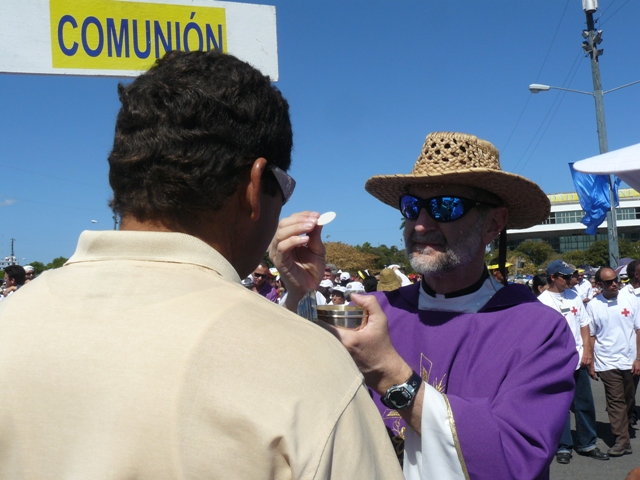
holy jama!


As anti-climactic as the Immaculate Conception: I’m sure you’ve already divined that the religious importance of having his Holiness here held no interest for me and in this I’m not alone: I’ve never seen an event so thinly attended in the iconic Plaza de la Revolución in my 10 years here. In fact, we strolled into the central area just a few moments before the 9:30 mass kicked off and were going against the current of people streaming away from the square. “I came and took the pictures I wanted; I’m going home,” a friend I ran into said. The curiosity seekers and thin crowds were surprising but make sense: as a whole, Cubans just aren’t that church-y. Religious and faith-bound, yes, but that’s different from kneeling before a man in a dress and goofy hat while he proselytizes a doctrine peppered with sins bound to doom your mortal soul. Cubans just aren’t down with that, but they do love a spectacle: one of my favorite moments was when a women who wanted to taste the host tried to fake her way through the motions while the priest held the wafer aloft. When he caught on, he patted her on the head and returned the host to his jaba. Though the Pope himself failed to inspire, Cubans never do.

Notes

1. This, Fidel and I have in common, except those same Jesuits expelled me my junior year (another story entirely!)

2. A simple example: journalists arrive here and compose some flaccid or purply prose (even leading with it occasionally, dios mío) about all the old cars rumbling about. For those of us with continuity here, that’s ‘dog bites man.’ The more compelling, ‘man bites dog’ story is the unbelievable amount of new cars on the road and what that means for traffic, transport options, pollution, etc.

3. The press conference by Foreign Minister Bruno Rodriguez upon the Pope’s arrival is case in point: his response to an English-speaking reporter about “freedom of consciousness” was elegant and sweeping in the original Spanish, mangled and less inspired in English.

4. Cuba has limited bandwidth due to the US embargo-cum-blockade which prohibits the island from connecting to underwater cables running nearby. Instead, the connection for the entire island is provided by a sole, slow Italian satellite. This bandwidth was prioritized for visiting press so they could report live from Cuba. It’s back now, thankfully, obviously.
19 Comments

Filed under Americans in cuba, Cuban customs, Cuban idiosyncracies, Cuban Revolution, Expat life, Fidel Castro, Living Abroad, Raul Castro, Travel to Cuba

Black Market a lo Cubano

[tweetmeme source=”connergo” only_single=false]

If you follow my blog or any similarly semi-intelligent Cuba-related news outlet, you know that things are fast a-changin’ on this side of the Straits. For those out of the loop: in April, 2011, a series of unprecedented policies – which amount to a new (and not without substantial risk) economic paradigm for the country – were approved at the Sixth Communist Party Congress (see note 1).

Though some of my Cuban friends gripe that change isn’t happening fast enough, I’ve been surprised by how many new policies have come to pass as promised: private sales of homes and cars, relaxed regulations for paladares and casas particulares, and the approval of nearly 200 pursuits and services for private enterprise. Other movement towards so-called normalcy is slower and more complicated still: unifying the two official currencies, salary increases, and phasing out the permiso de salida (see note 2) among them.

What these changes will mean for the most vulnerable remains to be seen and I have not a few friends here tormented by uncertainty, anxiety, and a generalized malaise in the face of it all. Uppermost in their hearts and minds: what might these changes mean for the political, social, and ethical tenor of the revolutionary project so many have fought so long to strengthen and so hard to save?

Some days it feels like it’s all going kablooey – that the Cuba we’ve known is reserved now for dewy-eyed nostalgics fingering grainy photos of the 10 million ton harvest. And this is heart breaking to people who have survived so much drama and tragedy: the rending of families in the 60s and 70s, (plus the Bay of Pigs and Missile Crisis), followed by the Mariel boat lift and collapse of the Eastern Bloc in the 80s which led to the torturous Special Period of the 90s. Then there was Fidel passing the baton to hermanito Raúl which I guarantee looks different from your off-island perspective than from ours here in Havana. And let’s not forget the 50 years of sabotage (both bald-faced and covert) by the behemoth to the north, to say nothing of terrorist attacks by US-sheltered individuals and groups.

So before it all goes kaboom (a day late and a dollar short, perhaps?), I’m determined to document the Cuba I’ve known for the past 10 years and the attendant change as accurately, responsibly, and comprehensively as possible. Today, I turn to an examination of the black market.

Jeans and stilettos, perfume and gas. Cigars of course, but also ice cream (Coppelia, the country’s best), and iMacs, milk and meat: it’s all available on Havana’s black market – if you have the hookup or happen upon someone “repurposing” Cuban Clorox or café. In the interest of full disclosure, I have very little direct experience with the black market (or parallel market as Cubans call it) despite a decade in residence; I have no car, so no need for gas, I buy my meat off the cement, fly-spotted counters at my local carnicería, and would love a Mac but don’t earn enough to join that club. Besides, all that shit is stolen (see note 3) and I’ve had enough stuff vicked in my life to know that if you ain’t part of the stolen goods solution, you’re definitely part of the problem.

But then the moral high ground begins to shift (Cuba is funny like that).

—–

Every once in a while, a kind-faced granny shows up at my door selling either eggs (see note 4) or powdered milk – a key ingredient in the Cuban kitchen. Someone on the block must have told her an extranjera lives in Apt 5 because she came straight to my door that first time, knocked hard and called me La Rusa (“The Russian” – old stereotypes die hard). She’s a bit gnarled and I can tell from the edge in her voice and the fade of her blouse that times are tough for the milk-peddling abuelita. Unfortunately, when I need eggs, she has milk; when I want milk, she has eggs. So even though I was keen to help her out, our supply and demand algorithm never quite jived. Last week, her friendly face appeared anew at my door.

“I have eggs,” she said.

“So do I. How about milk?” I asked.

She didn’t have any that day but promised to “resolve” some; I promised to buy it once she did.

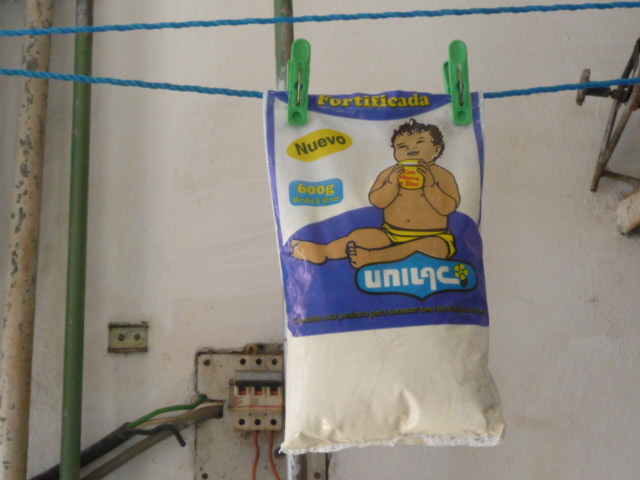
Sitting in my office yesterday whittling a Tweet down to 140 characters instead of working, I once again heard her hearty knock at my door. Smiling big, she told me she had three sacks of milk for sale at $2 a pop (a 50 cent savings over the official store price). I agreed to take one, glad I was finally getting the chance to help out granny. Until she pulled the sachet from her frayed knapsack: I, we both, were taking milk from the mouths of Cuban babes. What my elderly friend was selling was the milk the government guarantees to every child under 7 and I’d just purchased 600 grams of it. I knew that milk wasn’t going to be too tasty. 

—–

This transaction got me to thinking about where all this stolen stuff comes from and put me in mind of my friend Alberto. He has an old Lada on which his livelihood depends. Driving around recently, I noticed a balón de gas (the 20-lb tanks used here for home cooking) wedged behind his seat. Seems Alberto had converted his gas-powered car into a propane-propelled one.

This was a smart investment on his part: although the conversion kit cost $350 and had to be imported from abroad, Alberto fills that tank – which takes him 120 km or so – on the black market for just $5. By way of comparison, that same $5 would buy 15 liters of real gas on the black market; just over four at the pump. I’m glad Alberto has figured a way to enlarge his margins, but wonder about the families who show up to fill their kitchen tanks to be told “no hay” (there isn’t any).

This same pattern repeats itself with steaks and blocks of Gouda, stamps for official paperwork (I was surprised to be asked to produce receipts for my bank-bought stamps on my last visit to immigration) and cooking oil. And while I can appreciate the need for every last Cuban having to do something (or something extra-legal) to make ends meet, the more I parse the situation, the more unsettling it becomes.

And it makes me realize that a certain amount of that aforementioned moral ground is shifting below my feet. At these times I’m forced to ask myself: is this is a part of Cuban culture I wish to participate in? Unluckily for my milk-thieving granny, it is not. But I’m sure she’ll find other clients: as long as there are commodities like oil, meat, and milk to “redirect,” and resell for pure profit, folks will do it.

 As I said: old habits die hard.

 Notes

1. These political powwows are held every so often (the last was in 1997) or mejor dicho: whenever sufficient excrement threatens to make contact with the cooling element, if you know what I mean.

2. All of these issues came to the fore in nationwide public referendum-type debates held in late 2010. The permiso de salida is an exit permit which is mandatory for overseas travel by Cubans and residents. It earns the country revenue, but is also a barrier to travel – an issue that has to be reconciled somehow and soon.

 3. Except the goods in the black market Mac store. None of this is stolen, but rather all new, in-the-box gear with warranty and all, purchased in Miami and spirited into the country.

 4. Eggs aren’t usually stolen either, but rather the product of home-raised hens.

25 Comments

Filed under Americans in cuba, Cuban customs, Cuban economy, Cuban idiosyncracies, Cuban phrases, Cuban Revolution, Expat life, Fidel Castro, Living Abroad, Raul Castro, Travel to Cuba

The Cuban Food Question

[tweetmeme source=”connergo” only_single=false]Not questionable Cuban food, mind you, but questions about Cuban food which continue to dog me, even after 10 years here, like: why are there no croutons? Or guacamole? And why don’t Cubans cook with coconut (Baracoa excepted)? Or bacon? I mean, it’s not as if there aren’t enough cocos and pigs to go around. To be fair, bacon is making inroads (see note 1) and I’ve seen a couple of coconut dishes here in Havana, but a tasty use for stale bread and old avocados?! You’d think the frugal out of necessity and habit Cubans, people who always use a tea bag twice and for whom disposable diaper is an oxymoron would be all over these past expiration date preparations. But no.

As devoted readers of this blog well know, I’m preoccupied with food, maybe disproportionately so, but that’s what happens when your formative years are spent in a food insecure home (see note 2). Whether that’s the reason my mom and siblings are such avid, fantastic cooks, I can’t say, but it rubbed off on me. This devotion to inventive, well prepared food coupled with the hundreds of restaurants, bistros, cafés, buffets, and drive-ins (Hawaiian kine) I’ve had to review for guidebooks makes me an expert of sorts (the bad, overly critical kind perhaps, but hey, someone has to steer you clear of shitty food in your travels).

Not surprisingly, I’m both excited and wary about the explosion of new restaurants in Havana. Excited because the quality and diversity of menus are improving – even in state restaurants which seem to be upping their game in the face of stiffer competition. Wary because I know how horrifyingly crappy Cuban food can be and the tricks used to try and cover the fact. At the same time, I’m concerned for my fellow travelers since everyone is writing about these new eateries, including amateurs and hacks who are dangerously unqualified – either due to a lack of regard for good food in general or ignorance of Cuban cooking and context specifically. These poseurs shall remain nameless, (that would be tacky), but their “work” on the topic has motivated me to help out with some observations about eating in my fair city.

All the examples below are from new paladares which are currently or soon will be listed in my app Havana Good Time.

An Indian restaurant sans raita – So Cuba has its first “Indian” restaurant (note quotation marks people – punctuation has a function!). The space is quite lovely and the staff is attentive, but the food? Like the guy I lost my virginity to, being the first is not enough to win me over. I know, I know, I should be thankful that we even have an “Indian” restaurant here (see note 3), but you know what? I cook better Indian food and mine is accompanied by the requisite raita. For those not familiar with Indian cuisine, this traditional sauce is used to cut the spiciness of dishes while adding a dynamic flavor layer to the palate. And before you jump down my throat about the unavailability of certain ingredients here in Cuba: raita is yogurt, cucumbers, and garlic – three items that rarely go missing here in Havana.

“Vegetarian” spring rolls – It’s really too bad that the new Vedado paladar serving this toothsome finger food doesn’t heed punctuation as religiously as we do: when I cut into one of these rolls recently, out spilled bok choy, scallions, cabbage, carrots and…ham. When I asked the waitress (nicely, my shoulders unburdened of any NYC or foodie chip) what was in these rolls, she confirmed the presence of the ever-present pork. I pointed out that this could result in some serious problems – not only with vegetarians (see note 4), but also with Jews and Muslims too, who take as much solace as herbivores to see vegetarian selections on the typically pork-laden Cuban menu. When I asked why they call them “vegetarian,” she said with a straight face: ‘because there are lots of vegetables in there.’ 

Deep fried olives are considered nouvelle cuisine – I don’t know what was more shocking: seeing something besides Gouda cubes and croquettes as hors d’oeuvres or the realization that they had actually deep fried olives to serve to a group of foreign VIPs. While far from heart healthy, I have to admit these were disconcertingly tasty, which can be said for almost anything except the deep fried cucumbers I had last week. Both of these examples, by the way, hail from Habana Vieja, part of Eusebio Leal’s wickedly clever fiefdom (which is usually head and shoulders above regular state enterprises). Alas, sophistication is not an overly common Cuban trait, as evidenced by…

Oil & vinegar, the one and only dressing – Sure, you might get a nice honey Dijon in someone’s home, but in a high end paladar? Not likely, where the same tired oil-vinegar- salt trio prevails (lucky you if that exotic spice we call black pepper is available!).  A few places are starting to provide balsamic and olive oil, considering this the height of haute, showing how far we are from raspberry vinaigrettes or tahini-lemon dressing. Granted, raspberry vinegar and sesame paste are in short supply here, but honey, Dijon, blue cheese, anchovies, capers, soy sauce and many other ingredients for inventive dressings are available sin problema.  But this lack of sophistication is even more blatant in the place with…

Busty waitresses in low-cut blouses and Daisy Dukes – I don’t care how hot you are (or think you are or your manager thinks you are): I don’t want my steak served with more flesh in my face than Copacabana sees in summertime. In a word: inappropriate! Especially at this expensive high-end restaurant featured recently in several glossy magazines (which made a glaring omission of the “uniforms;” unsurprisingly, all the articles were written by men). Havana Hooters anyone?

The $4 fruit shake – Argue with me all you want (welcome to the club!), but this is simply wrong in our context and distorts the local economy like the thousands of bright-eyed NGO workers who rush into post-disaster Haiti or Indonesia and pay triple the going price for bananas, potable water, taxis, whatever. To all the new places offering the four dollar shakes and similar: consider yourself boycotted on GPs.

Musing about all this leads me to believe the absence of croutons, guacamole, and coconut-based dishes is due to lack of knowledge, experience, creativity, motivation, or a combination thereof.

What do you think readers? Any surprising omissions in your Cuban culinary travels?

Notes

1. I predict crispy bacon (not the flaccid, fatty crap at hotel buffet troughs) will explode in popularity as US visitors continue to pour in and restaurateurs realize the egg/bacon/toast triumvirate is as American as inequity.

2. Mom was a single mother of four which made her, out of necessity and habit, a creative, but stretched cook (and very Cuba in her way which is a big factor as to why I’ve been able to survive/thrive in the peculiar conditions on this side of the Straits. Epigenetics might have something to do with it too). We all remember with a shudder living on oatmeal for two weeks solid and the fight over who got more noodles. This fracas is still dragged out to this day – but in the best, sibling rivalry type of way now that our oatmeal and noodle days are behind us.

3. In the interest of full disclosure: everyone I’ve talked to who has eaten there – visitor and Cuban alike – was very impressed with the place which means one of two things: my standards are too high or theirs are too low.

4. I have seen a strict vegetarian take a bite into an egg roll he was told was 100% veggies and the resulting fisticuffs – never underestimate the strength and rage of a pissed off vegetarian!

41 Comments

Filed under cuban cooking, Cuban economy, Cuban idiosyncracies, Travel to Cuba

Conner’s Cuba Rules Part II

[tweetmeme source=”connergo” only_single=false] About six months ago I wrote Conner’s Cuba Rules, a super popular post that raised the ire of some readers. Rereading my musings six months later, I better understand some of the dissent offered by commenters. Given that much has changed here in Havana since then and I’ve had several opportunities to travel outside of the capital thanks to my day job, I’ve compiled a new, hopefully more positive, set of rules to complement the first ones.

The Revolution will be televised: I’ve met a lot of visitors (and even some foreign residents) who have never seen Televisión Cubana. Granted, there are only five channels here, but you’re missing out on a big chunk of Cuban culture if you don’t surf those five at least occassionally. For the intersection of politics and journalism, check out the Mesa Redonda (see note 1) and the prime time news. The latter is important in and of itself for the weather report; pay special attention if Dr José Rubiera is forecasting. Meanwhile, a good baseball game can rivet entire households, the novela even more so. Only if you watch TV here will you understand what Cubans mean when they say: “it was like the Saturday night movie” (see note 2). Meanwhile, the music shown down here – videos, documentaries, concerts and jam sessions – can be as moving as the live thing. I’ve seen Chucho Valdés, Clapton and Queen, the Festival of Modern Drumming and some guy from Uzbekistan singing Talk Boom, a riveting song I’m still trying to track down – all in a single night on Televisión Cubana. Watch it; you’ll like it (or at least get a good laugh or song lead).

Pack a sense of humor: It always amazes me when I read something that disregards, overlooks, or otherwise fails to recognize the Cuban sense of humor, which ranges from the side splitting to the sublime. The writer can be someone who knows and loves Cuba long time or a visitor who has parachuted in and out on vacation. No matter the source, the frequency with which folks miss the funny stuff here is alarming. It’s true, a lot depends on speaking Spanish (or a crackerjack translator), but however you resolve the language question, if you’re comparing Cuba to China, Vietnam, or the defunct USSR, you’re missing one of the most important ingredients in the Cuban character. These folks love to share stories, jokes, and the occassional tall tale, and use their verbal prowess to enliven, laugh, and woo; it is what has enabled these people to resist so much for so long. Even without Spanish skills or a translator, if you’re not laughing a lot on a visit here, you’re doing something wrong in my personal and professional opinion (see note 3).

Use pesos cubanos: If you know even a little about Cuba, you know we operate on a dual currency system with pesos cubanos and pesos convertibles circulating side by side. Since one of my goals of Here is Havana is to bust myths, I always take the opportunity to debunk one of the most pervasive: that foreigners cannot use pesos cubanos (AKA Moneda Nacional, MN), but only pesos convertibles (AKA divisa, chavitos, CUC). This is 100% false. Anyone can use either currency. It’s what each can buy where the difference lies. Certain goods and services, for example, are only available in CUC including cooking oil and butter, hotel rooms and the internet. But fruits and veggies, surprisingly pleasant cigars, fixed route taxis, movie tickets and lots of other stuff are sold in pesos cubanos – if you know where to look. My advice? Change some CUCs into MN (1:24) to experience firsthand how much pesos cubanos can buy and how the double economy works.

So as to avoid confusion +/o more myths: you can always pay for goods and services priced in pesos cubanos with hard currency pesos convertibles but never the other way around. And some services (interprovincial buses, concert and ballet tickets) are sold in pesos cubanos to Cubans and residents, but in hard currency to visitors.

Bring your own reading material: Rarely a week goes by when someone isn’t griping to me about the lack of English-language books and magazines here. What is available is largely limited to historical and political titles and they are very expensive (and make for dull beach reading besides). The Kindle can be handy in this regard, but the bonus to bringing print publications is that you can pass them along to some avid English reader (like me!) upon departure. Drop me a line if you have some good (ie no romance novels or sci fi pulp) English-language reading material to donate to the cause.

Hightail it out of Havana: This may seem contradictory, given that I have an iApp to the city and I recommend in my guidebooks and elsewhere that visitors consider basing their entire trip in Havana. But things are changing fast here and though I’m a city girl by birth and breeding, I’m back peddling a bit on that advice. Havana, with its dirt, garbage, and graft, noise and air pollution, and materialistic ways (I did call Habaneros ‘logo whores’ after all) is distorting Cuba’s image. In short, Havana is not Cuba, which can be said of every major city around the world from New York to Manila, Managua to Dakar. But since visitors often request recommendations for “authentic” experiences and how to discover the “real” Cuba, I now find it prudent to advise getting out of Havana and exploring farther afield. With more flights, both charter and commercial, to provincial capitals like Holguín, Camagüey, and Santiago de Cuba, this is also a more practical proposition than ever.

Above all, have fun and keep your head about you!

Notes

1. The Mesa Redonda (Round Table) is a nightly “debate” show which discusses a topic (US aggression overseas; Latin American intregration) on which all four guests and the modeator agree.There are many jokes in these parts about the program; the shortest and sweetest calls it the Mesa Cuadrada, meaning ‘Square Table’ in literal Spanish, but meaning something more along the lines of ‘Dogmatic Table’ in Cuban.

2. The Saturday night movie here is prefaced by a parental warning, the most common of which alerts viewers that the Hollywood action shlock about to be shown contains Nudity, Violence, & Foul Language. To wit: the old, slow, over-crowded camello buses (of which I took many), were always called ‘the Saturday night movie.’ [NB: did it annoy you to have to scroll down to read this note? Yeah, me too, but I haven’t been able to figure out how to hyperlink notes within posts; if someone has a solution, please get in touch].

3. Trying to connect to and use the internet excepted. Even casual visitors know that connectivity is no laughing matter here. Indeed, I flirted with the ledge and sharp knives today as I frittered away several hours trying to connect. Once I “succeeded,” it topped out at 9.6kbps – not nearly fast enough to load even a simple web page before timing out.

30 Comments

Filed under Americans in cuba, cigars, Communications, Cuban customs, Cuban economy, Cuban idiosyncracies, Cuban Revolution, Expat life, Living Abroad, lonely planet guidebooks, Travel to Cuba

How to Cope Like A Cuban

[tweetmeme source=”connergo” only_single=false]I’ve got a friend – I’ll call her Lucia. Life has been a bitch for Lucia in that special Cuban kind of way with family torn asunder by bi-lateralpolar politics; dramatic affairs of the heart and all the ardor and betrayal that implies; and the exhaustion inherent in raising three kids – the oldest two during those hard, indelible times known as the Periodo Especial, when stomachs growled and cramped with hunger and entire days were spent in blackout. The Special Period was also when mobs of people cast their fate to the wind, water, and sharks on slap-dash rafts with a 50/50 chance of making it across the Straits.

Many of those poor souls failed in their attempt to escape, dying outright en route or otherwise kept from stumbling into the open arms of Uncle Sam (see note 1). With a forced smile exemplifying the Cuban dicho ‘mal tiempo, buena cara,’ Lucia waved goodbye to friends and family, colleagues and acquaintances as they emigrated north. Due to circumstances financial and otherwise, many of Lucia’s people – including her only sister and two childhood friends – can’t return to visit Cuba. Like so many people I know, Lucia dreams of sharing a Cristal wet with sweat in the honeyed Havana light with her loved ones.

Paddling away on a raft or zipping off in a lancha (regular weekly departures for $10,000 a head) is the most dramatic and dangerous means of escape, but there are others: marrying a foreigner is perennially popular, as is the slower (but somehow less tedious) application for the bombo (see note 2); securing a Spanish passport if your family descends from those parts; or quedándose on a trip abroad. That is: going overseas for work or as a tourist (yes, some Cubans do travel for shopping pleasure) and neglecting to get on the plane back. To give you an idea of how profoundly the emigration question touches Cubans, consider ‘La Visa,’ the latest schoolyard game whereby a ball is thrown in the air and a country shouted out – Yuma! Mexico! España! The kid who catches the ball ‘gets’ the corresponding visa.

But contrary to what the world has been led to believe, there are more Cubans who don’t want to leave than do. Like Lucia. Like my husband and his family. Like many of my co-workers. But just because they aren’t scheming their great escape doesn’t mean they don’t feel trapped now and again. Hemmed in by water, but also bureaucracy, Third World economics, politics and other factors quite beyond one’s control – who wouldn’t be? It’s trying at times and requires figurative escapes – coping mechanisms to mollify the madness and loosen the psychological pretzel island living engenders.

In no particular order:

Sex, drugs, and rock ‘n roll: The Cuban penchant (and talent) for sex is legendary and sexual freedom in the form of multiple partners and the pursuit and conquest of same is part and parcel of our daily landscape. Not only is hooking up freeing in the personal sovereignty sense in that it affirms (however hollowly), one’s individual choice and control, but it’s also free entertainment. The flirting and dancing and piropos (pick up lines and compliments) and foreplay help keep boredom (however temporarily) at bay and serve as an escape from all those factors beyond our control.

Drugs – illicit or not – serve the same purpose and despite Granma’s assertion that drogas aren’t a health problem here, 10 years of living in Havana paints a different picture. I know more than a handful of hardcore drunks for example, and prescription pills are in such high demand family doctors have been trained how to handle patients angling for scripts. Marijuana and cocaine can be had at no small risk and price (see note 3) and I’ve heard about Cuban acid trips and X adventures. Rock ‘n roll (coupled with rolls in the hay) is my personal drug of choice and in this, I’m largely up shit’s creek here since Cuba has crappy rock, though regular gigs by accomplished cover bands like Los Kents provide certain succor.

The Novela: Soap operas are addicting, which you well know if you’ve spent any amount of time in Cuba, where ‘round about nine o’clock the city quietly retreats inside to catch the next installment. Brazilian, Argentine, Cuban – it doesn’t matter the origin, as long as the cast is beautiful, the food abundant and the tragedia delicious. These fantasy worlds provide needed escape for islanders of all stripes, from housewives to priests, cowboys to convicts. On December 31st, a hallowed night spent with family here, the clan licked pork fat from their fingers and waited to pop the cider that stands in for champagne here when all the women mysteriously melted away. ‘La novela,’ someone said when I asked after them. Even Fidel has interrupted one of his televised speeches to assure viewers he wouldn’t run over into the soap opera. If you think I’m kidding about soaps as serious escape, consider that two TV households aren’t uncommon here: one for those who want to watch the novela, another for watching pelota. Homes with just one set become divided and bicker-ridden when the soaps and baseball are simulcast.

DVDs: Even before the explosion of private entrepreneurs selling pirated DVDs descended upon us, Cubans habitually rented and copied movies (or entire seasons of their favorite soap), on VHS and now on DVD and in digital formats. Last week as I looked to buy a 5 movie combo from my neighborhood pirate, the saleswoman nodded knowingly when I told her I was looking for something to ‘desconectarme,’ to ‘saca el plug.’ Whether at home or in the theater, cinematic escape is familiar to all Cubans and the saleswoman had no trouble plucking a DVD from the rack with Moneyball, New Year’s Eve, and three other recent releases.

Sports: Technically (and for all the old timers), baseball may be the national sport, but football/soccer is making a play for the title. Every day in the park near my house, local kids field two full teams and kick up the dirt in bare feet as they drive towards the goal. When Barça or Real Madrid play, the bars are packed with fans wearing their colors who unleash a fury once reserved for the Industriales baseball club and national volleyball team. I’m not surprised that booting a little black and white ball about for millions of dollars while having all the super models, fast cars, and sprawling properties your heart desires is the escape-cum-dream package for so many Cubans.

And that’s what it’s all about, friends: the dream. Not the American one or the European one. Nor the dream of fame and fortune those places symbolize (but rarely actualize) for so many from points south. Just the dream, in and of itself regardless of time, space or place. This is what’s essential. We all have them. We all have the right to them. I encourage everyone, everywhere to embrace, as I have, my mom’s sage advice: ‘live your dreams.’ No matter what they are or where they may take you.

In the words of Blondie: “I’ll build a road in gold just to have some dreaming. Dreaming is free.”

Notes

1. The USA has an extra special immigration policy for Cubans known as ‘wet foot/dry foot’ whereby any Cubano who is able to touch toe to hallowed US ground is granted automatic residency in the Land o’ the Free. This ‘advance to Go, collect $200’ dangled before Cubans (and only Cubans) means would-be immigrants from this island are even more reckless than their nothing-left-to-lose brethren from other latitudes, risking life and limb to reach the USA. Again and again, it has proven fatal (Elián González ring a bell?).

2. Other extra special Cuban immigration rules coming from the USA include this emigration visa, 20,000 of which are pledged under current accords (Obama re-instated this old policy suspended by Bush Hijo).

3. I strongly advise everyone reading this against trying to procure illicit drugs here; see Locked Up Abroad.

20 Comments

Filed under Americans in cuba, bureacracy, Cuban customs, Cuban idiosyncracies, Cuban phrases, dream destinations, Expat life, Fidel Castro, Living Abroad, Travel to Cuba

Cuban Juju: New Year’s & Beyond

[tweetmeme source=”connergo” only_single=false]

Havana is a place that holds dear its superstitions and traditions. Where the former leaves off and the latter begins is a tough and tangled business, thanks in part to the very serious and more relevant and prevalent than you might imagine AfroCuban juju floating about the island. While slaves were being forced over here from the Congo and the Gambia, Senegal and Nigeria, bringing their rich and powerful belief systems with them, the Spanish colonists and Catholic Church (the Imperialist 1% digamos) were also in the mix, inventing Cuban traditions.

This wasn’t an entirely innocent affair, I learned recently from Fernando Martínez Heredia (among the country’s most knowledgeable and respected historians), as he worked the rocker in my living room and regaled me with the whole ignoble story about the arrival of the Virgen de la Caridad del Cobre on these shores. According to the legend, Cuba’s patron saint floated into the Bay of Nipe 400 years ago to save three local fisherman adrift in their skiff. With the seas threatening to capsize and surely kill the two mulatto hermanos and young slave aboard, a beautiful, diminutive black virgin floated towards the pobres, the raft on which she rode inscribed with the message: “I am the Virgin of Charity.” With her appearance, the sea instantly and magically calmed, becoming flat as a plate, as we say here.

A legend so pat and serendipitous begs certain questions: Exactly what would they be fishing for in that inland bay? ‘There are no fish worth the time in Nipe,’ Fernando observes. And what of the message, carried by the trio back to the folks living in the area? ‘How convenient that those guys could read – unheard of at the time for people of their station – and Spanish no less,’ my favorite historian continues. But what’s truly intriguing, says Fernando (and I agree), is the appearance, at this precise time, of similar virgins elsewhere in Latin America – the Virgen del Cobre, the Virgen de Guadalupe in Mexico, St Rose of Lima. Turns out there was nothing coincidental or mystical about this plethora of virgins: secular and clerical big wigs determined that consolidating power over their far flung New World colonies required a spiritual component beyond the Father, Son and Holy Ghost. So they created her (see note 1).

But the Spanish also introduced more benign customs, many of which mixed with those of African slaves of yore, more modern traditions and superstitions from around the globe, and others which are purely, wonderfully Cuban. In short, the traditions we observe here are an ajiaco, a stew of culture and influences that mirror Cuban society itself.

Need a karmic boost or extra dash of good luck? Visit El Caballero de Paris, frozen in midstride at the doorstep to the Iglesia de San Francisco de Asís and give his bronze beard a stroke or two – already polished to a high sheen by untold masses who have thusly petitioned for luck before you. If things are such that more pro-active measures are required, drop a coin (the bigger, the better!) down the wishing well at the opulent entrance to the Hotel Nacional; utter your desire aloud and hopefully it will come true.

When you really need to invoke the city’s store of good luck, taking three turns around the sacred ceiba facing El Templete each November 16 is an age-old Cuban tradition (dating back to those Spaniards again) for improving one’s lot or luck. Don’t forget to lay some coins at the base of the tree for extra aché (folks in the know tell me it can be CUCs or pesos cubanos since the spirits also maneuver in the double economy). And speaking of age old traditions: who hasn’t seen the red ribbons flying from the undercarriage of every Lada and Buick, Mitsubishi, and Muscovich around here? De rigueur, this good luck charm for the open road.

Sometimes I think Cubans take all this superstition stuff a bit too far, like trying to ward off evil spirits with strong scents. Why else would someone burn incense in a bakery of all places or douse themselves so early and often with cheap, noxious perfume? More than once I’ve come home from clubs or alit from cars, my taste buds coated with someone’s idea of a come-hither scent. But I digress…

Where traditions and superstitions really gain traction here is on New Year’s Eve. There’s the costumbre of eating 12 grapes on the last day of the year – one for each month, a wish made with each fruit popped into your mouth. This comes from the Spanish I’m told, but I’ve yet to take a shine to this ritual: it seems greedy to make a dozen wishes (I’d be happy with just one or three), plus grapes cost $4/lb here, so it makes for a pricey gambit.

Maybe you’ve been unfortunate enough to be walking under a balcony or open window ‘round midnight on December 31st, in which case you were unexpectedly and unceremoniously drenched by falling waters (don’t worry: it’s clean). One of our endearing and enduring traditions here is to heave a bucket of water out the window at the stroke of midnight, the idea being that you’re chucking all the bad shit from the year previous. I don’t know where this tradition originated (neither do any of the Cubans I’ve been asking), but I was the first at our party with bucket at the ready once 2011 was over and done with.

By far, my favorite New Year’s tradition (aside from religiously observing it with family while stuffing myself silly with roast pork and yucca and smoking one of the amazing high quality cigars that always come my way this time of year) is the walk around the block with your suitcase – a tradition/superstition that improves your chances of traveling in the upcoming year.

On a balcony overlooking the Malecón this December 31st, I ducked falling waters while the cannons boomed across the Bay, couples kissed, and glasses clinked. A sultry wind blew and I waved with delight at all the folks streaming from their homes to wheel their luggage over buckling sidewalks and potholed streets.

To all of you wishing to travel or hoping to fall in love, entreating the spirits for good health or a prosperous 2012, I toast you and hope all your dreams come true. To Cuba and all my friends and family here, there, and elsewhere: I raise my glass with love and respect and hope we continue to reap what we sow.

2012: We’ve got high hopes, in spite of it all.

Feliz Año Nuevo everyone.

POSTSCRIPT

Ive been talking to folks here about their New Year’s traditions since writing this post and a few have mentioned burning all that’s bad from the previous year in curbside fires in Boyeros y mas alla (mentioned by Kristen in comments below), while in Artemisa they burn effigies made of old clothes and such. The dirty water  (and much less toilet water – mentioned by Yemaya in the comments below) doesn’t have any adherents I’ve asked, but we do agree that we won’t be drinking sugar water this year, in accordance with Ifa’s  letra del ano.

Notes

1. You may have heard about La Virgencita’s recent tour around the island. If not, you’ll definitely hear about her as 2012 unfolds since The Pope’s visit to Cuba has been confirmed for March 26-28; his trip kicks off in Santiago de Cuba and a pilgrimage to meet the Virgen.

22 Comments

Filed under Cuban customs, Cuban idiosyncracies, Cuban phrases, Living Abroad

Cuba Contradictory

[tweetmeme source=”connergo” only_single=false]While other bloggers are making their end-of-year lists, I’m just waiting for this year to end. Loss and sorrow is what 2011 has meant for me and while a turn of the calendar page won’t cure what ails me, you, or the world, it can provide a dose of hope – false and fleeting as it may be – to help us keep on stepping. Like a car with an empty gas tank, the warning light red and taunting, we know we’re running on fumes, but moving forward nonetheless; ‘bound to cover just a little more ground,’ as the song goes.

Havana circa December 2011 feels similar: we may be running on fumes, but at least we’re still running.

But that’s today. Other days, Havana hops with energy and enthusiasm and drive, where the theme song is instead ‘How do you like it? How do you like it? More, more, more’ – more millennial and hip, more sophisticated and noteworthy. This fuel injection comes from new economic regulations permitting private businesses, the buying and selling of cars and homes, and relaxed travel rules by Obama for Cubans in the USA wanting to visit family on the island (see note 1).

So how Havana feels largely depends on the day you measure her. And your outlook, what you see and experience, and who you talk to. Just like anywhere else, I suppose (if you’re paying close enough attention), except this place is like nowhere else. The contradictions are starker, more frequent, funnier.

Here are some that have caught my attention recently:

The Limousine/Ox-Drawn Cart

When Cubans of a certain means and bent get married, the bride and groom tour around town in a convertible festooned with satin bows, the novia perched atop the back seat waving to passersby while the driver lays on the horn (some honk out the wedding march, others the Godfather theme). But a few days ago, I crossed paths with the newest fad of the nouveau riche: the black tinted stretch limo (there’s only one) rented from Rex Autos covered in the same satin bows. There was no horn honking, however, and no visible bride – defeating entirely the purpose of showing off to plebes and passersby. I guess the thrill of a limo ride is reward enough for some and it did turn heads, including mine.

A short time later, I waited as two oxen were maneuvered with coos and stick by their expert handler. They carted behind them the water tank (known as the pipa in these parts), that makes the rounds of neighborhoods without municipal water. The pipa is the savior of all those homes and families which only have water un día sí, un día no (or even more infrequently).

Stretch limos and oxen carts; conspicuous consumption and water shortages: Es Cuba, my friends.

Penthouse Too Big/House Too Small

Estrella lives in a propiedad horizontal – a floor-through apartment. And it’s a penthouse no less. These huge, luxurious flats are found throughout Vedado high-rises and are more reminiscent of Manhattan than Havana. They usually feature phenomenal city and sea views but are also a pain in the ass – hard to clean and maintain, they’re also a real liability during hurricanes when their height, exposure, and plate glass windows put them in direct path and danger of the elements. For these reasons, Estrella is looking to permutar her penthouse for something closer to the ground, a more manageable home in short.

Contrast this with my friend Gloria – 68 and a spitfire who has dedicated her life’s work to helping the revolution work, she shares a bedroom with her 6-year old grandson and 10-year old granddaughter. If you know Cuba and the housing crisis we’re in, you know multi-generational sleeping arrangements are common. Except in Gloria’s case, she not only shares the room with her grandkids, but a double bed with the boy to boot. Sadly, this is also not terribly uncommon.

Both Estrella and Gloria are equally revolutionary and politically committed; this too, is Cuba, dear readers.

Chocolate-filled Churros/Pallid Pizza

As the new economic regulations gel, Cubans are figuring ways to live with the Gordian Knot that is capitalism. Folks with money to invest and a head for business are differentiating their products and services – and making money hand over fist as a result. The full-service car wash that everyone is talking about is one example of entrepreneurial pluck and vision, as is the nearby scuba school. Since I have no car and don’t dive, these are simply a curiosity for me. Not so the cafeteria selling chocolate-filled churros; jamaliche that I am, this development piqued my interest. Using a machine imported from Ecuador, these folks crank out a fried, filled sweet treat that drives Cubans gaga – and all for the nice price of 3 pesos (less than 15 cents). Also taking the city by storm is the burger and pizza joint with one of those inflatable playhouses kids love so much in the yard. While the kids jump and play, their parents nosh and drink, dropping a bundle in the process. According to my sources, this cafeteria is netting 1500 pesos a day (around $62 – not bad for a startup here).

Meanwhile, block upon block of new cafeterias sell the same forgettable hot dogs and egg sandwiches, bread spread with cloying mayo or croquettes. Some of these places serve terrible food – tasteless or cold, on day old bread or presented to customers just after the flies have been swatted away. Last week, I stopped by a new cafeteria in my neighborhood selling the smallest, palest, saddest pizza I’ve ever seen. With cheese congealing (despite being placed beneath an office lamp), the pathetic pizza sold at Rapidos around town look delectable in comparison. No wonder the government estimates 80% of these new businesses will fail within a year.

The contradictions abound caballeros. Every human and society has them. But we’ve recently had many complexities introduced into our reality here on the island which are deepening these contradictions. It’s a confusing time – anxiety-ridden once you scratch the surface – but it seems these complexities have also sparked a new line of critical thinking and reflection.

Over several visits with different friends and families over the past week, discussions have turned on the theory and opinion that what we’re experiencing today can largely be chalked up to the Special Period – that time in the 90s when the Cuban economy crashed and burned, threatening to take the Revolution with it. So that wouldn’t come to pass, people tightened their belts, took a hold of their bootstraps, and sallied forth. But at a cost. These conversations didn’t focus on what the new economy is or isn’t doing for our present, but rather the hard times of the past and how they eroded values, placed the pursuit of things over relationships, and planted the seeds of individual survival over the collective.

“We used to live here so naturally.”

“People changed overnight.”

“It was 180° turn, fast and dizzying.”

These are some of the comments made to me recently about those trying years, but in relation to our current situation. Interesting food for thought and worth recalling, 20 years hence, as we contemplate the changes in Cuba circa 2011.

Notes

1. You should see what folks are bringing in from abroad to start their families’ businesses here – everything from car parts and coolers to snorkel masks and jungle gyms. Permissions for Cuban families from the USA to travel here is being threatened by political (but powerful, ojo) dinosaurs in Congress. Although it seems Obama isn’t going to let this happen, I encourage all Here is Havana readers to keep the pressure on to lift both the travel ban and the blockade.

21 Comments

Filed under Americans in cuba, cuban cooking, Cuban customs, Cuban economy, Cuban idiosyncracies, Cuban phrases, Relationships, Travel to Cuba

Why are Cubans so Damn Good?!

[tweetmeme source=”connergo” only_single=false]

December is always an interesting time in Havana – cool in temperature and temperament, but also cruel in many ways. Hurricane season has officially ended, so this is when we breathe easier (if Mother Nature has been benevolent) or tighten our belts one notch further (if she hasn’t). Christmas and New Year’s are bearing down, which means feasts of pork and yucca and the season’s first lettuce; dancing to Van Van in the Protestódromo (see note 1); and having a few days of well-deserved rest.

‘Tis the season to be jolly, certainly, but ‘tis also the season to be on your guard: there are few guarantees in Cuba, but a spike in robberies leading up to Christmas when the desire to provide gifts, food, and drink for the family trumps ethics and the law is one of them (a dramatic increase in water- and food-borne infections during the hot summer months is another).

Nevertheless, the prospect of being jacked is nothing compared to the heartache and nostalgia that afflict family and friends whose most ardent desire is to be in Cuba during fin de año – trust me, I know. The food and mood is superlative, of course, as is the camaraderie, but December in these parts is also Festival Time.

The Havana Film Festival is now well underway, and hot on its heels is the Jazz Festival, which showcases some of the world’s top jazz musicians in intimate (and cheap!) venues. This isn’t Cannes or Hollywood, Montreux or Manhattan: here the stars are in the seats and streets and whole days and nights are consumed hopping from theater to conference to club, followed by stellar after parties and sizzling jam sessions.

The depth and breadth of Cuban artistic output is (dare I say it?) unsurpassed by any other country its size and many much bigger (sorry my Commonwealth friends, but Australia and to a lesser degree, Canada, come to mind). With so many amazingly talented Cubans strutting their stuff these festival-filled days, I’ve begun to think seriously about Cuban culture and talent.

In short, is this surfeit of greatness thanks to Nature or Nurture?

O sea: is it 50 years of free education (including in all the arts) and the abundance of dirt cheap and even free cultural offerings that have nurtured such success? That’s part of it surely, but doesn’t explain all the Cuban cultural phenoms who predate the Revolution (Desi Arnaz notwithstanding) like Bola de Nieve, Ernesto Lecuona, and Benny Moré.

Maybe it’s in the genes then? This nature theory would explain a lot, like the prevalence of both dynastic families and cultural autodidacts, of which Cuba, as a country of only 11 million, has a disproportionate amount.

My first glimpse of this was provided by my friend, singer-songwriter Santiago Felíu. A high school dropout with a well of the maniacal genius bubbling deep within him, Santí taught himself to play guitar (better than any of his contemporaries mind you), as well as piano. If you know anything about Cuban music, the name Felíu will ring a bell: his older brother Vicente was a co-founder of the Nueva Trova musical movement and Vicente’s daughter, Aurora de los Andes, is a formidable singer and actress in her own right.

Not surprisingly, it was the Family Felíu that first aroused my interest in Cuba’s cultural autodidacts and dynasties. Like a spouse who suspects infidelity, once I started paying attention, I saw the connections everywhere – not just in music, but also theater, dance, art and of course, politics.

______

In honor of the Film Festival, I’ll start with the ‘7th Art.’ If you haven’t yet heard of Habanastation, you will: it’s an Oscar contender and was a blockbuster hit when it opened in Cuba this past July, captivating audiences with its dissection of class divisions in Havana and their effect on values. It was made by filmmaker Ian Padrón, son of Juan Padrón, creator of both Elpidio Valdés and the classic Vampiros en la Habana movies, both of which remain staples in the island’s canon. A young, budding dynasty, perhaps, but an impressive start nonetheless.

The Crematas, meanwhile, are another dynastic artistic family, with brothers Carlos Alberto and Juan Carlos making their marks as director of the Colmenita and director of films respectively.  

In dance, the Carreño tribe leaps to mind: Jose Manuel, Yoel, and Alihaydee, continue to nurture their legacy as some of the most accomplished ballet dancers around, as evidenced by their principal status in top companies. If you can make it in the American Ballet Theater and the Royal Ballet,you can make it anywhere, right? In theater, the Revueltas (Vicente, Raquel) are renowned for their work on stages near and far.

But nowhere is the dynasty dynamic as tangible as it is in music. The Familia Romeu (orchestral director Antonio María, pianist Armando, and Camerata Romeu director, Zenaida) is a good example, as are the López-Nussas – Ernán and Harold on piano, Ruy and son Ruy on drums – and the López-Gavilán Clan (Aldo plays piano, his father Guido is a classical composer and conductor, mother Teresita Junco was also a composer and brother Ilmar is a violinist). I’d be remiss if I didn’t give a shout out to the Alfonsos here: father Carlos and mother Eve Valdes founded the group Síntesis over 35 years ago (think the Partridge Family funkified), in which their musical children Eme (M) and Equis (X) cut their teeth, both of whom have healthy solo careers today (see note 2).

Controversial as he is of late, mention must be made of trova great Pablo Milanés, who also heads up a musical dynasty, with three daughters – Lynne, Haydée, and Suylen – nurturing successful singing careers of their own. Even Silvio Rodríguez, world famous and (almost) universally revered, is the head of a dynasty of sort: his son ‘Sivito El Libre’ is part of the highly polemic rap group Los Aldeanos. Salsa is another genre where families shine, as epitomized by Los Van Van founder Juan Formell and his drummer son Samuel.

 Apart from the dynasties, autodidacts also swell the ranks of Cuba’s über talented. In art, Yanluis Bergareche is an exciting emerging artist who is entirely self-taught. Is it not simply astounding that a young man could teach himself to paint canvasses such as these? In addition to the aforementioned Santiago Felíu and inimitable El Benny, self-taught musicians include up-and-coming rapper/chanteuse Danay Suárez and the blind tres player Arsenio Rodríguez – one of my all-time favorites.

 With artistic giants such as these, the ascendancy of regguetón – defined by simplistic rhythms and misogynistic vulgarity (see note 3) – is doubly shameful. Moreover, it obviously disproves the powers of both Nature and Nurture.

 Do you have a favorite Cuban autodidact or dynasty? Let me know!

  Notes

 1. Each New Year’s, the ‘Rolling Stones of Cuba’ play a free concert in the parade grounds directly in front of the US Interests Section (the pseudo embassy here). Inaugurated to protest the sequestration of Elián González in Miami, this space is officially named the Tribuna Anti-Imperialista, but is known as the Protestódromo in local lingo.

 2. X Alfonso is one of the most innovative musicians in Cuba today and works with artists and musicians in many diverse genres; try to catch a concert when you’re here.

 3. In one recent regguetón-related fracas, Osmany Garcia’s “song” Chupi Chupi was taken to task in the national media for its disgusting, degrading lyrics telling a woman to “come suck my cock, you know you’ll like it; open your little mouth and swallow it sweetheart.”

14 Comments

Filed under Americans in cuba, Cuban idiosyncracies, Cuban Revolution, dream destinations, Living Abroad

Let Me Count the Ways…

[tweetmeme source=”connergo” only_single=false]
Ay Cuba.

What have you done to my heart, torn in so many directions but always aching for 23° 7′ 55″ North, 82° 21′ 51″ West? And my soul? Of, by, and for New York from birth, but now reconfigured into an alma cubana that whispers mysteries in Spanish I’m still unable to cipher.

I’m not sure when this happened – feeling betwixt there and between here – though I know it’s common to long-term expats. Hell, I’ve even parsed some of this awkward, never complete transition over the years, crafting a sort of road map to the cultural, linguistic, and romantic bumps in my road.

Despite my musings and analysis, I entered some unknown territory on my most recent trip off-island: in a nutshell, I did not want to leave. Maybe I’ve been hanging out too much with Moises and Rina, two friends who had to travel to the United States recently, but neither of whom had the ganas to do so. It wasn’t due to fear – both have traveled several times for work – nor was it because they’d traveled so extensively that trips abroad had become old hat and rote (see note 1). They just didn’t want to leave the island and these days, nor do I. It feels wrong and a bit scary, like kissing a cousin or sibling.

It makes me sad because I know the lengths so many Cubans take just for a chance to see what lies beyond all that water crashing against the Malecón. And it’s confusing, because on every previous trip, I too felt the need to ‘saca el plug’ (pull the plug) and ‘desconectar’ from the drama-rama that is Cuba. Trips out used to be exciting, emotional, and necessary.

But not this time. I didn’t want to cut whatever cord hooks fast into those of us crazy for Cuba, making us spend money we don’t have, go against our better judgment, and jeopardize job, health, and relationships to get back to the island. In an effort to untangle that cord (or loosen the noose, depending on your POV), I offer all these reasons why I love Cuba (see note 2).

The $1 lunch – Whether it’s a cajita across from the CUJAE or a knife and fork sit down at El Ranchón (one of my all-time favorites), Cuba has some kick ass $1 lunch with all the fixings. Even at the airport: on my recent trip off-island, I filled up at the cafeteria outside Terminal 2 (clearly one of the greatest benefits of the new economic regulations) with a plate overflowing with pork, congris, yucca, salad, and chips. It was so tasty a fellow diner said: ‘my congratulations to the cook – he must be from Pinar del Río!’ (see note 3).

Touching, hugging, and general closeness – Latinos have a different concept of personal space and Cubans, as is their wont, take it to an extreme. Men embrace and greet each other with kisses on the cheek, female friends walk hand in hand, and my best salsa partners have been girlfriends. All of this is to say that Cubans aren’t afraid to touch – your leg when telling a story, your back as they try to pass you in the hall, your shoulder as they ask: ‘how is your family?’ Cubans fill elevators to its maximum capacity and I always delight in watching a mixed Cuban-foreigner crowd boarding them for the mutual awkwardness that ensues. Up in the States, the awkwardness is mine every time I step into a nearly full elevator, encroaching somehow, though there is always room for one more. That weird, reactionary, and let’s be frank, harmful rule that teachers can’t hug students in the USA? My Cuban friends can’t even grasp the concept when I try to explain it.

The hello/goodbye kiss – Related to touching is the traditional Cuban greeting – one kiss on the right cheek no matter if you know each other or not. Even taking leave of big groups results in blowing a kiss to the crowd. I think we should start this trend up north. Our world couldn’t be any worse off with more kisses, could it? On my visit to the States recently, I leaned in towards my host and said: ‘you were wonderful tonight,’ touching his knee as I spoke. Did he misread my Cuban-ness? Interpret it as something more?, I wondered later as he slid his hand down my back to cup my ass. This doesn’t happen in Cuba unless the signal is an unequivocal green (ie the ass grab is mutual).

Fun in the sun – I was born and bred in northern climes, but I’m a winter wimp through and through. Sure I loved tobogganing and ice skating and snowball fights as a kid – still do in fact – but the bulky clothing, the cold that turns wet once the fun is done, and the squeak of day old snow that sounds like someone is packing Styrofoam in your ear isn’t my bag. I like loose clothing, walking in the sun, and smelling gardenias or fresh cut grass in December. Summer clothing is sexier I think we can all agree, and as white as I am, when my freckles fuse into a pseudo tan, I work those scanty, loose-fitting clothes to full effect.

Drink, smoke, & be merry – The 8am Bucanero; the post-feast cigarette; the incessant regguetón: Cubans milk the ‘party hearty, the rest of you be damned’ approach to its fullest. Believe me, I know. And should it slip my mind, my neighbors are quick to bust out their state-of-the-art karaoke machine and warble drunken, sappy ballads until the wee hours.

And the smoking, dios mío. I remember going for my first pap smear at my local doctor’s office here in Havana…hoisting my feet into the stirrups, I watched aghast as the doctor took one last drag of her filter-less cigarette and with a deft flick of her gloved hand sent it flying out the window before diving between my legs (see note 4). If you’re a non-drinker, non-smoker, or not into music appreciation, you’ll probably find Havana offensive. But for those who like an after dinner cigar, enjoy (or need) some hair of the dog once in a while, or are usually the first on the dance floor at parties and functions, I bet Cuba will float your boat.

It’s safer than where you live – Okay, that’s a broad stroke, I know: after all, I don’t know where you live, much less the crime rates. But I can tell you that the absence of crack cocaine, crystal meth, heroin, and guns means a generally safer city. I’m not saying drugs, prostitution, violence, and rackets don’t exist in Havana. They do. But as a longtime traveler and writer of guidebooks to some of Latin America’s most violent cities (Caracas, Guatemala City, San Pedro Sula, Tegucigalpa) and an eyewitness to NYC’s crack attack in the 80s, I can tell you that Havana is a gated community comparatively. Kids play unsupervised in the street here and I walk home alone at night frequently. (Truth be told, I took a short hiatus of walking home alone after a tall guy grabbed me from behind and thrust both hands between my legs one night in Vedado, but I conquered whatever uncertainty the event planted within me). Most of the crime here is of the opportunistic/snatch and grab variety and tends to peak between October and December when people are trying to rally resources for Christmas and New Years’ celebrations.

These are some of the reasons why I love Havana and if you’ve been thinking about coming here, let me leave you with one piece of advice: don’t put it off any longer. The only certain thing in life is that life is uncertain.

Notes
1. Yes, there are Cubans who get tired of traveling they do it so much: politicians, organizers, academics, musicians, and artists, typically.

2. For those interested in earlier thoughts on this subject, see my earlier post Things I Love about Cuba.

3. Country cooking like they do in Pinar del Río is unrivaled – trust me on this one and seek out a campesino lunch next time you’re in that wonderful province.

4. For new readers to Here is Havana, let me reiterate that all the stories found throughout these pages are entirely true, though some names have been changed to protect the guilty.

20 Comments

Filed under Americans in cuba, cigars, cuban cooking, Cuban customs, Cuban economy, Cuban idiosyncracies, Cuban phrases, dream destinations, Expat life, Living Abroad, lonely planet guidebooks, Relationships, Travel to Cuba, Uncategorized

My Digital Divide

[tweetmeme source=”connergo” only_single=false]Have you ever lost a job or revenue due to tech inequity? Watched hours of productivity get sucked into the ether by a dial up connection that poke, poke, pokes along, draining all satisfaction from the act like an inexperienced or egotistical lover? Known the frustration of not being able to perform any task involving large documents, YouTube, streaming, or VOIP? And my list of music to download? A pipe dream – along with watching Jon Stewart – until I’m off-island. Is there anyone out there who feels my pain?

Before I detail the many and sundry ways Cuba, and more specifically I personally, am far behind the tech curve, let me be clear: it’s not all bad, this technological disadvantage – knowing how to write and submit via a super slow, unreliable connection for example, helped build skills and instill patience which served me well reporting from post-quake Haiti.

Let me also point out that in some cases my technological handicap is not because the gadgets aren’t available in Cuba, but because they’re out of my financial reach – which is the same thing in the end, and a reality faced by many of the world’s poor. Something to think about the next time you hear someone defending technology as the great leveler (and when you receive text messages from Yoani Sanchez: where does she get the money? I have to wonder).

Taken together, the technical challenges (see note 1) combine with the price of buying and maintaining new technologies to create a digital divide which I’m guessing most HIH readers can’t imagine. Here’s a litmus: have you ever folded laundry, washed dishes, or otherwise had to multi-task while waiting for a page to load? No? Then you probably can’t relate.

Before anyone kicks me to the curb for being a privileged foreigner who’s insensitive to what ‘regular Cubans’ go through (see note 2), let me clarify a couple of things. First, I have access to funds many Cubans don’t and I have the ability to open an internet account as an accredited journalist. So privileged? Yes. Insensitive? No – just ask my friends and family without access of their own.

Furthermore, my livelihood in large measure depends on my ability to research and submit articles, stories, and guidebooks and update my iApp via the internet. Without those gigs, I’d be left with just this blog and empty pockets. Don’t get me wrong: Here is Havana is a great writing tool, motivator, community-builder, outlet for angst and cathartic vent, but without my internet connection, it would go the way of Obama’s campaign promises, fast.

This is the practical effect of the digital divide, but there’s a subtler, more insidious side to the disconnect: it contributes to the outsider status of expats like me. Neither entirely comfortable where we came from or wholly accepted where we’ve moved to, we’re in this limbo that is pointed up every time someone waxes orgasmic about Angry Birds or Google +. Mostly I prefer being behind the tech curve (I’ll take the Flinstones over the Jetsons any day) but when it affects The Work, I bug (see note 3).

For those interested in how a decade living in Cuba translates vis-à-vis tech challenges, here goes:

I have no cell phone. Cubans are incredulous when they discover I’m not celled up, but their disbelief is based on their assumptions that a) I can afford one (see note 4) and b) I want or need to be localizable 24/7. They’re wrong on both counts.

I’ve never used a GPS. I’m a map idiot, I admit, but the GPS concept is just dangerous if you ask me. First, any map skills someone like me may have had (or had the chance of developing), go out the window once you introduce GPS. Second, they’re useless in contexts that don’t fit the traditional mapping mold, like Cuba, Hawaii, the Mosquito Coast, and every medina. Third, they limit one’s likelihood to get lost, thereby curbing new discoveries, spontaneity and flexibility, and chances for fun.

I’ve only played Wii once. Granted it was for three days straight and was a helluva lot fun but…Here in Havana I have a friend with a Wii, who calls it ‘healthier than Playstation’ and limits his daughter’s usage (but not his, I suspect!). Tip for those looking for a gift for Cuban friends: you can’t go wrong with a Wii, (two remotes, please).

Kindle-free. My take on the Kindle is kind of like my take on sexual diversity: to each his (or her) own – as long as it doesn’t infringe on my action. In other words: you can have your Kindle, but let me have my books. This is where my old fashioned ways are a disadvantage, to be sure, since hauling books here is a real pain in the ass (see note 5), plus they require shelf space. Sure, a Kindle would make my life easier, but it would also make it less enjoyable. When someone talks quality of life to me, that involves the look, smell, and heft of books.

Blue Tooth?! About a month ago I saw a Cuban American picking his way among the busted up sidewalks of Centro Habana with one of these gadgets wedged in his ear. I burst out laughing at the newest accessory in the Miami crowd’s insatiable need to ‘especular’ (show off their material goods). I tried to imagine what was so damn pressing on the other side of the Straits that this guy was willing to pay three months average Cuban salary (minimum!) to have it mainlined into his ear. Then I remembered what Cubans do with other signs of apparent wealth like watches and cell phones: they wear them and flash them, but it doesn’t mean they work. But it’s one thing to have a busted watch strapped to your wrist or a bunk cell phone clipped to your belt (that’s how the men do it here; the women tuck them into their cleavage), while it’s quite another to walk around with a pinguita in your ear.

¿Conclusión?

My life goes along happily, swimmingly without these advances. Just don’t bring it up at deadline time or mention Jon Stewart – unless you want to see me cry.

Notes

1. Cuba is prohibited by the blockade from connecting to any US satellites or fiber optic cables. At the moment, that leaves Cuba only one choice for connectivity – an Italian satellite which transmits all the data to and from the island.

2. While it’s true Cubans have the lowest connectivity rate in the hemisphere with only 14% of the population connected, these figures don’t reflect the reality since internet accounts are widely and regularly shared here. And the famous underwater cable that has been laid from Venezuela to Cuba and promises to increase our connectivity by 3000%? When it was announced a few years ago, I counseled folks to not hold their breath. Take my advice: keep breathing and continue to file under ‘I’ll Believe It When I See It.’

3. This post was inspired by an ongoing freelance gig that I couldn’t accept because I have no access to Skype.

4. Despite the exorbitant costs (to get a cell account here costs $40, with both incoming and outgoing calls charged at $0.10-$0.45/minute), most Cubans are gaga for cell technology and spend what little money they have to get it.

5. This is also extremely costly: on the direct flights from the USA to Cuba which I’m eligible to take, any luggage over 44 pounds is charged at $1/lb – and that includes carry on.

54 Comments

Filed under Americans in cuba, Communications, Cuban idiosyncracies, Expat life, Here is Haiti, Living Abroad, Travel to Cuba