Tag Archives: blackouts

Todavia Queda Gente Buena

Come morning in Cuba, you don’t know if you’ll have electricity. Or water. Or friends – they’re leaving in droves. You may not even have access to your hard-earned (or ill-gotten) funds.

The outpost of Banco Metropolitano in my neighborhood is a repurposed shipping container. It has two broken ATMs and no money for the teller to disburse. A famous artist who lives nearby had to come to the rescue, depositing 70,000 pesos in a unique-to-me public/private bailout which warms the heart (but troubles the mind). Naturally, I opt to bank at a proper branch, where at least one ATM should work and there’s actual cash. But nothing is assured in today’s Cuba; when I arrive, the whole area is in a blackout. No banking today.

I return the following day. There is electricity and a longer line than usual as a result. People exiting the bank have to elbow through the crowd waiting to gain access. The sun blazes. There is nowhere to sit. We are used to it. We have no choice.

For many reasons, standing in a Cuban line is bad for your mental health. The generalized national lament about ‘la cosa’ – everything from blackouts and mountains of festering garbage, to dismal public transport, inflation, and more. Even when you withstand an hours-long line and the sad stories of those in it, there’s no guarantee you’ll be served, met, or able to conduct the business you came for. The lights could snap off, the bread could run out, the one person in the office might be picking up their child or have a doctor’s appointment. Maybe they’re taking a leisurely lunch. Any manner of things could happen that prevent the line from moving.

When this is your day-to-day, you have to be strong, yet flexible, resilient while remaining human, and take concrete steps to keep yourself sane. Happiness is a luxury reserved for other contexts. This is survival. And some people aren’t making it. Loneliness. Helplessness. Hunger. Fatigue and frustration. Friends whisper to me about suicide. Therapists are in high demand and short supply. Yesterday, a doctor friend told me she was ‘in critical condition, but stable,’ which is an accurate diagnosis for the country as a whole right now.    

Cuba has been in acute, more-than-usual crisis for the past several years. We’ve all been sick without medication and lost friends to emigration. We struggle to get where we’re going and pay out the nose for necessities. But I reject the ad nauseum crisis dialogue and beeline elsewhere when someone starts in with it. I try to remain calm on every line. I breathe deep with each new bureaucratic odyssey and expect the least, hoping I will be pleasantly surprised. I realize lowering expectations is succumbing, a soft surrender. Still, I decline to participate in the national lament. Sometimes I fail.

But not today. I approach the line with a buenos días and a smile, taking the ‘último’ from a middle-aged woman and giving it to a hunched 92-year-old with cloudy eyes who ambles up next. A fellow arrives, asks for the last person in line, and inquires how fast it’s moving.

“It isn’t, but we’re hopeful,” I say.

“YES!” says the woman in front of me. “This is the corner of hope. We will get in!”

Within moments, the door opens and five people are granted passage. We smile and back clap. Score one for the hopeful crew.

_____

Ostensibly, this post is about hope in Cuba, autumn 2024. I’m on the lookout, my antenna swiveling towards those good people, doing charitable acts guided by ethics, not greed or individualism. The young man who helps a little old lady configure her phone while they wait for the bus. The single mother who rescues dogs abandoned by their owners when they split for El Norte. The neighbor who plants trees instead of cutting down yours under the cloak of night (true story, like everything I write here). Local Development Projects that put people before profit like Bacoretto and Armonía. I’m collecting these stories so that the world knows that todavia queda gente buena in Cuba. Here, there are still good people. If anyone tells you different, send them this link.

For reasons too complex (and boring) to go into here, I found myself in the Comunales office last week. Comunales is a strange administrative division charged with garbage collection, keeping green areas tidy and other mortal matters like cremation and freezer rental for cadavers. I was there about garbage: how and when we dispose of it and our right as a Local Development Project to do so. Even though garbage collection is largely theoretical these days (the bulldozer and convict brigade shoveling the rubbish into an open truck haven’t been by in a while; there is rotting garbage half a block long), community projects like ours have to pay to use the dumpsters.

I arrived with a smile and my ‘hopefully I can achieve something today’ attitude. Every person in that dim and doleful office where they earn in a month what a coffee and donut cost at Starbucks, was incredibly kind, friendly, and professional. As I sat with the garbage specialist, she multi-tasked in a way that is shocking for a Cuban bureaucrat, taking calls from her daughter (Supermarket 23 was at their door with a delivery), fielding questions from colleagues about garbage paperwork, and deftly sifting through contracts old, new, and out-of-date on her dented metal desk. We were laughing at one of her jokes when a man entered, holding aloft the keys to my e-bike.

“Are these yours? They were in the street beside your moto.”

“Oh, my god. Yes!” I hadn’t even noticed I’d dropped them.

“Anyone could have taken it.”

We were stunned. He was right. Anyone could have taken it. HE could have taken it. If he hadn’t done the right thing and hunted me down behind the hallway of closed doors, anyone else WOULD have taken it…todavía queda gente buena.

_____

The chance to steal an e-bike and he didn’t?! I shared this unbelievable story with Alfredo which prompted him to share his own: cruising in a collective taxi recently between Vedado and Centro Habana, the four other passengers disembarked one by one between the University and Ameijeiras. Barreling down San Lazaro, it was just Alfredo and the driver when a young man waved down the hulking car. Accompanied by three foreign women, the tout offered the driver $5 USD to go the dozen blocks to the Capitolio. The driver nodded ascent and motioned for them to get in the back.

“Five dollars for the entire car. Without other passengers,” he said, looking at Alfredo.

My friend sighed, preparing to get out.

“Keep your five dollars. He was my fare first,” the driver said before speeding off. He wouldn’t even take the 300 extra pesos Alfredo offered him. Todavía queda gente buena.

People around me are clamoring for these human stories. We crave an uplifting, a pause from the crisis lament in which we wallow. When friends hear I’m writing this post, they offer their own tales. Dr Laura tells of taxi drivers who refuse to charge her on her morning commute and José was able to recover his wallet, left on an incoming American flight and found by aircraft cleaning crew. Drivers have saved Dr Laura thousands of pesos and the money in José’s wallet was more than a year’s salary for one of those cleaning people.

Aldito offers another gente buena story to the collection: A neighbor came to his door to change US dollars for Cuban pesos. Sounds straightforward but in reality, involves rucksacks of bills, big numbers, and some risk. A calculator is always involved and a bill counter as well, but only when there’s electricity. The neighbor is selling $50 USD, for which he’ll receive 16,000 pesos. But Aldito had been conducting business all morning and his brain was a bit frazzled. He had $100 USD/32,000 pesos stuck in his head and this is what he gave the neighbor, who suffers from bad eyesight and perhaps a touch of dementia. They sealed the deal with a handshake.

Fast forward a few hours and Aldito realizes his mistake. He has no way of contacting the neighbor and though he’s from the barrio, Aldito doesn’t know where he lives. Swear words are uttered and self-loathing gallops headlong into the evening. Suddenly, there’s a knock on the door.

“I’m not good with money or numbers, but as I was paying me bills, I realized I had a lot left over. You must have given me more. I think you made a mistake.” He handed a stack of bills to Aldito totaling 15,650 pesos. Todavía queda gente buena.

Lend a hand. Give a lift. Slow down. Cede way. Walk in your neighbors’ shoes. Be mindful. Join us in making each day somehow better.

¡Gente buena! Do you know some or a good story? Please share!

25 Comments

Filed under Americans in cuba, Cuban economy, Cuban idiosyncracies, Cuban Revolution, Expat life, Living Abroad, Travel to Cuba

Adventures of the Cuban Virgins: Part II

[tweetmeme source=”connergo” only_single=false]

We last left our protagonists – American musicians on the island for the first time – as they were figuratively deflowered by the temptress that is Cuba and literally robbed by her inhabitants.

With only 48 hours in country, they were already acquainted with water-borne bichos and explosive diarrhea; frolicked (and perhaps even fornicated) along the Malecón; and acquired groupies. In short, they were partying late, sleeping little, creating music, and making very merry.

The theft of the Fender bass after the Will Magid 4’s first Jazz Festival gig did little to dampen their spirits or enthusiasm for this place. On the contrary: the kind, well-equipped stranger who offered to loan us a bass for the next gigs only reinforced their admiration for Cubans and their ways.

Before you can say ‘pass the planchao, asere,’ it was Friday, hours before the gig that had everyone hot and bothered. It wasn’t a festival event, the crowd would be small by design (we had to keep it quiet in the interest of crowd control), and we weren’t sure how the band would fit in the performance space. But after another rehearsal in my living room, all we could talk about was the Guagua Loca.

Box o rum, at the nice price!

Box o rum, at the nice price!

It’s not really called the ‘Crazy Bus,’ (see note 1); that’s my name for it because it is a little loco (and muy cool) this gutted bus packed with Havana’s best DJs making music and fun on its midnight tour of the city. To date, the Guagua Loca had only made one voyage; my guys were excited to be the first foreigners invited to play this innovative mobile music party.

Clearly, a jazz quartet has no place on the Guagua Loca. But while the Will Magid 4 was here to play Jazz Fest, they aren’t really a jazz combo at all, but an amalgam of funk and groove, sampling and swing drawing on musical roots from New Orleans to Ghana. This is music to boogie and have revelations by and after just one gig, Cubans were already gaga for their delicious mix of live and electronic music. And after meeting Iliam and Alexis, (collectively known as I.A. Electronica, the brain trust behind the Bus), the feeling was mutual. Hopes were high for Friday night’s adventure.

As the sun set and excitement swelled as big as the almost-full moon, the Will Magid 4 + 4 dribbled in from their day’s explorations. I waited until all were assembled to give them the news: the Guagua Loca was off. For reasons beyond our control or comprehension, it had been cancelled by The Deciders. I was at pains to explain it – maybe it was a little too loco for this place and time? Regardless, everyone – the Will Magid 4, the other DJs, and fans – was saddened by this turn of events. So we turned to rum for succor and set our sights on Saturday night’s Jazz Festival gig.

_____

We were running late for the sound check and I was tasting the bane of all music managers: organizing musicians is like wrangling cats in heat. When my phone rang at 4 on the dot and it was Wil Campa asking “Where are you? We’ve got the bass and are waiting at the theater,” I started to fret for real. The bass was locked in, but now we were missing the bass player.

At the beginning of this trip, if I’d had to bet who would go missing, show up late, or somehow leave us hanging, my money would have been on the drummer. To my surprise, Terry turned out to be the only one at our early morning meeting after partying all night and was settled behind his kit on time, every time, earning him a new nickname: Mr Professional. Adam, meanwhile, had taken to Cuba like a drunk to an open bar (despite the theft of his bass), and he was out mixing and mingling somewhere when we had a sound check and a Cuban musician of international renown waiting on us.

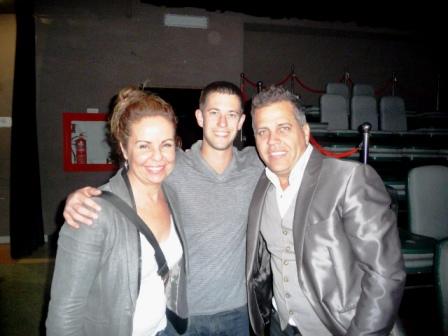
Smile on his face and jaba in hand, Adam sauntered up at about 4:05 and we rushed to pack ourselves into an almendrón to the Bertol Brecht Theater. True to his word, Wil Campa and his wife Tony awaited us there with a beautiful six string Rickenbacker they were loaning Adam for the night.

Tony, Adamm & Wil Campa, post-gig

Tony, Adamm & Wil Campa, post-gig

“Please, please, please don’t let this bass out of your sight,” Tony implored.

Slipping the case on to his back, Adam said: “don’t worry, I won’t.”

After kisses and hugs all around, our saviors sped away in their late-model BMW to shoot a music video in the setting sun.
_____

The room was big and a few of our tribe were still suffering from bouts of explosive diarrhea forcing them into a step we’d dubbed ‘the clench and scurry.’ If you’ve ever been to a theater anywhere in Havana, you know how apocalyptic/toxic/disgusting the bathrooms can be. But everyone took this in (scurrying) stride, as they did all their Cuban experiences, from cockroaches in the bedroom to stolen instruments and cancelled gigs.

The Will Magid 4 set up – live electric bass and guitar, drums (with some sort of electronic component I never did grok), trumpet, MacBook, and sequencer – was presenting problems during the sound check. There weren’t enough outlets and we didn’t have the right adapters. We were short a few cables and there was a false contact somewhere between the amp and bass obligating Adam into his own dance and scurry. Little by little we worked together to get it together, but everything was running late and the 25-piece college ensemble following us fiddled with their instruments, anxious to get their sound check rolling. After a few false starts, things were finally set and I took a seat alongside Will’s parents. The first notes erupted from Will’s trumpet and I started to relax when suddenly everything went dark and silent.

Blackout.

Dios mío. Would Cuba pull any punches for these guys?

I followed Emilio, the laid back runner-of-things at the Brecht, onstage. In trembling sotto voce I asked: had the group’s rig blown the circuit?

“Some cables are down,” he explained. (Whew). “The electric company is on their way. Chill out for an hour or so with some beers and I’ll call you when we’re back online.”

Will packed up his Mac, Adam shouldered “his” bass, and we stowed the rest for safe keeping. After a couple of lagers and lively conversation with some Cuban musicians who told me there are only 8 or so fretless Fender Jazz basses in all of Havana (I will find you cabrón, whoever you are) and that both Carlos Varela and Liuba María Hevia had both suffered thefts of their guitars (the WM4 was in good company), Emilio’s call came through: llegó la luz; haul your asses back.

Once there, the sound check went quickly, I bought Emilio a Bucanero, and we cut loose until showtime. In spite of all the mishaps and low level stress (mine, not theirs), energy and hopes were high for this gig. It was indoors, so the sound would be better that at the previous show and we’d done a lot of publicity to get a good crowd. I’d set up two interviews for Will and invitations had already been extended for their return to Cuba.

_____

The Will Magid 4 went on after the talented Jorge Aragón Trio and though the crowd was thinner than we’d hoped, the potential was palpable. I prayed to whomever listens to me – that is, no one in particular – for good sound and functioning equipment. I knew the rest would be superbly attended by the four guys on stage.

WM 4 ADsmall

By the end of their first number, feet were tapping and heads bobbing as the audience got into it. The last notes of Cuban Swing were winding around and down when suddenly everything went dark and silent.

Blackout. (‘Shit!, again?!’)

“Thank you all and good night,” Ethan said into his mic, unplugging his guitar.

“¡Qué lástima!” Terry exclaimed, using his new favorite phrase.

Once again I followed Emilio onstage.

“Leave your rig and gear hooked up. We’re checking on the problem and you guys’ll continue once it’s solved.”

Will looked at the band, lit by the beam from Terry’s iPhone.

“I saw a stand up bass backstage,” Adam ventured.

“St James Infirmary. Acoustic. Let’s do it,” Will said.

And there in that dark theater, the quartet – now a trio as Ethan held the iPhone up high for light – gathered in close. Will began teasing out the first notes of what turned out to be the most soulful and novel version of that jazz-blues standard ever heard on these shores. The Cubans in the audience sat stunned and smiling. Emilio caught my eye with his big thumbs up and nothing could keep my goose bumps down. The notes from Will’s trumpet trembled and leapt through the dark in a visceral eulogy to life’s lost love. The rhythm section paced our emotion, carrying us through one of those impossible to plan and hard to forget only-in-Cuba moments.

It was musical alchemy. The band knew it. The audience felt it and we had the talent and solidarity, dreams, hard work and dedication of so many people, strangers and friends alike, to thanks. It was magic not unlike Cuba itself.

As the last stanzas enveloped us, the band was suddenly, glaringly, bathed in light.

Llegó la luz.

“Can’t we have a little more blackout?” someone in the audience asked.

They finished their impromptu number, Adam traded the stand up for the Rickenbacker, Ethan plugged in and the Will Magid 4 played out their set to a dancing crowd – small, but exultant.

2013? I’m chasing more musical alchemy. Won’t you join me?

My deepest thanks and respect to Will, Adam, Terry, Ethan, Larry, Patti, Julie, Josue, Wil Campa, Tony Massolin, I.A. Electronica, and all the organizers of Festival Jazz Plaza 2012 for helping make my dream of bringing US musicians to Cuba come true.

Notes
1. It’s real name is the ElectroBus; look for it.

1 Comment

Filed under Americans in cuba, Cuban customs, Cuban phrases, cuban words without translation, Expat life, Living Abroad, Travel to Cuba

Survival Skills for Cuban Cooks – Part 1

[tweetmeme source=”connergo” only_single=false]

To say I come from a long line of inept cooks is an understatement. My grandmother – a well-heeled dame from Philadelphia’s Main Line – was so artless at the stove she used to have Thanksgiving catered; our observations that she’d mistakedly put the gravy on the green beans and drenched the potatoes in vinaigrette were met with a call for a fresh gin and tonic. In her mind she was a martyr: her mother had live-in help, an entire staff to dress the vegetables and cook the bird. All this living large ended with my mother, the quintessential black sheep who was black balled from the family when she got knocked up at 19.

Four kids and a lousy divorce later, the wolf was at our proverbial door. We were headed for the skids and stories of these lean times endure. There was the time we survived on nothing but oatmeal, three times a day, every day (see note 1) and the Christmas when my mother somehow scored a ham. As we slept, she dog tired from trying to make a poor Christmas joyful and us kids tossing and turning in anticipation, our beloved beagle Barney pawed open the refrigerator door and wolfed that whole ham down. What we awoke to wasn’t carols and candy but Mom, furious as we’d rarely seen her, chasing that beagle with a rolled up newspaper. Needless to say, that was the end of Barney (see note 2).

Some years later, we’d volunteer one Saturday a month to cut mammoth slabs of tasteless cheese into manageable blocks that we received in kind from the Park Slope food co-op near where we lived. One time, when there was another windfall like the one that brought us Barney’s Christmas ham, Mom bought half a cow. It was cheaper that way. “Bessie” sat in our freezer for a year getting eaten little by little until a Cuban-style blackout forced us to cook all those cow parts in one fell swoop.

Except for the week or two of oatmeal (family accounts differ as to how long we actually had to survive on that slop), I didn’t realize how poor we were when it came to the dinner table. Sure, we knew our classmates were eating burgers and fried chicken while we sat down to ratatouille, jambalaya, and moussaka (see note 3), but we figured it was an insatiable interest in other cultures that brought these exotic dishes to our table and not precarious finances. But the fact is, most ethnic food is poor people’s food, made with whatever happens to be on hand.

In “food insecure households” such as ours, it pays to know how to cook and I’m convinced my mom learned her way around a kitchen out of necessity (see note 4). My brothers, sister, and I followed suit, habitually making stock from chicken bones; reviving old bread with a few sprinkles of water and some minutes in the oven; transforming stale crackers into breading as tasty as any herbed panko; and hacking mold from cheese and scraping surface scum from maple syrup and sauces (see note 5).

All of this is to say that this culture of waste not, want not is serving me well here in Cuba.

To be continued….

Notes

1. To this day, none of us can stomach the sight of it. To us, oatmeal is survival gruel.

2. Before you get all PETA on me, let me underscore the premise here: if an animal, any animal – pet, barnyard, or wild – is taking from your children’s mouths, the beast, in my opinion, has got to go (what my buddy Jack calls the “25 cent solution” – apparently this is what bullets cost in his stomping grounds).

3. This last was usually meatless – no lamb, no ground chuck – meaning it was pure eggplant. We dubbed it “moose kaka” a name that stuck.

4. Incidentally, my mom is not only a creative cook, she is also efficient (and somewhat diabolical: every year on Halloween, she’d make us sit down to big bowls of pea soup before we could go trick or treating. Talk about cruel and unusual punishment!) When we were young, she used to cook a week’s worth of dinners each weekend and freeze them so she wouldn’t have to come home from several jobs and work some more cooking for us. Monday we’d extract a meatloaf, Tuesday a lasagne and so on. Sometimes however, her system had dramatic, unforeseen results…

I remember when I was 11 (a brutal age for girls then, now, and evermore), I was desperately trying to make friends. Being the poor daughter of a divorcee made me an easy outcast, plus I was generally considered just plain weird, so when someone had the bright idea for me to host a Valentine’s Day party with all my little prospective girl friends, I was game. There was a pretty successful scavenger hunt, plus candies of all sorts of course; all in all, everyone seemed to be having a helluva time. As the afternoon drew to a close, it was time for the party’s highlight: a beautiful heart-shaped chocolate cake made with all the love in the world by my mom during one of her marathon weekend cooking sessions. When Stephanie – the most popular girl in the 5th grade and the prime target of my fledgling attempts at friendship – cut into her cake, out tumbled a chunk of ham. Apparently the offending cube had straggled behind, escaping from being cooked into what would be Friday night’s quiche and slipping into the cake batter instead. That was the end of my attempt at pre-teen popularity; thereafter I was truly weird.

5. We have friends that didn’t grow up like we did, who aren’t down with reviving old food like we do. So when Mom recently hauled out a sack of year-old madeleines from the freezer to invent something, there were gasps. A year old! Frozen that whole time! No matter that the cookies were from Café Baloud. But mom knew better and whipped up that poster child of poor folk dessert: bread pudding. M’hija. That year-old-Baloud-madeleine bread pudding was so delicious even the naysayers couldn’t wait for dinnertime, spooning it up to wash it down with their morning coffee.

15 Comments

Filed under Americans in cuba, Living Abroad