Monthly Archives: May 2013

Cuba: What You Know but Don’t Realize

Over the years, I’ve dedicated (probably too) many hours analyzing, writing, editing, and commenting about the differences between here and there. The ‘there’ of which I speak is the US – from where I hail – but could easily be anywhere North, whither Big Macs and reality television conspire to make people fat and stupid.

Did I just say that? You betcha. I’m sorry if that applies to you, but my internal editor has been on sabbatical ever since a guy richer than Croesus got all up in my grill dissing Cuba like he actually knew what he was talking about.

Which is part of what sparked this post.

There’s a type of visitor here – usually imperious, moneyed men skidding down the hill of middle age towards moldering (and the aforementioned rich fulano fits the bill) – who has Cuba all figured after four days here. Sometimes even before getting here. Cuba is more complex than you could have imagined, you’re more close-minded than you care to admit, and your facile analysis belies the intelligence I’m sure you evidence in your back home life. For those in this category, I’ve crafted this post to clue you in. Just a little.

First, we’re facing a wave of economic, paradigmatic change here without precedent. It roils with an energy confusing, contradictory and encouraging (in its way), towards our shores. Indeed, already it’s breaking on our eroding sands. Like a tow surfer (see note 1) whose very survival depends on accurately calculating wave height, speed, and interval, while accounting for hidden (i.e. underwater) and surface (i.e. other surfers and their support crews) factors, we’re gauging the wave, trying to maintain balance, remain upright, and most importantly, keep from being sucked under.

But as any tow surfer will tell you: surviving a 75-foot wave and riding it are two entirely different experiences – as different as summiting Everest with throngs of weekend warriors as attaining the peak without oxygen. One simply takes money and some machismo and motivation; the other requires experience, training, skill, meticulous preparation, and a measure of karma and respect born of intimacy with the context.

So as this monster, freak wave feathers and breaks over Havana, I want to ride it, not simply survive it. And to do that, I – we – have to measure and analyze the conditions, bring our skills and knowledge to bear, channel positive energy, and ensure our fear is healthily spiked with faith. The first step in successfully positioning ourselves to ride this wave, it seems to me, is to understand the culture, in all its contradictory complexities, which brought us to…right…now…

While many emphasize the differences between here and there, between the land of Big Macs and the tierra de pan con croqueta, I take this opportunity to explain how we are the same:

Opinions vary: One of the questions I field most often is: do people like Fidel/Raúl/socialism/the revolution? This is as absurd as asking do people like Obama/capitalism/federalism? Setting aside the fact that the question itself is unsophisticated and dopey (governance and mandate are not about like or dislike but rather about measurable progress and peace within a society, plus, any –ism is just theory; it’s how it works in practice that counts), I posit that it all depends on whom you ask. Up there, a brother from the Bronx is unlikely to share views with a Tea Party mother of two. Similarly, an 18-year old from Fanguito won’t agree with a doctor from Tercer Frente.

It’s obvious, but visitors tend to forget that here, like there, you must consider the source when posing such questions. Less obvious is that here, it also depends on how you ask the question. But that’s a more advanced topic beyond the purview of this post.

People like stuff: On the whole, Cubans are voracious shoppers – always have been, always will be. Whether it’s shoes, books, handbags, wooden/porcelain/glass/papier mâché tschotskes, fake flowers, clothes, or packaged food, Cubans will buy it. Or at the very least browse and touch and dream of buying it. Some folks – like the ones who inspired this post – deny capitalist, consumerist culture ever existed in Cuba before now, revealing their lack of knowledge. I’m embarrassed for them; on the upside, it means many up there are clueless to fact that if you dropped a jaba bursting with a new pair of Nikes and Ray Bans, iPod (or better yet, Pad), some Levis, a pound of La Llave, gross of Trojans, and a couple bottles of Just For Men on every Cuban doorstep, with a note instructing them to come over to the imperialist dark side, a lot, the majority even, would do it. Being Cuban, a lot would pledge to ditch and switch just for the swag, of course, but that too, is an advanced topic beyond the purview of this post.

Until that day, folks here are gobbling up stuff as fast as the shelves can be stocked. In short, todo por un dolar is rivaling hasta la victoria siempre as most popular slogan around here.

It’s all about the kids: Here, as there, parents want a better life for their kids. While what constitutes “better” (again, here as there) depends on whom you ask, this desire to leave a more comfortable/equitable/safe/luxurious life and legacy to one’s kids is human nature. It drives people to rickety rafts, May Day parades, and long, hard overseas postings. It makes parents compromise their own mental health, spend beyond their means and completely subsume their own lives to their children’s. Case in point: have you ever seen what a Cuban goes through – psychically, financially – to celebrate a daughter’s quince? Hundreds, thousands of dollars and days, months, years of preparation are spent for the all-important photos, party, clothes, and gifts for their darling little girls. Families living six to a room in Centro Habana spending $5000 for their 15-year old’s celebration remind me of US folks who scrimp, struggle, and sacrifice to pay for their kid’s wedding/down payment/tuition. Children first – at all cost and any price, here as there.

We are the best in the world: Drop in anytime, anywhere in Cuba or the US and whomever you encounter will profess their country is the best. Greatness or weakness such bravado and pride? A little of both, I figure. That such hubris has contributed to where we are today, riding the wave, I have no doubt.

Notes
1. I’ve just finished reading The Wave, a spectacularly, adventurously researched and highly readable book on giant waves and the guys – tow surfers – who live to ride them. Check it out.
31 Comments

Filed under Americans in cuba, Cuban customs, Cuban economy, Cuban idiosyncracies, Cuban phrases, Cuban Revolution, dream destinations, Expat life, Fidel Castro, Living Abroad, Raul Castro, Travel to Cuba

Pushing Your Luck in Cuba

The querida phenomenon; why locals love iron bars and pure-bred dogs; and the story behind those ridiculous ‘dos: Here is Havana is your go-to resource for the inside scoop on all sorts of Cuban cultural minutiae.

This place is so intriguing and complex, I’m constantly heeding Mom’s advice to ‘learn something new every day.’ If you’ve been here, you know this perpetual learning curve of which I speak, surely. Or maybe you live somewhere/somehow that, like Cuba, allows – indeed forces – you to learn something new every day. If so, I salute you.

What’s holding my fascination and providing ‘ah ha!’ moments lately is the long-standing, deeply-rooted Cuban tradition known as La Bolita.

From Ciego’s piña-studded campo to the listing wooden houses of Regla, Cubans are playing the numbers. Like an underground Powerball, La Bolita is technically illegal but in practice allowed to function (not unlike other things here including the world’s oldest profession; two houses sharing one phone line; and foreigners buying property). Not only does it function, La Bolita flourishes as a twice-daily gambling habit nursed across the country.

I was quite surprised to discover how many people I know play La Bolita – work colleagues, neighborhood doctors, Harley dudes, government guys, grannies, ballet dancers. So diverse are the Cubans playing the numbers, I think it may be one of the most genuinely and naturally integrated and equitable systems in contemporary Cuba. La Bolita leaps across class, race, gender, and geographical lines and though I haven’t made a point of asking, I’m sure my LGBT friends are also placing their daily bets (see note 1). In short: La Bolita doesn’t discriminate.

First a little background: Most HIH readers know that until los barbudos rolled into Havana in 1959, Cuba was a viper’s nest of dissolution – rotten with drugs, prostitutes, gin joints, and gambling (no wonder Hemingway called it home!). In those days, fun seekers and ne’er-do-wells from the US used to hop down to use the island like college kids do Cancún and the ghetto: a place to score, get sloppy and slum, before returning to safe, cushy lives back home.

The Revolution put an end to all that (mostly, technically, anyway) and gambling was especially targeted and vilified. Big, lucrative casinos in nightclubs like the Tropicana and Sans Souci and hotels including the Riviera and Capri were shut down, along with smaller enterprises in the back alleys of Barrio Chino and out in Boyeros. La Bolita, however, was a national pastime, a traditional pursuit and while publically and officially banned, has survived all these years. The daily numbers, for those wondering, are drawn in Miami and Caracas, if my sources are correct (see note 2).

From why folks emigrate to how Cubans (mis)behave at all-inclusive resorts, I find all aspects of culture intriguing here. But La Bolita captures my fascination beyond what may be rational. To wit: I recently placed my first bet. I thought this was just a question of picking a series of numbers from the 100 in play and laying down my money á la the NY Lotto. Silly me. This is some really complicated shit and I needed a tutorial from my friend Aldo to place my bet correctly.

>Here’s what I learned:

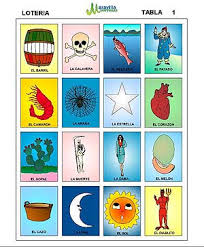
Numbers range from 1 to 100. Nothing complicated there. But each number corresponds to a symbol – think Mexican lotería.
loteria mexicana
The symbols are key and transcend simple number-figure association, however. For instance, Cubans often play numbers appearing in dreams: if you’re chased by a Doberman while dreaming, you should play 95 (big dog), if it’s a Dachshund, 15 (little dog) is more appropriate. Beware dreams of 63 leading to 8, because that will land you in 78 and finally 14 (murder, death, casket, cemetery). Scary. When this happens, do you play these numbers, just in case?

Folks also bet numbers they see in their daydreams – I’m sure you know someone who hopes to get a 100 or some 38 (car, money) or a Cubana who has already made their dreams come true through a 62 (marriage) to a foreigner.

The numbers and their corresponding symbols have also passed into common vernacular. Fidel is called the caballo (1) for obvious reasons and for those who doubt my claim that Cuban Spanish can stump even fluent, native speakers, what would you do if your taxi driver said you owe a fish and a nun? Would you hand over $5? $20? $50? You’d be ripping either yourself or him off if you did (see note 3).

My life (like everyone’s if we choose to pay attention) is riddled with symbols and I had no problem knowing what numbers I would play. In fact, I determined not to let this year go by without playing La Bolita as soon as I learned 43 (my age) stands for scorpion (my sign). What could be more propitious?

But how to play? I knew I’d have Aldo place the bet because I didn’t want to show my foreigner face at any of the neighborhood ‘bancos’ – Cuban for Bolita bookie – lest I make them  nervous; it is illegal after all. So I’d play 43 and if I needed to pick a bonus number, I figured I’d go with 52 in honor of my beloved Frances.

Were it that easy.

As it turns out, there are all kinds of variations you can play, including the ‘parlé’ (a type of trifecta); a fixed number with additional jackpot numbers; and other combinations which still confuse me. There’s also a specific way to note your numbers on a piece of paper that needs to be folded a special way when you place your bet. The minimum bet is 1 peso cubano (about 4 cents)  but most people wager more; payoffs can be huge – Aldo recently hit for 700 pesos and another friend’s uncle once won 5,000. Of course, he’d bet much more over the course of his lifetime, but that’s the gambler’s carrot and curse, no?

En fin: like many things Cuban, I’m sure La Bolita is played differently in different latitudes (see note 4) – including in South Florida where it thrives. What I relate here is simply how it went down in my corner of Cuba. I ended up playing scorpion-San Lazaro-machete (43-17-94) in keeping with various symbolic occurrences lately. Alas, my 37 (brujería) proved powerless: I lost my 25 pesos.

Oh well, there’s always tomorrow for learning something new (and placing another bet).

Notes

1. Let me take this opportunity to wave the rainbow flag: every May, Cuba celebrates the ‘jornada de anti-homofobia’ known as IDAHOBIT globally – and it’s one helluva good time. This year’s festivities kick off May 7 and run through May 18 in Havana and this year’s host province, Ciego de Ávila.

2. Over several years of writing this blog, it has become clear that Here is Havana readers are hip, informed, and sit upon a wealth of knowledge; if anyone has light to shed on the mecánica or history of La Bolita, please share!

3. A nun is 5 and a fish is 10; your taxi ride cost $15.

4. While researching this post in fact, a friend of mine and closet bet-placer, told me about La Charada (traditionally la charada china). This predates La Bolita, which takes its first 36 numbers (horse/caballo through pipe/cachimba) from the older chinese tradition. This numbers game dates from the 1800s when Chinese workers arrived on these shores. According to one source, in 1957, Cubans wagered between $90 and 100 million on La Charada, la Bolita and other numbers’ games.

18 Comments

Filed under Cuban customs, Cuban idiosyncracies, Cuban phrases, Cuban Revolution, Fidel Castro, Living Abroad